Feeds:
Posts
Comments

Posts Tagged ‘criminal’

Photo: Rebecca Rosman for NPR.
For 20 years, Dutch art detective Arthur Brand has acted as an intermediary between the police and people who know where stolen artwork might be hidden.

Is there one thing that makes someone successful at recovering stolen art?

According to today’s article about Arthur Brand, the secret might be motive. You can’t get both police and thieves to trust you if you are in it for the money. Arthur Brand is in it to save art.

Rebecca Rosman reports from Amsterdam for National Public Radio (NPR), “In his modest IKEA-furnished apartment, Arthur Brand paces to distract himself.

” ‘I’m nervous,'”‘ he says, with the honesty of a man who has learned that bravado is useless in his line of work. He lights a cigarette, leans out the window, and scans the street below. ‘The waiting is the hardest part.’

“Brand, 56, has made a career out of waiting: for a phone call, a knock at the door, and, every once in a blue moon, a Picasso or a Van Gogh left discreetly on his doorstep.

” ‘Those are the moments you realize it’s worth it,’ he says. …

“In another life, Brand says, he’ll take his mother’s advice and ‘find a normal job.’ But in this one, he’s helped recover stolen art for two decades — often the cases police can’t solve alone. …

“He says he has recovered more than 150 stolen paintings and artifacts. His cases regularly make international headlines.

“There’s the stolen Van Gogh that showed up on his doorstep in 2023, stuffed into a blood-soaked pillow in a blue IKEA bag. The Salvador Dali painting he recovered in 2016. The Picasso he tracked down for a Saudi sheikh in 2019. …

” ‘You know, you cannot go to university and say, I want to become an art detective,’ Brand says. ‘This is a job created more or less out of lack of other opportunities.’

“He traces his entry point to Michel van Rijn, a notorious Dutch figure in the art underworld who introduced [him] to a shadowy ecosystem of smugglers, thieves and forgers — and law enforcement.

“After making a cold call to van Rijn’s office, Brand says he became his apprentice in London — which regularly involved sitting quietly in a corner while older men swapped stories. ‘Everybody thought — who is this idiot?’ he says.

“Van Rijn, Brand later discovered, was straddling two sides. In 2009, he walked away after learning his boss was working with police while still keeping ‘one leg’ in the criminal world.

“The experience left him with a simple rule for survival: In a world where people expect betrayal, being honest — and keeping your word — is its own form of power. …

” ‘The police don’t trust the informants. The informants don’t trust the police. So I want to form a bridge between them to see what can be done. And in most cases, it’s possible.’

“The bridge only holds if Brand is seen as independent. ‘I’m not hired by an insurance company,’ he says. ‘The police, of course, don’t pay me. So I do this work [at my own expense].’

“He supports himself by consulting for art galleries and helping Jewish families trace art looted during World War II. But the majority of his energy goes to the work he does on his own dime — acting as a go-between when someone wants to quietly unload a masterpiece they can’t keep.

“Stolen masterpieces, he says, are hard to enjoy and even harder to sell. ‘Who buys stolen art? You cannot show it to your friends. You cannot leave it to your children. ‘

“Dutch police say Brand’s motive matters. Richard Bronswijk, who heads the Dutch police art crime unit, says he’s seen private detectives create problems when money is the driver. … Brand, he points out, has always been driven by something else: the thrill of the chase. …

“Still, sometimes Brand’s trust isn’t enough on its own. When an informant is deciding whether to return stolen art, Brand says fear can take over … of the police, of retaliation, of being tricked.

“That’s when he calls in his ace — Octave Durham.

“In 2002, Durham, already a seasoned bank robber, stole two Van Gogh paintings from the Van Gogh Museum in Amsterdam. … ‘I’m a born burglar,’ adding he doesn’t steal anymore but ‘still can.’

“Today, he works with Brand to recover stolen art.”

At NPR, here, you can read how that partnership led to the moment Brand “opened his door and found a blue IKEA bag on his doorstep” with a pillow soaked in blood and a missing Van Gogh.
Read Full Post »

Photo: Dean Paton.
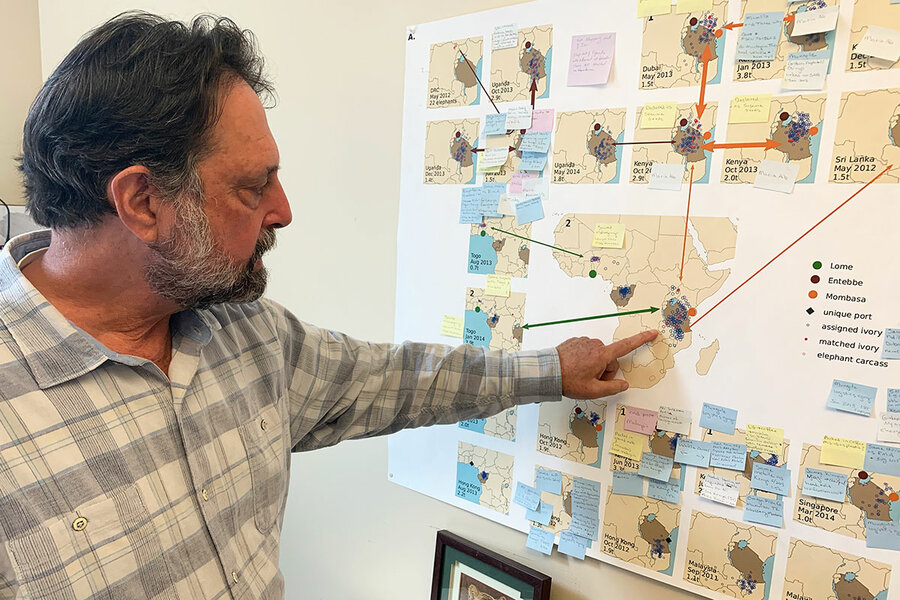
At Sam Wasser’s University of Washington office, maps show where ivory poaching occurs and where the contraband is exported. Dr. Wasser’s DNA work revealed that most ivory comes from east and west-central Africa.

It’s sad to read that gangs with powerful tentacles in every country are deeply embedded in the trafficking of endangered species. But on the other side, you know, environmental warriors have superpowers of their own, powers that go beyond righteous indignation.

Dean Paton writes at the Christian Science Monitor, “When Sam Wasser was a young biologist studying baboons in Tanzania, he never imagined he would one day lead an international force cracking down on the smuggling of illegal goods, from elephant ivory to pangolins and timber.

“Yet fighting transnational criminal organizations, or TCOs in law enforcement parlance, is exactly what he’s doing today, all because of his passion for animals.

“And because he discovered how to extract DNA from elephant poop.

“Today, Dr. Wasser is a professor at the University of Washington in Seattle. But in 1989 he was observing environmental stresses on baboons when Tanzania launched … a ‘brutal crackdown’ on elephant poaching rings. Tanzania battles a reputation for being among a handful of worst offenders in Asia and Africa that fuel the illegal ivory trade.   

“[The crackdown] had unexpected consequences. ‘All of a sudden our baboons started to be killed by leopards at an incredibly high rate,’ Dr. Wasser says. … The team realized the leopards had mostly ignored the local baboon fare while feasting on the remains of elephants left by poachers, who took only the tusks.  

“The decline in elephant carrion and subsequent decimation of the baboon troops ‘made me realize how significant poaching really was on all levels,’ he says, ‘and on all the other species that were similarly affected by the ecological cascade of events.’

“A self-described ‘animal nerd,’ Dr. Wasser points out that elephants are ‘some of the smartest animals around,’ he says. ‘They can recognize themselves in a mirror. You can put a spot on their forehead, and they’ll look in a mirror and they’ll wipe it off. That’s a high cognitive ability.’ But ‘we lost over 100,000 elephants from 2007 to 2015. There are currently an estimated 415,000 elephants remaining in Africa.’

“Dr. Wasser explains that poachers often go back and kill members of the same elephant families – so frequently that he believes it creates a form of elephant PTSD.

“Elephants also exhibit a strong interest in their dead. ‘They’ll go and they’ll just explore the carcasses of elephants. … It’s just too hard to watch, and the fact that we’re developing ways to potentially stop it – it keeps me going.’

“For the baboon studies, Dr. Wasser used hormones from animal dung to help understand their reproductive successes or failures. That work led Dr. Wasser to think, ‘You know, I could apply these tools to elephants. … You could then go and collect dung samples from elephants across the continent, genotype all the samples, and essentially create a DNA map,’ he explains. ‘And we could then get the DNA from the ivory to match to the map.’ …

“By 1997 Dr. Wasser had cracked the code and published one of the first papers on extracting DNA from elephant feces, and ‘right around the same time we were moving forward to see if we could develop methods to get DNA out of ivory.’

“Dr. Wasser’s team got its first break in 2005: Bill Clark, chair of Interpol’s Wildlife Crime Working Group, asked for help analyzing a shipment of ivory intercepted three years earlier in Singapore. It had been the largest seizure of ivory to date, about 6 tons, which included 40,000 carved hankos – also called chops – small pieces of ivory used throughout Asia to ink one’s name or seal on correspondence. Each would fetch about $200 retail, making the hankos alone worth $8 million.

“Until Dr. Wasser and his colleagues employed their emerging science to analyze that seizure, the biologist says ‘everyone’ believed these tusks were coming from all across Africa. But, using their dung-to-DNA analyses, ‘that’s not what we found.’

“Dr. Wasser’s game-changing work helped law enforcement realize the ivory was coming from a small number of specific areas in east and west-central Africa – yet was being shipped out of ports on either side of the continent. …

” ‘People don’t understand the intricate structure in wildlife crime,’ explains Rod Khattabi, a former homeland security agent who now runs the Justice Initiative for the Grace Farms Foundation, which partners with Dr. Wasser to train law enforcement agencies in Africa. … Wildlife criminals operate like independent cells, which makes arresting disparate elements of the syndicate tougher.

“ ‘That’s why Sam is so critical – because he can connect the dots,’ Mr. Khattabi says. ‘He’ll tell me, “Rod, this stuff is coming from Rwanda” even if it shipped out of Togo. He can almost pinpoint where the elephant got killed.’ …

“Dr. Wasser’s sleuthing has expanded beyond elephants. ‘The work that we were doing with the illegal ivory trade – we realized it was relevant to all of these other species that are all coming out of Africa,’ he says. ‘Same problem: transnational criminals shipping it on containers – and us needing to really get the transnational criminals.’

“In 2021, with funding from the Washington State Legislature, Dr. Wasser and his colleagues formed the Center for Environmental Forensic Science. ‘There were also other tools that other scientists were using that could complement what we’re doing,’ he says. ‘Now we’ve got over 40 scientists from the University of Washington alone that are part of our center’ using an array of synergistic methods including isotopes, chemistry, and handheld DNA detectors to fight a spectrum of crimes.”

More at the Monitor, here. No firewall.

Read Full Post »

chicago-illinois-a-mural-on-a-building-in-the-largely-mexican-american-fx446e

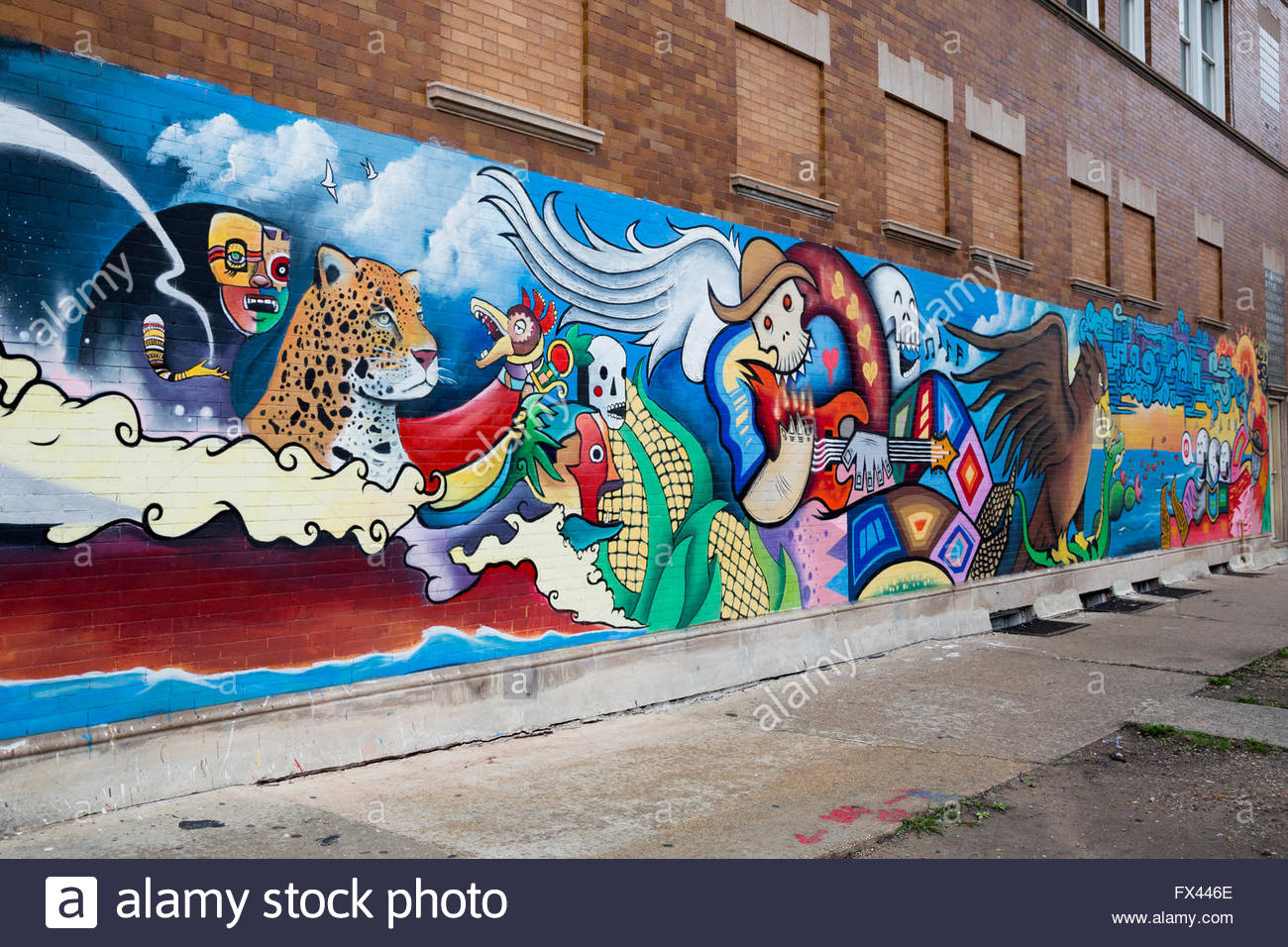
Mural in Little Village, a Chicago neighborhood with a strong Latino presence. Most research shows a correlation between immigrants moving into communities and an improvement in safety for all residents.

Despite lots of reliable data that immigrants tend to improve the safety of communities where they live, misperceptions persist. Naturally, anyone who is a dangerous criminal, whether a US citizen or immigrant, must always be dealt with, but people who come here just for a decent life are as likely as anyone else — maybe more likely — to try to make communities better.

Chiraag Bains, a senior fellow at Harvard Law School’s Criminal Justice Policy Program, talks about the issue at the Marshall Project.

“A trove of empirical research contradicts the notion that immigrants are [a] violent criminal horde. … In fact, studies consistently show that they commit significantly less crime than native-born Americans, and although the data are difficult to untangle, this appears to be true of both authorized and unauthorized immigrants. Even more, new findings suggest that immigrants may actually cause crime to decline in the areas where they live.

“In a study published recently in the Journal of Ethnicity in Criminal Justice, researchers analyzed Census Bureau and Federal Bureau of Investigation crime data across 200 metropolitan areas in every census year from 1970 to 2010….

“The researchers found a reduction of almost five violent crimes per 100,000 residents for every 1 percent increase in the foreign-born population. Analyses of city- and neighborhood-level data in ‘gateway’ cities such as New York, Chicago, Miami and El Paso have similarly found that violent crime rates — homicide rates in particular — are not higher, but actually lower in areas with more immigrants. This might help explain how violent crime dropped 48 percent over the same period that our undocumented population grew from 3.5 million to 11.2 million.

“One example of this effect in action is the Canarsie section of Brooklyn. Researchers with the Americas Society and Council of the Americas found that as white residents fled the neighborhood during the 1990s, the threat of depopulation and disinvestment was countered by an influx of immigrants, mostly from the Caribbean. Today, Canarsie has below-city average rates of poverty and housing vacancy, and its crime rate dropped from just above the city average in 1990 to 44 percent below the city average in 2010.

“There are logical reasons immigrants would be less likely to commit crimes. They may represent those among their countrymen with the most motivation and the greatest ability to seek a better life abroad. They may also have the most to lose, especially if they entered illegally or have family back home counting on their income.

“There are also explanations for why immigrants help bring down violent crime — apart from the fact that they commit less of it. New immigrants often repopulate hard-hit neighborhoods and increase the labor market opportunities of native-born workers. They also tend to create and strengthen social institutions in their neighborhoods, leading in turn to communities that are more stable and safer. This is the explanation scholars find most likely.”

More here.

Read Full Post »