Feeds:
Posts
Comments

Posts Tagged ‘detective’

Photo: Rebecca Rosman for NPR.
For 20 years, Dutch art detective Arthur Brand has acted as an intermediary between the police and people who know where stolen artwork might be hidden.

Is there one thing that makes someone successful at recovering stolen art?

According to today’s article about Arthur Brand, the secret might be motive. You can’t get both police and thieves to trust you if you are in it for the money. Arthur Brand is in it to save art.

Rebecca Rosman reports from Amsterdam for National Public Radio (NPR), “In his modest IKEA-furnished apartment, Arthur Brand paces to distract himself.

” ‘I’m nervous,'”‘ he says, with the honesty of a man who has learned that bravado is useless in his line of work. He lights a cigarette, leans out the window, and scans the street below. ‘The waiting is the hardest part.’

“Brand, 56, has made a career out of waiting: for a phone call, a knock at the door, and, every once in a blue moon, a Picasso or a Van Gogh left discreetly on his doorstep.

” ‘Those are the moments you realize it’s worth it,’ he says. …

“In another life, Brand says, he’ll take his mother’s advice and ‘find a normal job.’ But in this one, he’s helped recover stolen art for two decades — often the cases police can’t solve alone. …

“He says he has recovered more than 150 stolen paintings and artifacts. His cases regularly make international headlines.

“There’s the stolen Van Gogh that showed up on his doorstep in 2023, stuffed into a blood-soaked pillow in a blue IKEA bag. The Salvador Dali painting he recovered in 2016. The Picasso he tracked down for a Saudi sheikh in 2019. …

” ‘You know, you cannot go to university and say, I want to become an art detective,’ Brand says. ‘This is a job created more or less out of lack of other opportunities.’

“He traces his entry point to Michel van Rijn, a notorious Dutch figure in the art underworld who introduced [him] to a shadowy ecosystem of smugglers, thieves and forgers — and law enforcement.

“After making a cold call to van Rijn’s office, Brand says he became his apprentice in London — which regularly involved sitting quietly in a corner while older men swapped stories. ‘Everybody thought — who is this idiot?’ he says.

“Van Rijn, Brand later discovered, was straddling two sides. In 2009, he walked away after learning his boss was working with police while still keeping ‘one leg’ in the criminal world.

“The experience left him with a simple rule for survival: In a world where people expect betrayal, being honest — and keeping your word — is its own form of power. …

” ‘The police don’t trust the informants. The informants don’t trust the police. So I want to form a bridge between them to see what can be done. And in most cases, it’s possible.’

“The bridge only holds if Brand is seen as independent. ‘I’m not hired by an insurance company,’ he says. ‘The police, of course, don’t pay me. So I do this work [at my own expense].’

“He supports himself by consulting for art galleries and helping Jewish families trace art looted during World War II. But the majority of his energy goes to the work he does on his own dime — acting as a go-between when someone wants to quietly unload a masterpiece they can’t keep.

“Stolen masterpieces, he says, are hard to enjoy and even harder to sell. ‘Who buys stolen art? You cannot show it to your friends. You cannot leave it to your children. ‘

“Dutch police say Brand’s motive matters. Richard Bronswijk, who heads the Dutch police art crime unit, says he’s seen private detectives create problems when money is the driver. … Brand, he points out, has always been driven by something else: the thrill of the chase. …

“Still, sometimes Brand’s trust isn’t enough on its own. When an informant is deciding whether to return stolen art, Brand says fear can take over … of the police, of retaliation, of being tricked.

“That’s when he calls in his ace — Octave Durham.

“In 2002, Durham, already a seasoned bank robber, stole two Van Gogh paintings from the Van Gogh Museum in Amsterdam. … ‘I’m a born burglar,’ adding he doesn’t steal anymore but ‘still can.’

“Today, he works with Brand to recover stolen art.”

At NPR, here, you can read how that partnership led to the moment Brand “opened his door and found a blue IKEA bag on his doorstep” with a pillow soaked in blood and a missing Van Gogh.
Read Full Post »

Photo: Ibl/REX/Shutterstock.
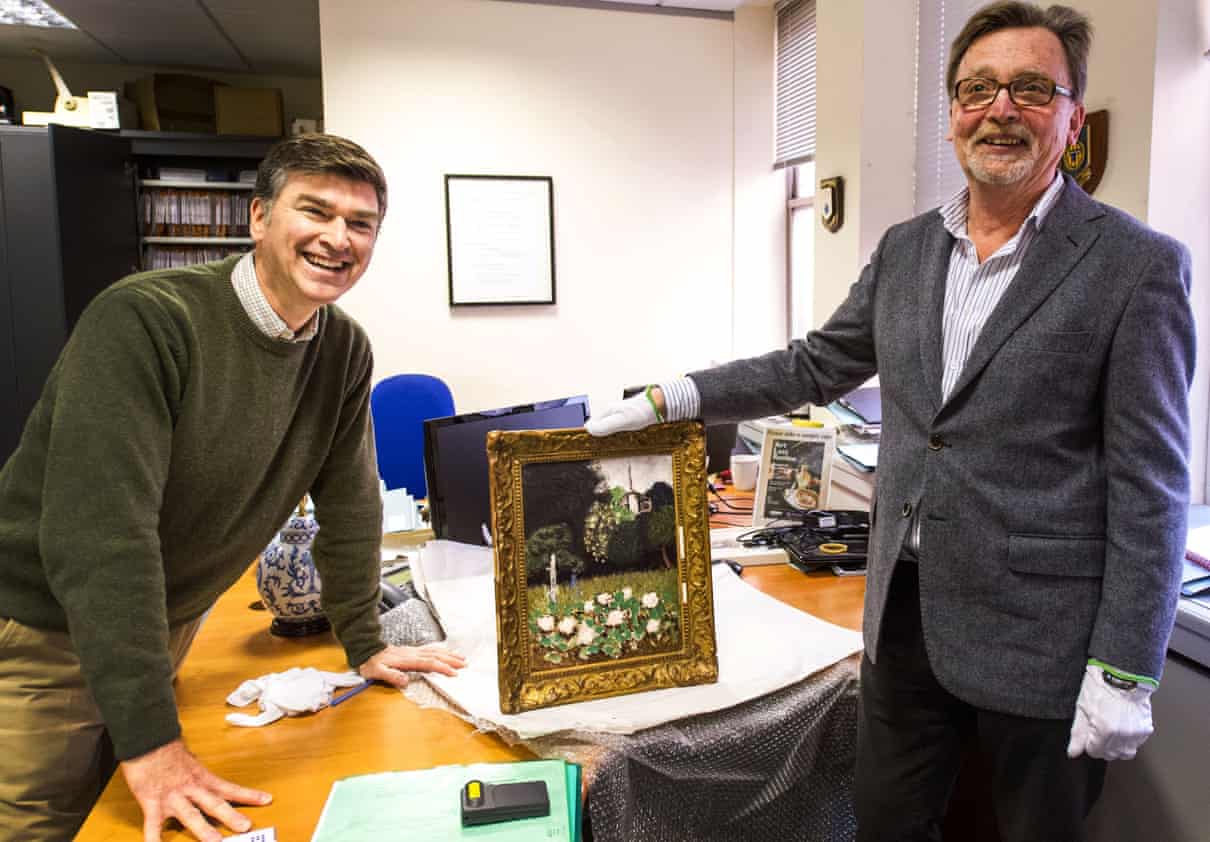
Art detective Christopher Marinello, left, returning the long-lost Le Jardin by Matisse to Lars Bystrom of the Modern Museum in Stockholm in 2013.

Now for something completely different, how about we delve into the life of a lawyer who walks some dangerous paths to recover stolen art?

Alex Daniel writes at the Guardian, “One summer morning in 2008, Christopher Marinello was waiting on 72nd Street in Manhattan, New York. The traffic was busy, but after a few minutes he saw what he was waiting for: a gold Mercedes with blacked-out windows drew near. As it pulled up to the kerb, a man in the passenger seat held a large bin-liner out of the window. ‘Here you go,’ he said. Marinello took the bag and the car sped off. Inside was a rolled-up painting by the Belgian artist Paul Delvaux, Le Rendez-vous d’Ephèse. Its estimated worth was $6m, and at that point it had been missing for 40 years.

“Marinello is one of a handful of people who track down stolen masterpieces for a living. Operating in the grey area between wealthy collectors, private investigators, and high-value thieves, he has spent three decades going after lost works by the likes of Warhol, Picasso and Van Gogh. In that time, he says he has recovered art worth more than half a billion dollars. …

“Cases tend to go the following way. A stolen artwork – in this instance, a bird by the Martin Brothers pottery makers, which was swiped from a London library in 2005 – will often turn up at auction or on social media. It then falls to Marinello to establish whether it is actually the missing work and, sometimes, to get it back. This, he says, is usually relatively simple.

“Stolen works often change hands several times before resurfacing, leaving subsequent possessors in the dark about their provenance. This is most likely what happened with the Delvaux. The painting, completed in 1967, depicts several nude women in a dreamlike landscape that’s part classical architecture, part mid-century tram station. Delvaux himself sold it a year later, but it was stolen before it reached the buyer. In 2008, Marinello got a call from somebody who wanted to return it. What happened to it in the intervening 40 years is unclear, although its final location is known. It was rolled up, says Marinello, in the wardrobe of ‘a very well-heeled celebrity. And their very expensive lawyer made it clear they would never be named.’ …

“A slight, 58-year-old Italian American with a soft Brooklyn accent, Marinello … trained as a lawyer, cutting his teeth as a litigator in New York representing galleries, collectors and dealers in cases involving disputed works. ‘Eventually, it developed into a full-time art recovery practice,’ he says. In 2013, he formed his own company, Art Recovery International, which is based in Venice but has offices in London. …

He says. ‘[I’m] a pretty good negotiator. I can convince people to do the right thing. … The bottom line [is] that if you are trying to sell something that is stolen, you’re the one with a problem, not me.’ …

“He adds: ‘With a lot of art crime, there is nobody to arrest and people rarely go to prison. It’s just a matter of recovering the work.’

“However, sometimes a suspect will refuse to cooperate. Then, things are different. ‘We go after them like pitbulls and never let go,’ he says. ‘And that is when they start getting nasty, when they are concerned they’re going to go to prison.’ “

More at the Guardian, here. If you don’t follow the Guardian online, do check it out. I really love it. It’s free, but grateful readers volunteer to pay what they can.

Read Full Post »

I’ve been an inveterate reader of mysteries since my Nancy Drew days, and Asakiyume, who follows my mini reviews of mysteries and other books at GoodReads, suggested that I blog about what I think makes a good mystery. Maybe other readers of these books will chime in.

I like a book that is literate by normal fiction standards. There should be at least one likable character, several plausible perps, no cliches, and loose ends tied up in the conclusion. You should be able to look back in the story and see that clues were carefully laid, and not just in the last quarter. But the clues should be puzzling as you read along. The reader’s brain should be engaged at all times, trying to figure out where the plot is headed.

I like the bad guys or gals to be caught, not to die a natural death or commit suicide, which always feels like a cop-out.

Some people say that Bleak House was the first detective mystery. Dickens certainly sets a high standard for all the measures I value.

I am often drawn to a mystery because of a locale that’s exotic, at least to me, and I find that many authors, even if they have a weak plot, do research into the setting that I appreciate. Still, I may have to take a long break from this genre as I am getting extremely frustrated with increasing inconsistencies, carelessness about plots, typos, and the hostility to readers that starts to appear when authors feel too much pressure to keep churning out more books.

It’s hard to define what I mean by hostility to readers. I noted it, for example, in Martha Grimes, Walter Mosley, and others I once loved but had to stop reading. It has something to do with throwing favorite characters at the reader in a perfunctory way with no new shades. It has something to do with the bones of the formula being too visible, to the point that you can almost see the writer at her desk with her chart of what has to happen in each chapter. And it has something to do with endings that fail to tie up loose threads. I often feel resentment from an author about the pressure from readers to keep delivering this exact sort of book when perhaps the author would prefer to tackle a completely different genre.

Inspector Bucket in Bleak House, by Charles Dickens.

Read Full Post »

We had a great time at the Concord Festival of Authors Friday night. The brainchild of book maven Rob Mitchell, the festival has been going strong for about 20 years and lasts a month. The authors and topics are always amazing.

The event we most wanted to see this year featured a panel of mystery writers: Archer Mayor,  Spencer Quinn, and one whose books I know well, S.J. Rozan. The fans of these three novelists — and of Concord-based moderator and author Mark De Binder — filled the lobby of the Concord Library to overflowing.

I already knew from the Lydia Chin/Bill Smith mysteries that S.J. had a wacky sense of humor, but Mayor and Quinn also were hilarious in talking about their work and their lives. My husband said, “Who knew mystery writers were funny?”

Read about S.J. at the festival here and at her own site here.

“In her new novel, Ghost Hero, American-born Chinese P.I. Lydia Chin is called in on what appears to be a simple case. An art world insider wants her to track down a rumor. Contemporary Chinese painting is sizzling hot on the art scene and no one is hotter than Chau Chun, known as the Ghost Hero. A talented and celebrated ink painter, Chau’s highly prized work mixes classical forms and modern political commentary. The rumor of new paintings by Chau is shaking up the art world. There’s only one problem—Ghost Hero Chau has been dead for twenty years, killed in the 1989 Tiananmen Square uprising.” We enjoyed hearing S.J. read a passage from Ghost Hero, in which she had Bill Smith adopt her grandfather’s Russian accent and locution.

Quinn made me envious of his blog’s success. It attracts hordes of people who love his canine protagonist so much that they upload photos of their  pets to be the dog detective’s friend. Perhaps if I weren’t such an eclectic blogger …

If I had one reliable focus, though, I’d get bored.

Read Full Post »

Not sure if, as a fan of detective mysteries, I should be disppointed or delighted about a new police database in Florida.

I learned about the database from an e-mail listserv I receive at the office. It’s called Innovators Insights. Sign up here to tell the Ash Center at Harvard’s Kennedy School what sorts of public policy topics interested you, and they will e-mail Innovators Insights to you weekly with short descriptions of relevant articles from around the nation — and links to the full story.

Here’s the Florida gumshoe story (to coin a phrase).

“In Cape Coral, Florida, the police department is employing a sophisticated shoe-print database that helps investigators quickly identify what type of shoe a suspect was wearing. While shoeprints are often important in identifying a perpetrator, the traditional process of manually casting a shoeprint and searching the Internet and catalogs for the matching type of shoe can be time-consuming when expedience is of the essence. By contrast, the software houses over 24,000 shoe types and allows information like side-shots of the shoes, their manufacturer, and their color schemes to be immediately forwarded to detectives. If investigators have a suspect’s shoe, they can also compare a digital image of its sole with a shoeprint from other crime scenes and look for a match. Cape Coral police have already used the technology to arrest one offender.”

Read all about it. And no matter how many exotic and unfamiliar shoes you buy in places around the world, you better behave yourself in Coral Gables.

Read Full Post »