Feeds:
Posts
Comments

Posts Tagged ‘Merlin’

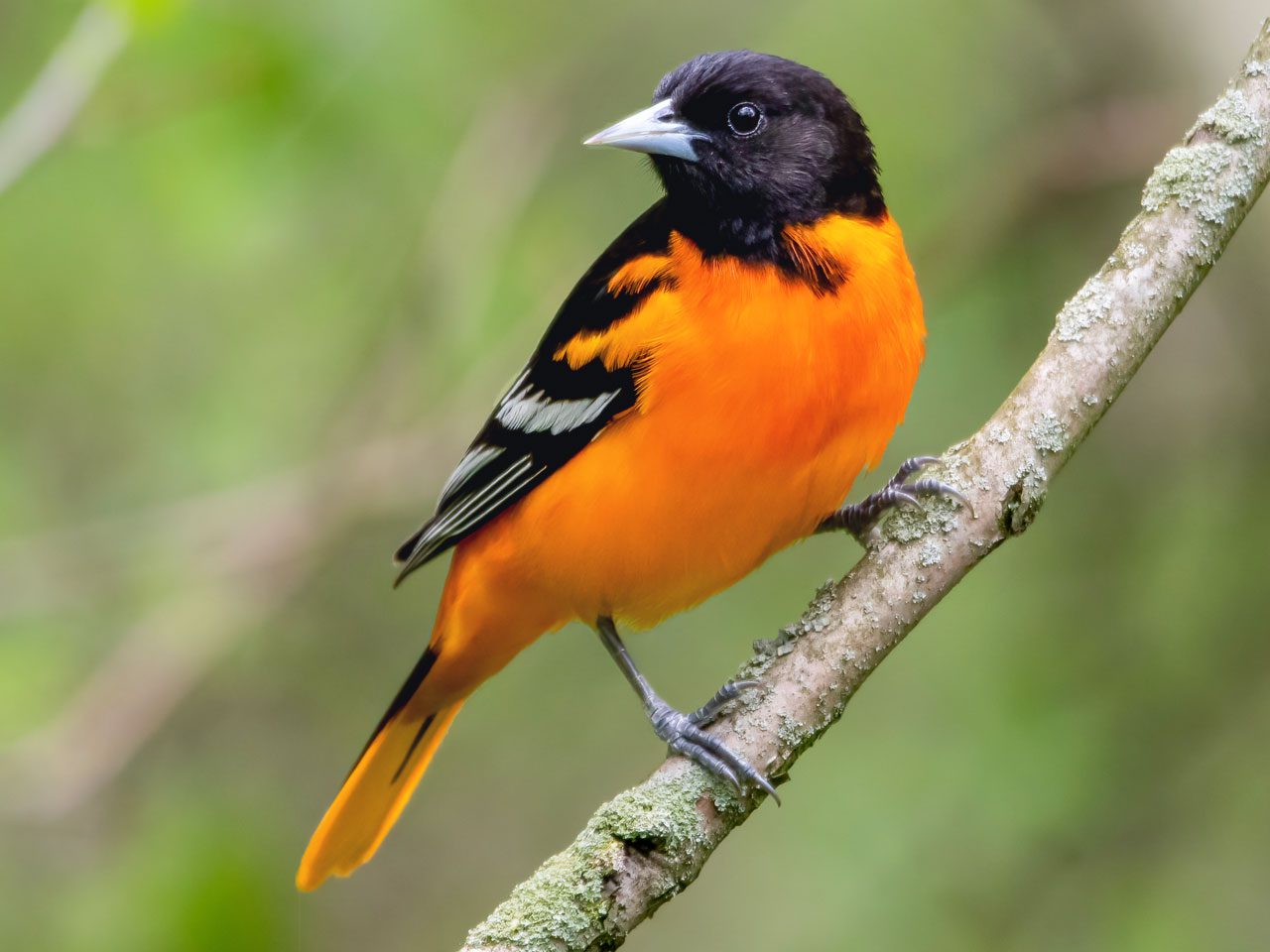
Photo: Matthew Plante / Macaulay Library.
The Baltimore Oriole is a bird I can never get enough of. I found this picture at birds.cornell.edu. The last Baltimore Oriole I saw was thanks to the Merlin app telling me it was somewhere near.

Have you used the free Merlin app to identify birds? I really love it. Among other things, it has helped me recognize some birdcalls by myself. The red-bellied woodpecker, for example, which I would describe as a squawk and a gargle.

Sandra Laville writes at the Guardian, “The Merlin bird ID app will allow users to feed real-time bird identifications into one of the world’s biggest citizen-science biodiversity projects in an update it is hoped will aid conservation of at-risk birds.

“Since 2021, the free Merlin app, created by the Cornell Lab for Ornithology, has used machine learning to provide an almost instantaneous sound-identification service for birdsong, along with an image for each bird identified. In future, the detections of bird species recorded by people will be automatically collected on the global online database eBird, which contains more than 2bn bird observation records.

“In the UK, the total bird population has fallen by more than 70 million in the last 50 years, according to the British Trust for Ornithology. The Guardian has created an audio soundscape that recreates the abundance of birdsong the public would have heard in 1976, compared with today. …

“Cornell also runs the eBird platform, which was created in 2002 to gather information from citizen scientists of their millions of bird observations, building one of the world’s biggest environmental science platforms.

“Jessie Barry, one of the leaders of the Merlin project, said: ‘The eBird mobile app will soon have the ability to upload recordings, which can be recorded in Merlin. Upcoming feature developments will make an even better link to the eBird systems so that we can use the data from what users “hear” with Merlin to monitor bird populations. …

“At present, the app can identify 2,066 bird species, including most birds in the US, Canada and Europe, and the more common and widespread species in India and across Central and South America. …

“The Merlin app is cited by some as an opportunity to connect more people to nature and help enhance conservation work. But there are some concerns that the app can misidentify birds, and the European Bird Census Council recommends not using Merlin in official breeding bird surveys. The EBCC has set up a monitoring group to coordinate, align and integrate acoustic bird monitoring across Europe.

“Moira Forsyth, a Merlin user who lives in the Muir of Ord in Scotland, said she used the app along with other forms of identification. ‘We have been astonished to discover we had a much wider range of birds here than we thought,’ she said. ‘Armed with the app, the RSPB book of Scottish birds, my trusty old copy of Collins Complete British Wildlife and the binoculars we keep on the kitchen windowsill, we are getting a bit better at this.’

“Prof Richard Gregory, of the RSPB, said: ‘It is super-positive that it is increasing in popularity and use, and especially to a new, wider and different group of people.’ …

“Gregory warned, however, that the app still made mistakes in identification and had identified his dachshund as a mallard. ‘If you aren’t an expert, you wouldn’t necessarily know there was an error,’ he said. ‘It is interesting to hear that Cornell is making changes which mean that recordings from Merlin will go to eBird more easily, so that’s great if the species recognition is correct [but] a problem for conservation when it is not.’

“Barry said research teams who regularly used these types of data sources would address challenges with the data quality. ‘Our ability to understand changes in bird populations will be better served with more data to work with than if we don’t collect it at all.’ ”

More at the Guardian, here.”
Read Full Post »

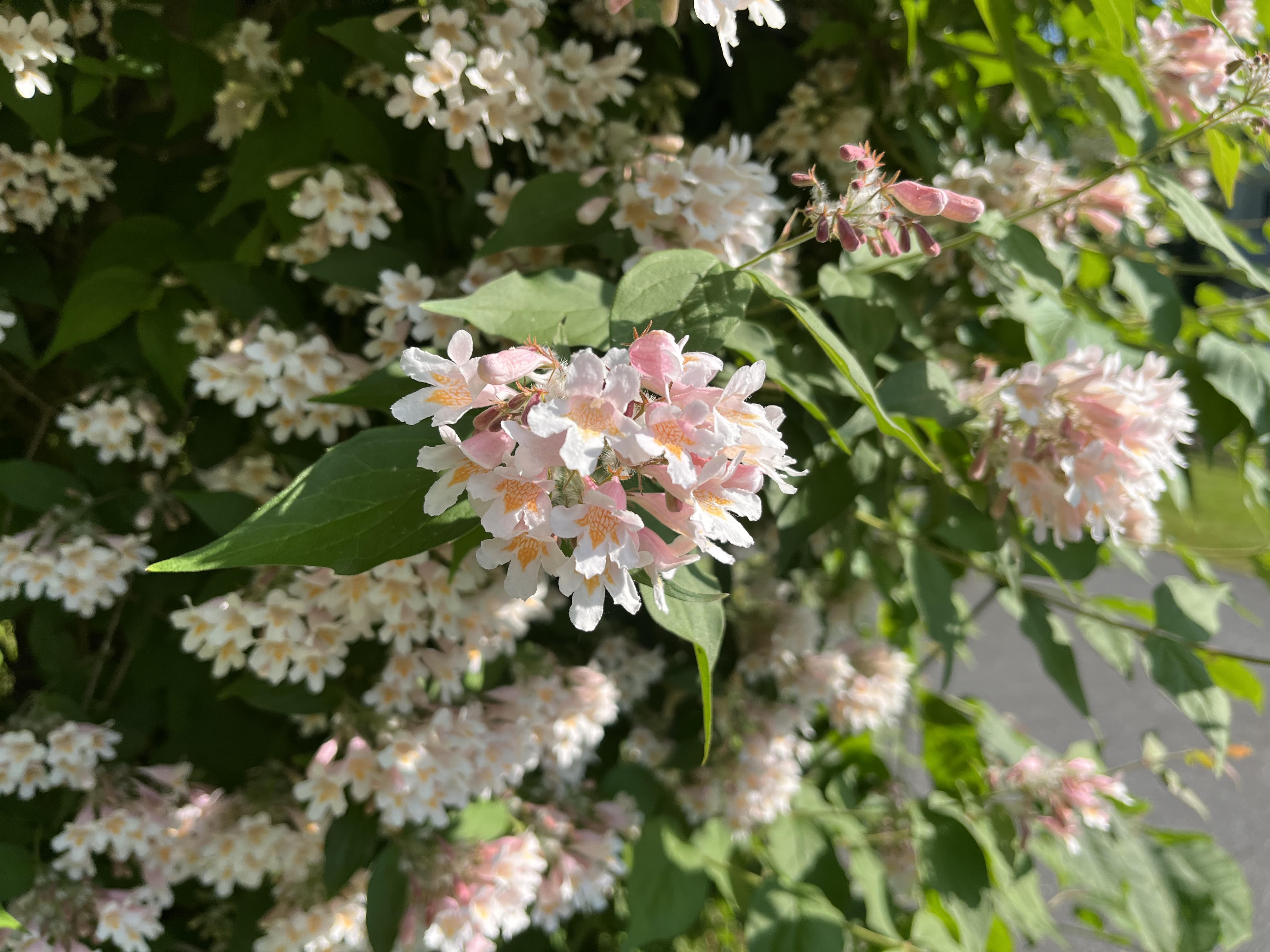
Photo: John and Suzanne’s Mom.
The PictureThis app calls this Beauty Bush. If you want to use the app, note that they try to hide the spot where you click “cancel” to get the free part.

Today’s article, by Michael J. Coren at the Washington Post, will be useful for anyone who walks outside and wonders what kind of flower or tree that is, what bird has that unusual song. It’s a post about apps. I myself use these freebies: Merlin for bird identification and PictureThis for plants (thanking Claudia for that tip).

From Coren: “First I see the wall barley, like tiny fields of wheat on the side of the road. Then a profusion of musk stork’s-bill overflowing with purple flowers. That’s just the crack in the sidewalk. By the time I reach my office, I’ve identified dozens of species, most unknown to me a few hours earlier.

“I’m not a master naturalist, but I have one in my pocket. Thanks to artificial intelligence trained on millions of observations, anyone with a smartphone can snap a picture or record a sound to identify tens of thousands of species. …

“It’s the kind of thing I would normally miss while walking or pedaling to work. Birdsong might be gorgeous but I’d barely hear it. I’d note ‘pine tree’ as a catchall for conifers.

“That has changed. I’m now on a first-name basis with most of my wild neighbors. It has reconnected me to a natural world I love. ….

“For 2.5 million years, humans spent a huge share, if not virtually all, of their time outdoors. Today, many adults are spending more hours on screens than outside.

“Nature is even disappearing from our books, songs and culture, say researchers who looked at nature-related words in popular works during the mid-20th century. Our mental and physical health has declined alongside our estrangement from the outdoors. …

“This new generation of naturalist apps is the Rosetta Stone to the natural world. Reestablishing relationships with your outdoor neighbors might not only transform your commute, it might change your life. There are more than a dozen apps promising to help you identify the natural world, many of them paid. Don’t bother.

Four apps, designed and managed by scientists with world-class data, meet all your ID needs free of charge. And every observation will advance our scientific understanding of the natural world.

“The easiest to use is Seek. The app, an offshoot of iNaturalist, a joint initiative of the California Academy of Sciences and the National Geographic Society, lets you shoot live video. It automatically grabs frames and analyzes them. The augmented reality experience is like downloading a foreign language into your brain. The app identifies the taxonomy of plants and animals instantly as you shoot. If it can’t figure out the species, it will give you its best guess.

“In less than an hour, I had racked up dozens of plants and insects near my house from Bombus vosnesenskii, a native yellow-faced bumblebee, to the purple-flowered bush lupine it was buzzing around. The only drawback? The app doesn’t include deeper context about the species it identifies.

“For that, there’s iNaturalist and Pl@ntNet. Both offer sophisticated, if slightly less user-friendly, apps that upload and analyze photographs of flora. In seconds, they typically return a ranked list of potential candidates with rich descriptions of each. The identification of the most common species is a slam dunk. For rarer ones, it’s easy to compare your observation against those of others in the database.

“The apps’ real superpower is the community around them: Millions of citizen scientists who can vet and confirm your observations. It’s particularly satisfying to watch your skills — and ranking — rise in the apps as you get to know your neighborhood. When you’re ready to up your game, download these apps.

“Finally, there’s Merlin Bird ID, a project of the Cornell Lab of Ornithology. Merlin feels like magic. The app uses a phone’s sensitive microphone to identify bird vocalizations in the sonic landscape around you, painting a visual representation or sonogram analogous to a musical score. …

“Merlin has permanently changed how I hear the world. I can now tune in to birdsong operas that had never entered my consciousness. Within a day, I was able to recognize distinct calls without consulting the app. …

“But the apps are more than tools to get acquainted with nature. They’re pushing AI identification — and conservation — forward. Recognizing natural inhabitants, and our relationship to them, helps us rediscover what remains and protect it.

“ ‘We’re just at the beginning of actual real scientific progress,’ says [Grant Van Horn, a machine learning researcher at the Cornell Lab, who helped build Merlin’s sound ID feature]. ‘And none of this stuff happens without a passionate group of people that helps you curate, train and evaluate the data.’ …

“The first big breakthrough came around 2018 from Snapshot Serengeti, a research project using digital camera traps to photograph thousands of migrating African animals. Organizing this enormous collection featuring a variety of animals, from wildebeests to giraffes, proved overwhelming for the small team of scientists.

“So researchers enlisted thousands of online volunteers to sort and label more than 3 million images. That allowed Jeff Clune, then a computer scientist at the University of Wyoming, and his collaborators to unleash algorithms on what was at the time the world’s largest collection of labeled wildlife images. The new algorithms could identify animals in 99 percent of images with the same accuracy as human volunteers, around 97 percent. …

“Citizen science-powered algorithms are now going beyond individual organisms. They’re mapping their relationships to an entire ecosystem, from the flower a butterfly pollinates to the leaf where the insect lays its eggs.

“ ‘My goal is to turn ecosystems into fire hoses of data,’ says Clune. ‘In the same way a video game company knows everything that happens inside their system, we should know that for the Amazon rainforest. Imagine what that would mean for science.’ …

“Ultimately, the apps’ greatest breakthrough may not be technological at all. It may be raising our awareness. We are nearly blind to entire categories of living creatures. In her book Braiding Sweetgrass, Robin Wall Kimmerer described it as ‘being lost in a foreign city where you can’t read the street signs,’ a form of species loneliness. While these plants and animals are our neighbors, we scarcely acknowledge their existence, let alone their right to exist. …

“This could reverse one of the great losses of the past century: our severed connection to the unique, wild character of where we live.”

More at the Post, here.

And speaking of technology that gets you closer to nature, check this live camera in the early morning East Coast time to watch an osprey feed its baby. Catch it soon, before the baby fledges.
http://198.7.226.69:8023/#view

Read Full Post »

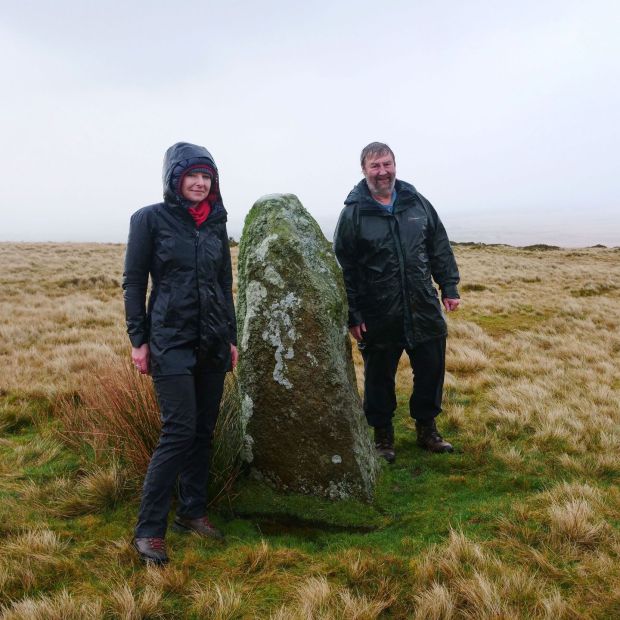
Photo: Barney Rowe/BBC.
Professors Alice Roberts and Mike Parker Pearson in Wales with the key to a legend about Merlin.

One should never completely dismiss a myth. There is usually a grain of historical truth buried inside. It has just gotten distorted as told and retold over centuries. I feel the same qualified trust about fantasy novels. I know they are imagined, but there is something about them I believe.

In today’s story we find archaeological proof of historical truth underlying an Arthurian legend about the magician Merlin.

As Dalya Alberge writes at the Irish Times, “An ancient myth about Stonehenge, first recorded 900 years ago, tells of the wizard Merlin leading men to Ireland to capture a magical stone circle called the Giants’ Dance and rebuilding it in western England as a memorial to the dead.

“Geoffrey of Monmouth’s account had been dismissed, partly because he was wrong on other historical facts, although the bluestones of the monument came from a region of Wales that was considered Irish territory in his day.

“Now a vast stone circle created by our Neolithic ancestors has been discovered in Wales with features suggesting that the 12th-century legend may not be complete fantasy. Its diameter of [120 yards] is identical to the ditch that encloses Stonehenge, and it is aligned on the midsummer solstice sunrise, just like the Wiltshire monument.

“A series of buried stone holes that follow the circle’s outline has been unearthed, with shapes that can be linked to Stonehenge’s bluestone pillars. One of them bears an imprint in its base that matches the unusual cross section of a Stonehenge bluestone ‘like a key in a lock,’ the archaeologists discovered.

Mike Parker Pearson, a professor of British later prehistory at University College London, says:

‘I’ve been researching Stonehenge for 20 years now, and this really is the most exciting thing we’ve ever found.’

“The evidence backs a century-old theory that the great prehistoric monument was built in Wales and venerated for hundreds of years before being dismantled and dragged to Wiltshire, where it was resurrected as a second-hand monument.

“Geoffrey had written of ‘stones of a vast magnitude’ in his History of the Kings of Britain, which popularised the legend of King Arthur but is considered as much myth as historical fact. … The discovery will be published in Antiquity, the peer-reviewed journal of world archaeology, and explored in a documentary on BBC Two on [presented] by Prof Alice Roberts.

“A century ago the geologist Herbert Thomas established that the spotted dolerite bluestones at Stonehenge originated in the Preseli hills of Pembrokeshire [Wales] where, he suspected, they had originally formed a ‘venerated stone circle.’ The newly discovered circle – one of the largest ever constructed in Britain – is about 5km from the Preseli quarries from which the bluestones were extracted before being dragged more than 225km to Salisbury Plain some 5,000 years ago.

“In 2015 Parker Pearson’s team discovered a series of recesses in the outcrops of Carn Goedog and Craig Rhos-y-felin with similar stones that the prehistoric builders extracted but left behind … quarried almost four centuries before Stonehenge was constructed.

“It convinced Parker Pearson in 2015 that ‘somewhere near the quarries there is the first Stonehenge and that what we’re seeing at Stonehenge is a second-hand monument.’ “

At the Irish Times, here, you can learn how the archaeologists managed to carbon-date the circle despite the destructive effects of acidic soil.

Read Full Post »