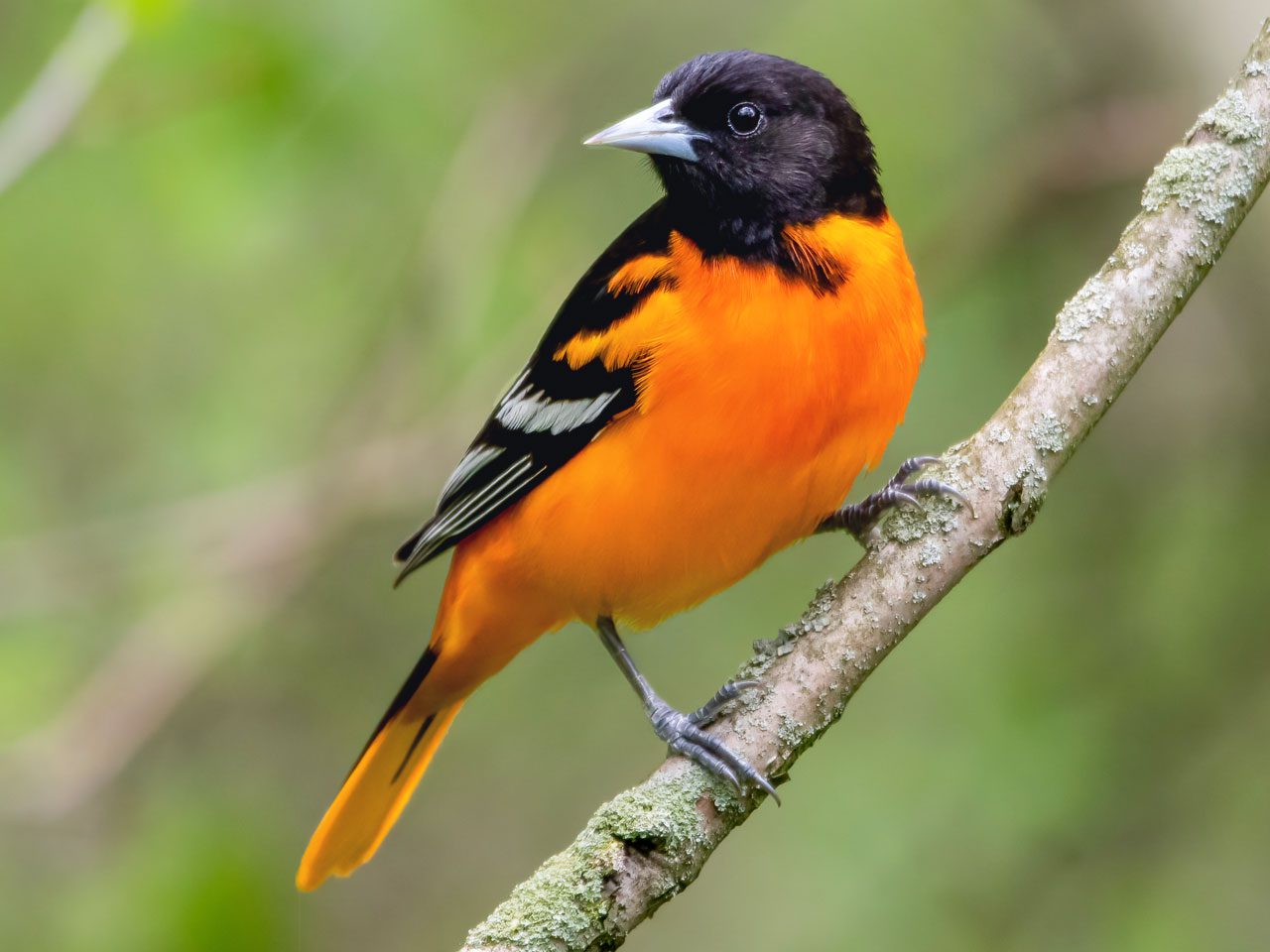
Photo: Matthew Plante / Macaulay Library.
The Baltimore Oriole is a bird I can never get enough of. I found this picture at birds.cornell.edu. The last Baltimore Oriole I saw was thanks to the Merlin app telling me it was somewhere near.
Have you used the free Merlin app to identify birds? I really love it. Among other things, it has helped me recognize some birdcalls by myself. The red-bellied woodpecker, for example, which I would describe as a squawk and a gargle.
Sandra Laville writes at the Guardian, “The Merlin bird ID app will allow users to feed real-time bird identifications into one of the world’s biggest citizen-science biodiversity projects in an update it is hoped will aid conservation of at-risk birds.
“Since 2021, the free Merlin app, created by the Cornell Lab for Ornithology, has used machine learning to provide an almost instantaneous sound-identification service for birdsong, along with an image for each bird identified. In future, the detections of bird species recorded by people will be automatically collected on the global online database eBird, which contains more than 2bn bird observation records.
“In the UK, the total bird population has fallen by more than 70 million in the last 50 years, according to the British Trust for Ornithology. The Guardian has created an audio soundscape that recreates the abundance of birdsong the public would have heard in 1976, compared with today. …
“Cornell also runs the eBird platform, which was created in 2002 to gather information from citizen scientists of their millions of bird observations, building one of the world’s biggest environmental science platforms.
“Jessie Barry, one of the leaders of the Merlin project, said: ‘The eBird mobile app will soon have the ability to upload recordings, which can be recorded in Merlin. Upcoming feature developments will make an even better link to the eBird systems so that we can use the data from what users “hear” with Merlin to monitor bird populations. …
“At present, the app can identify 2,066 bird species, including most birds in the US, Canada and Europe, and the more common and widespread species in India and across Central and South America. …
“The Merlin app is cited by some as an opportunity to connect more people to nature and help enhance conservation work. But there are some concerns that the app can misidentify birds, and the European Bird Census Council recommends not using Merlin in official breeding bird surveys. The EBCC has set up a monitoring group to coordinate, align and integrate acoustic bird monitoring across Europe.
“Moira Forsyth, a Merlin user who lives in the Muir of Ord in Scotland, said she used the app along with other forms of identification. ‘We have been astonished to discover we had a much wider range of birds here than we thought,’ she said. ‘Armed with the app, the RSPB book of Scottish birds, my trusty old copy of Collins Complete British Wildlife and the binoculars we keep on the kitchen windowsill, we are getting a bit better at this.’
“Prof Richard Gregory, of the RSPB, said: ‘It is super-positive that it is increasing in popularity and use, and especially to a new, wider and different group of people.’ …
“Gregory warned, however, that the app still made mistakes in identification and had identified his dachshund as a mallard. ‘If you aren’t an expert, you wouldn’t necessarily know there was an error,’ he said. ‘It is interesting to hear that Cornell is making changes which mean that recordings from Merlin will go to eBird more easily, so that’s great if the species recognition is correct [but] a problem for conservation when it is not.’
“Barry said research teams who regularly used these types of data sources would address challenges with the data quality. ‘Our ability to understand changes in bird populations will be better served with more data to work with than if we don’t collect it at all.’ ”
More at the Guardian, here.”


