Feeds:
Posts
Comments

Posts Tagged ‘ornithology’

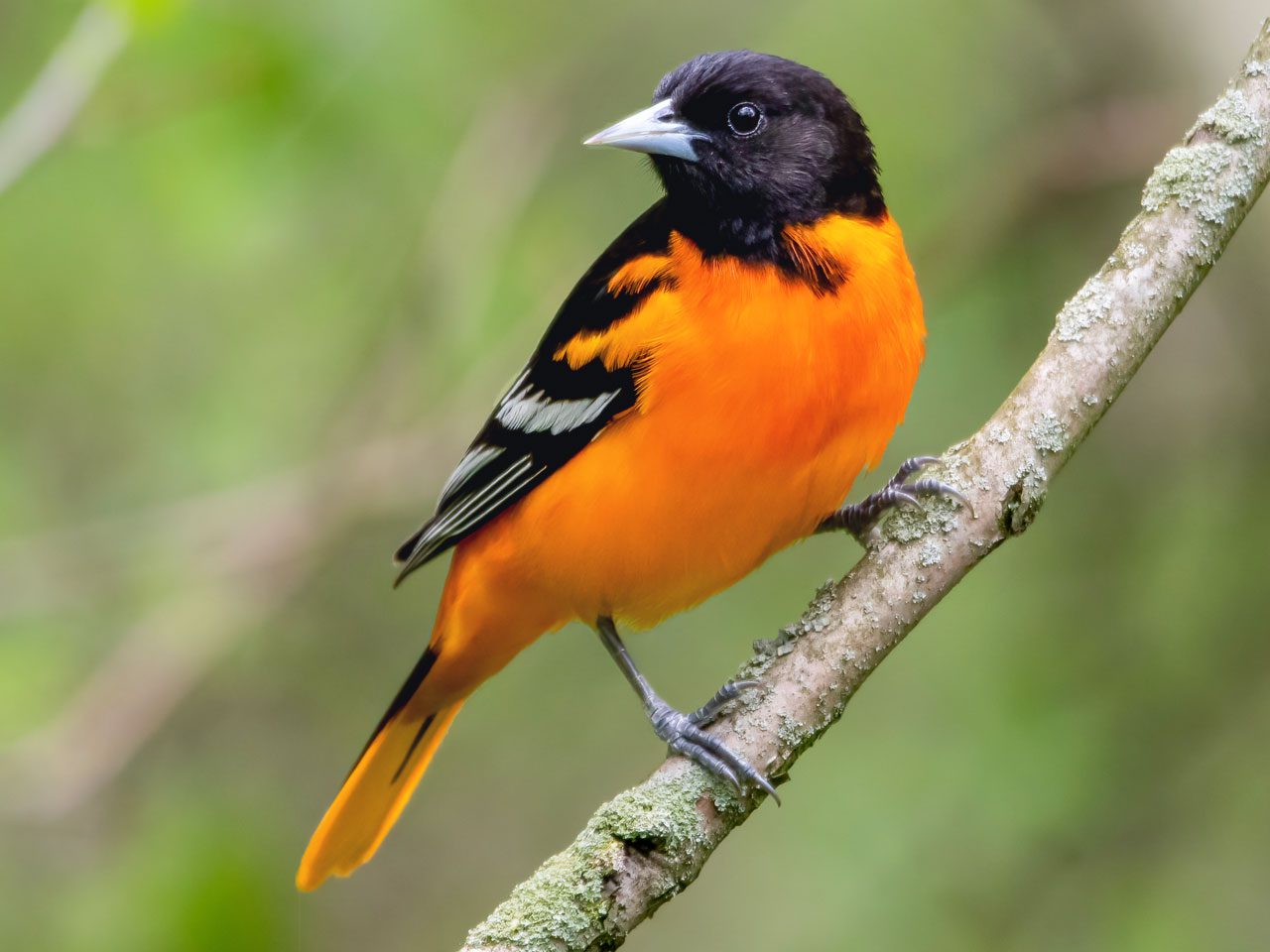
Photo: Matthew Plante / Macaulay Library.
The Baltimore Oriole is a bird I can never get enough of. I found this picture at birds.cornell.edu. The last Baltimore Oriole I saw was thanks to the Merlin app telling me it was somewhere near.

Have you used the free Merlin app to identify birds? I really love it. Among other things, it has helped me recognize some birdcalls by myself. The red-bellied woodpecker, for example, which I would describe as a squawk and a gargle.

Sandra Laville writes at the Guardian, “The Merlin bird ID app will allow users to feed real-time bird identifications into one of the world’s biggest citizen-science biodiversity projects in an update it is hoped will aid conservation of at-risk birds.

“Since 2021, the free Merlin app, created by the Cornell Lab for Ornithology, has used machine learning to provide an almost instantaneous sound-identification service for birdsong, along with an image for each bird identified. In future, the detections of bird species recorded by people will be automatically collected on the global online database eBird, which contains more than 2bn bird observation records.

“In the UK, the total bird population has fallen by more than 70 million in the last 50 years, according to the British Trust for Ornithology. The Guardian has created an audio soundscape that recreates the abundance of birdsong the public would have heard in 1976, compared with today. …

“Cornell also runs the eBird platform, which was created in 2002 to gather information from citizen scientists of their millions of bird observations, building one of the world’s biggest environmental science platforms.

“Jessie Barry, one of the leaders of the Merlin project, said: ‘The eBird mobile app will soon have the ability to upload recordings, which can be recorded in Merlin. Upcoming feature developments will make an even better link to the eBird systems so that we can use the data from what users “hear” with Merlin to monitor bird populations. …

“At present, the app can identify 2,066 bird species, including most birds in the US, Canada and Europe, and the more common and widespread species in India and across Central and South America. …

“The Merlin app is cited by some as an opportunity to connect more people to nature and help enhance conservation work. But there are some concerns that the app can misidentify birds, and the European Bird Census Council recommends not using Merlin in official breeding bird surveys. The EBCC has set up a monitoring group to coordinate, align and integrate acoustic bird monitoring across Europe.

“Moira Forsyth, a Merlin user who lives in the Muir of Ord in Scotland, said she used the app along with other forms of identification. ‘We have been astonished to discover we had a much wider range of birds here than we thought,’ she said. ‘Armed with the app, the RSPB book of Scottish birds, my trusty old copy of Collins Complete British Wildlife and the binoculars we keep on the kitchen windowsill, we are getting a bit better at this.’

“Prof Richard Gregory, of the RSPB, said: ‘It is super-positive that it is increasing in popularity and use, and especially to a new, wider and different group of people.’ …

“Gregory warned, however, that the app still made mistakes in identification and had identified his dachshund as a mallard. ‘If you aren’t an expert, you wouldn’t necessarily know there was an error,’ he said. ‘It is interesting to hear that Cornell is making changes which mean that recordings from Merlin will go to eBird more easily, so that’s great if the species recognition is correct [but] a problem for conservation when it is not.’

“Barry said research teams who regularly used these types of data sources would address challenges with the data quality. ‘Our ability to understand changes in bird populations will be better served with more data to work with than if we don’t collect it at all.’ ”

More at the Guardian, here.”
Read Full Post »

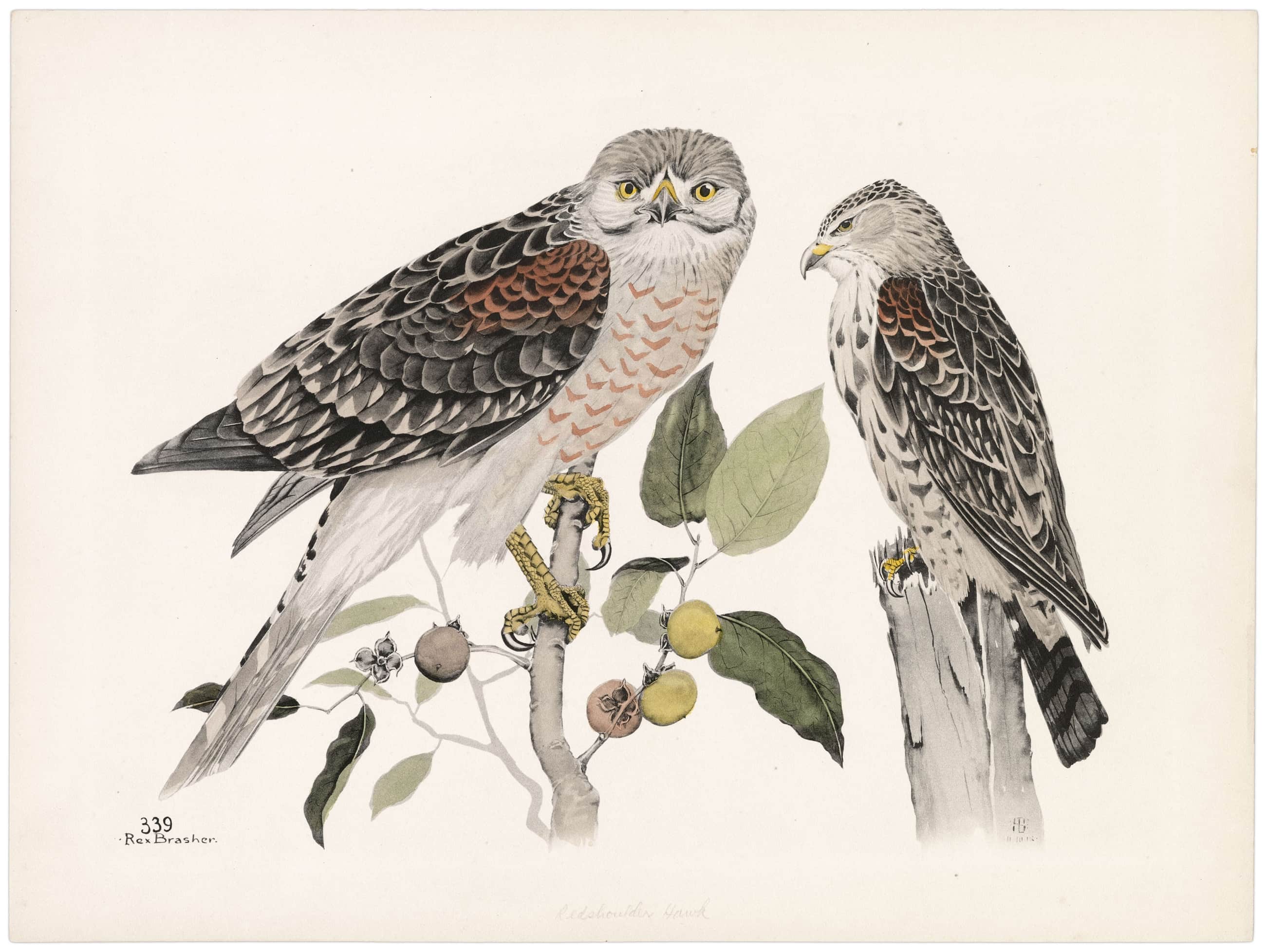
Art: Rex Brasher.
Rex Brasher painted more birds than Audubon — and never owned slaves.

With the more widespread understanding that bird painter John James Audubon owned slaves, controversy about honoring his name has erupted. Although for now the National Audubon Society is still the National Audubon Society, carrying on its otherwise great work, a small group called the Rex Brasher Association is advocating for more attention to another prolific bird painter of roughly the same period, Rex Brasher.

Philip Kennicott writes at the Washington Post, “On a gray day in March, Rex Brasher’s place looks a bit forlorn. The farmhouse is empty and the little shop made of cinder blocks feels derelict. But the leaders of the Rex Brasher Association who have gathered to show off the place see only possibilities for the 116-acre property.

“They want to place this wooded patch of the Taconic Range into conservancy, add modern studios for artist and naturalist residencies, refurbish the main house and cottage, and build a small museum inside the old shop. Two years after the death of the last Brasher relative to live on-site, they hope to resurrect the legacy and reputation of a man many people feel painted birds as well as or better than John James Audubon.

“Born in 1869, Brasher left an enormous body of paintings, almost 900 large-scale watercolors documenting American bird life and habitat, that became the source material for a monumental 12-volume compendium of hand-colored reproductions published as Birds & Trees of North America. He also made an unknown number of miscellaneous paintings and drawings, wrote a delightfully eccentric volume of philosophical reflections called Secrets of the Friendly Woods, and penned a hand-illustrated autobiographical account of his early forays, by sailboat, to document waterfowl from New England to Florida.

“Brasher was a retiring artist — a modest man who lived much of his life off the grid — which may be one reason he isn’t more famous. But his life’s project to document American birds, an effort to outdo Audubon that began in the 1890s and continued into the 1920s, was celebrated in its day, with an exhibition at the Explorers Hall of the National Geographic Society in 1938. Later, when he began hand-coloring more than 87,000 individual plates for publication, the project attracted subscriptions from collectors and patrons, as well as universities and libraries. Today, a complete set of his printed work can fetch more than $40,000. 

“He was praised by naturalists including John Burroughs (‘he is the greatest bird painter of all time’) and T. Gilbert Pearson, who helped found the organization that would ultimately become the National Audubon Society.

‘When you see a Brasher bird, you have seen the bird itself, lifelike and in a natural attitude.’

“But Brasher was very much a man of the 19th century, and despite periodic efforts to revive his work, his legacy — closely observed, naturalistic renderings of animal life — still suffers from having been out of step with the avant-garde and experimental art of the 20th century.

“That could change, however. The Connecticut State Museum of Natural History, which owns some 800 of the original watercolors, is planning to make them more accessible to the public with exhibitions in a new building, for which they will shortly begin fundraising. The efforts of the Rex Brasher Association, which has taken stewardship of the Upstate New York property near Kent, Conn., where Brasher lived until the mid 1940s, include digitizing and publicizing his work. And cultural changes, including a broader sense of what qualifies as fine art and a new urgency about the fragility of the natural world, may make people today more sympathetic to rediscovering his legacy.

“Brasher may also benefit from growing awareness that Audubon, to whom he was often compared, was a complicated, often odious figure, whose interest in birds grew out of a raw will to power more than any particular love of the species. Audubon was a formidable artist but also a ferocious antagonist within what Audubon scholar Gregory Nobles calls the ‘ornithological wars of the 1830s.’ He was also an enslaver and deeply contemptuous of the abolitionist movement in both the United States and the United Kingdom, where he spent considerable time preparing his landmark publication, The Birds of America, published between 1827 and 1838. The National Audubon Society is in turmoil today as local chapters drop the Audubon name and board members resign because the national leadership refuses to do so.

“Audubon studied birds in the wild before shooting them and then staging their carcasses in lifelike poses, a work process that has also aroused criticism even though it was standard practice for naturalists to kill animals they sought to collect and preserve. Those collections remain scientifically invaluable. …

“Audubon’s original paintings are a marvel, especially when seen up close. They are marvelously detailed and dramatic, and Audubon was particularly alert to the iridescent quality of feathers, which he reproduced with layers of silvery graphite over the pigments. But these images are also stagy and contrived, as if his birds are players on a stage, dramatically illuminated in the glow of gaslight. …

“Brasher sought a more naturalistic treatment, without Audubon’s operatic drama. Although he hunted and collected birds as a young man, he gave up that approach later, preferring close observation to specimen hunting. His paintings have a lightness and transparency wholly different from Audubon’s heightened atmosphere. He also had access to museums with extensive specimen collections and the published work of predecessors. He painted over 1,200 species of birds, far more than Audubon’s 497, but he was also building on the legacy of Audubon and others. …

“Between the early days of the artist-woodsman ornithologists and the death of Brasher a century and a half later, the science of ornithology spun off a vital and flourishing adjunct: birdwatching. Brasher might be considered the patron saint of that project. He was keenly interested in making accurate images of birds, but he was also interested in learning from birds. In Secrets of the Friendly Woods, he wrote about nature with a mix of genial animism and psychological insight. Nature was inexhaustible for him: ‘Forty years have not diminished the hope that each time afield I shall see something new, learn a novel habit of a bird or animal, and that expectation is seldom disappointed.’ …

“The difference between the artists’ work is like the difference between a grand aristocratic portrait and a psychologically nuanced character sketch. Audubon gets the dress and regalia right, and his birds project a powerful, self-fashioning sense of their own presence and importance. Brasher’s birds live contentedly in their own world and don’t need to perform or impress the viewer. If Brasher sometimes tends to moralize when he writes about birds, it isn’t Aesopian. The moral is almost always the same: We could learn a lot from birds.”

More at the Post, here.

Read Full Post »

kids-with-bins-15-e1417551569689-980x560

Photo: Cornell Lab of Ornithology
Increasing numbers of young people, like boys in Cornell’s BirdSleuth K-12 program, are into birding — developing their observational skills and their inherent love of nature.

One of the most hopeful things around is to see kids get interested in birds, learning to identify them and to spot unusual ones. This summer I’ve been getting a kick out of grandchildren who aim to test my ability (limited) to recognize bird calls. We have a book with buttons that you press for different calls. They press, I identify. I’m getting better.

Penelope Green reported recently at the New York Times about young urban adults who assisted with an international bird count in May.

“On Global Big Day last month, birders around the world counted all the species they could spot in 24 hours. It was a super-birding event in the bonanza that is spring migration — which runs from late April to early June, but peaks for songbirds in May — when millions of birds make their way from parts south to breed in the Northern latitudes.

“In Prospect Park, members of the Feminist Bird Club did their bit for this enormous citizen-scientist data collection effort. Led by Molly Adams, its founder, the group clocked over 80 species in under 10 hours, including one black-billed cuckoo and a cerulean warbler. These were good ‘gets’: The cerulean warbler is at risk of extinction — like so many birds, a casualty of habitat loss — so noting its whereabouts is particularly important for conservation efforts. The cuckoo is not a rare bird, it’s just hard to see and not many of them stop in New York City during their migration; that made its sighting a bit of thrill, Ms. Adams said. …

“Younger urban birders — yubbies? — like those led by Ms. Adams are the new faces in the birding world. They use social media to track their ornithological marks, with digital assists from apps like Ibird or Merlin and websites like ebird — the data collection site run by the Cornell Lab of Ornithology — which have replaced old-fashioned Sibley guides to aid in identification (though Sibley has an app, too). They are drawn in by the visual seductions of Instagram, as well as a desire for community inflected by environmentalism.  …

“Pete Lengyel, a co-founder of the Kings County Brewers Collective, a craft beer brewery and tap room in Bushwick, was hooked by [the movie} ‘Birders’ when he saw it a few years ago. Its filmmaker, Jeffrey Kimball, an urban birding convert, captured four seasons of Central Park’s birding community in an engaging portrait of its singular characters. … Mr. Lengyel, 44, sent the film to all his friends, and convened his own birding group, the Beerders, which includes two brewers, a baker, a butcher and a fashion designer — a nice cross-section of Brooklyn professions. …

“[Meanwhile, Chelsea Lawrence, a software tester for a television company] might spend half of a Saturday in Prospect Park, but if she spots a warbler at lunchtime in the planter in front of her midtown office, ‘that’s birding, too,’ she said. ‘I’m really into citizen science and data collection. It can be as competitive as you want it to be. It’s also really meditative. You have to be very present to be a good birder.’ ”

More at the New York Times, here.

Read Full Post »

There’s always something fun over at PRI’s environmental radio show Living on Earth. Here’s a story that ran in March about the unique bird species isolated in Northeastern Australian rainforests.

Bob Sundstrom wrote up the audio report of BirdNote‘s Mary McCann: “The Eastern Whipbird hangs out in the dense understory. It’s dark, crested … nearly a foot long and emerald-green with white spots. … The large, pigeon-like Wompoo Fruit-Dove … feathered in a stunning combination of green, purple, and yellow, [is] clearly named for its voice.

“Pig-like grunting on the forest floor tells us we’re in the company of the largest bird on the continent – the Southern Cassowary. On average, the female weighs 130 pounds and stands around 5 feet tall, looking like a giant, lush, black hairpiece on thick legs. A helmet called a casque makes it look as much like a dinosaur as any living bird.” Five feet tall? I think I know a one-year-old who would like to try riding it.

The bird sounds on the radio show were provided by The Macaulay Library of Natural Sounds at the Cornell Lab of Ornithology. Hear them all here, where you can also enjoy the equally far-out pictures.

Photo: Jan Anne
Southern Cassowary

Read Full Post »

A woman in Estonia watching a webcam trained on an osprey nest in Montana was able to alert researchers that an endangered baby osprey was in trouble.

My husband, who likes to read nature magazines, knew this story was a good one for Suzanne’s Mom’s Blog the minute he saw it this afternoon.

Doug Stewart writes at National Wildlife, “The nest overlooks the parking lot of a nursing home in Hellgate Canyon near Missoula. All summer, hundreds of thousands of people watched online as three nestlings screamed deliriously at fish deliveries or listened to their parents vent their fury at encroaching bald eagles.

“At one point last summer, one of the three chicks became entangled in monofilament line from a fish brought back to the nest. Fishing line can quickly strangle an osprey chick. It was a Sunday, and the researchers had not been online to check the nest.

“ ‘We were first alerted to the fishing line by an email from a woman in Estonia,’ says [biologist Erick] Greene. ‘Then we heard from a woman in Wales.’ The researchers also had set up a Facebook page for the ospreys, and in no time it became filled with alerts from concerned visitors. Borrowing a truck equipped with a bucket that can raise up to the level of the nest, the biologists raced to the scene to cut away the line from the chick and removed a fish hook embedded in its wing. The bird survived.”

More great details at National Wildlife, including a description of 700 kids at an urban school watching the webcam and tweeting questions about the osprey to researchers, here.

Watch the osprey here.

Photo: National Wildlife

Read Full Post »