Feeds:
Posts
Comments

Posts Tagged ‘age’

Photo: Jessica Rinaldi/Globe (WHAT a picture! Rinaldi is among the best.)
Virginia Oliver tossed back an undersized lobster as she and her son, Max, haul traps in Maine.

Are you ready for another story about someone loving their job at an advanced age? Brian MacQuarrie of the Boston Globe interviewed a 101-year-old woman who still fishes for lobster — Virginia Oliver of South Thomaston, Maine.

“It’s not yet 5 a.m.,” he writes, “and the landing at the Spruce Head Fishermen’s Co-op is shrouded in predawn fog that obscures the waters beyond. It’s time to go to work, and Virginia Oliver and her son Max approach the dock in the dark in a 30-foot lobster boat.

“They tie up under the stark, mist-speckled glare from an overhead light. Bait is brought aboard, equipment adjusted, and Max peers into the gloom as he eases the boat into Penobscot Bay.

“In the world of Maine lobstering, it’s a scene that is repeated countless times up and down the state’s rugged coast. But here’s the difference: No other boat has a 101-year-old lobsterwoman aboard, and a fully working one at that.

” ‘I grew up with this,’ said Virginia Oliver, a Rockland woman who began lobstering when she was 8, just before the Great Depression. ‘It’s not hard work for me. It might be for somebody else, but not me.’ …

“The fog began to burn off shortly before 7 a.m., and … Max pointed out a ‘sweet spot’ for lobstering among the many small, rocky islands.

“His mother came to work this day with a bit of makeup on her face, her blue eyes and a pair of small earrings twinkling in the hazy dawn. …

“Virginia Oliver has been working these waters since she first accompanied her lobsterman father as a young girl. After raising four children, she returned to the bay with her husband, who died 15 years ago. Since then, she has continued to venture from shore, three mornings a week, to a saltwater world as familiar as the street where she was born and still lives.

“ ‘When I first started, there weren’t any women but me,’ Oliver said, dressed in olive-green overalls, a blue sweatshirt, and high boots. ‘My husband and I used to go out in all kinds of weather. There aren’t as many lobsters today, though. They’re way overfished, like everything else.’

“Oliver’s job is to measure the lobsters, using pliers to place tight bands around the claws of the keepers, tossing the undersized overboard, and stuffing small pogies into bait bags.

“Naturally right-handed, Oliver has worked the pliers with her left hand since she broke her right wrist several years ago. Despite the change, her hand movements seem remarkably supple and strong. …

“Oliver is meticulous when she measures, tossing back lobsters that are only a hair shorter than the 3¼-inch legal minimum from the eye socket to the rear of the body shell. She also can’t keep egg-bearing or reproductive females, a state requirement that helps bolster the lobster stock. …

“Max Oliver, 78, does double duty as helmsman and hauler, emptying every trap that a hydraulic wheel pulls from the water. Between mother and son, they have choreographed an intricate ballet of demanding, physical work that’s conducted quietly and efficiently.

“Max chuckled over his mother’s stamina and work ethic.

“ ‘It’s pretty damn good, that’s what I call it,’ he said, maneuvering the boat in low water past pine-studded islands. ‘She might give me hell once in a while, though,’ he added with a laugh. ‘She’s the boss.’ …

“Her son drives her to the boat during lobster season, which for the Olivers stretches from the end of May to the beginning of November. They rise about 3 a.m., go to bed at 10 p.m., and look mildly amused when asked how they manage it.

“Oliver said she doesn’t nap when the lobstering is done for the day. There’s shopping to do; there are errands and trips to the post office.

“ ‘I find plenty of housework, too. I don’t like to do it, but I have to do it,’ she said. … ‘I still drive — a GMC four-wheel-drive truck. As you can tell, I’m pretty independent.’

“Her three sons and one daughter range in age from 76 to 82. One of them, 79-year-old Bill, waited at the Spruce Head Co-op this recent morning as he prepared to go lobstering in a separate boat. His mother’s work habits seem to run in the family.

“ ‘Someone asked me, why don’t you retire? I said, “I can’t. My mother would break my neck.” ‘ “

Read more and enjoy all Jessica Rinaldi’s amazing photos of this woman at the Globe, here.

Read Full Post »

Photo: Carter Burden Gallery
The Carter Burden Gallery in Chelsea shows works by artists who are at least 60 years old.

I’m always happy to see that older people are still appreciated in some quarters — in this case, at a New York gallery that features only artists over 60. Susan Stamberg has the story at National Public Radio (NPR).

“Some artists in New York may be wishing to get older faster. A gallery there caters to artists age 60 and older. No kids allowed.

“Some 200 artists have exhibited at the Carter Burden Gallery since it opened nine years ago in Chelsea. Business is good, and works sell from $200 to $9,000. It’s a lot like hundreds of other galleries in New York — except for one important thing: The Carter Burden has an age limit. Why?

” ‘Older adults do not stop being who they are because they hit a particular age,’ said gallery director Marlena Vaccaro. ‘Professional artists never stop doing what we do, and in many cases we get better at it as we go along.’

“What does change is the art market. With rare exceptions, artists who were hot when they started out found that galleries, and certainly museums, cooled to them as years passed. They kept making art, but weren’t being shown or bought. Carter Burden’s mission is to give them a wall, ‘because walls are the thing we need,’ Vaccaro said.

“According to Vaccaro, very few galleries represent older professional artists, unless they’re really famous. ‘And I get that,’ she said. “Galleries are a business. They need to show artists that are going to bring in big bucks.’

“Carter Burden is different. It’s a nonprofit, supported by a board, a corporate sponsor and philanthropists. …

“Artist Nieves Saah, 67, originally from Bilbao, Spain, has painted all her life. ‘My first show was in SoHo in ’85,’ she said. ‘And I had like 28 paintings there. I sold a few, and then from that I got many shows. I think that year I was in like 15 shows.’

“Then things slowed down. There wasn’t much interest for 10 years. Saah kept on painting her figures and fantasies in vividly colored, cheerful oils. One day she heard about Carter Burden and decided to apply online. ‘I was in a show one month after I sent the application,’ she recalled. …

“Werner Bargsten, a newbie, had his first show this past October. It consisted of stunning, powerful sculptured wall hangings made with clay and copper tubing, and formed into what look like wrapped packages. …

“At 69, Bargsten is glad to be part of the Carter Burden over-60 crowd. ‘I mean, look, it’s always harder to get out of bed the older you get, but most of the artists that I’ve met here seemed like they missed that memo that they were getting old. Most of them have the brains of a 20-year-old or a 30-year-old or something. So they haven’t really aged in terms of their spirit.’ ”

More at NPR, here.

Photo: Carter Burden Gallery
“Under the Stars,” by Nieves Saah, an 0ver-60 artist who shows her work at the Carter Burden Gallery in New York.

Read Full Post »

I gravitate to stories about older people who keep on truckin’ and don’t let age keep them from doing what they love.

Here’s one about a 102-year-old museum docent, who is being honored with a café in her name.

Chuck Hinman of Rhode Island Public Radio reported, “There’s something new at the Rhode Island School of Design in Providence … . Visitors to the [Rhode Island School of Design] Museum have been unable to use its Benefit St. entrance since mid-April, but that entrance now has been re-opened, as RISD unveils what it’s been working on these past few months: its first café, called Café Pearl, after one of the museum’s most dedicated and long-serving docents, Pearl Nathan.

“RIPR’s Chuck Hinman talked to the 102-year-old Nathan at her home in East Providence, about her long association with the RISD Museum.”

Hinman goes on to say Nathan is bemused by the café and her new fame. She tells him her “emphasis was on my art collection,” not the food.  She graduated with a degree in art history in New York. When she came to Providence, a friend got her involved in “touring with the children,” and she stayed on. For 70 years.

When Hinman asks who Nathan’s favorite artist is, she says she thinks she will surprise him: “I adore Francis Bacon!”

Now, that takes a certain kind of person, I’d say. A person open to experience. Listen to the audio here and see a photo of Nathan leading a tour in 1962.

Photo: Chuck Hinman / RIPR

Pearl Nathan, 102, a guide at the museum of the Rhode Island School of Design.

Read Full Post »

I have to say, I found this new research fascinating as I had been experiencing something similar to the contrast sensitivity described. And I was delighted to see you could train your eyes to counteract the perceptions that can cause a stumble.

Jan Hoffman writes at the NY Times, “As adults age, vision deteriorates. One common type of decline is in contrast sensitivity, the ability to distinguish gradations of light to dark, making it possible to discern where one object ends and another begins.

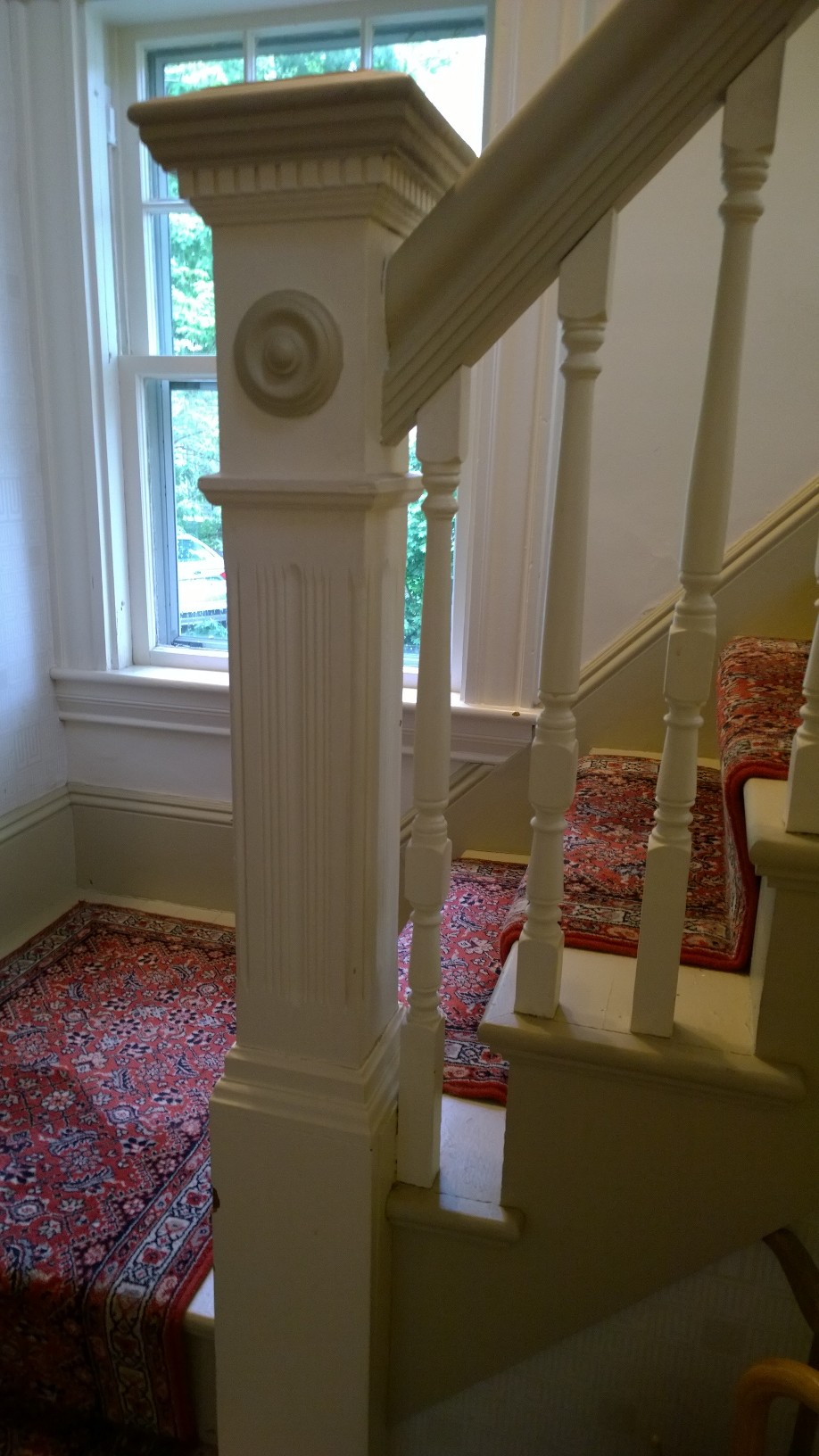
“When an older adult descends a flight of stairs, for example, she may not tell the edge of one step from the next, so she stumbles. At night, an older driver may squint to see the edge of white road stripes on blacktop. Caught in the glare of headlights, he swerves.

“But new research suggests that contrast sensitivity can be improved with brain-training exercises. In a study published [in March] in Psychological Science, researchers at the University of California, Riverside, and Brown University showed that after just five sessions of behavioral exercises, the vision of 16 people in their 60s and 70s significantly improved.”

Read more at the NY Times, here, or go straight to “Improving Vision Among Older Adults: Behavioral Training to Improve Sight,” here. Authors Denton J. DeLoss and George J. Andersen are from the University of California, and Takeo Watanabe is at Brown.

stairs

Read Full Post »