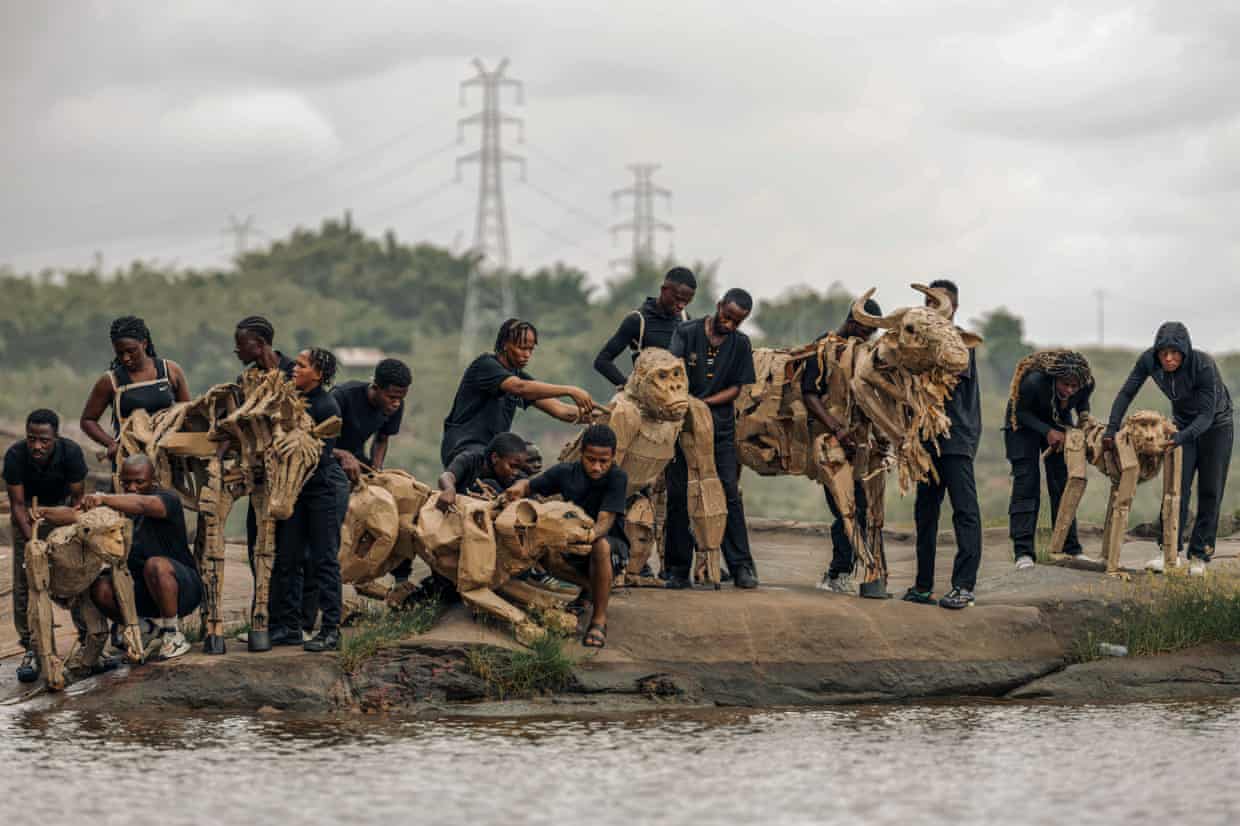
Photo: Berclaire/walk productions. Above, a puppet herd beginning its 20,000km [~2,400 mile] journey in Kinshasa, the Democratic Republic of the Congo. The caravan of zebras, wildebeest, monkeys, giraffes and baboons “will make its way from Dakar to Morocco, then into Europe, including London and Paris, arriving in the Arctic Circle in early August,” the Guardian reports.
Do you remember Little Amal, the world-traveling puppet designed to spread empathy for asylum seekers, especially children? Well, now the creators of Little Amal have launched a slew of puppet animals to bring attention to another cause — the effects of global warming on all living things.
In April, Isabel Choat wrote at the Guardian about the project. “Hundreds of life-size animal puppets have begun a 20,000km (12,400 mile) journey from central Africa to the Arctic Circle as part of an ambitious project created by the team behind Little Amal, the giant puppet of a Syrian girl that travelled across the world.
“The public art initiative called The Herds, which has already visited Kinshasa and Lagos, will travel to 20 cities over four months to raise awareness of the climate crisis.
“It is the second major project from The Walk Productions, which introduced Little Amal, a 12-foot puppet, to the world in Gaziantep, near the Turkey-Syria border, in 2021. The award-winning project, co-founded by the Palestinian playwright and director Amir Nizar Zuabi, reached 2 million people in 17 countries as she travelled from Turkey to the UK.
In Dakar more than 300 artists applied for 80 roles as artists and puppet guides.
“The Herds’ journey began in Kinshasa’s Botanical Gardens on 10 April, kicking off four days of events. It moved on to Lagos, Nigeria, the following week, where up to 5,000 people attended events performed by more than 60 puppeteers.
“On Friday the streets of Dakar in Senegal will be filled with more than 40 puppet zebras, wildebeest, monkeys, giraffes and baboons as they run through Médina, one of the busiest neighborhoods, where they will encounter a creation by Fabrice Monteiro, a Belgium-born artist who lives in Senegal, and is known for his large-scale sculptures. …
“The first set of animal puppets was created by Ukwanda Puppetry and Designs Art Collective in Cape Town using recycled materials, but in each location local volunteers are taught how to make their own animals using prototypes provided by Ukwanda. The project has already attracted huge interest from people keen to get involved. In Dakar more than 300 artists applied for 80 roles as artists and puppet guides. About 2,000 people will be trained to make the puppets over the duration of the project. …
“Zuabi has spoken of The Herds as a continuation of Little Amal’s journey, which was inspired by refugees, who often cite climate disaster as a trigger for forced migration. The Herds will put the environmental emergency center stage, and will encourage communities to launch their own events to discuss the significance of the project and get involved in climate activism. …
“The Herds’ Senegal producer, Sarah Desbois [expects] thousands of people to view the four events being staged over the weekend. ‘We don’t have a tradition of puppetry in Senegal. As soon as the project started, when people were shown pictures of the puppets, they were going crazy.’ “
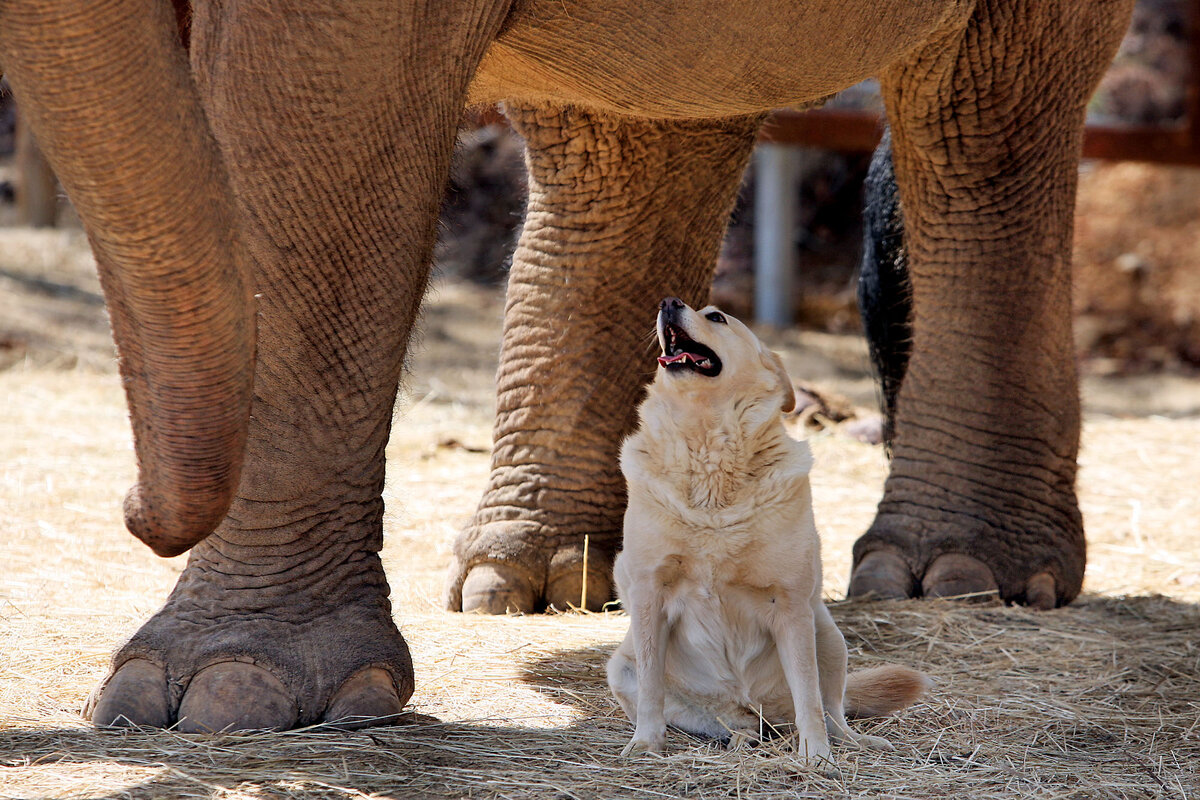
Photo: Melanie Stetson Freeman/CSM. The friendship between Bella, a stray dog, and Tarra, a resident of the Elephant Sanctuary in Tennessee, exemplifies feelings that are not unusual in the animal kingdom.
If you have ever heard Sy Montgomery on Boston Public Radio or read any of her wonderful books about animals, you will know that there is at least one scientist who believes critters have feelings. (FYI: with the exception of the Bobbitt worm, Sy Montgomery loves them all.)
Other scientists also have noticed that animals have feelings. At the Christian Science Monitor, Stephanie Hanes reports on research showing that many “animals exhibit signs of experiencing emotions and being self-aware.”
“This past April,” she writes, “a group of biologists and philosophers unveiled the New York Declaration on Animal Consciousness at a conference at New York University in Manhattan. The statement declared that there is ‘strong scientific support for attributions of conscious experience to other mammals and to birds.’ It also said that empirical evidence points to ‘at least a realistic possibility of conscious experience’ in all vertebrates and many invertebrates, including crustaceans and insects.
“Researchers have found myriads of indications of perception, emotion, and self-awareness in animals. The bumblebee plays. Cuttlefish remember how they experienced past events. Crows can be trained to report what they see.
“Given these findings, many believe there should be a fundamental shift in the way that humans interact with other species. Rather than people assuming that animals lack consciousness until evidence proves otherwise, researchers say, isn’t it far more ethical to make decisions with the assumption that they are sentient beings with feelings?
“ ‘All of these animals have a realistic chance of being conscious, so we should aspire to treat them compassionately,’ says Jeff Sebo, director of the Center for Mind, Ethics, and Policy at New York University. ‘But you can accept that much and then disagree about how to flesh that out and how to translate it into policies.’
“Sasha Prasad-Shreckengast is trying to get into the mind of a chicken. This is not the easiest of feats, even here at Farm Sanctuary in Watkins Glen, a scenic hamlet in the rolling Finger Lakes region of upstate New York. For decades the sanctuary has housed, and observed the behavior of, farm animals – like the laying hens Ms. Prasad-Shreckengast is hoping to tempt into her study.
“Chickens, it turns out, have moods. Some might be eager and willing to waddle into a puzzle box to demonstrate innovative problem-solving abilities. But other chickens might just not feel like it.
“Ms. Prasad-Shreckengast also knows from her research, published this fall in the Journal of Applied Animal Welfare Science, that some chickens are just more optimistic than others – although pessimistic birds seem to become more upbeat the more they learn tasks.
“ ‘We just really want to know what chickens are capable of and what chickens are motivated by when they are outside of an industrial setting,’ Ms. Prasad-Shreckengast says. ‘They have a lot more agency and autonomy.’ …
“In other words, how do chickens really think? And how do they feel? And, to get big picture about it, what does all of that say about chicken consciousness?
“In some ways, these are questions that are impossible to answer. There is no way for humans, with their own specific ways of perceiving and being in the world, to fully understand the perspective of a chicken – a dinosaur descendant that can see ultraviolet light and has a 300-degree field of vision.
“Yet increasingly, scientists like Ms. Prasad-Shreckengast are trying to find answers. What they are discovering, whether in farm animals, bumblebees, dogs, or octopuses, is a complexity beyond anything acknowledged in the past. …
“Researchers have found myriads of indications of perception, emotion, and self-awareness in animals. The bumblebee plays. Cuttlefish remember how they experienced past events. Crows can be trained to report what they see. …
“Ms. Prasad-Shreckengast’s study takes place in the wide hallway of Farm Sanctuary’s breezy chicken house. Unlike in pretty much any other chicken facility, the birds here come and go as they please from spacious pens.
“Following up on her previous research, she has designed a challenge that she hopes will appeal to most of her moody chickens. It is a ground-level puzzle box, with a push option, a pull option, and a swipe option. Birds are rewarded with a blueberry when they solve a challenge. …
“The idea of consent – which is a basic, foundational principle in the study of human behavior – is also a hallmark of animal studies here at Farm Sanctuary. To the uninitiated, this might sound absurd, with images of chickens signing above the dotted line. But it is not actually all that rare. Studies of dogs, dolphins, and primates all depend on the animals agreeing, in their own way, to participate. …
“Spearheaded by Kristin Andrews, professor of philosophy and the research chair in animal minds at York University in Canada, the idea emerged from conversations she had with two colleagues, Jonathan Birch, a philosopher at the London School of Economics and Political Science, and Jeff Sebo, director of the Center for Mind, Ethics, and Policy at New York University. …
“ ‘People were dimly aware that new studies were identifying new evidence for consciousness – not only in birds, but also reptiles, amphibians, fishes, and then a lot of invertebrates, too,’ says Dr. Sebo. ‘But there was no central, authoritative place people could look for evidence that the views of mainstream scientists were shifting.’ …
“For instance, trees communicate, and fungal networks send messages throughout a forest. Species such as sea turtles and bats use electromagnetic fields, a force we cannot even perceive, to guide their movements and migrations. Snakes see infrared light, birds and reindeer see ultraviolet light, and dolphins use sound waves to navigate underwater. …
“For generations, the dominant perspective has been that the human perspective is the best view in the house, with the most complex and complete picture of reality.
“But there hasn’t been a species studied over the past 20 years that hasn’t turned out to exhibit pain. There hasn’t been a species that hasn’t turned out to be more internally complicated than people expected, Dr. Andrews says. …
“ ‘That word, “consciousness,” is the problem,’ Dr. Andrews says. ‘The thing that everybody in the field agrees on is that consciousness refers to feeling – ability to feel things. … But then if you start asking people to give a real, concrete definition of consciousness, they’re not able to do it.’ …
“For the purposes of the declaration, researchers said, they focused on what is called ‘phenomenal consciousness.’ This is the idea that ‘There is something that it’s like to be a particular organism,’ explains Christopher Krupenye, professor of psychological and brain sciences at Johns Hopkins University. … Basically means that an animal experiences the world not as a machine, but as a being. Phenomenal consciousness is what you are experiencing right now in your body with the sight of words on a page as you read this article.”
There are numerous species described in the article at the Monitor, here. Don’t miss the playful bees.
I think we don’t give enough credit to ancient wisdom. Researchers of former times may have been ignorant of cars and computers and smart phones, but why do we think they were unintelligent? (I’m a little cranky because I recently attended a talk on reflexology that barely mentioned traditional Chinese medicine.)
Today we learn that art works from centuries ago suggest humans were observing animals self-medicating long before contemporary scientists started publishing papers on the practice.
Adrienne Mayor, a classics, history and philosophy of science scholar at Stanford University, writes in the Conversation, “When a wild orangutan in Sumatra recently suffered a facial wound, apparently after fighting with another male, he did something that caught the attention of the scientists observing him.
“The animal chewed the leaves of a liana vine – a plant not normally eaten by apes. Over several days, the orangutan carefully applied the juice to its wound, then covered it with a paste of chewed-up liana. The wound healed with only a faint scar. The tropical plant he selected has antibacterial and antioxidant properties and is known to alleviate pain, fever, bleeding and inflammation. …
“In interviews and in their research paper, the scientists stated that this is ‘the first systematically documented case of active wound treatment by a wild animal’ with a biologically active plant. …
“To me, the behavior of the orangutan sounded familiar. As a historian of ancient science who investigates what Greeks and Romans knew about plants and animals, I was reminded of similar cases reported by Aristotle, Pliny the Elder, Aelian and other naturalists from antiquity. A remarkable body of accounts from ancient to medieval times describes self-medication by many different animals. The animals used plants to treat illness, repel parasites, neutralize poisons and heal wounds.
“The term zoopharmacognosy – ‘animal medicine knowledge’ – was invented in 1987. But as the Roman natural historian Pliny pointed out 2,000 years ago, many animals have made medical discoveries useful for humans.
Indeed, a large number of medicinal plants used in modern drugs were first discovered by Indigenous peoples and past cultures who observed animals employing plants and emulated them.
“Some of the earliest written examples of animal self-medication appear in Aristotle’s ‘History of Animals‘ from the fourth century BCE, such as the well-known habit of dogs to eat grass when ill, probably for purging and deworming.
“Aristotle also noted that after hibernation, bears seek wild garlic as their first food. It is rich in vitamin C, iron and magnesium, healthful nutrients after a long winter’s nap. The Latin name reflects this folk belief: Allium ursinum translates to ‘bear lily,’ and the common name in many other languages refers to bears.
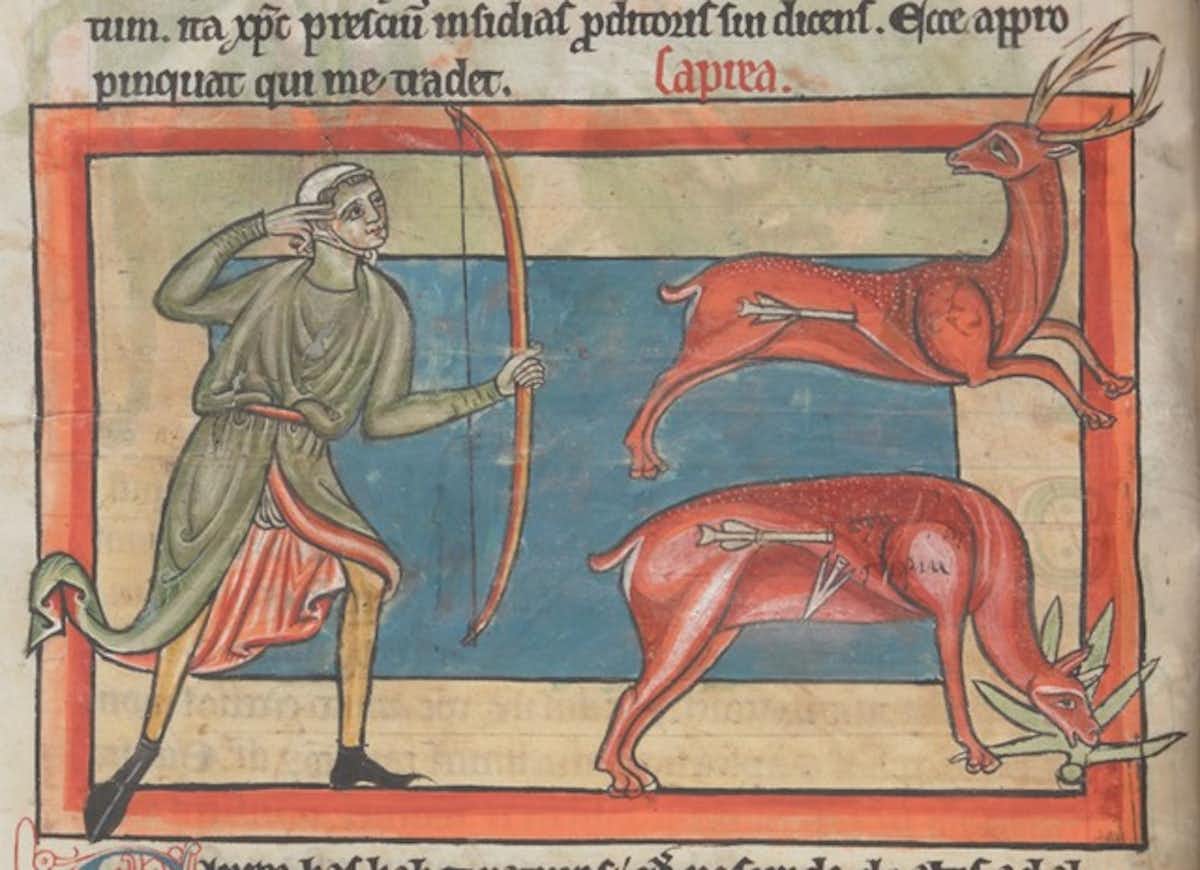
“Pliny explained how the use of dittany, also known as wild oregano, to treat arrow wounds arose from watching wounded stags grazing on the herb. Aristotle and Dioscorides credited wild goats with the discovery. Vergil, Cicero, Plutarch, Solinus, Celsus and Galen claimed that dittany has the ability to expel an arrowhead and close the wound. Among dittany’s many known phytochemical properties are antiseptic, anti-inflammatory and coagulating effects.
“According to Pliny, deer also knew an antidote for toxic plants: wild artichokes. The leaves relieve nausea and stomach cramps and protect the liver. To cure themselves of spider bites, Pliny wrote, deer ate crabs washed up on the beach, and sick goats did the same. Notably, crab shells contain chitosan, which boosts the immune system.
“When elephants accidentally swallowed chameleons hidden on green foliage, they ate olive leaves, a natural antibiotic to combat salmonella harbored by lizards. Pliny said ravens eat chameleons, but then ingest bay leaves to counter the lizards’ toxicity. Antibacterial bay leaves relieve diarrhea and gastrointestinal distress. Pliny noted that blackbirds, partridges, jays and pigeons also eat bay leaves for digestive problems.
“Weasels were said to roll in the evergreen plant rue to counter wounds and snakebites. Fresh rue is toxic. Its medical value is unclear, but the dried plant is included in many traditional folk medicines. Swallows collect another toxic plant, celandine, to make a poultice for their chicks’ eyes. Snakes emerging from hibernation rub their eyes on fennel. Fennel bulbs contain compounds that promote tissue repair and immunity.
“According to the naturalist Aelian, who lived in the third century BCE, the Egyptians traced much of their medical knowledge to the wisdom of animals. Aelian described elephants treating spear wounds with olive flowers and oil. He also mentioned storks, partridges and turtledoves crushing oregano leaves and applying the paste to wounds.”
Need more proof that modern science sometimes just reinvents the wheel? Read the Conversation, here. No paywall. Fun artworks.
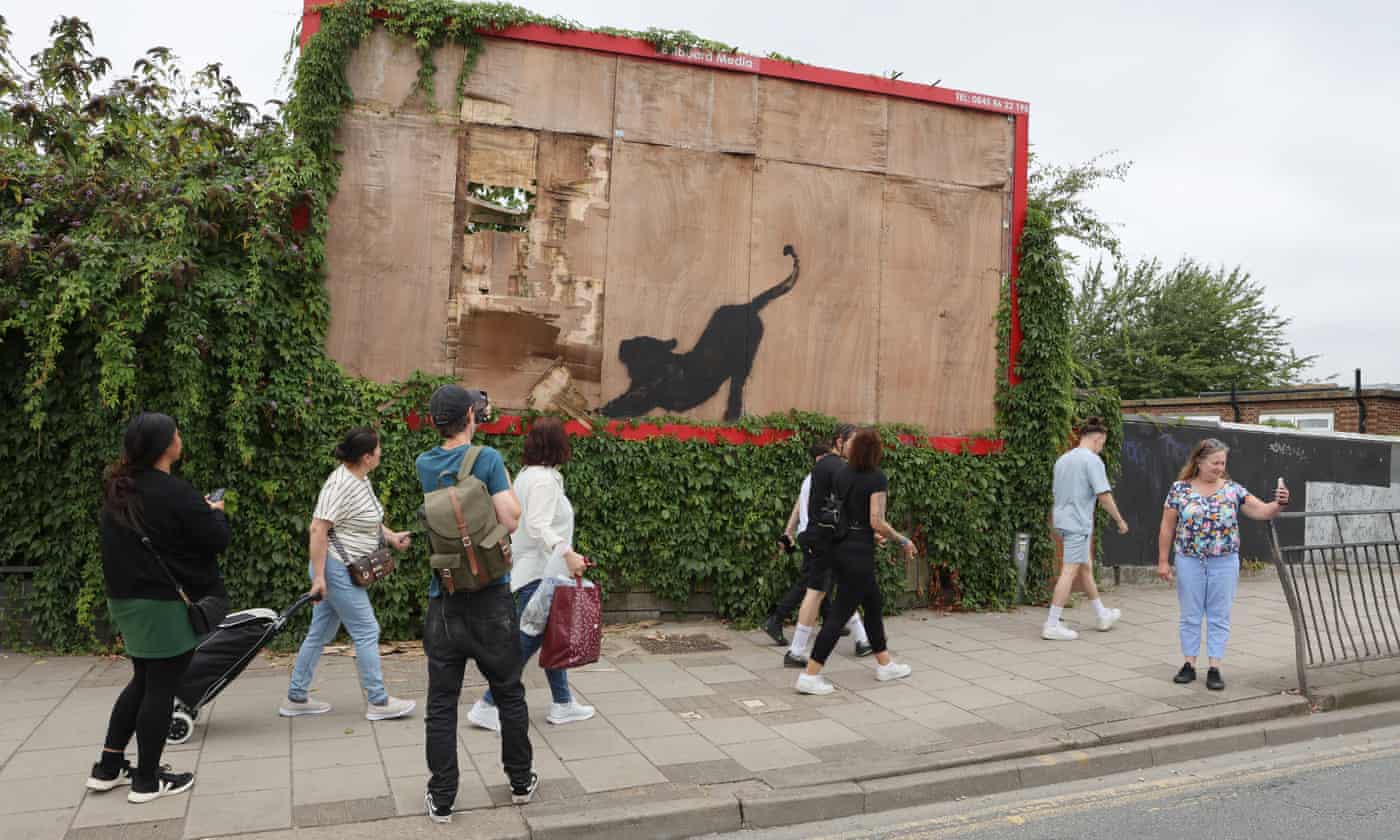
Photo: Andy Hall/The Observer. The Banksy cat mural in Cricklewood, north-west London, before the billboard was removed last summer.
I love the stealth artworks of Banksy and have taken a few photos of murals that could have been his, except that they were in Boston and New York.
People love guessing what the pieces mean, what his angle is.
At the Guardian last August, Vanesa Thorpe demonstrated that Banksy’s views are increasingly transparent.
“A big cat by Banksy appeared briefly, stretching in the morning sun, on a bare advertising hoarding on Edgware Road in Cricklewood, north-west London, on Saturday. A few hours later,” Thorpe writes, “it had gone, removed by contractors who feared it would be ripped down.
“The anonymous artist known as Banksy, who confirmed the image was his at lunchtime on Saturday, also promised a little more summer fun to come. …
“For a week now, the streets of the capital have been populated by a string of unusual animal sightings, courtesy of Banksy, including pelicans, a goat and a trio of monkeys.
“The artist’s vision is simple: the latest street art has been designed to cheer up the public during a period when the news headlines have been bleak. … Banksy’s hope, it is understood, is that the uplifting works cheer people with a moment of unexpected amusement, as well as to gently underline the human capacity for creative play, rather than for destruction and negativity.
“Some recent theorizing about the deeper significance of each new image has been way too involved, Banksy’s support organization, Pest Control Office, has indicated.
“When a goat teetering on a precipice first appeared on Monday near Kew Bridge, in south-west London, some thought it might be a symbol of humanity’s folly. Others speculated it might be a visual pun on the idea of the goat, now standing for ‘greatest of all time’ in popular parlance.
“On Tuesday, two silhouetted elephant heads popped up, their trunks reaching out to each other through the bricked-up windows of a house in Chelsea.
“Next came perhaps the most joyous so far when a trio of monkeys was revealed on Wednesday, swinging their way across a bridge over Brick Lane in east London.
“On Thursday, an outline of a howling lone wolf, painted on to a large satellite dish on a roof in Peckham, was removed by two masked men with a ladder, who made off with their prize. …
“On Friday, a pair of hungry pelicans appeared above a Walthamstow fish and chip shop on a corner of Pretoria Avenue, their long beaks snapping at fish. …
“While Banksy’s new menagerie has been springing up, the rescue boat the artist funds has been working to help endangered asylum seekers to reach safety. The M V Louise Michel, a high-speed lifeboat, patrols migrant routes in the Mediterranean.
“It has picked up at least 85 survivors in the past couple of days, taking them safely to Pozzallo, Sicily. … Five years ago, Banksy announced that he would finance the vessel, named after a French feminist anarchist, with the intention of rescuing refugees in difficulty as they fled north Africa.
“In June, at Glastonbury, an inflatable migrant boat created by Banksy was used to crowdsurf during performances by Bristol indie punk band Idles and rapper Little Simz. The Conservative home secretary at the time, James Cleverly, said the artist was ‘trivializing‘ small boat crossings and ‘vile.’
“Banksy responded that the detention of the Louise Michel by Italian authorities at the time was the really ‘vile and unacceptable’ development.
“His latest street art, however, is deliberately lighthearted, like Banksy’s lockdown series the Great British Spraycation of 2020. Banksy’s seaside series also memorably featured chips, with an image of a seagull hovering over oversized ‘chips.’ …
“Another image from the lockdown campaign made reference to the refugee crisis. It showed three children sitting in a rickety boat made of scrap metal. Above them, Banksy had inscribed: ‘We’re all in the same boat.’ “
More at the Guardian, here. No paywall. Delightful photos.
Photo: Madeline Harper. A faucet in a pet-food station designed by Daley Home makes it easy to add water to your pampered pet’s bowl.
Need an indoor shower designed for your dog? How about a built-in food and water station? Tim McKeough writes in the real estate section of the New York Times that for some wealthy pet owners, amenities know no bounds.
“When you’re designing or decorating a home, you have to consider the needs of the occupants — and that means not just people, but any resident animals,” McKeough writes.
“ ‘Our clients are very serious about their animals,’ said Jimmy Crisp, the principal of Crisp Architects, in Millbrook, N.Y. … Many of the homes he designs have built-in amenities for pets.
“Amy Storm, the principal of the interior design firm Amy Storm & Company, in Glen Ellyn, Ill., thinks along the same lines. … ‘It would actually be unusual that we wouldn’t be working on some sort of location for the pets to eat and bathe.’ …
“One of the most popular features is a dog shower. Usually placed in a mudroom or laundry room with direct outdoor access, it offers a convenient way to rinse muddy paws and fur.
“Kate Marker, an interior designer in Barrington, Ill., added a shower for her two dogs to the lower-level mudroom of her own home. … There is no shower curtain or glass door to get in the way, which makes it easier to reach in and scrub the dog.
“For larger dogs, a shower with an opening at the floor makes the most sense, Ms. Storm said. But for smaller dogs, it’s often better to raise the shower, so that it resembles an oversized sink [and] you don’t have to hunch over. …
“Food and water bowls can look like an afterthought if separate dishes are simply placed on a waterproof mat. A better alternative is a built-in pet-food station.
“Shelby Van Daley, a founder of the interior design firm Daley Home, included an open cabinet with built-in dog bowls when she was designing a kitchenette for a family room in Austin, Texas. The pet dining space is lined in quartz countertop material and has cutouts to hold removable stainless-steel bowls. …
“ ‘A lot of our clients look for things they can add to their home to make it easier having pets,’ Ms. Van Daley said.
“If you don’t want to see bowls sitting out all day long, there’s another option: Install a low drawer in a bank of cabinetry, with cutouts for bowls, so you can slide it closed when it’s not in use. …
“Crate training your dog shouldn’t mean putting up with an ugly wire structure in the middle of your living space. Many designers are creating upscale custom crates that are built into homes.
“Ms. Van Daley designed a pair of crates with brass-mesh doors and enough space inside for dog beds as part of storage cabinets in the primary bedroom of one project. And Mr. Crisp designed a custom crate to fill the unused space under a staircase.
“If you don’t need a crate, but want a place to hold wet dogs in the mudroom, there are other options.
“For one client, Ms. Storm designed a mudroom with a half-height screened pocket door that pulls out of the wall like a baby gate. Compared to a solid door, ‘you still have good light and good air, and everyone can still see each other,’ she said, ‘even though the dogs are secured.’
“While dogs can usually get outside to play, indoor cats don’t have that opportunity. To compensate, some cat owners design their interiors to double as feline playgrounds.
“Alexandra Barker, the founder of the Brooklyn-based architecture firm BAAO, prioritized cat-friendly features while renovating a Brooklyn rowhouse for a couple of cat lovers. …
“The home’s defining feature is a built-in bookcase that runs along one wall of the living room. Some of the shelves project out into the room to serve as cat steps, and the top of the structure angles up and down to serve as a cat run. At one end, the run reaches a ceiling hatch that opens to the primary bedroom above; at the other, a hatch opens to an art studio.
“For another client in Brooklyn, Ms. Barker is designing a cat bathroom that conceals the litter box. ‘It’s a door into a closet with a portal in it,’ she said, so the cats can come and go as they please and no one has to look at the litter box. …
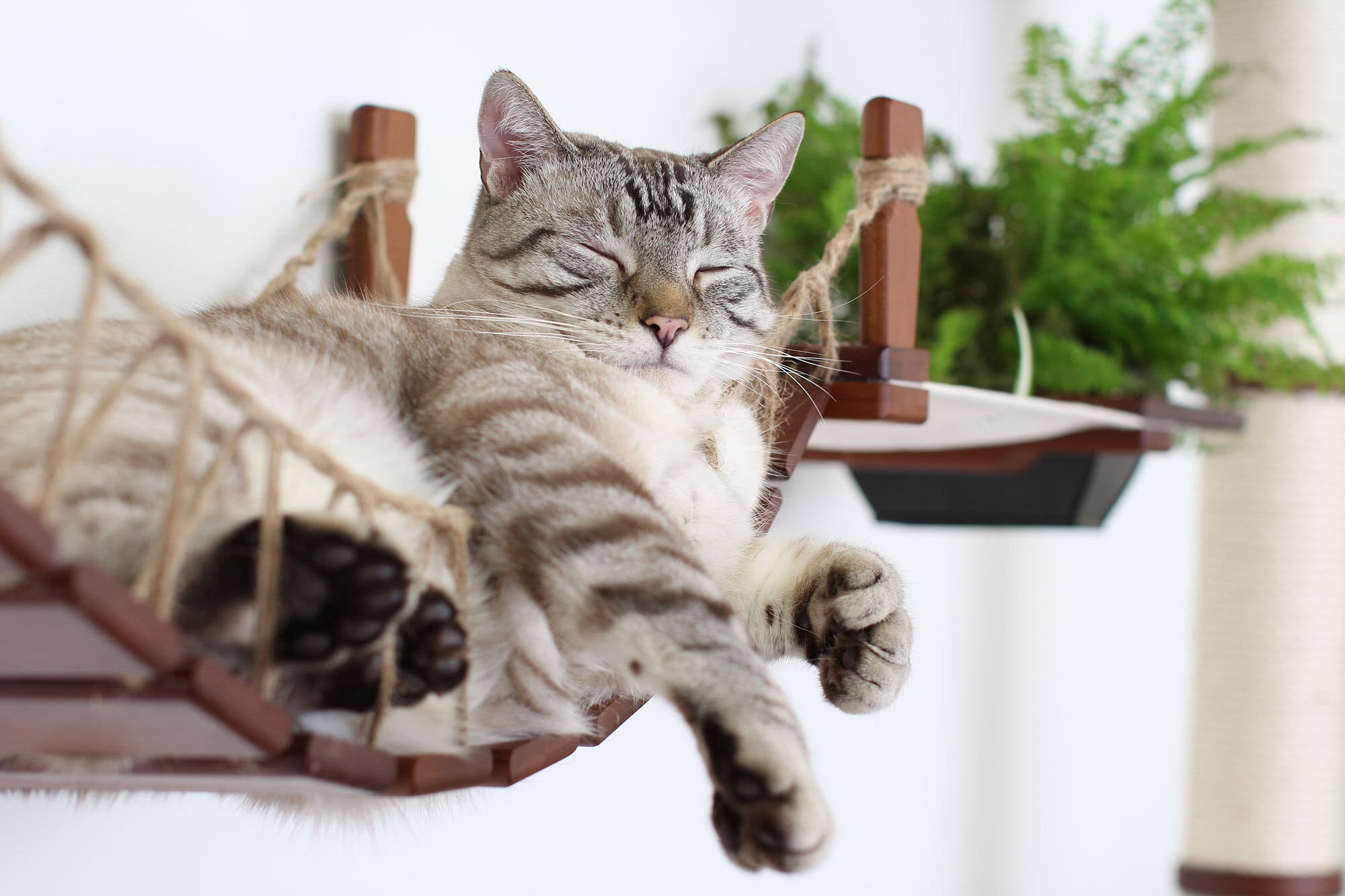
“If you want to create an indoor feline playground but aren’t ready to renovate, there are products that can be installed on an existing wall. Mike Wilson co-founded Catastrophic Creations, a manufacturer of cat-play equipment in Grand Rapids, Mich., after devising a wall-mounted rope bridge for his own cat. …
“On Etsy, the bridge was a hit, and the company soon developed a range of wall-mounted cat runways, steps, scratch posts and hammocks.
“Jackson Cunningham started Tuft & Paw in Vancouver, British Columbia, for similar reasons. ‘The idea came from our own experience of living in a smaller space in the city and caring about the stuff we put in that space,’ Mr. Cunningham said. …
“Tuft & Paw now makes cat hammocks, perches, beds and litter boxes that are as considered as any piece of designer furniture.”
More at the Times, here. OK, what do you think? You still have to walk the dog and empty the litter box. And do you think such things would improve the value of a home at resale — or would all those amenities have to be torn out?
Photo: American Kennel Club
Most species respond to music, just not in the same way humans do.
Now that you have absorbed yesterday’s post on the responsiveness of cheese to music, it should come as no surprise that mammals, birds, and fish also have an affinity for music.
University of Amsterdam professor of music cognition Henkjan Honing writes at Nautilus, “We are all born with a predisposition for music, a predisposition that develops spontaneously and is refined by listening to music. Nearly everyone possesses the musical skills essential to experiencing and appreciating music. … Is musicality something uniquely human? Or do we share musicality with other animals. …
“By the beginning of the 20th century, Ivan Pavlov had discovered that dogs could remember a single tone and associate it with food. Wolves and rats also recognize members of their own species by the perfect pitch of their call and can also differentiate tones. The same applies to starlings and rhesus macaques. …
“Zebra finches turn out to focus mostly on the musical aspects of [sequences, as opposed to the order]. This does not mean they are insensitive to the order … but it is mainly the differences in pitch (intonation), duration, and dynamic accents [that] they use to differentiate the sequences. …
“Humans may share a form of musical listening with zebra finches, a form of listening in which attention is paid to the musical aspects of sound (musical prosody), not to the syntax and semantics that humans heed so closely in speech. … The research on starlings and zebra finches reveals that songbirds use the entire sound spectrum to gather information. They appear to have a capacity for listening ‘relatively,’ that is, on the basis of the contours of the timbre, intonation, and dynamic range of the sound. …
“What we know for sure is that humans, songbirds, pigeons, rats, and some fish (such as goldfish and carp) can easily distinguish between different melodies. It remains highly questionable, though, whether [animals] do so in the same way as humans do, that is, by listening to the structural features of the music.
“A North American study using koi carp — a fish species that, like goldfish, hears better than most other fish — offers an unusual example. Carp are often called ‘hearing specialists’ because of their good hearing. The sensitivity of a carp’s hearing can be compared to the way sounds might be heard over a telephone line: Though quality may be lacking in the higher and lower ranges, the carp will hear most of the sounds very clearly.
“Three koi — Beauty, Oro, and Pepi — were housed in an aquarium at Harvard University’s Rowland Institute, where they had already participated in a variety of other listening experiments. … In the discrimination experiment, the koi were exposed to compositions by Johann Sebastian Bach and the blues singer John Lee Hooker to see whether they could differentiate between the two. In the categorization experiment, the koi were tested to see if they could classify a composition as belonging to either the blues or the classical genre. In the latter experiment, they were alternately exposed to recordings of different blues singers and classical composers ranging from Vivaldi to Schubert.
“The surprising outcome was that all three koi were able to distinguish not only between compositions by John Lee Hooker and Bach, but also between the blues and classical genres in general. The fish appeared to be able to generalize, to correctly classify a new, as yet unheard piece of music based on a previously learned distinction. …
“Rock doves, too, [pigeons] can distinguish between compositions by Bach and Stravinsky. And, like carp, rock doves can also generalize what they have learned from only two pieces of music to other, unfamiliar pieces of music. They can even distinguish between compositions by contemporaries of Bach and Stravinsky. …
“These species can do all of this with no significant listening experience. … This, in itself, is an exceptional trait. Most likely it is a successful tactic to generate food. Yet it still offers no insight into the ‘perception, if not the enjoyment,’ of music. That may be one aspect of musicality that belongs to humans alone.”
More at Nautilus, here. And while we are on the subject of critters’ artistic sensibilities, be sure to read the children’s book This is a Poem that Heals Fish. Hat tip: The inestimable Brainpickings.
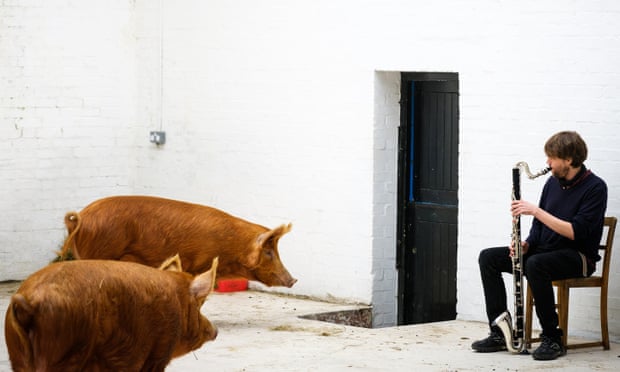
Photo: Ben Gilbert/Wellcome Collection
Art and science meet at performances for farm animals in England.
Today I have another of my offbeat stories for you. It’s about performing for farm animals and checking their reactions.
Lyn Gardner writes at the Guardian, “Almost 10 years ago, David Harradine made a show in a basement for the Brighton festival. It was called An Infinite Line and featured a horse that stood entirely unconcerned throughout the performance, barely blinking at what went on around him. He was an impressively large presence, a symbolic representation of the natural world, and clearly didn’t give a fig for the theatrical avant-garde.”
Harradine was looking for more reaction from animals in March as his company, Fevered Sleep, conducted “an experiment in which human artists perform for sheep, pigs and goats at a location in Peckham. …
“The show [was] part of the Wellcome Collection’s fascinating Making Nature exhibition, which aims to explore our relationship with the natural world and how we perceive animals. ‘We are starting from the point of view that perception is knowledge,’ says its curator, Honor Beddard, ‘but when you have an encounter with an animal, how do you know that you are not projecting something on to it?’ …
“For Harradine it’s definitely ‘the most bonkers project I’ve been involved in. But it’s fascinating too. The performances are being used to start a conversation.’
“As Harradine says, we prefer not to see animals as being just like us: complex, sentient beings, with emotional responses. To that end, the animals chosen to experience Fevered Sleep’s performance are all what Harradine, himself a vegan, describes as creatures that are mostly perceived as ‘meals in waiting.’ … ‘The purpose is not to suggest that people shouldn’t eat meat but to examine our relationship with animals – and the ethical and political responsibilities of humans towards them.’ ” More here.
Sounds like such fun to be part of a “bonkers” performance. I think we could all do with a little nutty creativity in our lives.
In this story from radio show Studio 360, we learn that music is intriguing to animals, at the very least arousing their curiosity and perhaps stimulating and soothing them.
“Laurel Braitman is a historian of science and the author of ‘Animal Madness: How Anxious Dogs, Compulsive Parrots, and Elephants in Recovery Help Us Understand Ourselves.’ She’s particularly interested in the mental health of animals in captivity.
“ ‘If their minds aren’t stimulated, they can end up with all sorts of disturbing behaviors,’ she says. Braitman wondered if music — so often soothing to people, but usually foisted on animals without their permission — could help counter their symptoms of anxiety and depression.
“That led Braitman to arrange a series of concerts for all-animal audiences: gorillas in a Boston zoo and a small herd of bison in Golden Gate Park. Recently, the bluegrass band Black Prairie played for the residents of Wolf Haven wolf sanctuary in Tenino, Washington. …
“Can we say that they liked it?
“Researchers are trying to answer this question in controlled experiments where they observe whether animals move toward or away from speakers, depending on the music.
“Dr. Charles Snowdon of the University of Wisconsin collaborates with a composer, David Teie, who writes music tailored for certain species. They base their compositions on sonic frequencies the animals use in nature. Their music for domestic cats features tempos of purring or suckling kittens; small monkeys called cotton-top tamarins, on the other hand, got music that sounds remarkably like nails on a blackboard. ‘It is pretty godawful if you ask me,’ Snowdon says. ‘But the tamarins dig it.’ ”
The New York Times Science section had a cute piece in January about surprising friendships among different species of animals. Perhaps you saw it.
Erica Goode reported, “Videos of unlikely animal pairs romping or snuggling have become so common that they are piquing the interest of some scientists, who say they invite more systematic study. Among other things, researchers say, the alliances could add to an understanding of how species communicate, what propels certain animals to connect across species lines and the degree to which some animals can adopt the behaviors of other species.
” ‘There’s no question that studying these relationships can give you some insight into the factors that go into normal relationships,’ said Gordon Burghardt, a professor in the departments of psychology and ecology and evolutionary biology at the University of Tennessee, who added that one video he liked to show students was of a small and persistent tortoise tussling over a ball with a Jack Russell terrier. …
“Until recently, any suggestion that interspecies relationships might be based simply on companionship would probably have been met with derision, dismissed as Pixar-like anthropomorphism. That has changed as research has gradually eroded some boundaries between homo sapiens and other animals. Other species, it turns out, share abilities once considered exclusive to humans, including some emotions, tool use, counting, certain aspects of language and even a moral sense. …
“Barbara J. King, an anthropologist at the College of William and Mary, said that she hoped researchers would begin to collect examples of cross-species interactions to build a database that would merit scientific scrutiny. ‘I think we’re not even at the point of being able to extract patterns because the database is so small,’ she said, adding that the topic could also benefit from a rigorous definition of what constitutes a ‘friendship’ between members of different species.” More here.
On the whole, I believe in having zoos, but I do realize most of the animals would rather not be there.
So I was interested in a zoo concept that was tweeted this week by @SmallerCitiesU. It’s an article about a plan for a zoo in Denmark.
At Good magazine, Caroline Pham asks, “Is there an ethical way to publicly display captive animals? Danish architecture firm BIG (Bjarke Ingels Group) is on a mission to answer that question with a hefty redesign of Denmark’s Givskud Zoo. …
“Their recently revealed plans for what has been dubbed ‘Zootopia’ attempt to mesh nature with inventive design in a 1,200,000 square meter park imagined under advisement from the zoo staff. Manmade buildings would hide within the constructed natural environments and animal habitats would mimic ones found in the wild as much as possible.
“Renderings showcase a circular central plaza with an ascending ramp-like border where visitors can enjoy panoramic views of the entire park, which features varying natural environments (that seem to be fairly open-air) connected by a four-kilometer hiking trail. …
“The project is currently in progress, with the first phase set for completion in 2019.” More here.
Photo: Ashley Foughty, via Associated Press. Foughty spotted the renegade Rusty in Washington’s Adams Morgan neighborhood, and twitter did the rest.
Ashley Foughty uses social media. And a good thing, too. If she hadn’t responded to the zoo’s call for help finding an escaped red panda, who knows what might have happened.
Trip Gabriel writes at the NY Times, “Rusty the red panda, who disappeared from the National Zoo, hijacked the news cycle on Monday.
“To help find Rusty, a raccoon-size mammal with a striped tail and moon-shaped face, the zoo turned to social media, and suddenly half of official Washington broke from Serious Events to tune in to the saga of the runaway panda.
“On Twitter and Facebook, the hunt for 11-month-old Rusty … exploded in a mix of concern, humor. …
“ ‘Rusty the Red Panda eats shoots and leaves,’ Jake Tapper, CNN’s chief Washington correspondent, filed to Twitter. …
“The zoo announced Rusty’s disappearance to its thousands of Twitter followers in a message at 11:51 a.m, which was retweeted nearly 3,000 times in an hour. …
“At midday, mentions of ‘Rusty’ on Twitter nearly equaled those of ‘Obama.’ ….
“ ‘Edward Snowden and Rusty the red panda relaxing on a Havana beach,’ wrote J. D. Ross, a communications director at Syracuse University, referring to the American security contractor wanted on spying charges. …
“Once again, social media proved to be a powerful dragnet. Around 1:15 p.m., a Washingtonian posted a picture on Twitter of Rusty in a patch of weeds in the Adams Morgan district, not far from the 163-acre zoo.”
I took a walk on Lakeside Drive today and saw scores (hundreds?) of swallows swooping and wheeling like berserk bats toward the lake, upside down over the road, then sideways and shuddering back toward the lake again in a group dance with no obvious explanation.
When I went online and Googled “swallows going berserk,” I found an Audubon blog post in New Hampshire that used that exact phrase. But the author thought the swallows were just feeding and happy to see spring arrive.
I have decided that the collective noun for swallow should be “delirium,” as in “a delirium of swallows.”
Are you into collective nouns for birds and animals? They can be a lot of fun, with terms going back hundreds of years. Find your favorites at Wikipedia, here. A congregation of alligators, a rabble of bees, a coalition of cheetah, a gulp of cormorants, a consortium of crabs, a murder of crows — and I am only in the c’s!
Be sure to use “a delirium of swallows” as your next opportunity and appear to know something esoteric that no one else knows.



 Suzanne's Mom's Blog