Feeds:
Posts
Comments

Posts Tagged ‘Armenia’

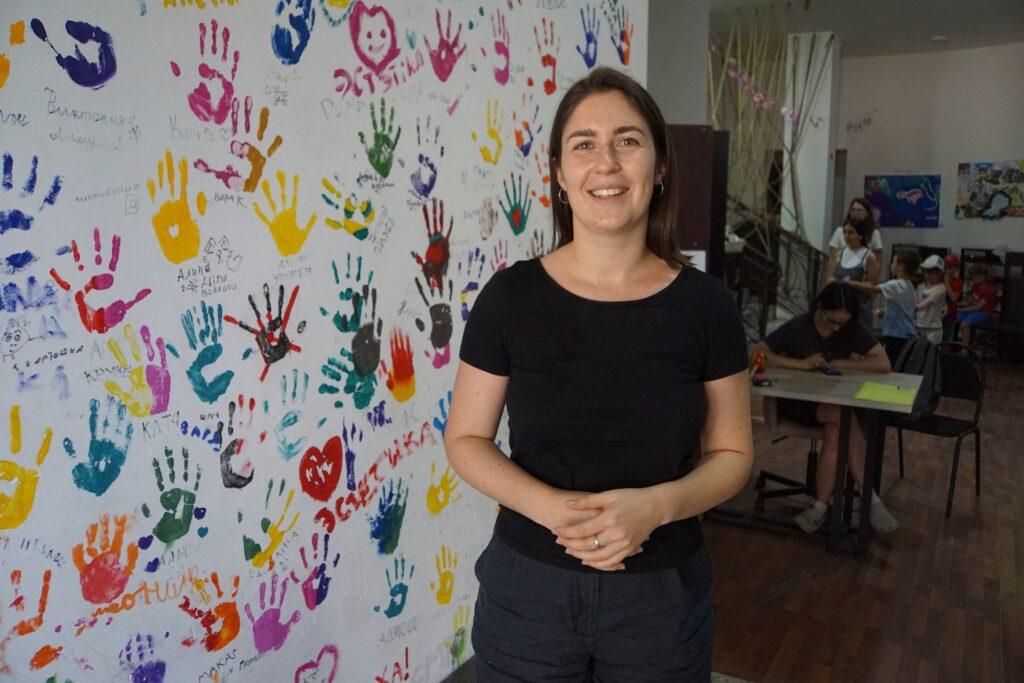
Photo: Daniel Ofman/The World.
Elena Chegodaeva is the founder of the Liberated School in Yerevan, Armenia. Most of the students are the kids of Russian immigrants who left Russia because of the war in Ukraine.

When tyrants like Putin have total control over the media, it’s easy to forget that there may be some people in the country who are not supportive of tyranny. In today’s story we learn about Russian dissenters who fled to Armenia after Russia’s full-scale invasion of Ukraine — and how they are trying to make a new life there. (Do you know why media outlets always say “full-scale” invasion? Because Russia has been doing other, more limited invasions for a long time.)

With contributions from Stepan Adamyan, Daniel Ofman reported the story for Public Radio International’s The World.

“Russian Elena Chegodaeva left Moscow in early March of 2022 — about a week after Russia began its full-scale invasion of Ukraine.

“Chegodaeva was against the war and fled to Yerevan, Armenia. … Chegodaeva is among the hundreds of thousands of Russians who have left their homeland since the invasion of Ukraine. Most of them oppose Russia’s war in Ukraine, or they fear getting drafted. 

“Many have wound up all over Europe — and Turkey, Georgia and Armenia have become some of the most-frequent destinations for exiled Russians. According to some estimates, more than 100,000 Russian citizens fled to Armenia alone. This reality has led to some changes within Yerevan, the Armenian capital, as the new residents try to put down roots.

“Chegodaeva, an educator, soon realized the need for a school for the Russian children coming to the city. So, after coordinating with families and securing teachers and a space within a couple of weeks, she started the Svobodnaya Shkola, which is Russian for Liberated School. …

“At first, the school only had 40 students — all kids of Russian immigrants. Back then, many of the families thought the war would end and they would soon return to Russia. The school operated out of an apartment. Now, 2 1/2 years later, many of the families are still here, and the student body has grown to 250, with classes held in two different buildings. Lessons are taught in Russian and English, while Armenian is also taught twice a week. …

“Yura Boguslavsky, a parent of two sons, ages 10 and 15, at Chegodaeva’s school, said that their education is one of the reasons he left Russia. … [And] when he and his family first arrived in Armenia, they also struggled. ‘I think the first two or three weeks was just a shock; we managed to find someplace to live, and all the streets in Yerevan were full of lost people with backpacks who were very sad.’ …

“Back in Russia, Boguslavsky attended anti-war protests, and was opposed to the Kremlin’s politics. Professionally though, Boguslavsky said, he was thriving. In Moscow, he ran a studio and an animation school. But once he got to Yerevan, he had to start from scratch. …

“A year after arriving in Yerevan, Boguslavsky started a new animation studio called Invisible Friends. He also teaches animation to students of all ages. He produced a Claymation, stop-motion documentary called, We flew, we came here, based on interviews that Armenian students conducted with Russian kids who had recently arrived in Yerevan.

“In the film, one child says that he didn’t know how long they were leaving Russia for — but when he found out, he says he ‘began missing his friends’ and sometimes cried at night. The kids described the toys they took with them and the ones they left behind.

“Boguslavsky said that the kids were a lot more expressive than the adults were. That’s why he chose to feature children in the film.

“ ‘All the adults … were saying almost the same things, just retelling the news. And the kids were sometimes even funny; they talked about how they understood what their parents told them. They were speaking a lot about their feelings.’

“Boguslavsky said that this film inspired him to find a way to keep teaching animation in Armenia. He said that nowadays, he feels comfortable in Armenia, but he knows that many other people are having a hard time.

“Finding affordable housing, and consistent work, is a challenge for many Russian immigrants who don’t work in the tech sector. A lot of people are also having trouble adjusting because they’re still hoping to return to Russia.

“ ‘I know many people who were suffering a lot, and not living their lives, and they were stuck in the past, and I don’t want to be like that, you know.’

“Boguslavsky said that it’s unlikely that he’ll return to Russia anytime soon. He said that he’s focused on making a life for himself and his family here in Armenia.

“Chegodaeva said that’s her mindset as well, and one of the reasons she founded the school. However, she said she still holds out hope that she’ll one day go back to Russia.”

More at The World, here.

Read Full Post »

shadow1

Photo: Narek Harutyunyan
Armenian shadow puppetry uses light and shadow to bring folklore to life. Going back to the 1300s, the art is being revived in a more child-oriented form today.

Throughout the centuries, people have used puppets to express ideas that would be hard to express directly. The oldest version of shadow puppetry in Armenia addressed religious and reproductive topics. In its revived form, shadow puppetry passes Armenian folklore to a new generation.

Allison Keyes reports at Smithsonian, “Behind a screen, puppets mounted on long, slim sticks dance and sway, twirling, backlit so that only their dark shadows appear, while puppeteers called Karagyoz players sing, provide sound effects and create voices for the characters. An interpreter translates, telling in English the Armenian stories like a libretto for an opera, so the audience will understand.

“The Armenian Shadow Puppet Theater, known as Karagyoz, was especially popular in the 18th century. But it has roots dating back to the 14th century, with shared sources in South Asia, the Middle East and North Africa.

“ ‘They are oldest in Egypt and the countries of Maghrib, Greece and the Ottoman Empire,’ explains Levon Abrahamian, an anthropologist and a curator of the 2018 Armenia program at the Smithsonian Folklife Festival. ‘Armenians were doing this in the Ottoman Empire because part of Armenia, Western Armenia, is now in Turkey.’

“Now, a new version of the Armenian Shadow Puppet Theater, called Ayrogi, is touring Armenia, staging modern performances reviving the traditions of the past. Ayrogi performed at this year’s Folklife Festival. … Some of the players travel by horseback, stopping to perform horse shows, songs, folk dances and shadow puppet shows.

“[Director Armen Kirakosyan says], ‘In Armenian theater, the puppets were colored in black, so it is a principle of shadow. The light comes from behind them in such a way that you have only shadows.’ Black and white, he says, has a far greater impact on the imagination, and the characters develop a much more menacing or hilarious presence in the minds of the viewers. …

“The stories Ayrogi tells now are for a general audience, and many are adapted for children. Modern shadow puppetry, Abrahamian says, is based on traditional folktales such as ”The Cat of Martiros.’ Martiros is a popular Armenian name meaning ‘martyr,’ and the theater company performs a series of tales about him.

“One story begins with a man who is content and free of troubles, says Kirakosyan in Armenian as Abrahamian translates. He laughs because the man’s life is about to get complicated.

“ ‘The man is complaining about this mouse, saying it is eating his shoes. . . People came and said, “We will help you,” giving him a cat. The cat solved the problem but created other problems, meowing, and the man says he can’t sleep. So the people say, “it is hungry, thirsty—give him milk!” But where would he get the milk? So they give him a cow to solve the problem. He had to have a field to have something for the cow to eat some grass. Lots of problems come, so they give him a wife! Now he has a lot of children, and when he is dying, he calls his eldest son, and tells him, “You can do anything you want, but never let a cat come to your house!” ‘ ”

More here.

Photo: Narek Harutyunyan
Armen Kirakosyan, director of the Ayrudzi horseback riding club and Ayrogi puppet theater, poses with shadow puppets.

shadow3

Read Full Post »

arev_oom_2017_ezerum_close-up

Photo: J. Urban/Smithsonian
Arev Armenian Dance Ensemble

Because I live in the Greater Boston area, where there is a large Armenian population, I was interested to read how how Armenian dance is helping to preserve the culture in the diaspora.

Roger Catlin writes at Smithsonian that Armenian dance has adapted in intriguing ways over time and place.

“Can dancing preserve culture?” he asks. “Those who circle up, link pinkies and swirl to the traditional village dances of Armenia believe they can.

“And as part of the 52nd annual Smithsonian Folklife Festival this summer, scores of dancers from Armenia and across North America will perform, present master classes and share technique. [Note: This took pace in July.] …

“One of the oldest centers of civilization, Armenia once stretched from the Black Sea to the Caspian Sea and between the Mediterranean Sea and Lake Urmia in present-day Iran. Its key location in the South Caucaus region of Eurasia made it a central place for commerce with other cultures, but also a site for constant invasion from neighboring empires, the Ottomans to the west and Iran to the south and Russia to the east.

“Already the dance traditions of individual villages, separated by mountainous topography had been unique to each town. But with the Armenian diaspora, the dancing, which continued as a way to keep connected to the old country, became even more individualistic, [says Carolyn Rapkievian, who is serving as an Armenian dance advisor for this year’s Folklife Festival], noting that the dances were further influenced by the host countries. …

“Gary and Susan Lind-Sinanian, dance historians at the Armenian Museum of America in Watertown, Massachusetts, say traditional western Armenian music and dance remained an important cultural touchstone for the immigrating community.

“ ‘As the Armenian language fell into disuse among many American-born Armenians, the music and dance gained even more importance, as one of the remaining avenues of cultural identity maintenance,’ they have written. ‘Today, this music and dance have developed into a characteristic form unique to the United States, and one of the principal means that today’s Armenian-American youth assert their Armenian identity.’

“ ‘The two means of expression, outside of being a member of the church, to mark you as an Armenian are dance and food,’ Gary Lind-Sinanian says. ‘Those are the two every Armenian family practices to some degree.’ Still, every village seemed to have its own style, he said. ‘When people make their pilgrimages to some monastery for a festival, they could see, when various groups danced to a melody, by the way they danced, you could tell where they came from.’

More at the Smithsonian, here. If you are ever in Watertown, try to get some Armenian food. It’s delicious — a little bit like Middle Eastern cuisines you already know, a little bit not. And you can get an interesting angle on the Ottoman Empire’s relationship with the Armenians from this wonderful book, Destiny Disrupted, by Tamin Ansary.

Read Full Post »