Feeds:
Posts
Comments

Posts Tagged ‘artifact’

Photo: Felipe Cohen / Project Museu Nacional Vive.
Clean-up crews have treated the site like an archaeological dig, combing for remnants from the fire and also discovering new finds previously hidden underneath the museum. 

For scientists around the world, too much that was irreplaceable was lost in the great fire at Brazil’s national museum in 2018. That hasn’t stopped Brazilians from trying to rebuild, and in the process, they have discovered new artifacts under the building.

Joel Balsam writes at Smithsonian magazine, “The news arrived with both excitement and a pang of grief: The oldest national history museum in the Americas was slated to partially reopen for the first time since a 2018 fire destroyed more than 16 million objects — 80 percent of its collections. ‘We put out tickets; it sold out in hours,’ says Ronaldo Fernandes, director of the 208-year-old National Museum in Rio de Janeiro.

“Before the fire, some 300,000 Brazilian schoolchildren visited the museum each year. My partner had been one of them, so I got us free tickets to the temporary exhibition in September 2025. The building, Paço São Cristóvão, was a former residence of Portuguese and Brazilian monarchs, and it was as regal as she remembered it. We found that the yellow-and-white facade had been restored, along with 30 statues of Greek gods that adorned the roofline. Inside, the Bendegó meteorite, a 11,820-pound space rock found in Brazil in 1784, had survived the flames and was still on display in the entry room.

“But noticeable changes were everywhere. Some walls remained blackened from the flames. Steel support beams were still twisted and exposed. On the positive side of the experience, we saw new acquisitions, including a 51-and-a-half-foot-long sperm whale skeleton that hung from a fresh 138-glass-panel skylight. … The museum is still rebuilding its spaces and collections, targeting a 2029 reopening date. …

“The morning after the fire, hundreds of people gathered outside the museum’s gates to see the extent of the damage. When some tried to jump the fence, the police responded with tear gas and pepper spray. The outer walls, which had been solidly built by enslaved Africans, remained intact. But historian Regina Dantas remembers entering her third-floor office. … ‘I lost everything — I didn’t have a pen.’

“Items stored in nearby buildings were safe from the blaze: Torah scrolls from the 13th or 14th century, the vertebrate and herbarium collections and a 500,000-volume library. Some researchers dashed into the main building during the fire’s early stages and saved precious specimens that had been used to define entire species. …

Losses included Egyptian mummies, a royal Hawaiian feather cloak gifted to Brazil’s last regent, audio recordings of Indigenous languages no longer spoken and the museum’s entire insect collection.

“A nonprofit called Projeto Museu Nacional Vive — or The National Museum Is Alive — is raising funds for the museum’s reopening, with backing from UNESCO, the Federal University of Rio de Janeiro and the Vale Cultural Institute. But the project is still about $29 million short. …

“Brazil’s Ministry of Education provided about $2.35 million so the rebuilding could begin right away. Crews sifted through the rubble layer by layer, treating the palace like an archaeological site in hopes that some items had survived the fire. Crews found a shard of a French vase gifted to Emperor Dom Pedro II, and, miraculously, the skull of Luzia, the oldest human remains discovered in the Americas. About 5,000 artifacts recovered from the wreckage are being restored by archaeologists, a process that could take decades. …

“When cleanup crews reached the final layer of rubble, they encountered a surprise: the foundations of a chapel built in 1840 and destroyed in 1910. ‘We knew all the time there was a chapel there … and now we found it,’ says Fernandes. The fire also uncovered bricks from earlier periods, as well as layers of wallpaper not seen since the exile of Brazil’s last monarch, in 1889. …

“The reopened museum will showcase the chapel ruins and exposed bricks. The museum also plans to maintain some charred walls and exposed beams to commemorate the tragedy. …

“All the while, new artifacts are coming in — more than 16,700 to date. Burkhard Pohl, a Swiss-German collector who maintains one of the world’s largest fossil collections, donated 1,105 fossils from the Araripe Basin, in northern Brazil, that date back 115 million years. The National Museum of Denmark has also returned a Tupinambá feather cloak taken from Brazil in 1689. …

“The museum doesn’t simply want to redo its collections as they were. Like many 19th-century institutions, it featured numerous stolen artifacts and neglected to consult the Indigenous peoples and enslaved Africans whose cultures help make up the country’s history.”

More at Smithsonian, here. I’m cheered by these efforts, but I still can still hear entomology professor and photographer Alex Wild lamenting the permanent loss of the vast insect collecrtion. It will never be the same.

By the way, I wrote in 2022 about how Brazil is bringing its indigenous communities into the rebuilding process. Read that post here.

Read Full Post »

Photo: Rainer Jensen/picture-alliance/dpa/AP Images.
A visitor walks through the exhibition of Aboriginal artist John Mawurndjul at the Sprengel Museum in Germany.

As much as we have appreciated seeing the art of indigenous people around the world, it can’t be right for museums and collectors just to help themselves. In the US, many items now being returned have religious significance for tribes or were raided from burial sites.

Perhaps as art gets repatriated, native communities will show some of the works in their own way. In any case, one country has big plans to get Aboriginal art back from overseas. Tessa Solomon writes at the Art Newspaper that Australia is putting serious money behind repatriation of artifacts.

“The Australian government has pledged A$10.1 million (about $7.2 million) in additional funds over four years toward the return Indigenous cultural heritage objects held in collections overseas. The pilot program was launched in 2018 with a A$2 million ($1.4 million) budget by the Australian Institute of Aboriginal and Torres Strait Islander Studies (AIATSIS), a national institution that supports the cultural resurgence of Australia’s native peoples.

” ‘We wanted to help the nation understand that there was an Indigenous perspective on this history,’ Lyndall Ley, the executive director of the institution’s Return of Cultural Heritage project, told the Art Newspaper.

“The project’s first two years were focused on artifacts held in public collections overseas and will now expand to facilitate the return of objects held in private collections. According to Ley, a U.K.-based collector made the first private repatriation, retuning eight secular artifacts of the Australia’s Yindjibarndi community. …

“A report released in September by AIATSIS under the title Return of Cultural Heritage 2018-20 identified 199 overseas institutions with Aboriginal and Torres Strait Islander cultural heritage collections — collectively containing around 100,000 secular and ceremonial Indigenous objects. Some 33 percent of these objects are held in U.K. collections.

Of the 199 institutions identified by the report, 44 expressed enthusiasm at the prospect of returning Indigenous artifacts to their respective communities.

“The project’s second phase kicks off amid renewed interest. … In March, Arts Council England asked the Institute of Art and Law to develop guidance for U.K. museums on restitution, including advice on ‘dealing with claims and making decisions on the potential return of objects.’

“France voted this earlier this year to pass a bill to return 27 artifacts from French museums to Benin and Senegal. The vote followed a 2018 report on the repatriation of African artifacts commissioned by President Macron from the French historian Bénédicte Savoy and Senegalese economist Felwine Sarr, which recommended the restitution by French museums of works in their collections taken ‘without consent’ unless the institutions can prove the objects where acquired legitimately from former African colonies. Macron pledged in a speech in Burkina Faso that his government would facilitate ‘the temporary or definitive restitution of African heritage to Africa’ within five years.”

More at the Art Newspaper, here

Read Full Post »

2251

Photos: British Museum
Tello in Iraq is the site of one of the oldest cities on earth. After the fall of Saddam, looted treasures ended up in London and, thanks to archaeological detective work, have been returned. Today the site is protected by both Iraqi archaeological police and a local tribe.

When you think something is lost forever, hold on to hope. If looted archaeological fragments that have been smuggled to another country can be identified and returned, you can find the family heirloom you put in a too-safe place. You can find the delight you once took in simple things back when you were too young to read the news.

Maev Kennedy reported for the Guardian in August, “A collection of 5,000-year-old antiquities looted from a site in Iraq in 2003 after the fall of Saddam Hussein, and then seized by the Metropolitan police from a dealer in London, will be returned to Baghdad this week.

“It comes after experts at the British Museum identified not just the site they came from but the temple wall they were stolen from.

The eight small pieces had no documentation of any kind to help the police, but the museum experts could literally read their origin.

“They included cone-shaped ceramics with cuneiform inscriptions identifying the site as Tello, ancient Girsu in southern Iraq, one of the oldest cities on earth recorded in the earliest form of true written language.

“The inscriptions named the Sumerian king who had them made almost 5,000 years ago, the god they were dedicated to, and the temple. And by an extraordinary coincidence the museum had an archaeologist, Sebastian Rey, leading a team of Iraqi archaeologists at the site, uncovering the holes in the mudbrick walls of the temple they were torn from, and the broken pieces the looters had discarded. …

“Iraqi ambassador Salih Husain Ali [said] the protection of antiquities was an international responsibility and praised the British Museum and its staff ‘for their exceptional efforts in the process of identifying and returning looted antiquities to Iraq.’ …

“St John Simpson, the assistant keeper at the Middle East department of the museum, said: ‘Uniquely we could trace them not just to the site but to within inches of where they were stolen from. This is a very happy outcome, nothing like this has happened for a very, very long time if ever.’ …

“The site of the Eninnu temple at Tello is now protected, not just by the reformed Iraqi archaeological police, but by a local tribe. …

“With no apparent way of tracing their origin, they sat in police stores until some of the antiquities cold cases were reopened with the reforming of the Met’s art and antiquities squad, and brought to the museum earlier this year. …

“The museum experts hope their methodology could be used to create maps of specific sites and types of antiquities, making the work of looters much more difficult.”

More at the Guardian, here. Wouldn’t you like to reach across time and tell the craftsman of the sweet little bull below that people in 2018 are still enjoying it?

Treasures looted from the site of an ancient city in Iraq include a tiny marble amulet of a bull.

1793

Read Full Post »

David Guttenfelder seems to get into North Korea and take pictures there more than anyone else, but what are you allowed to take pictures of in North Korea?

When Guttenfelder isn’t attending any official event, he improvises. He may have invented an art form in North Korea — artifact photography. He snaps bunches of plastic flowers in a hotel room, dinner menus, concert programs and labels them as “artifacts,” numbered.

No wonder he is involved with a new artifact museum, mmuseumm, which features the kooky things people collect.

Consider Toothpaste Tubes from Around the World, collected by Tucker Viemeister.  Says Viemeister, “Although I come from a ‘Crest family,’ I got my first tube of foreign toothpaste in Finland in 1985. We were shopping for normal stuff (Marimekko and toiletries). I saw a tube of toothpaste that’s [got a] name as long as the tube! They have long words in Finland.

“As I traveled around, I’d sample the toothpaste around the world. It was fun to buy and fit easily in my bag. Meanwhile it was an easy gift!

“I noticed that toothpaste is a universal media for indigenous people – a veritable blank canvas — both graphics on the generic tube and the flavors of the paste. French brands are more gourmet, Asian is more fruity, while American is very sharp (it this stereotyping?).” More here.

The museum is in Cortlandt Alley between Franklin St. and White St. in Manhattan.

(I wonder if my collection of wooden thread spools is extensive enough for a museum. I am afraid I lost the varied European toilet papers I collected on a trip at age 15.)


Read Full Post »

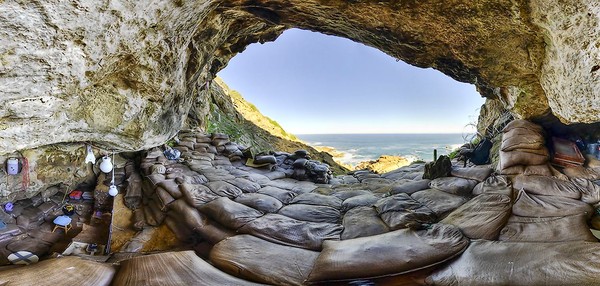
“In a tiny South African cave,” writes Amina Khan in the Los Angeles Times, “archaeologists have unearthed a 100,000-year-old art studio that contains tools for mixing powder from red and yellow rocks with animal fat and marrow to make vibrant paints as well as abalone shells full of dried-out red pigment, the oldest paint containers ever found. (Photo by Magnus Haaland / October 5, 2011)

“The discovery, described in [the 10/14/11] edition of the journal Science, suggests that humans may have been thinking symbolically — more like modern-day humans think — much earlier than previously recognized, experts said. Symbolic thinking could have been a key evolutionary step in the development of other quintessentially human abilities, such as language, art and complex ritual.

“The artifacts were uncovered at a well-studied site called the Blombos Cave, which sits by the edge of the Indian Ocean about 180 miles east of Cape Town. The two shells, lying about 6 inches from each other, had a red residue from a soft, grindable stone known as ochre. Ochre is rich in iron compounds that usually give it red or yellow hues, and it is known to have been used in ancient paints.”

It is lovely to think that the longing to be creative is something innate. Now we know that at least 100,000 years ago, people were experiencing that urge and acting on it.

Read more here.

Read Full Post »