Feeds:
Posts
Comments

Posts Tagged ‘audubon’

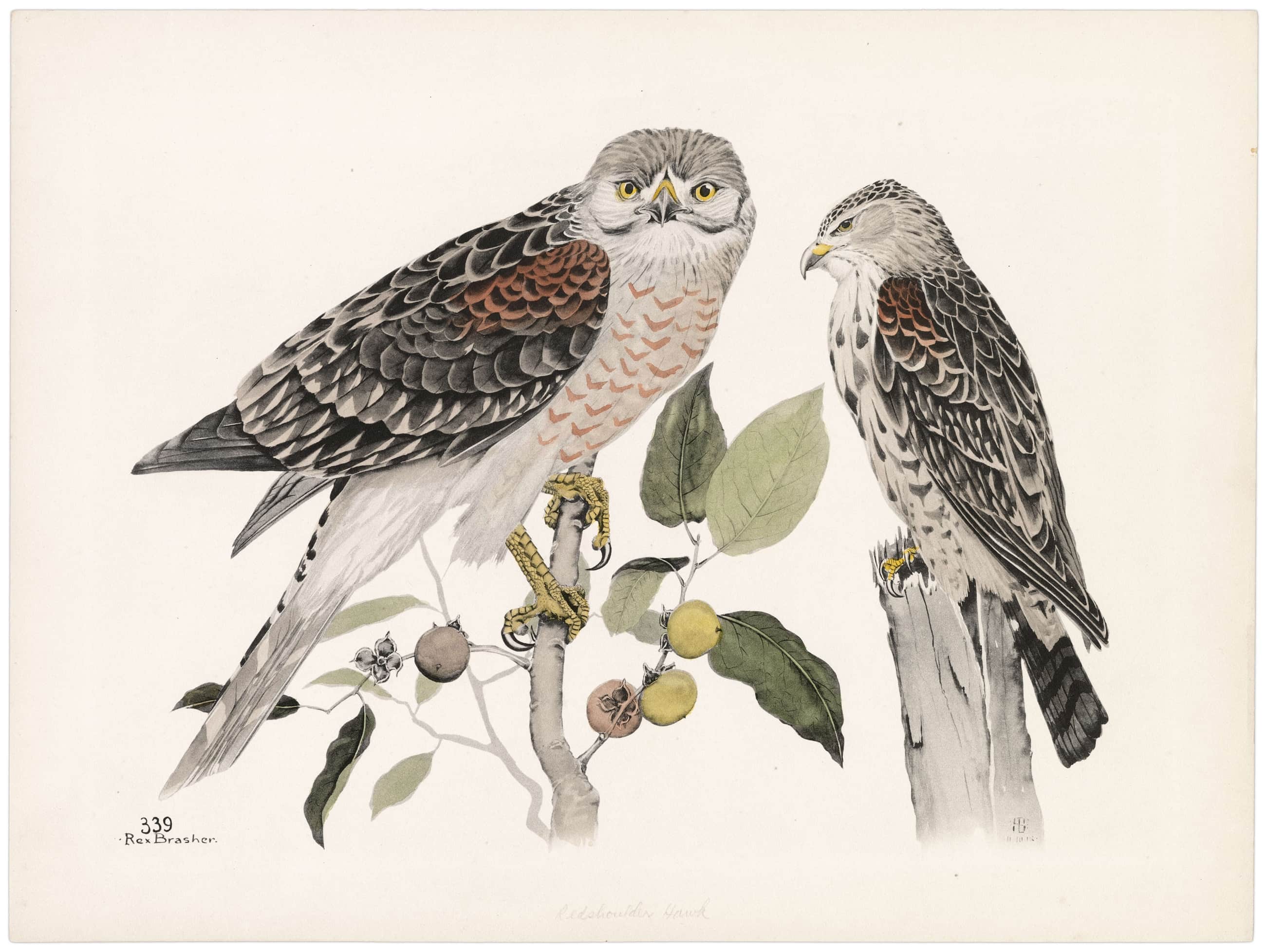
Art: Rex Brasher.
Rex Brasher painted more birds than Audubon — and never owned slaves.

With the more widespread understanding that bird painter John James Audubon owned slaves, controversy about honoring his name has erupted. Although for now the National Audubon Society is still the National Audubon Society, carrying on its otherwise great work, a small group called the Rex Brasher Association is advocating for more attention to another prolific bird painter of roughly the same period, Rex Brasher.

Philip Kennicott writes at the Washington Post, “On a gray day in March, Rex Brasher’s place looks a bit forlorn. The farmhouse is empty and the little shop made of cinder blocks feels derelict. But the leaders of the Rex Brasher Association who have gathered to show off the place see only possibilities for the 116-acre property.

“They want to place this wooded patch of the Taconic Range into conservancy, add modern studios for artist and naturalist residencies, refurbish the main house and cottage, and build a small museum inside the old shop. Two years after the death of the last Brasher relative to live on-site, they hope to resurrect the legacy and reputation of a man many people feel painted birds as well as or better than John James Audubon.

“Born in 1869, Brasher left an enormous body of paintings, almost 900 large-scale watercolors documenting American bird life and habitat, that became the source material for a monumental 12-volume compendium of hand-colored reproductions published as Birds & Trees of North America. He also made an unknown number of miscellaneous paintings and drawings, wrote a delightfully eccentric volume of philosophical reflections called Secrets of the Friendly Woods, and penned a hand-illustrated autobiographical account of his early forays, by sailboat, to document waterfowl from New England to Florida.

“Brasher was a retiring artist — a modest man who lived much of his life off the grid — which may be one reason he isn’t more famous. But his life’s project to document American birds, an effort to outdo Audubon that began in the 1890s and continued into the 1920s, was celebrated in its day, with an exhibition at the Explorers Hall of the National Geographic Society in 1938. Later, when he began hand-coloring more than 87,000 individual plates for publication, the project attracted subscriptions from collectors and patrons, as well as universities and libraries. Today, a complete set of his printed work can fetch more than $40,000. 

“He was praised by naturalists including John Burroughs (‘he is the greatest bird painter of all time’) and T. Gilbert Pearson, who helped found the organization that would ultimately become the National Audubon Society.

‘When you see a Brasher bird, you have seen the bird itself, lifelike and in a natural attitude.’

“But Brasher was very much a man of the 19th century, and despite periodic efforts to revive his work, his legacy — closely observed, naturalistic renderings of animal life — still suffers from having been out of step with the avant-garde and experimental art of the 20th century.

“That could change, however. The Connecticut State Museum of Natural History, which owns some 800 of the original watercolors, is planning to make them more accessible to the public with exhibitions in a new building, for which they will shortly begin fundraising. The efforts of the Rex Brasher Association, which has taken stewardship of the Upstate New York property near Kent, Conn., where Brasher lived until the mid 1940s, include digitizing and publicizing his work. And cultural changes, including a broader sense of what qualifies as fine art and a new urgency about the fragility of the natural world, may make people today more sympathetic to rediscovering his legacy.

“Brasher may also benefit from growing awareness that Audubon, to whom he was often compared, was a complicated, often odious figure, whose interest in birds grew out of a raw will to power more than any particular love of the species. Audubon was a formidable artist but also a ferocious antagonist within what Audubon scholar Gregory Nobles calls the ‘ornithological wars of the 1830s.’ He was also an enslaver and deeply contemptuous of the abolitionist movement in both the United States and the United Kingdom, where he spent considerable time preparing his landmark publication, The Birds of America, published between 1827 and 1838. The National Audubon Society is in turmoil today as local chapters drop the Audubon name and board members resign because the national leadership refuses to do so.

“Audubon studied birds in the wild before shooting them and then staging their carcasses in lifelike poses, a work process that has also aroused criticism even though it was standard practice for naturalists to kill animals they sought to collect and preserve. Those collections remain scientifically invaluable. …

“Audubon’s original paintings are a marvel, especially when seen up close. They are marvelously detailed and dramatic, and Audubon was particularly alert to the iridescent quality of feathers, which he reproduced with layers of silvery graphite over the pigments. But these images are also stagy and contrived, as if his birds are players on a stage, dramatically illuminated in the glow of gaslight. …

“Brasher sought a more naturalistic treatment, without Audubon’s operatic drama. Although he hunted and collected birds as a young man, he gave up that approach later, preferring close observation to specimen hunting. His paintings have a lightness and transparency wholly different from Audubon’s heightened atmosphere. He also had access to museums with extensive specimen collections and the published work of predecessors. He painted over 1,200 species of birds, far more than Audubon’s 497, but he was also building on the legacy of Audubon and others. …

“Between the early days of the artist-woodsman ornithologists and the death of Brasher a century and a half later, the science of ornithology spun off a vital and flourishing adjunct: birdwatching. Brasher might be considered the patron saint of that project. He was keenly interested in making accurate images of birds, but he was also interested in learning from birds. In Secrets of the Friendly Woods, he wrote about nature with a mix of genial animism and psychological insight. Nature was inexhaustible for him: ‘Forty years have not diminished the hope that each time afield I shall see something new, learn a novel habit of a bird or animal, and that expectation is seldom disappointed.’ …

“The difference between the artists’ work is like the difference between a grand aristocratic portrait and a psychologically nuanced character sketch. Audubon gets the dress and regalia right, and his birds project a powerful, self-fashioning sense of their own presence and importance. Brasher’s birds live contentedly in their own world and don’t need to perform or impress the viewer. If Brasher sometimes tends to moralize when he writes about birds, it isn’t Aesopian. The moral is almost always the same: We could learn a lot from birds.”

More at the Post, here.
Read Full Post »

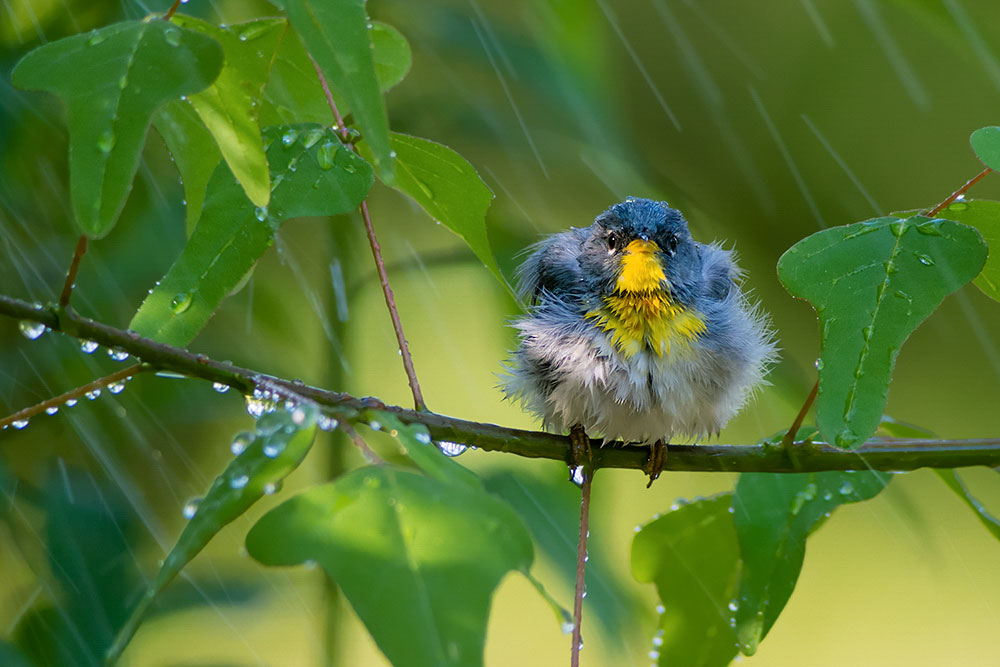
apa_2013_28408_227010_taratanaka_northern_parula_kk_0

Photo: Tara Tanaka/Audubon Photography Awards
A Northern Parula like this definitely qualifies for the affectionate label “birb.” In fact, in its fluffed-up form, it also fits the birb subcategory “floof.” (All in fun.)

You can discover some entertaining things on twitter, especially when someone you follow retweets an unusual item from someone else. I keep tabs on a lot of nature lovers, and that’s how I learned about birbs.

Asher Elbein writes at Audubon magazine that because birbs have been an internet meme for seven years (who knew?), “it’s high time we establish some ground rules. …

“For those not terminally online, birb is affectionate internet-speak for birds. The word began, as near as anyone can tell, when the absurdist Twitter account BirdsRightsActivist tweeted the single word ‘Birb’ out on November 2012. … The term is seemingly designed for the internet: one syllable, beginning and ending with ‘b,’ connoting a pleasant roundness, a warm mouth-feel. ‘What a good birb,’ you might say, or ‘I’m so glad we went birb-watching,’ or ‘I love Alfred Hitchcock’s The Birbs.’

“Birb is a slightly daffy word from the same school of internet absurdity that gave us LOLCats (‘I Can Haz Cheezburger’). … Yet unlike these online gags, or memes, birb functions as a category rather than a stock character. It is roughly akin to ‘doggo,’ or ‘snek,’ yet all dogs and snakes are contained within those words; birb remains amorphous. … Are some birds more birb-like than others? What is a birb, really?

“First, let’s consider the canonized usages. The subreddit r/birbs defines a birb as any bird that’s ‘being funny, cute, or silly in some way.’ Urban Dictionary has a more varied set of definitions, many of which allude to a generalized smallness. …

“What this question requires, therefore, are some basic operational rules.

“Rule 1: Birbs are often (though not conclusively) small. Adult Ostriches are thus disqualified, as is any bird larger than a turkey; warblers, sparrows, flycatchers, and other songbirds are the most likely demographic. Even large birds start small, however: An ostrich or crane chick is absolutely a birb. We may understand, then, that while ‘birb’ can be a developmental stage, some birds are birbs their whole lives.

“Rule 2: Birbs are often (though not always) round. People tend to regard round animals as cuter, and round objects in general to be more pleasant. … Classic songbirds and rotund groundbirds like grouse and ptarmigans have the advantage: They look like little balls of fluff, an important component for birbness. … If the Pileated Woodpecker didn’t lose its birb status under Rule 1, it does now, though smaller and rounder woodpeckers like the Downy or Red-bellied are most certainly birbs.

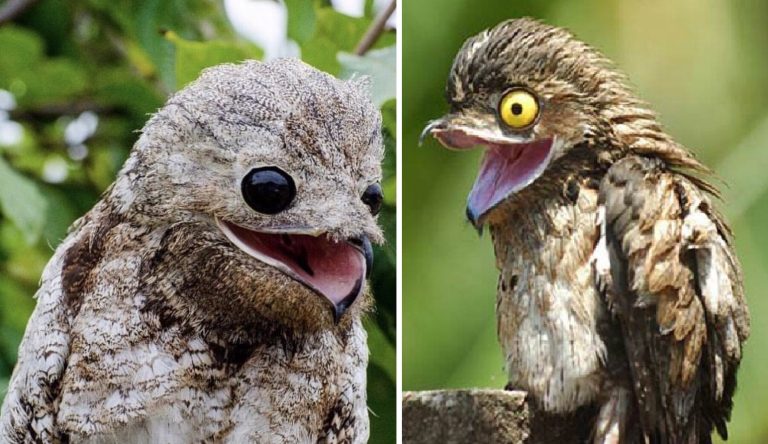
“Rule 3: Birbs appear cute. This gets into slightly dicier territory: Isn’t cuteness subjective? Up to a point, but Rule 2 helps here. Humans tend to like looking at round and fluffy things. So much so, in fact, that violent or unseemly behavior doesn’t disqualify a bird from birbness: the aggression of hummingbirds, the Vlad-the-impaler antics of shrikes, brood parasitism of cuckoos, and brain-eating of Great Tits are immaterial to their round fluffiness. You could post a picture of any of these on reddit under ‘murder birb’ and nobody would blink. … Silliness and absurdity also come into play: The potoo bird is large and not particularly fluffy, but its general muppety appearance makes it a contender for the title. …

“The following can be unquestionably judged as birbs, hitting the natural sweet spot of round, fluffy, and small: The vast majority of songbirds. Burrowing Owls, Elf Owls, both screech-owls, American Kestrels, and other small raptors also qualify. So do prairie chickens, quail, shorebirds like sandpipers, and smaller seabirds like puffins and penguins. … Little waders like the Green Heron are in, but the Great Blue Heron? Sorry, not a birb.

“Big raptors, while incredible and fascinating creatures, are not birbs. … Most cranes, herons, and storks are too large and lanky. And then you get to birds like the Cassowary, which is perhaps the least birb-like bird on the planet. Its chicks may qualify as birbs (see Rule 1), but the adults most definitely do not.

“Now, one might reasonably ask why it matters which birds qualify as birbs. Strictly speaking, of course, it doesn’t. But viewed sidelong, it becomes a taxonomic game, akin to ‘is a hot dog a sandwich?’ ”

Which, you have to admit, is one of the more urgent questions of our time.

More at Audubon, here. There is no way I would ever have heard about birbs were it not for twitter.

Photo: Honest to Paws
The Muppet-like goofiness of the Great Potoo allows it to qualify as a birb.

the-great-potoo-and-the-common-potoo-768x444-1

Read Full Post »

Recently, my husband pointed out an amazing story in the Audubon magazine about birds that were extinct in Central Europe. Today they are being reintroduced and learning where to fly by following a human-powered light aircraft.

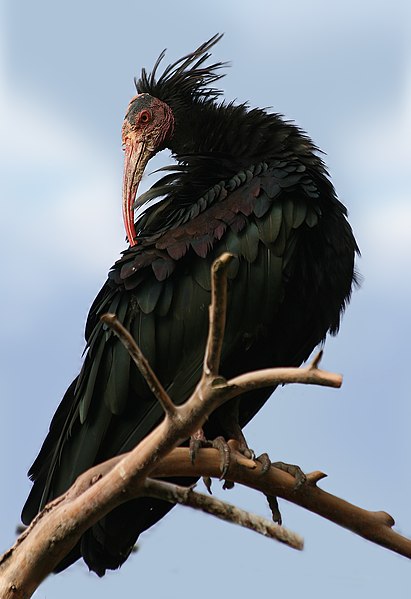
Esther Horvath wrote, “Anne-Gabriela Schmalstieg and Corinna Esterer aren’t your typical foster mothers. For starters, the youngsters they care for aren’t humans — they’re captive-bred Northern Bald Ibises, a species that went extinct in Central Europe more than three centuries ago.

“For six months each year the two 20-somethings dedicate their lives to the birds, living onsite in campers at the Schönbrunn Zoo in Vienna, Austria, and looking after the ibises from sunrise to sunset seven days a week. The entire first month the women must abstain from coffee, alcohol, and cigarettes because they have to spit in the birds’ food to make it easier to digest. The chicks eat as many as 15 times a day, dining on a mash of rat, mouse, and chicken, as well as fresh grasshoppers.

“When the ibises aren’t eating or resting, the foster moms spend as much time as possible bonding with them. …

“From day one, they call over and over: ‘Komm, komm, Waldies, komm, komm’ (‘Come, come, ibis, come, come’). When the chicks are three months old, their caretakers move them from the zoo to an aviary in Seekirchen, where they slowly become accustomed to a microlight aircraft and learn to follow it during training exercises, the women calling all the while. …

“The birds journey between the same breeding grounds their ancestors did centuries ago and a suitable overwintering site. Unlike back then, humans now watch them every flap of the way thanks to GPS tags attached to each bird. (To follow their annual trek, download the Animal Tracker app.)

‘For us it is very emotional,’ Schmalstieg says. ‘The birds follow the aircraft because we are sitting in it.’

If you get the Audubon magazine, you can see the actual craft with the birds following it high in the air. Read the online version here.

Photo: Wikimedia
Adult Northern Bald Ibis

Read Full Post »

I asked around whether any local nonprofits were providing a service opportunity in honor of Martin Luther King Jr. on the Monday holiday. Here is what I learned.

Rhode Island

The Rhode Island Black Heritage Society told me it published a 12-page booklet to honor Dr. Martin Luther King, Jr and celebrate the 50th Anniversary of the Selma-to-Montgomery March. The Dr. King Booklet is free. Postage is $3 for one booklet or $4 for two or more copies.  To have one mailed, send a $3 check to RIBHS at 123 North Main Street, Providence, RI 02903 or call 401-421-0606.

“Let Freedom Ring: 50 Years Later …” Woonsocket, RI. Memorial Service, King Memorial Sculpture Garden, South Main Street, across from St. James Baptist Church, 10 a.m., January 19, 2015. Youth Service Learning Project, St. James Baptist Church, 340 South Main St., 11 a.m.-2 p.m. Participants will help collect basic-needs items and snack food for the homeless. Contact nofokansi@neighborworksbrv.org or call 762-0993, ext. 234.

Providence College MLK Jr. Day of Service (2nd annual). Open Mic Night and Potluck, PC/Smith Hill Annex, 231 Douglas Ave., Providence. 2-5:30 p.m. Click here for info.

Special programs are being held to celebrate Martin Luther King Day at Audubon’s Environmental Education Center in Bristol, January 19, 10 – 2. Click here to volunteer to do crafts with children on Monday.

RI School of Design (RISD) has planned MLK Jr. events in Providence. Day of Service, Martin Luther King Jr. Elementary School, 35 Camp St., RISD and the Mt. Hope Learning Center partner to celebrate King’s teaching by inspiring children to reach their full potential through the arts, crafts and special activities. 8:30 a.m.-2:30 p.m. Click here for details.

Greater Boston

I also wanted to check on what Kids4Peace Boston was doing because I know they are into service. Youth from the interfaith organization are volunteering on MLK Jr. Day at Solutions at Work. Matt says, “Approximately 12 of our teens will be helping to revitalize the space at Solutions at Work, which works to end homelessness in the Boston area.” Click here for some of the nonprofit’s other MLK Jr. service options.

Next year I hope to reach more nonprofits to give them — and the idea of a service day — publicity.

Photo: http://commons.wikimedia.org/wiki
Martin Luther King Jr., Washington DC

Read Full Post »

Years pass, and I forget how delightful Drumlin Farm is and how close. The Audubon Shop there is also a wonder. You find things in the shop that you don’t find anywhere else. All nature related.

It must have been years since I visited, because it looks like the “new” entrance and parking lot have been there a long time.

It’s a good place to go on a day that feels like summer.

Read Full Post »