Feeds:
Posts
Comments

Posts Tagged ‘austin’

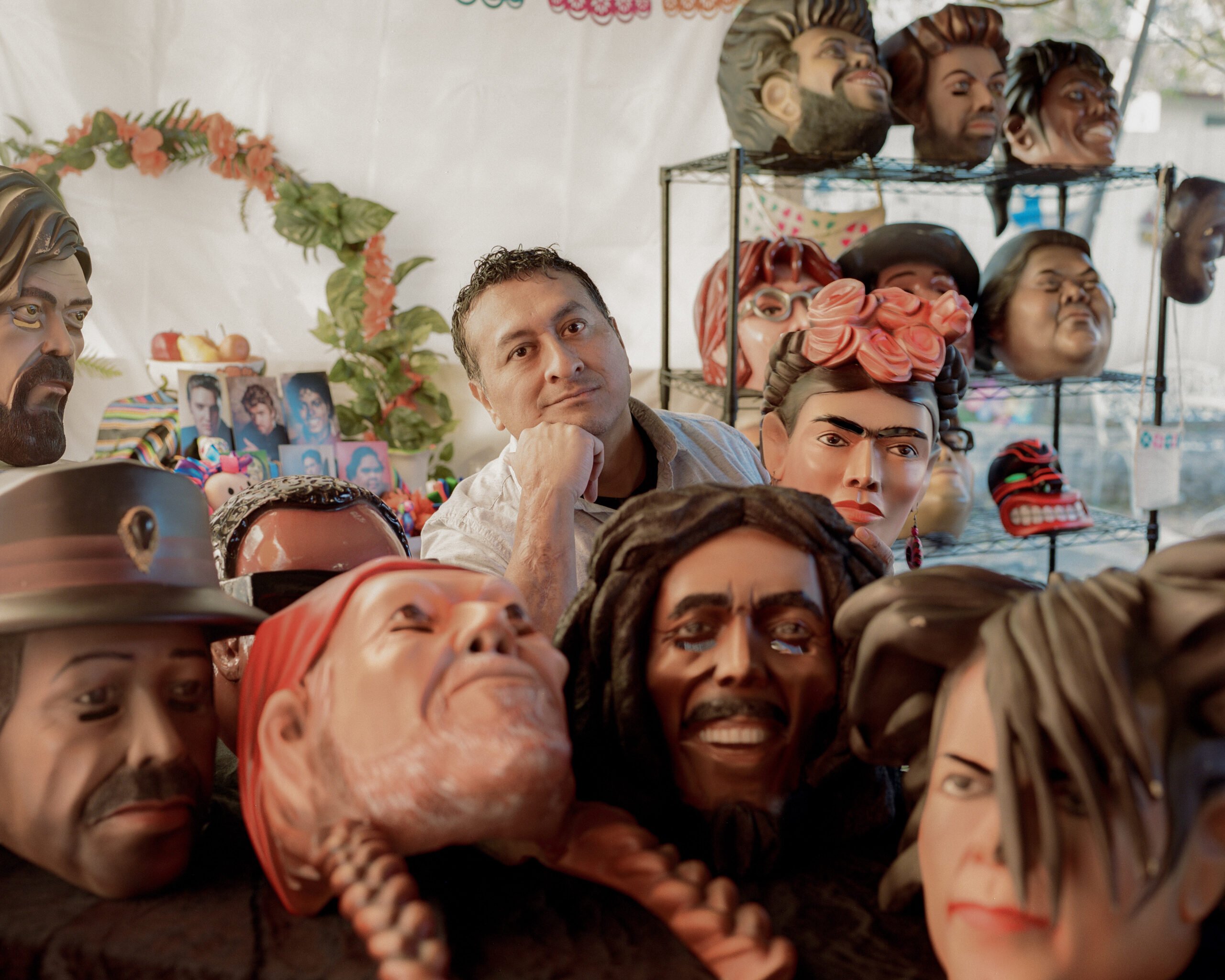
Photo: Harmon Li for the Texas Observer.
Austin’s Willy Baltazar is a man of many masks. From Veracruz to Texas, he keeps a centuries-old tradition alive.

I’m back from California and doing my best to adjust to the time change and life in the East. Having enjoyed the influence of Mexico for the past few days — especially the great Mexican food — I thought I would take a look at a beautiful Mexican art.

Barbara Campos writes at the Texas Observer, “On the back porch of his Southeast Austin home, Willy Baltazar displays a vibrant Día de los Muertos-style altar that honors more than just ancestors.

“Lined up are portraits of legends who have shaped Mexican culture and beyond: Vicente Fernández, Paquita la del Barrio, Frida Kahlo, Bob Marley, and Michael Jackson. Each icon is paired with a matching hand-carved wooden mask laid nearby — a living extension of Xantoloa centuries-old spiritual festival from Veracruz’s La Huasteca region in coastal Mexico.

“This pop culture mash-up serves as a bridge between his Austin life and the native custom that still defines him.

“Baltazar was raised in Tantoyuca, Veracruz, known as the Pearl of the Huastecas, an area famous for preserving Nahua heritage and a main keeper of Xantolo. The three-day sacred festivity — with the liveliness of a carnival — starts in late October and blends Huastec rituals with Catholic practices to honor the dead. During what’s widely regarded as the region’s own version of Día de los Muertos, every home sets up an altar adorned with cempasúchil [marigold flowers], veladoras de santos [saint-etched candles], and ofrendas [food offerings]. The streets fill with the smell of incense and the sounds of  string instruments. Dancers in ceremonial masks parade through Tantoyuca to guide lost loved ones back to the world of the living.

“ ‘It’s not something you miss,’ Baltazar proudly recounts. ‘It completely transforms the town and runs through our blood.’

“Baltazar vividly remembers cuadrillas [dancing troupes] parading in brightly colored costumes with masks looming large as they moved rhythmically through every neighborhood. He was always captivated by la embarazada [the pregnant woman], el diablo [the devil], and el vaquero [the cowboy]. The three symbolic figures represent the fundamental cycle of human existence: birth, mortality, and the enduring human spirit. Troupe members embody this essence while maintaining a vow of anonymity. ‘You must never know who is behind the mask,’ Baltazar warns. 

“At the festival’s close, the entire town makes its way to the cemetery, where dancers honor those who have performed before them and undergo the destape, a public unmasking that reveals their identity.

“Children are encouraged to join the cuadrillas as early as age 3. Baltazar dreamed of participating, or at least owning a mask, but the elaborate costume regalia was beyond what his family could afford. Instead, he watched from the sidelines and promised himself that one day he’d be a part of it. When Baltazar moved to Texas more than 20 years ago, his priority shifted to starting a family and finding his footing in a city where he didn’t yet speak the language.

“Meanwhile, in Veracruz, rehearsals start as soon as the festival ends and continue year-round. Joining a cuadrilla comes with a seven-year cycle of mandatory dancing during Xantolo — otherwise attracting bad luck. Unable to commit to that rhythm from afar, he returned each October as an observer. ‘I felt like I was looking in from the outside,’ he recalls.

“That outsider’s view transformed in 2021. Determined to weave his Mexican customs with Austin’s cultural scene, he placed his first order of masks with an artisan in Veracruz. The two figures were not conventional subjects: Freddie Mercury and John Lennon, his two musical icons and the ultimate bridge to his heritage. …

“A mask can be made in a day, but high demand delayed the process for weeks. Baltazar drove 13 hours to his hometown to pick them up once they were ready — a 700-mile journey that was a turning point in his life. 

“Holding the finished creations, he realized he could keep expanding his collection beyond traditional designs. For a long time, he wasn’t sure if they would become an exhibition, a personal display, or something else entirely. Regardless, he collected them. Since, he’s picked them up in batches of five to 10 — now holding more than 70 pieces depicting Prince, Marilyn Monroe, Ray Charles, and Elvis Presley.

“Between trips, Baltazar calls his car a ‘mobile gallery.’ As a full-time Uber driver, he keeps a few masks displayed. ‘It always starts a conversation,’ he says. …

“Riders often take photos with the pieces, impressed by the lifelike detail, and have started requesting personalized ones of their loved ones who’ve passed away. ‘It’s like the tradition is adapting. Maybe they don’t know much about Xantolo, but honoring our ancestors is universal,’ he says. 

“The constant travel eventually led to investing in a dedicated van for his three to four annual trips. ‘Flying out would be easier, but they’re too fragile and I can’t risk them getting damaged in cargo,’ he notes. ‘It’s a sacrifice, but this is part of the preservation.’ ”

More at the Texas Observer, here.

Read Full Post »

Here’s a recent story about how fungi, of all things, may be affecting global warming.

From ScienceDaily: “Microscopic fungi that live in plants’ roots play a major role in the storage and release of carbon from the soil into the atmosphere, according to a University of Texas at Austin researcher and his colleagues at Boston University and the Smithsonian Tropical Research Institute. The role of these fungi is currently unaccounted for in global climate models. Some types of symbiotic fungi can lead to 70 percent more carbon stored in the soil.

” ‘Natural fluxes of carbon between the land and atmosphere are enormous and play a crucial role in regulating the concentration of carbon dioxide in the atmosphere and, in turn, Earth’s climate,’ said Colin Averill, lead author on the study and graduate student in the College of Natural Sciences at UT Austin. …

“Soil contains more carbon than both the atmosphere and vegetation combined, so predictions about future climate depend on a solid understanding of how carbon cycles between the land and air.

“Plants remove carbon from the atmosphere during photosynthesis in the form of carbon dioxide. Eventually the plant dies, sheds leaves, or loses a branch or two, and that carbon is added to the soil. The carbon remains locked away in the soil until the remains of the plant decompose, when soil-dwelling microbes feast on the dead plant matter and other organic detritus. That releases carbon back into the air. …

“Where plants partner with [ecto- and ericoid mycorrhizal] (EEM) fungi, the soil contains 70 percent more carbon per unit of nitrogen than in locales where [other] fungi are the norm. The EEM fungi allow the plants to compete with the microbes for available nitrogen, thus

reducing the amount of decomposition and lowering the amount of carbon released back into the atmosphere.

More.

Photo: Colin Averill
The fruiting body of a fungus associated with the roots of a Hemlock tree in Harvard Forest.

h

Read Full Post »

Here’s a good one from the radio show Living on Earth (LOE).

“At Huston-Tillotson University in Austin, Texas, an environmental science professor teaches sustainability by example, transforming an empty dumpster into a tiny apartment where he’s lived for a year. Professor Jeff Wilson tells [LOE] host Steve Curwood about life in his micro home and his long-term goals for Project Dumpster.

CURWOOD: “Dr. Jeff Wilson, aka Professor Dumpster, is teaching sustainability by downsizing his living quarters to the dimensions of a dumpster – a clean dumpster, mind you. Jeff Wilson joins me now from his steel abode on the campus of Huston-Tillotson University in Austin, Texas, where he’s Dean of the University College and teaches environmental science. Welcome to Living on Earth, Jeff, or, do you prefer, ‘Professor Dumpster?’

WILSON: “I’ll take Professor Dumpster and you’re at my disposal.

CURWOOD: [LAUGHS] “Right now you’re in your dumpster. What kind of headroom do you have?

WILSON: “Well, it’s a standard 10 cubic yard dumpster, which means it’s six foot by six foot at the base. And this one’s actually quite tall; it’s about seven feet…. I’ve got a wooden false floor, so the actual height of standing room is about 6’2” right now. I’ve got a window unit air conditioner. I have a few tapestries hanging on the wall. I have a twin bed and then a very small bookshelf on the corner with various things like an Oscar the Grouch mug …

“The main point of this entire experiment is to test if one can have a pretty good life on a whole lot less. … A lot of people asked why we used a dumpster instead of a tiny house or instead of even a container, and the reason we did that were some of the awareness and educational aspects of this project around addressing waste. And dumpsters, you know, are these magical boxes that we put our waste into and come back a few days later … and everything’s disappeared. So we want to highlight some of those subjects as well. …

“One of the things we’re interested in is the increased interactions with the community and the environment when you’re in a smaller home like this, sort of what that might do for one’s sort of quality-of-life and sense of experience and just the overall magic that is brought into the everyday. If you want to call it dumpster magic.”

Find the rest of the interview transcript, plus the audio version and pictures, here.

Photo: Jeff Wilson
Egress from the the professor’s dumpster home can be challenging. 

Read Full Post »

I took modern dance in high school. The teacher was said to have studied with Isadora Duncan, and she certainly liked that flowing kind of movement.

Miss Hinney once challenged us to choreograph a dance about an abstract topic. Page and I chose Lavoisier’s discovery of oxygen, for which we used music from the Firebird Suite. We were not allowed to act it out as if we were Lavoisier, rather we had to interpret the chemical reaction using dance. It was impossible, so we were naturally very proud when we pulled it off.

Since then I have felt a great respect for the inventiveness of choreographers.

Here is one who sounds pretty cool. Allison Orr has closely observed garbage men in Austin, Texas, and has made their movements into a dance. More recently she worked with employees of the power company.

Robert Faires at the Austin Chronicle describes “The Trash Project, her award-winning, phenomenally popular collaboration with the city’s Solid Waste Services Department (now Resource Recovery) that made dancers of sanitation workers and the machines they operate. … Now, the Forklift Danceworks artistic director is at it again, albeit with a different city department, Austin Energy, whose employees are the focus for PowerUP. …

“For Orr, who’s made a career of making dances from the movements of people who aren’t trained in the art form – firefighters, gondoliers, roller skaters, orchestra conductors, Elvis impersonators, traffic cops, et al. – the personal stories of her subjects have become as important as their moves. She talks at length to the people with whom she collaborates on a dance and weaves recorded excerpts from interviews into the performance as the subjects are moving,” The latest Production, PowerUP was performed in September at the Travis County Exposition Center. More.

Photo: John Anderson
Power company choreography.

Read Full Post »

It was good to have a little lawn when Suzanne and John were kids, but we gave up the hassle after they grew up. In place of a lawn we have a lovely ground cover called vinca. In spring the yard is entirely purple.

On the East Coast as fall approaches, many homeowners are thinking about taking advantage of cooler weather to rev up their lawns. But in the Southwest there’s a concerted effort to move away from the green carpet.

Ian Lovett writes at the NY Times that since 2009, Los Angeles “has paid $1.4 million to homeowners willing to rip out their front lawns and plant less thirsty landscaping.

“At least the lawns are still legal [there]. Grass front yards are banned at new developments in Las Vegas, where even the grass medians on the Strip have been replaced with synthetic turf.

“In Austin, Tex., lawns are allowed; watering them, however, is not — at least not before sunset. Police units cruise through middle-class neighborhoods hunting for sprinklers running in daylight and issuing $475 fines to their owners.”

In Las Vegas “in the last decade, 9.2 billion gallons of water have been saved through turf removal, and water use in Southern Nevada has been cut by a third, even as the population has continued to grow. …

“The idea that extensive grass lawns are wasteful has now taken hold with many people in this region, especially the young and environmentally conscious.

“And municipalities, hoping [the] savings can be expanded, have tried to entice more residents to dig up their lawns by offering more money. Last month, Los Angeles raised its rebate to $2 from $1.50 a square foot of grass removed. Long Beach now offers $3 a square foot.” Read more here.

Photos: Monica Almeida/The New York Times
Top, Flowering artichoke plants in Mitch and Leslie Aiken’s drought-tolerant yard in Pasadena, Calif. Below, the couple survey the effect of desert plantings.

Read Full Post »