Feeds:
Posts
Comments

Posts Tagged ‘banned’

Photo: Rukhshana Media.
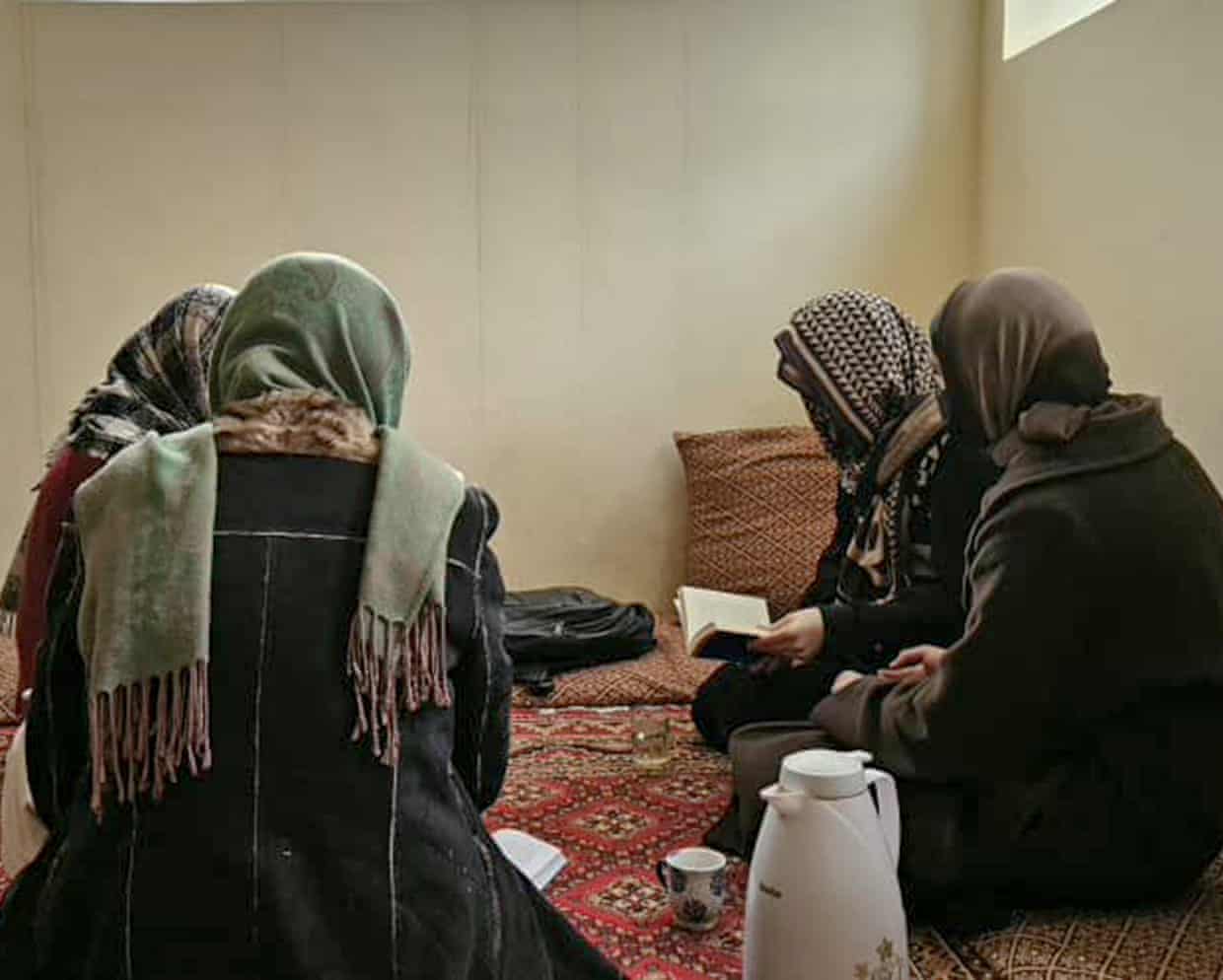
Every Thursday, five friends come together – one over the phone – to discuss what they’ve been reading. They call their group “women with books and imagination.” Such determination offers hope for Afghanistan. After all, as one of the group says, “If a woman is aware, a family is aware.”

When we were young, it was not unusual to be so enthralled by a book that we would read it with a flashlight at night under the covers, knowing that we could get in trouble. But trouble was never going to be anything much worse than a scolding.

Not so for women in Afghanistan whose reading of forbidden texts is against the law and whose rebellion could ultimately lead to death.

Azada Raha, from Rukhshana Media, reports at the Guardian, “Four young women sit together, waiting for the phone to ring. When the call finally comes, their friend’s voice is crackly and hard to make out, but they wait patiently for the signal to improve so they can start discussing their chosen book.

“Every Thursday, the five friends come together away from the disapproving gaze of the Taliban for a reading circle. They read not for entertainment but, as they put it, to understand life and the world around them. They call their group ‘women with books and imagination.’

“Most of the women in the group meet in person, but Parwana [their names have been changed here], 21, lives in a different district so has to join by phone. She was still a child when the Taliban pulled girls out of education, so didn’t get to finish school. Now, she says, her entire week revolves around books.

“ ‘When they banned us from attending school, I lost all hope. My mother encouraged me, but I knew things wouldn’t improve,’ she says. ‘I decided to do something myself.’ …

“This week, Parwana is leading a discussion on The Year of Turmoil, a novel by the Iranian writer Abbas Maroufi about a young woman named Noushafarin who finds herself trapped in an oppressive marriage. Set against the backdrop of turmoil in mid-20th-century Iran, its themes of repression, faith and patriarchal power resonate strongly with the women. …

“ ‘She represents women who have suffered, who have remained trapped, and who are oppressed by family and society in today’s Afghanistan,’ says Parwana of the character. ‘From the very beginning, I identified with her; it was painful, very painful.’

“Most of the books the five women have discussed since they started the reading circle last June are classics, and most deal with issues of power, suffering, and the place of women. … The works they’ve read include George Orwell’s Animal Farm, Ernest Hemingway’s The Old Man and the Sea, Zoya Pirzad’s I Will Turn Off the Lights and Symphony of the Dead, also by Abbas Maroufi.

“Most of the books can be found online and downloaded free, although occasionally they borrow books from libraries.

“They meet every week for an hour-and-a-half at the home of one of the members, varying the location to avoid scrutiny in a country where women’s freedoms have been severely curtailed.

“Parwana sometimes has to climb a hill to get a strong enough internet connection on her phone to download the book they are reading. But it’s worth it, she says, and she has the support of her elder brother, who has told her to keep at it. … ‘The excitement I feel for these sessions is indescribable,’ she says. …

“ ‘Reading has always been an integral part of my life,’ says the group’s coordinator Darya, 25, who was in her third year of a language and literature degree when the Taliban closed universities to women. ‘When I read, I feel as if I’m in another world – the characters, the places, nature. Sometimes I cry with the story, sometimes I laugh. But always, books have given color to my life.’

“Darya says The Year of Turmoil had a particularly strong impact on her. ‘This novel narrates years full of pressure and restriction. … Her situation mirrors the lives of people in today’s Afghanistan – people grappling with educational restrictions, social repression and political pressure. Like the characters in the novel, we keep hope alive through resistance and learning.’

“Roya, another member, explains the purpose of the circle this way: ‘Most women who accept oppression do so because they are unaware of their rights. The books we read are about suffering, choice and standing up to force – things we ourselves live with every day.’

“Morwarid, 22, says many women in Afghanistan resemble Noushafarin, who she sees as ‘trapped between tradition, religious power and social judgment.’

“ ‘She transforms from a silent woman into an aware human being. Her fate shows that, in such an environment, the very desire to choose is a form of resistance,’ says Morwarid, who won a place at Balkh University in northern Afghanistan to study law and political science, but wasn’t able to take it up before the ban was introduced.

“ ‘The very night I was supposed to leave for Balkh, universities were closed to women,’ she says. ‘I cried until morning. Life became dark for me. Through reading and this group, I gradually emerged from that nightmare. … The Taliban fear aware women. To confront the Taliban, one must become aware and grow – all together,’ she says.”

More at the Guardian, here.
Read Full Post »

Photo: Kolya Kuprich
Outlawed Belarus Free Theatre has been successfully performing
A School for Fools and other plays despite the pandemic. It took some ingenuity, but they have plenty of that.

What kind of theater could handle a pandemic better than one that is of necessity always underground? If you’re fighting an authoritarian regime, you will continually find ways it doesn’t know about for getting your work out into the world — or you’ll go to prison.

Verity Healey writes at HowlRound,* “If any theatre company is going to feel at home during COVID-19 and the challenges the pandemic has brought to theatres worldwide, it is going to be Belarus Free Theatre (BFT), an outlawed company based in Belarus and the UK (its artistic directors Natalia Kaliada and Nicolai Khalezin, in fear of their lives, had to seek asylum in Britain in 2011).

In Belarus, where dictator President Lukashenko faces national elections in August — and is busy arresting citizens attending opposition rallies — the BFT ensemble is banned from performing and from registering as a theatre company because it produces democracy-promoting plays and global campaigns advancing human rights.

“Working out of a small garage in a secret location in Minsk, the country’s capital city, BFT is ineligible to apply for national funding, and ensemble members, continuing to perform illegally and underground, face the very real and constant threat of being arrested by the KGB. …

“On top of this, Lukashenko is a COVID-19 denier and has advised his citizens to drive tractors, go to the sauna, and drink vodka to prevent infection. Whilst he has not imposed a lockdown, he is using the virus as an excuse to ban protests of any kind (prescient in the run-up to the elections) and arrest anyone who raises a voice in opposition. This means that, in Minsk, BFT, in tandem with their colleagues in the UK, have voluntarily gone into self-isolation to protect themselves and their families whilst creating work from their living quarters — turning their homes, quite literally, into performance spaces.

“ ‘I get to spend twenty-four hours a day with the people I love, otherwise the lockdown is no different for me,’ says Khalezin.

“It will not come as a surprise then that, since late February, the company has premiered two full-length plays, facilitated and broadcast several online fairy tales with renowned artists such as Stephen Fry, Juliet Stevenson, Will Attenborough, and Sam West for their campaign #LoveOverVirus, and made all of their previous shows accessible for free on YouTube. …

“It’s their latest show, though, A School for Fools (ASFF), which is streaming live online, that has recently made the headlines. Adapted from Sasha Sokolov’s 1960s phantasmagoric modernist novel of the same name … the story charts the experiences of a young boy living with a dual personality disorder attending an oppressive school, a kind of place that used to exist in Eastern Europe (and still does in Kazakhstan). …

“Starring twelve of BFT’s ensemble members, all living in Minsk, in twelve locations (the actors’ mostly small Soviet-style [flats]), and with sixteen different camera setups hosted by Zoom, it is a feat of technical wizardry imagined by [director Pavel] Haradnitski’s artistic vision and Sveta Sugako’s broadcasting direction. …

“Haradnitski calls the need to do ASFF ‘a desire to act, because even in two months, actors can lose their skills.’ Previous conversations had with Haradnitski, Sugako, and Nadia Brodskaya, the producer for ASFF, have also revealed to me that for everyone in the ensemble BFT is a way of life, 24/7. …

“ASFF is not just an ideological road map out of the pandemic — i.e., using technology and social media platforms in new ways to bring live drama to people at home via laptops and devices. It is also a way of doing theatre that, as Khalezin says, we may have to return to more and more if the world faces other pandemics. …

“Zoom is not custom-made to handle large-scale live performances—it was invented purely for business meetings and conferences and it lacks the interfaces custom-made platforms might have (there are ones being developed especially for BFT, but they were not ready in time for the pandemic). ..

“One of Sugako’s and Haradnitski’s main difficulties, for example, was working out how to let the actors know what marks to hit, especially when it was required for actors to make it look like they were physically interacting with each other. In the end, Sugako had to use a webcam, pointed at her Zoom host interface, which allowed her to share her screen with the actors so they could see they were in the right place to make it look like they were connecting across frames.

“The other issue is Zoom’s propensity to kick people off the platform if their internet connection drops — which anyone who has ever been to Belarus will know is a common occurrence. And to make things more complicated, Sugako had to line up the sixteen devices — laptops, phones — in a particular order for actors to hit their cues. If they get out of sync, the whole show is scrambled.” Read how they handled that difficulty and others at Howlround,* here.

By the way, John has been to Belarus. Maybe he will confirm that the internet connections often get dropped.

* The staff of HowlRound Theatre Commons at Emerson College wish to respectfully acknowledge that our offices are situated on land stolen from its original holders, the Massachuset and Wampanoag people. We wish to pay our respects to their people past, present, and future.

Read Full Post »

image

Photos: Lebrecht Music & Arts / Alamy Stock; Getty/whitemay
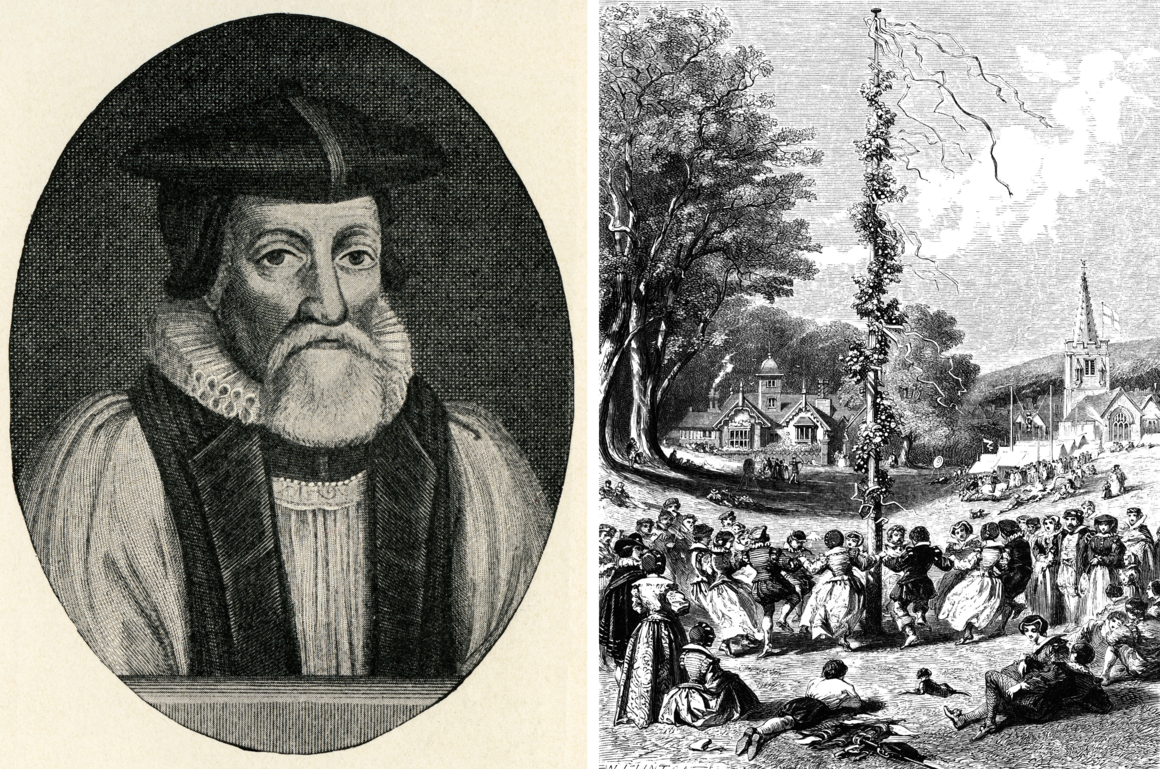
Unlike the Puritans he lived among, Thomas Morton loved nature, local tribes, and pagan traditions like dancing around the maypole. The Puritans banned a book book he wrote — the first banned book in America. 

Today we joke about Boston and its “Banned in Boston” moniker. We criticize other communities that ban books they believe threaten local morals. People have always tried to address threats they believe are posed by certain ideas. Even now we argue about the best way to keep fake news off social media. But who is to decide? I hope we don’t think government officials — whether they’re currently the ones we voted for or not —  are capable of deciding.

Let’s take a look at an old controversy over America’s first banned book.

Matthew Taub writes at Atlas Obscura, “Apparently, Thomas Morton didn’t get the memo. The English businessman arrived in Massachusetts in 1624 with the Puritans, but he wasn’t exactly on board with the strict, insular, and pious society they had hoped to build for themselves.

“ ‘He was very much a dandy and a playboy,’ says William Heath, a retired professor from Mount Saint Mary’s University who has published extensively on the Puritans. …

“Within just a few short years, Morton established his own unrecognized offshoot of the Plymouth Colony, in what is now the town of Quincy, Massachusetts (the birthplace of presidents John Adams and John Quincy Adams). He revived forbidden old-world customs, faced off with a Puritan militia determined to quash his pagan festivals, and wound up in exile.

“He eventually sued and, like any savvy rabble-rouser should, got a book deal out of the whole affair. Published in 1637, his New English Canaan mounted a harsh and heretical critique of Puritan customs and power structures that went far beyond what most New English settlers could accept. So they banned it — making it likely the first book explicitly banned in what is now the United States. …

“The Puritans’ move across the ‘pond’ was motivated by both religion and commerce, but Morton was there only for the latter reason, as one of the owners of the Wollaston Company. He loved what he saw of his new surroundings, later writing that Massachusetts was the ‘masterpiece of nature.’ His business partner — slave-owning Richard Wollaston — moved south to Virginia to expand the company’s business, but Morton was already deeply attached to the land. …

‘He was extremely responsive to the natural world and had very friendly relations with the Indians,’ says Heath, while ‘the Puritans took the opposite stance: that the natural world was a howling wilderness, and the Indians were wild men that needed to be suppressed.’

“After Wollaston left, Morton enlisted the help of some brave recruits — both English and Native — to establish the breakoff settlement of Ma-Re Mount, also known as Merrymount. …

“The Puritan authorities didn’t see Merrymount as a free-wheeling annoyance; they saw an existential threat. The problem wasn’t only that Morton was taking goods and commerce away from Plymouth, but that he was giving that business to the Native Americans, including trading guns to the Algonquins.

“With Plymouth’s monopoly dissolved and its perceived enemies armed, Morton had perhaps done more than anyone else to undermine the Puritan project in Massachusetts. Worse yet, in the words of Plymouth’s governor William Bradford, Morton condoned ‘dancing and frisking together’ with the Native Americans . … Governor Bradford nicknamed Morton the ‘Lord of Misrule.’

“There could be no greater symbol of such misrule than Morton’s maypole. … Throughout medieval Europe, maypoles had been a popular installation for May Day (or Pentecost or midsummer, in some regions) — encouraging human fertility as the land itself sprung up from winter. Now that was a tradition that Morton could get behind, and he gladly called upon the residents of Merrymount to drink, dance, and frolic around the pole. The establishment of Merrymount had been a provocation, but Morton’s May Day celebrations meant war.”

What happened next? Find out at Atlas Obscura, here.

Read Full Post »