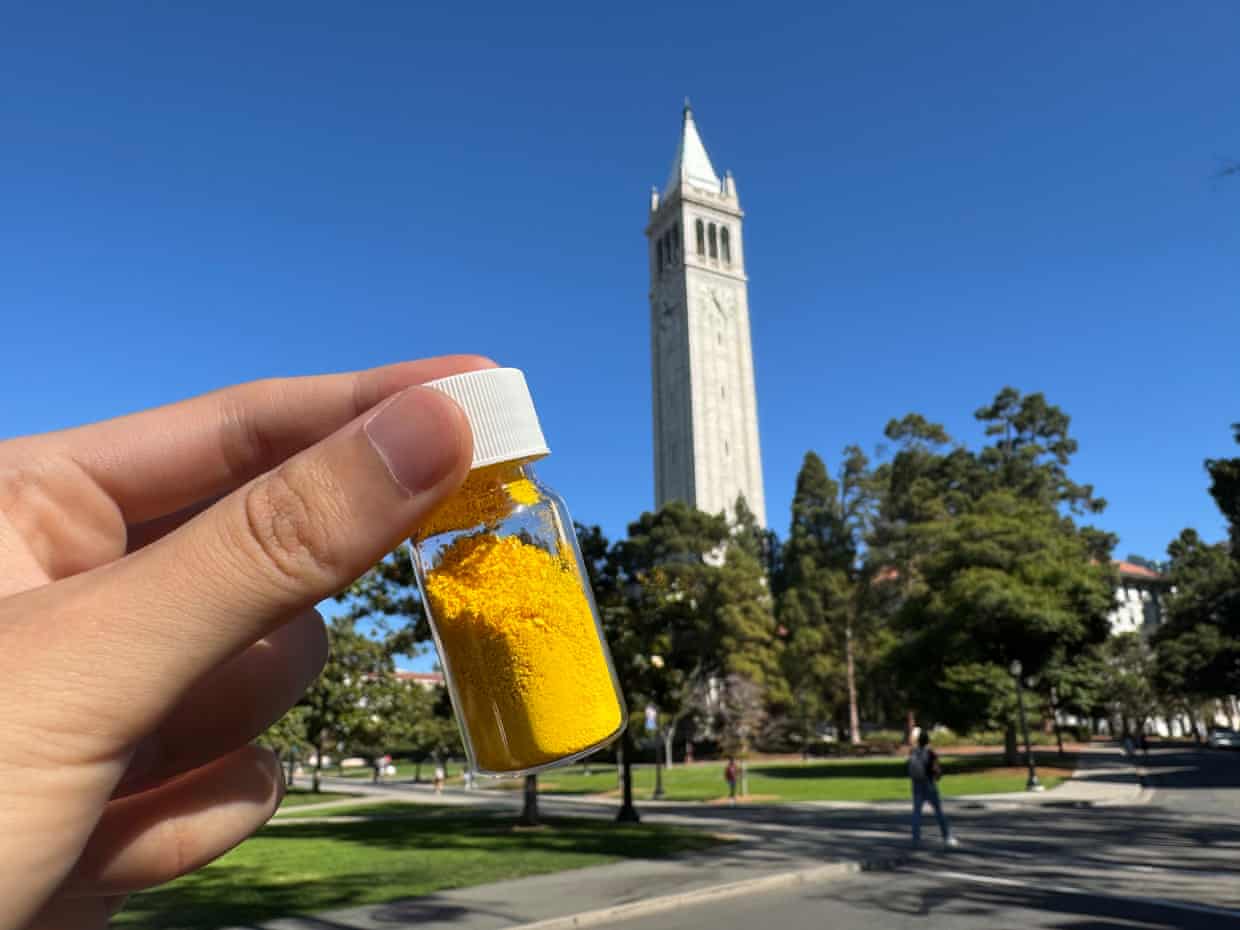
Photo: Zihui Zhou/University of California, Berkeley.
A carbon-capturing powder, pictured on Berkeley’s campus.
Somehow or other scientific research about global warming will continue. Today’s example comes from Berkeley in California.
At the Guardian, Katharine Gammon reports, “An innocuous yellow powder, created in a lab, could be a new way to combat the climate crisis by absorbing carbon from the air.
“Just half a pound of the stuff may remove as much carbon dioxide as a tree can, according to early tests. Once the carbon is absorbed by the powder, it can be released into safe storage or be used in industrial processes, like carbonizing drinks.
“ ‘This really addresses a major problem in the tech field, and it gives an opportunity now for us to scale it up and start using it,’ says Omar Yaghi, a chemist at the University of California, Berkeley. It’s not the first material to absorb carbon, but ‘it’s a quantum leap ahead [of other compounds] in terms of the durability of the material.’
“The powder is known as a covalent organic framework, with strong chemical bonds that pull gases out of the air. The material is both durable and porous, and can be used hundreds of times, making it superior to other materials used for carbon capture.
“Yaghi has been working on similar materials for decades. It’s part of a broader push to collect tiny amounts of carbon from the air – either from power plants or from air around cities. Yaghi’s research with Zihui Zhou, a graduate student in his lab, and others was published in the journal Nature. …
“Yaghi’s team tested the new powder and found that it could successfully absorb and release carbon more than 100 times. It fills up with carbon in about two hours, and then must be heated to release the gas before starting the process over again. It only requires a temperature of about 120F to release the carbon; that makes it an improvement over other methods, which require a much higher temperature.
“That feature means places that already produce extra heat – such as factories or power plants – could use it to release the gas and start the cycle again. The material could be incorporated into existing carbon capture systems or future technology.
“Yaghi … plans to scale the use of this type of carbon capture with his Irvine, California-based company, Atoco, and believes the powder can be manufactured in multi-ton quantities in less than a year.
“Shengqian Ma, a chemist at the University of North Texas who was not involved in the new work, says this technology could be gamechanging. ‘One longstanding challenge for direct air capture lies in the high regeneration temperatures,’ he says, adding that the new material can substantially reduce the energy needed to use direct air capture. …
“Says Farzan Kazemifar, a associate professor in the department of mechanical engineering at San Jose State University who was not involved in the new study, ‘In the short term, replacing large emitters of carbon dioxide – like coal power plants – with renewable electricity offers the fastest reduction in emissions. However, in the long term, in case the emissions don’t go down at the desired pace, or if global warming effects intensify, we may need to rely on technologies that can remove carbon dioxide from the atmosphere, and direct air capture is one of those technologies.’
“Still, removing carbon from the air remains difficult, and as with all early-stage lab-scale studies, the challenge is scaling up the system for pilot studies. … Any technology to capture the gas from the air requires moving huge volumes of air – and that requires large electricity consumption for running fans, says Kazemifar. …
“Some scientists worry that the expectations of direct air capture systems has been overly rosy. A group of scientists from MIT recently wrote a paper analyzing the assumptions of many climate stabilization plans, and pointing to ways that direct air capture may be overly optimistic.
“Ma also points out that a major challenge to using this approach to combat climate change lies in the high cost of materials for creating substances that capture carbon.
“Still, Yaghi says this material can change the way we address carbon removal. ‘This is something we’ve been working on for 15 years, that basically addresses some of the lingering problems,’ he says.”
More at the Guardian, here.


 Suzanne's Mom's Blog