Photo: David Becker/Zuma Press Wire/Shutterstock.
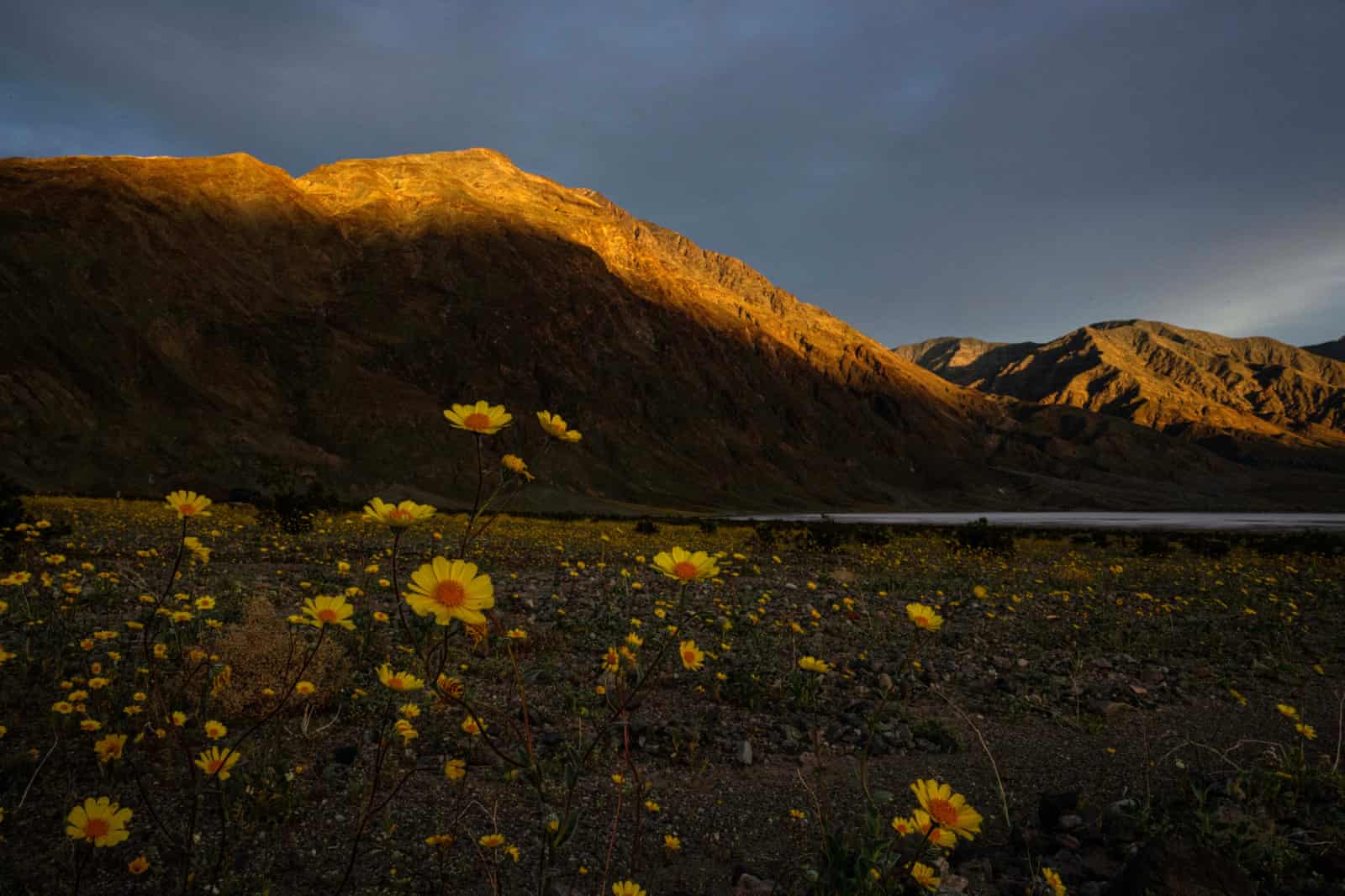
A field of blooming desert sunflowers or desert gold wildflowers are seen as the sun sets on rugged mountains inside Death Valley national park.
Having recently recently returned to Massachusetts from California, dazzled by the exotic flora there, I find that today’s story about a superbloom in the desert is just what I need to keep feeding my sense of wonder.
According to Wikipedia, “Death Valley [is] in the northern Mojave Desert, bordering the Great Basin Desert. The World Meteorological Organization lists Death Valley as the site of the hottest surface temperature recorded on Earth.
“Death Valley’s Badwater Basin is the point of lowest elevation in North America, at 282 feet (86 m) below sea level. … On the afternoon hours of July 10, 1913, the United States Weather Bureau recorded a temperature of 134 °F (56.7 °C) at Furnace Creek in Death Valley, which stands as the highest ambient air temperature ever recorded on the surface of the Earth. However, this reading and several others taken in that period are disputed by some modern experts.
“Lying mostly in Inyo County, California, near the border of California and Nevada, in the Great Basin, east of the Sierra Nevada mountains, Death Valley constitutes much of Death Valley National Park and is the principal feature of the Mojave and Colorado Deserts Biosphere Reserve. It runs from north to south between the Amargosa Range on the east and the Panamint Range on the west. The Grapevine Mountains and the Owlshead Mountains form its northern and southern boundaries, respectively. …
“Death Valley is home to the Timbisha tribe of Native Americans, formerly known as the Panamint Shoshone. They have inhabited the valley for at least the past millennium. Their name for Death Valley is Tümpisa, meaning ‘rock paint.’ This refers to the presence of red ochre in the valley.
“The valley got the name Death Valley in the winter of 1849–1850 when a group of American pioneers were traveling through on their way to the California gold rush. The Death Valley 49ers got lost in the valley and feared that they would all perish there. They did eventually make their way out after suffering the loss of just one of the group.”
Now that I’ve filled you with dread, let me turn to the story by Sara Braun at the Guardian about the rare and thrilling superbloom in Death Valley this year.
“After a winter of record rainfall, a superbloom has erupted in Death Valley, covering the famously arid desert in a blanket of vibrant pink, purple and yellow flowers. As travelers from around the world make their way to the desert, they can expect to be greeted by fragrant air and a quilt of delicate hues.
“While there is no official definition for a superbloom, the National Park Service uses the term to ‘describe conditions when so many flowers are present that they appear as swaths of color across the landscape, rather than isolated plants, especially striking at low elevations where the ground is typically sand, gravel and rock.’
“The park last experienced a superbloom in 2016, which can only occur in ‘perfect conditions,’ with ‘well-spaced rainfall’ and mild temperatures.
“The National Park Service said that low-elevation flowers would continue blooming until mid- to late March, depending on the weather.
Higher elevations will experience blooms in April through June.
“Time is of the essence to catch a glimpse of the superbloom, so if tourists can get there in time, they should keep an eye out for some of the most commonly occurring (and eye-catching) flowers: desert gold, brown-eyed evening primrose, golden evening primrose, phacelia and mojave poppy, to name a few.”
More at the Guardian, here. See also Wikipedia, here.
Somehow, the idea that a barren desert can turn lush and fragrant after a ten-year dry spell makes me feel encouraged about the possibility of change in other realms.


