Feeds:
Posts
Comments

Posts Tagged ‘board game’

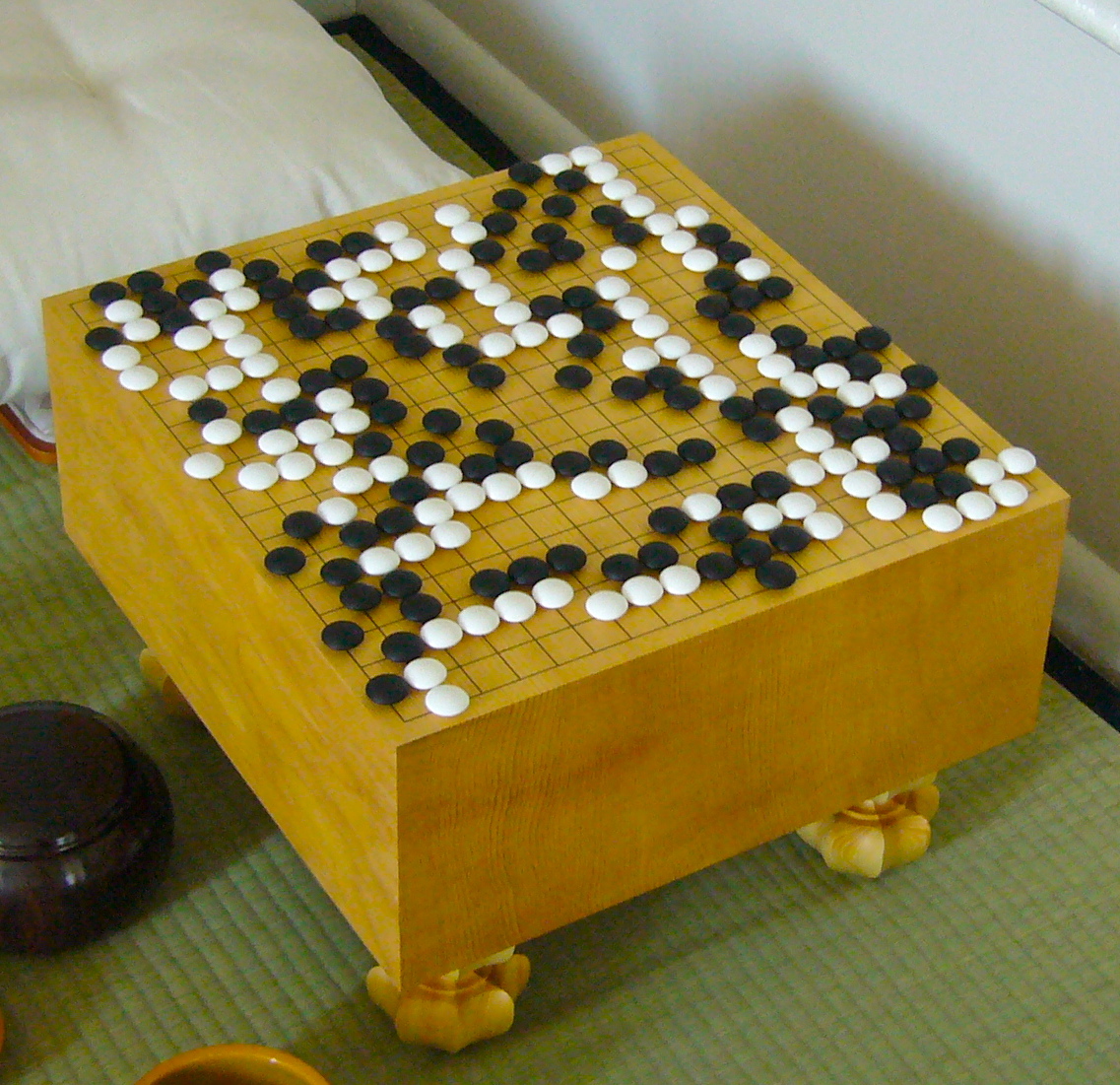
Photo: Goban1.
The Chinese game called Go is more than 2,500 years old.

This past summer, I blogged about a new board game called Wingspan. It sounded wonderful, especially for bird lovers, like those in my family. I bought it.

Well, I think it is going to be wonderful, but the rules are really hard. Recommended for people over 14, it is still too “buch for be, “as Rudyard Kipling’s Elephant’s Child says.

Fortunately, it’s not too much for my 9-year-old grandson, who is gradually figuring it out and explaining it. Otherwise, I might have had to call on artificial intelligence experts, like those described in today’s story.

Samantha HuiQi Yow explains at Wired: “In 1901, on an excavation trip to Crete, British archaeologist Arthur Evans unearthed items he believed belonged to a royal game dating back millennia: a board fashioned out of ivory, gold, silver, and rock crystals, and four conical pieces nearby, assumed to be the tokens. Playing it, however, stumped Evans, and many others after him who took a stab at it. There was no rulebook, no hints, and no other copies have ever been found. Games need instructions for players to follow. Without any, the Greek board’s function remained unresolved—that is, until recently.

“Enter artificial intelligence and a group of researchers from Maastricht University in the Netherlands. Thanks to an algorithm the team used to analyze the playability of one suggested ruleset, the century-old guesswork could soon be taken out of the Knossos game. Today, not only can its recognition as a game be further assessed, with hopes of a clearer answer in future, a version of it is also playable online.  And for the first time, so are hundreds of other games thought to have been lost to history.

“Board games go back a long way. Centuries ago, before the chess we know today, there was Chaturanga in India, Shogi in Japan, and Xiangqi in China. And long before them was Senet, one of the earliest known games, which, along with others played in ancient Egypt, may have ultimately inspired backgammon. ‘Games are social lubricants,’ explains Cameron Browne, a computer scientist at the university who received his PhD in AI and game design. ‘Even if two cultures don’t speak the same language, they can exchange play. This happened throughout history. Wherever people spread to, wherever soldiers were stationed, wherever merchants were trading. Anyone who had time to kill would often teach those around them the games they knew.’ …

“[But] the rules were typically passed on by word of mouth instead of being written down. The little that is known is left open to modern interpretation.

“It’s these lapses in board game history that gave legs to the five-year Digital Ludeme Project, which Browne leads. ‘Games are a great cultural resource that’s been largely underutilized. We don’t even know how so many of them were played, especially when you go farther back in time,’ he says. ‘So the question for me was, can we use modern AI techniques to shed insight into how these ancient games were played and, together with the evidence available, help reconstruct them?’

“As it turns out, the answer is a resounding yes. It’s been three years since Browne and his colleagues set to work, and already they have brought nearly a thousand board games online, ranging from across three time periods and nine regions. Thanks to them, games once popular in the second and first millennia BC, like 58 holes, are now just a few clicks away for anyone on the internet.

“Interestingly enough, this reconstruction process begins with the opposite. Games are first broken down into fundamental units of information called ludemes, which refers to elements of play such as the number of players, movement of pieces, or criteria to win. Once a game is codified in this manner, the team then fills in the missing pages of its rulebook with the help of relevant historical information, like when it or another game with similar ludemes was played and by whom.

“The riddle however is only partly solved at this stage. Others who do similar work–manually–usually hit a dead end here. It’s because what looks good on paper might not translate as well in reality, Browne explains. ‘The rules might make sense when you read them, but you don’t know how well they actually work unless you play the game. Quite often, rules that make perfect sense play terribly as games.’ …

“But computers can have blind spots too, in that they only measure what’s measurable. Here’s where Walter Crist comes in.” More at Wired, here.
Read Full Post »

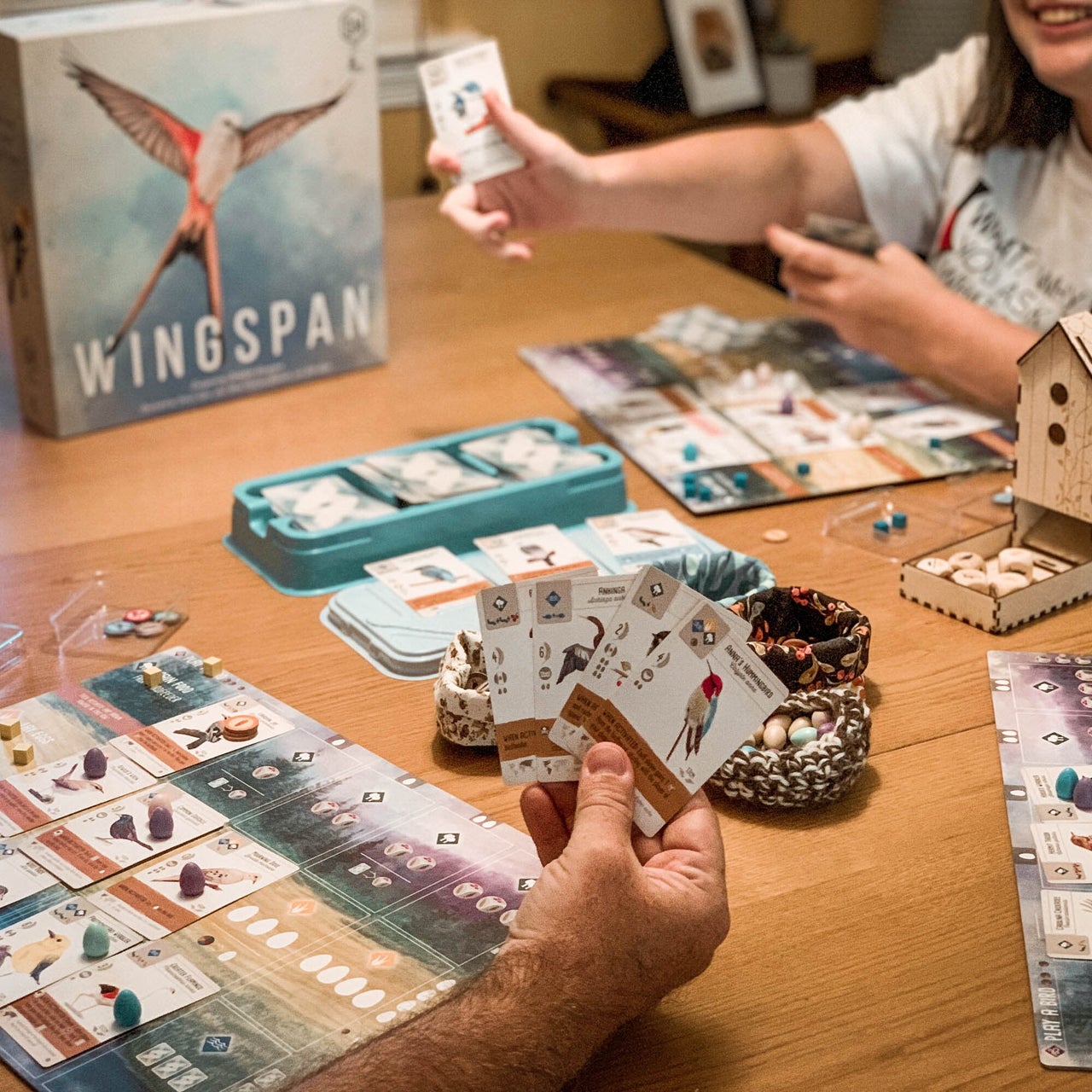
Photo: Alia Smith.
Playing the Wingspan board game.

Are you a board-game enthusiast? I am not usually, but as Hurricane Henri sweeps over Rhode Island and activities are shut down like it’s the pandemic all over again, I’m thinking we may need more board games in the house. And the one in today’s story looks like a winner.

Dan Kois writes at Slate about Wingspan’s recent phenomenal success.

“In the winter of 2005, Elizabeth Hargrave, a health policy analyst, took a ski trip with a group of friends from her church. The problem was, she said, she grew up in Florida, ‘and I don’t actually enjoy skiing, or any winter sports.’ One of the friends had brought a selection of board games. … Hargrave, who played bridge but hadn’t really played board games since she was a kid, was ‘totally hooked,’ she said. …

“After she returned home to the D.C. suburbs, she continued playing games. She loved the math of them, the way they became puzzles. … In her newfound fandom, Hargrave was like thousands of adults who’ve rediscovered the joy of board games, especially as a new kind of game took over the market.

“In ‘Eurostyle’ games, players complete complex, evolving challenges more involved than simply traveling around a game board answering trivia questions or paying rent. And in Eurostyle games, players are never eliminated. …

“[But Hargrave] and her friends found themselves annoyed that all the games seemed to revolve around medieval villages, or trains, or trading economies in vaguely Mediterranean locales. ‘At one point we placed a moratorium on games about castles,’ she said. This led her to a question: Why weren’t there games about subjects she actually found compelling? Maybe she would design one, she thought. And that led to another question: What did she like enough to want to make a whole game out of it?

“That one was easy. Birds.

“My family discovered Wingspan,” the Slate reporter continues, “with its beautiful, hand-painted cards and gentle, strategic gameplay, last year, and soon we were playing it every weekend. Wingspan has transformed the way I think about games, about competition, and even about art. ,,,

“When it was released in 2019, it was an instant hit, and that was before everyone found themselves stuck inside during the pandemic. In 2020, as the pandemic drove Americans both into their homes to stare at their families and out into the woods to stare at birds, Wingspan blew up, outselling every other game its publisher makes combined. That company, Stonemaier Games, has now sold 1.3 million copies of the game and its expansions, plus another 125,000 digital editions on Steam, Nintendo Switch, Xbox, and iOS. …

“Wngspan is what’s known among serious gamers as an ‘engine-building game,’ which means that as the game goes on, the combination of birds you play becomes more and more efficient at generating points each turn, like an engine running faster and faster. Your cuckoo lays eggs, and the eggs not only give you points but make it possible to play more birds, which also give you more points but have their own powers that generate points in other ways. I prefer thinking about the mechanism of Wingspan not as an engine I am building, but as an ecosystem I am fostering.

If I’ve strategized well, the birds in my ecosystem will be knitted together into a web of complex, mutually beneficial relationships. …

“It’s those interconnections that Hargrave began mapping out in a ginormous spreadsheet once she decided she really did want to design a board game. For four years, she researched birds, brainstormed play ideas, and — most crucially — tested the game, over and over, every week for years, with a group of friends. …

“During the years she was playtesting Wingspan, she worked as a health policy consultant, often running focus groups, and her experience with analyzing data and interpreting consumer response was also crucial to Wingspan’s development. The numbers work in Wingspan. What seems at the beginning like a set of coincidences or accidents reveal themselves by game’s end as a cleverly designed system that ensures everyone finds a way to score points.

“When Hargrave felt she had a solid game, she cold-emailed every publisher that seemed like it might be amenable to a game about birds by a first-time designer. Most ignored her or turned her down, but in 2016 she did land a few meetings at Gen Con, an Indianapolis board game convention. One executive, Jamey Stegmaier of Stonemaier Games, listened to her pitch for Bring in the Birds, as it was called, responded with a list of suggested changes, and told her that if she revised the game and came back to him, he’d consider it. That meant another half-year of unpaid work before Stegmaier accepted her revision and agreed to manufacture the game. Hargrave, as a first-time designer, received no advance, so until the game sold, she wouldn’t see a dime.

“But boy, did the game sell. …

“I think that the game’s sly cooperative nature — the way Hargrave’s design gently pushes you not to beat your neighbor but to succeed with her, together — goes hand in hand with its conservationist spirit. Of course passionate birders become Wingspan players, and Hargrave has heard from many nonbirder Wingspan fans who are now investing in bird feeders and signing up for eBird accounts (us, for example). But there’s also something inspiring about engaging with the outdoors in this constructive way, at a time when most human impact upon the environment seems so dire. Nature is not a zero-sum game, and neither is the human effort to preserve it: The more people you invite to the table to work together, the more everyone achieves. “

More at Slate, here.

Read Full Post »

Rainy days at the shore and holidays are for many families today the only time they play board games.

But for folks in Omaha, Nebraska, an unusual coffee shop provides frequent opportunities to play games — including some that, guaranteed, you never heard of.

Robyn Murray reported the story at the radio show Only a Game.

“Remember playing Monopoly and Scrabble around the dinner table? Arguing with your siblings about who gets to be the car or the Scottish Terrier? Or whether Z-A-Q could ever be a real word? Well those days are coming back — with just one variation: The arguments are getting weird. Did you feed your monster properly? Can you trust her to save the world with you? And what’s the best way to ensure your family doesn’t have to go begging — selling bread or planting beans?

“Welcome to the revamped world of board games.

“At Spielbound in Omaha, Neb. — a newly opened coffee shop and board game library with what’s believed to be the largest collection of board games in the country — the Short family recently played Takenoko, a Japanese board game.

“ ‘We are trying to please the emperor by taking care of his panda and growing a most excellent garden that feeds his panda,’ Justin Short explained.

“There’s a comfortable feeling about Spielbound. The tables are wooden and the booths leather. There are no television screens, just a cozy bar that serves beer and coffees with names like ‘Taste of Sweet Victory’ and ‘Dice Delight.’ Downstairs, four foot shelves are stocked with board games. Each box is a little work of art, with titles like ‘Arkham Horror’ and ‘The Road to Canterbury,’ with pictures of ships, dragons and submarines.

“The Shorts come here a lot on their monthly family pass. Short has a collection of 200 board games at home. But that’s nothing compared to the 1,200 available at Spielbound, at least according to the Shorts’ children:

“ ‘It’s just fun to play as a family whenever we get down here,’ Isabelle said.

“ ‘I like pretending to be something else and do something else,’ Sabrina said.

“ ‘I like beating people,’ Cameron said, laughing.”

More here.

Photo: Robyn Murray/Only A Game 
Spielbound, a coffee shop and board game library in Omaha, Neb., holds what’s believed to be the largest collection of board games in the U.S. with over 1,200 games available for patrons.

Read Full Post »