Feeds:
Posts
Comments

Posts Tagged ‘cooperative’

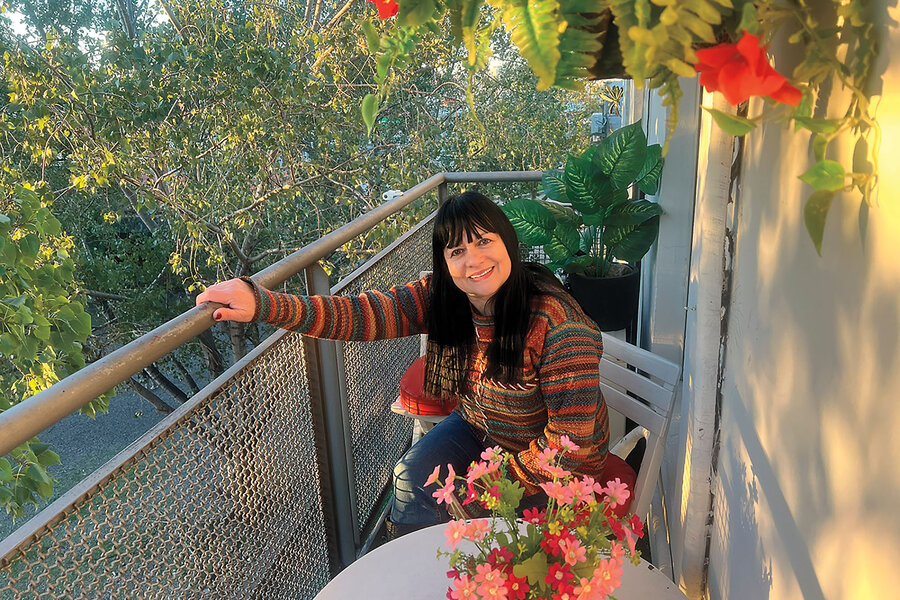
Photo: Constance Malleret.
Sandra Cáceres sitting on her balcony in Montevideo, Uruguay, last April. She helped found the Covicivi I cooperative, which renovated an abandoned bakery in Montevideo’s Old Town. It now houses 34 apartments.

Uruguay’s co-op-housing model is an exercise in getting along with strangers and compromising. But it can build a sense of community, and it definitely keeps housing costs down.

Constance Malleret wrote about it recently at the Christian Science Monitor.

“As a young couple with three children in the 1970s, Teresita Palomeque and her husband thought buying a house was an unattainable dream.

“So, when they were invited to join a housing cooperative – an emerging model at the time – they scrimped to pay the entry fee alongside colleagues from the bank where they worked. 

“Construction lasted four years, and in 1975, the family of five moved into a compact three-bedroom apartment in a development of redbrick tower blocks on one of Montevideo’s main avenues. Ms. Palomeque still lives there to this day with a thousand other co-op residents. …

“Cooperatives, and community-centered housing more generally, are part of a ‘tool kit of solutions’ to the global housing shortage, estimated at 288 million homes, [says Elkin Velásquez, regional director for Latin America and the Caribbean at UN-Habitat, the United Nations agency for urbanization]. It’s top of mind for people around the world, as concerns around affordability grow. The United States Congress passed a housing bill to boost supply, signed into law in early July. The 21st Century Road to Housing Act was one of the rare pieces of legislation to win bipartisan support in recent years.

“It was under similar conditions that the Uruguayan model was thought up in the 1960s, when the country was gripped by an economic crisis and a group of architects saw in co-op-owned residences a solution to the housing deficit. The idea drew on Uruguay’s strong culture of organizing through cooperatives and a working-class tradition of self-building homes, says Alina del Castillo, a professor at the University of the Republic’s Faculty of Architecture, Design, and Urbanism. 

“There are now over 70,000 co-op-owned homes in Uruguay – 5.1% of the country’s total housing stock, according to the 2023 census. Some were built from scratch, sometimes by the residents themselves, while others repurposed existing buildings, all with state loans and technical support from a government-vetted group of experts.

“Uruguay’s law, which viewed an individual’s ability to work as a form of capital, was ‘very pioneering,’ says Dr. Del Castillo.

“Sandra Cáceres has a before-and-after photo of an abandoned bakery in Montevideo’s Old Town hanging by her front door. She put in 30 hours a week for eight years to restore the once crumbling structure in the 1990s. Today it’s a residential building with 34 apartments, one of which is hers.

“ ‘The ovens were made of very long, large stones. The stones had to be removed; it was a huge amount of work,’ she says. ‘It was tiring, but was it worth it? Of course it was.’

“The building’s transformation helped revitalize the rundown neighborhood and ward off real estate speculation. It also created a new sense of community. 

“The societal ‘norm is for you to not know anything about who lives next door, above, below,’ says Matías Paparamborda, who grew up in the same housing complex as Ms. Palomeque, Complejo Bulevar, and returned in 2021 after starting his own family. ‘Here, everyone knows who you are.’ …

“Mr. Paparamborda is a writer and filmmaker and puts his social mobility – his father was an electrician and his mother a schoolteacher – down to the diversity of people he knew growing up in the co-op.

“But he says collective living has its challenges, too. ‘In general, the decisions that are taken during the assemblies are not what I would do,’ he says. ‘But I’ve learned to embrace this, because one of the most important things that you learn with community living is that life is not about doing what you want.’

“Ms. Cáceres compares it to a marriage, where a couple must learn to compromise and cohabit. …

“More than 60 years on from the national housing law, Dr. Del Castillo believes the system’s current rigidity may be holding it back. Rules around government funding for housing means that new cooperatives can no longer build commercial areas, or leisure spaces such as a soccer pitch, as part of a residential complex.

“ ‘Regulations have become very restrictive. Projects are evaluated according to a checklist … there’s no case-by-case study,’ she says. ‘The law contains incredible values and for its time it was very innovative,’ she says. But to meet the needs of a modern, growing society it may be time for the system ‘to be revised.’

“There’s no need to ‘copy-paste’ the Uruguayan experience, Mr. Velásquez says. But if adapted to the specific conditions of each country, it can serve as an inspiration for other nations trying to navigate affordable, quality housing.”

More at the Monitor, here.
Read Full Post »

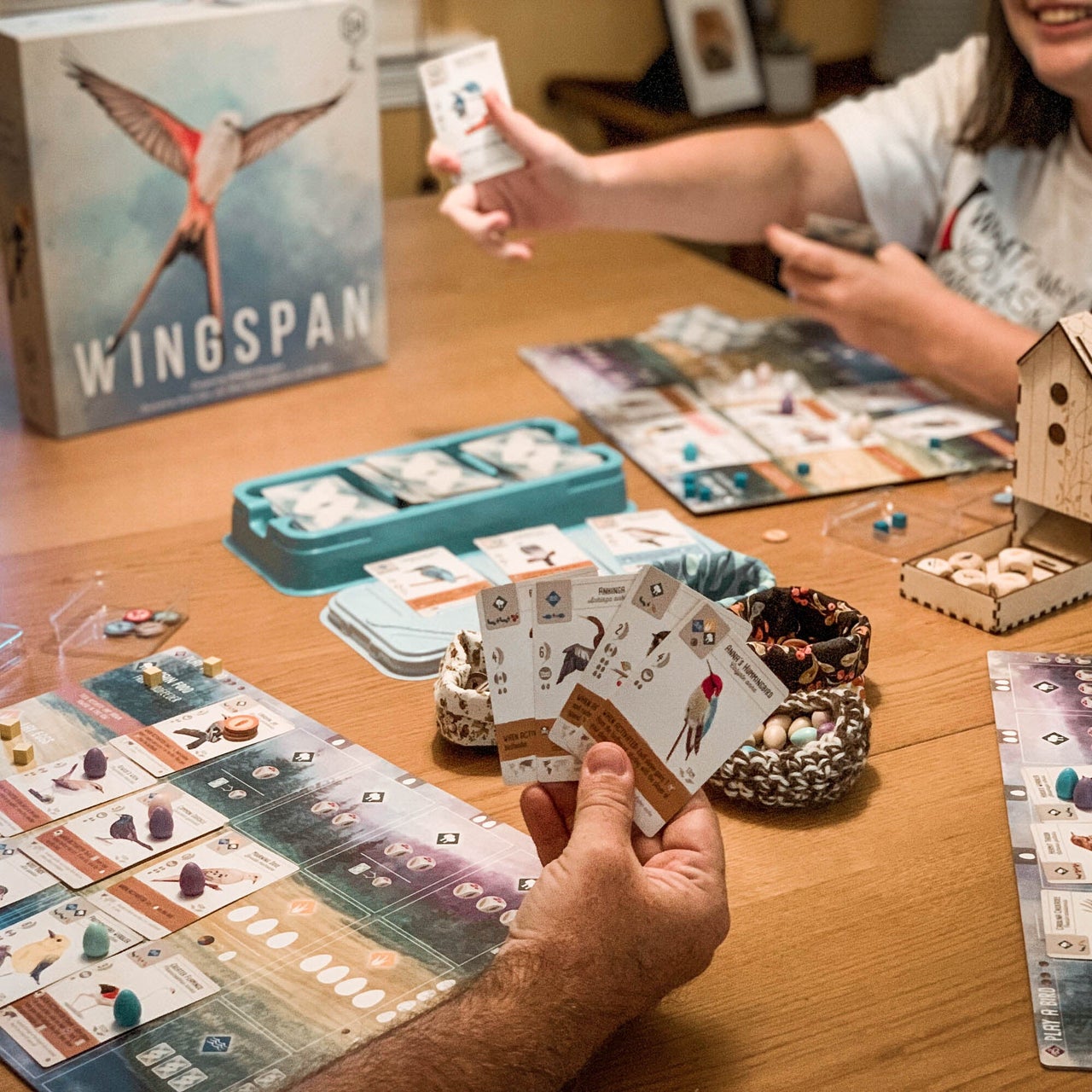
Photo: Alia Smith.
Playing the Wingspan board game.

Are you a board-game enthusiast? I am not usually, but as Hurricane Henri sweeps over Rhode Island and activities are shut down like it’s the pandemic all over again, I’m thinking we may need more board games in the house. And the one in today’s story looks like a winner.

Dan Kois writes at Slate about Wingspan’s recent phenomenal success.

“In the winter of 2005, Elizabeth Hargrave, a health policy analyst, took a ski trip with a group of friends from her church. The problem was, she said, she grew up in Florida, ‘and I don’t actually enjoy skiing, or any winter sports.’ One of the friends had brought a selection of board games. … Hargrave, who played bridge but hadn’t really played board games since she was a kid, was ‘totally hooked,’ she said. …

“After she returned home to the D.C. suburbs, she continued playing games. She loved the math of them, the way they became puzzles. … In her newfound fandom, Hargrave was like thousands of adults who’ve rediscovered the joy of board games, especially as a new kind of game took over the market.

“In ‘Eurostyle’ games, players complete complex, evolving challenges more involved than simply traveling around a game board answering trivia questions or paying rent. And in Eurostyle games, players are never eliminated. …

“[But Hargrave] and her friends found themselves annoyed that all the games seemed to revolve around medieval villages, or trains, or trading economies in vaguely Mediterranean locales. ‘At one point we placed a moratorium on games about castles,’ she said. This led her to a question: Why weren’t there games about subjects she actually found compelling? Maybe she would design one, she thought. And that led to another question: What did she like enough to want to make a whole game out of it?

“That one was easy. Birds.

“My family discovered Wingspan,” the Slate reporter continues, “with its beautiful, hand-painted cards and gentle, strategic gameplay, last year, and soon we were playing it every weekend. Wingspan has transformed the way I think about games, about competition, and even about art. ,,,

“When it was released in 2019, it was an instant hit, and that was before everyone found themselves stuck inside during the pandemic. In 2020, as the pandemic drove Americans both into their homes to stare at their families and out into the woods to stare at birds, Wingspan blew up, outselling every other game its publisher makes combined. That company, Stonemaier Games, has now sold 1.3 million copies of the game and its expansions, plus another 125,000 digital editions on Steam, Nintendo Switch, Xbox, and iOS. …

“Wngspan is what’s known among serious gamers as an ‘engine-building game,’ which means that as the game goes on, the combination of birds you play becomes more and more efficient at generating points each turn, like an engine running faster and faster. Your cuckoo lays eggs, and the eggs not only give you points but make it possible to play more birds, which also give you more points but have their own powers that generate points in other ways. I prefer thinking about the mechanism of Wingspan not as an engine I am building, but as an ecosystem I am fostering.

If I’ve strategized well, the birds in my ecosystem will be knitted together into a web of complex, mutually beneficial relationships. …

“It’s those interconnections that Hargrave began mapping out in a ginormous spreadsheet once she decided she really did want to design a board game. For four years, she researched birds, brainstormed play ideas, and — most crucially — tested the game, over and over, every week for years, with a group of friends. …

“During the years she was playtesting Wingspan, she worked as a health policy consultant, often running focus groups, and her experience with analyzing data and interpreting consumer response was also crucial to Wingspan’s development. The numbers work in Wingspan. What seems at the beginning like a set of coincidences or accidents reveal themselves by game’s end as a cleverly designed system that ensures everyone finds a way to score points.

“When Hargrave felt she had a solid game, she cold-emailed every publisher that seemed like it might be amenable to a game about birds by a first-time designer. Most ignored her or turned her down, but in 2016 she did land a few meetings at Gen Con, an Indianapolis board game convention. One executive, Jamey Stegmaier of Stonemaier Games, listened to her pitch for Bring in the Birds, as it was called, responded with a list of suggested changes, and told her that if she revised the game and came back to him, he’d consider it. That meant another half-year of unpaid work before Stegmaier accepted her revision and agreed to manufacture the game. Hargrave, as a first-time designer, received no advance, so until the game sold, she wouldn’t see a dime.

“But boy, did the game sell. …

“I think that the game’s sly cooperative nature — the way Hargrave’s design gently pushes you not to beat your neighbor but to succeed with her, together — goes hand in hand with its conservationist spirit. Of course passionate birders become Wingspan players, and Hargrave has heard from many nonbirder Wingspan fans who are now investing in bird feeders and signing up for eBird accounts (us, for example). But there’s also something inspiring about engaging with the outdoors in this constructive way, at a time when most human impact upon the environment seems so dire. Nature is not a zero-sum game, and neither is the human effort to preserve it: The more people you invite to the table to work together, the more everyone achieves. “

More at Slate, here.

Read Full Post »

I had heard about community-supported-agriculture-type efforts that deliver fish directly to consumers in the Greater Boston area. Very fresh. What I did not know is that this sort of initiative is taking place on a wider scale.

My husband recently pointed out a NY Times story on how professional Rhode Island fishermen have made it easy for chefs to buy directly from the daily catch. And according to the Times, the chefs are ecstatic.

“This boat-to-table initiative is part of Trace and Trust, a program that [Point Judith-based fisherman Steve] Arnold; Christopher Brown, the head of the Rhode Island Commercial Fishermen’s Association; and Bob Westcott, another local fisherman, started this year to make fishing more lucrative and shopping more reliable. …

“Trace and Trust comes at a moment when the seafood industry is under attack because of misleading labeling as well as the freshness and sustainability of what it sells. Consumers and fishermen have reacted by setting up community-supported fisheries, in which consumers pay in advance for a weekly delivery of seafood. And fishermen have reached out to chefs before. But Trace and Trust has used technology to create a more direct and responsive connection between consumers and fishermen than any other program in the country, said Peter Baker, director of Northeast Fisheries Program for the Pew Environment Group.”

Read more here. See also the Pew Environment Group’s focus on Conserving New England Fish.

Because of the field I’m in, I do have to spare a thought for the fish-processing jobs that may be lost with more of this direct marketing, but there is no doubt that for the fisherman, the consumer, and the restaurant, fresh is best.

Here’s a picture I took of the Point Judith (RI) fishing fleet at rest.

Read Full Post »