Feeds:
Posts
Comments

Posts Tagged ‘breathing’

Photo: Mary Jo Hoffman.
Palourde clam shells from the Mediterranean Sea, part of Mary Jo Hoffman’s decades-long creative endeavor celebrating the beauty of the natural world.

I’m reading a lovely YA novel celebrating the wonder of the natural world (Gather), so my train of thought today fits right in with the topic of a recent New Scientist article. It’s about a woman with a huge collection of nature photos.

Gege Li writes, “Since 2012, Mary Jo Hoffman has taken one snap a day of the natural objects around her. She explains what lies behind two of them – and what the ‘art of noticing’ has brought to her life. …

“Since 2012, aeronautical engineer-turned-artist Mary Jo Hoffman has taken one photo a day of the natural objects around her. But what started out as a creative challenge to simply get better at art composition has now evolved into a ‘comprehensive way of being,’ she says.

“Twelve years and thousands of photos later, Hoffman still finds beauty in her surroundings, often no further away than her home in Saint Paul, Minnesota. Her book, Still: The art of noticing .. collects 275 photos from her project, two of which are shown [at New ScientistI].

“Pictured in the main image above, are an assortment of palourde clam shells from the Mediterranean Sea, the remnants of a spaghetti and clam dinner in southern France. Hoffman wanted to commemorate the varied coloration of each clam, and this aftermath proved too good an opportunity to pass up.

“[Another photo shows] a feather from a sandhill crane. Hoffman selected this downy number during the moulting season of a resident pair of cranes that have set up their summer nests next to her house.

“Hoffman’s background in aeronautics means her idea of beauty has always bent towards the mathematical – the intricacies of feathers, for example, seen with the naked eye or zoomed in to the finest details, illustrate ‘beauty at every level,’ she says.

“As for the project, ‘I truly feel I have stumbled onto an elegantly simple practice that lets me experience the sacred almost every day,’ she says.” More at New Scientist, here.

“The art of noticing” is also what you’re supposed to do in meditation and breathing exercises, am I right? That sort of thing really calms me down if I need calming down. Some instructors even enccourage noticing each of your five senses slwoly and thoughtfully because when you are just noticing your breath or your sense of smell, say, you don’t get overwhelmed by whirling thoughts.

By the way, blogger Rebecca Cuningham is another photographer who’s an artist at noticing. From Minnesota, too. Check her out.
Read Full Post »

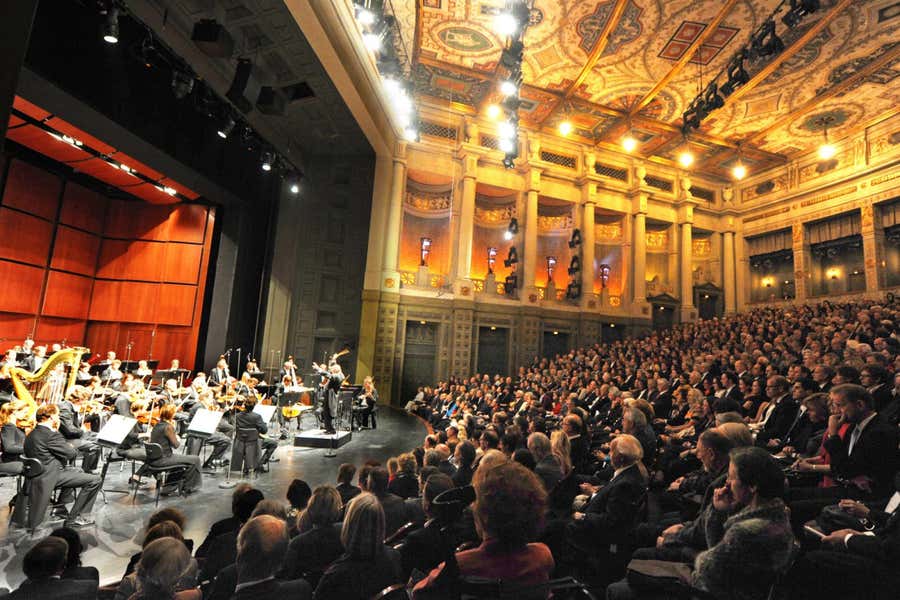
Photo: Stephan Rumpf/Süddeutsche Zeitung Photo/Alamy.
Research involving self-reported personality traits shows that music can synchronize the heartbeats of some members of an audience.

For about a year or so, I have been learning to breathe. Ha. I always made fun of that sort of thing, but noticing your breathing is supposed to be good for your health, and I have found it often does lower my blood pressure.

So, what was my delight to read this related research! It’s about how classical music often synchronizes the heartbeats of an audience.

Jason Arunn Murugesu wrote at New Scientist, “Audience members’ heartbeats, breathing speeds and even degree of sweating synchronize when they watch a classical music concert together.

Wolfgang Tschacher at the University of Bern in Switzerland and his colleagues monitored 132 people who were separated into three groups to watch different concerts of the same pieces of music – Ludwig van Beethoven’s Op. 104 in C minor, Brett Dean’s Epitaphs and Johannes Brahms’s Op. 111 in G major – while wearing body sensors.

“Various measurements became more synchronized during the concerts, such as the participants’ heart rates, breathing speeds and their skin conductance, which measures how much someone is sweating based on their skin’s varying electrical properties.

“Prior to the concerts, the researchers asked the participants to complete a personality test. They found that this synchronization was more likely to occur among people who considered themselves to be agreeable or open. …

“Tschacher expects that this synchronization would also apply to non-classical music genres and would probably be stronger still outside a trial setting. Due to covid-19 restrictions at the time of the experiment, the audience members were socially distanced. In a normal music concert, where audience members often engage with one another, the synchrony may be more pronounced, he says.

“The timing of the participants’ breathing, such as when they inhaled and exhaled, didn’t synchronize, however. Otherwise, you might think that a synchronized heart rate somehow leads to a synchronized breathing pattern, says Daniel Richardson at University College London. Instead, perhaps a person’s heart rate is influenced by their enjoyment of the music, he says.” More at New Scientist, here.

Aristos Georgiou at Newsweek adds, “Synchronization between humans is usually observed in physical bodily responses, such as breathing. Most frequently, this synchronization is the result of direct social interaction with another person. But it can also be induced by other external factors that are not related to such social interactions.

” ‘Synchrony is an important part of social interaction, and psychology has started to measure how much people become synchronized in different settings,’ such as in psychotherapy, discussions between spouses, and other conversations, Wolfgang Tschacher, an author of the study from the University of Bern’s Hospital of Psychiatry and Psychotherapy in Switzerland, told Newsweek. …

“While the researchers found that the audience members shared the same heart rate during the concerts, the heartbeats themselves were likely not all occurring at the same time, Tschacher said. The same applied to their breathing. The rate at which the audience members breathed was synchronized, but the individual ‘in’ and ‘out’ breaths of each attendee did not necessarily all occur at the same time.

“In addition, the researchers found that the [self-reported] personality traits of a listener were associated with the likelihood of their physical responses being synchronized with other audience members. Those participants who rated more highly for personality traits such as agreeableness or openness were more likely to become synchronized. On the other hand, those with neurotic or extraverted traits were less likely to become synchronized. …

“Alexander Khalil, a researcher in the Department of Music at University College Cork in Ireland, who was not involved in the study, told Newsweek that the scale and scope of the latest research is notable.

” ‘Typically, musical synchrony studies only address a small number of parameters at a time and in a relatively small group of people,’ he said. ‘Here, we have data on interpersonal synchrony amongst audience members attending a concert recorded from a large group of people.’ …

“The study is ‘particularly interesting and useful’ because individual variation across these different parameters has been compared with the subjective experience and personality traits of audience members, Khalil said. …

” ‘It tells us that that urge to tap your foot, nod your head, or sway from side to side is just the tip of the iceberg: from head to toe, body and mind are in motion with those of other listeners.’ ” More at Newsweek, here.

Read Full Post »

Photo: David A. Lindon/BBC.
These micro paintings cannot be seen with the naked eye.

We were speaking of miniatures. Today’s story is about an artist who goes beyond miniature to microscopic: art that can’t be seen with the naked eye, art that has to be painted at night to avoid the slightest jostling from traffic.

Cathy Free wrote about the artist at the Washington Post. “Late at night while most everyone in the coastal English town of Bournemouth is sleeping, David A. Lindon sits in front of a microscope making the tiniest of artworks. His creations are so minuscule and precise, he steadies his hands by only moving them between his own heartbeats.

“One twitch — or worse, something as disastrous as a sneeze — and his latest painting or sculpture could disappear into the fibers of his carpet or be lost forever in the jumble of tools on his desk. … A few years ago, at least one piece of artwork became lodged inside Lindon’s nose, never to be seen again.

“ ‘I inhaled it by accident, and poof. It was gone,’ he said. ‘To do what I do, you practically have to work yourself into a trance.’ …

“He started out putting each of his tiny masterpieces inside the eye of a needle or on top of a pin. His latest work is rotating as a wearable miniature art gallery inside a watch.

“To celebrate the 50th anniversary of the Van Gogh Museum in the Netherlands last month, Lindon collaborated with Edward Hammond, the founder of Hammond Galleries in the United Kingdom, to re-create three of Vincent van Gogh’s most famous paintings — ‘Starry Night,‘ ‘Sunflowers‘ and ‘Self-Portrait‘ in micro form. … The project took him six months.

“The watch with the microscopic Van Goghs is now on view at Hammond Galleries, valued at $190,000. …

“Lindon has three other pieces on display in New York this summer at an exhibition called ‘Small Is Beautiful,’ and he said he’s next hoping to showcase the world’s smallest zoo. …

“ ‘What I do doesn’t take up much space, but it’s very, very hard to do,’ he said. ‘It takes hundreds of hours.’ …

“Lindon, a former engineer who once worked in the aircraft industry, said he developed a fascination [with] ultra small-scale art after watching a TV special in the U.K. about artists who enjoyed creating diminutive works.

“In 2019, he said he decided to create a few of his own pieces and spent months working on his painstaking technique. His first piece was a wee Dalmatian that he made for his daughter, Abigail. It measured about a half of a millimeter long, and was crafted from materials that included porcelain, nylon, carbon fiber and precious metals.

“ ‘She suggested that I put it online, so I posted it on Facebook and Instagram,’ he said. ‘When people went nuts over it, I knew I must be on to something.’

“Lindon experimented with materials such as carpet fibers and crushed micro pigments, and he developed his own small tools, including a blade made from a hypodermic needle with a diamond fragment on the tip, and brushes made with fibers from silkworms.

“ ‘People ask me, “Do you paint with the leg of a fly?” But I actually use micro hooks and shovels that I’m constantly remaking,’ he said. …

“His work is reminiscent of the famed micro artist Willard Wigan, who for decades has painted with materials such as human eyelashes, and has won two Guinness World Records for the tiniest art made by a human hand. Other micro artists — including Hasan Kale, who paints on a grain of rice, as well as almond slivers, and Salavat Fidai, who makes sculptures on the tip of a pencil — have gained notoriety for their talents in the world of tiny art.

“Lindon said he usually works late at night so vibrations from traffic won’t disturb his concentration or cause his art to tremble under the microscope. ‘One mistake and it’s gone,’ he said. …

“His most frustrating loss was a mini reproduction of Pablo Picasso’s ‘Weeping Woman,‘ Lindon said.

“ ‘She has lots of color and is very angular with lots of straight lines,’ he said. ‘Basically, she’s a jigsaw. Earlier this year, I got three-quarters of the way through this complicated piece when my fingers suddenly twitched and I ripped the painting apart.

“ ‘I could have cried, but I carried on,’ Lindon added. …

“He said that mishaps happen less frequently now that he has taught himself to control his heartbeat by slowing down his breathing and relaxing.”

People sure come up with the most amazing hobbies! More at the Post, here.

Read Full Post »

Photo: Tim Street-Porter.
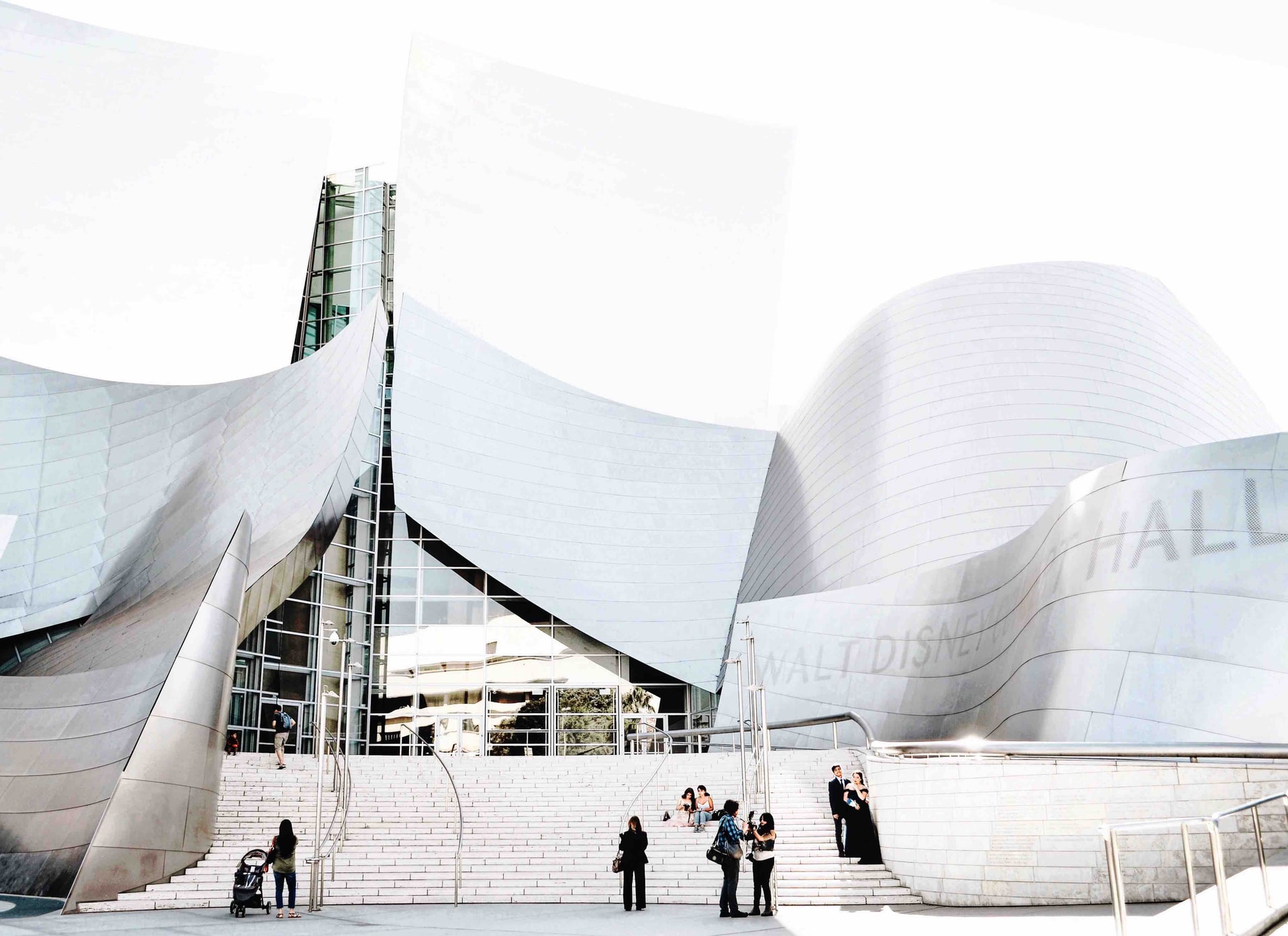
The view looking across the Los Angeles Music Center Plaza toward the Dorothy Chandler Pavilion, one of four venues to pass a new UL verification program for indoor air quality.

We have learned so much in the past year! Remember when we thought Covid-19 might be like Ebola, when we were advised to wipe down all the groceries with bleach? Gradually we learned that although it might be possible to get the coronavirus from surfaces, the air we were breathing in close quarters was the real danger. Even now, when more people are getting vaccinated every day, spending time in crowded indoor spaces with poor ventilation could extend the life of the scourge.

That is why people who manage buildings, once concerned that they be airtight to keep in heat and air conditioning, are now much more concerned about ventilation. How is the public to know which buildings will be safe to enter?

Jessica Gelt writes at the Los Angeles Times, “The Music Center in downtown Los Angeles [recently announced] that it is the first performing arts organization in the country to receive a UL ‘healthy building’ verification, representing high standards for air quality at four venues — Walt Disney Concert Hall, Dorothy Chandler Pavilion, Mark Taper Forum and Ahmanson Theatre.

“Don’t throw away your mask just yet, though.

“ ‘This isn’t necessarily a COVID program. It’s not about putting up a force field for keeping a building completely safe from COVID. You can’t do that,’ said Sean McCrady, director of assets and sustainability, real estate and properties at UL, the safety science company that issues the Verified Healthy Buildings for Indoor Air Verification Mark, which will be posted at the entrances of Music Center venues.

“McCrady reiterated the scientific consensus that air purification and good ventilation can reduce airborne germs in indoor spaces. In September the Centers for Disease Control and Prevention updated its guidance to say the coronavirus spreads most commonly through the inhalation of droplets and tiny respiratory particles that can remain suspended in the air.

“The UL verification program emphasizes filtration, ventilation and the overall hygiene of air systems and of buildings in general. Buildings are required to use MERV 13 air filters, which remove particles between 1 and 5 microns. The coronavirus is smaller than that, but McCrady said the filter has an 85% efficacy rate and captures much of the particulate matter to which the virus hitches itself. Prior to COVID-19, the industry standard was the lower-performing MERV 8 filter.

“UL verified buildings must bring in fresh air and move it effectively around the space. The Music Center will be facilitating four to six air changes per hour, which is recommended by the American Society of Heating, Refrigerating and Air-Conditioning Engineers.

That means the air volume of a building will be replaced an average of every 10 to 15 minutes. …

“The hygiene of the air filtration and ventilation systems also is crucial. If mold spores or fibers are present, the technology won’t work as it should. … UL also looks at the chemicals used in the cleaning of the space and makes sure that they don’t pollute the air. …

“The Music Center hopes the UL verification will help to maintain the trust of audiences. … If the science surrounding the virus and how to protect against it changes, or if the CDC or more local health officials issues new guidance, the Music Center intends to pivot too. …

“ ‘This is an ongoing process. We will not be stopping when we open our doors,’ ” Music Center COO Howard Sherman told the Times. More here.

Photo: Michelle Chiu
The Walt Disney Concert Hall in Los Angeles has Healthy Building Certification.

Read Full Post »

When John was 3, I made a 16 mm movie for a class. It was abstract. It involved giant road signs saying, “You Slow Down!” and my 3-year-old doing one of his favorite activities — dragging all the yard tools onto the top of my car.

My teacher didn’t give me a good grade because (a) there was no logic to it (so?) and (b) there were too many jump cuts (point taken). But who can see a sign like that and not want to take a picture of it? “You Slow Down!”

Wherever I drove today, there were too many crowds and too few parking spaces. An anxious vibe was abroad in the land.

Fortunately, there are activities that invariably slow me down: an hour at tai chi, with lots of ocean breathing; a couple hours playing with grandchildren and singing with them to John’s guitar; an amble among the hurried shoppers; doing my exercises; drinking hot cider; writing about it all. I can’t do any of that fast.

Now I have a question. Does ambling among hurried shoppers just make them irritated or help to calm them, too?

The photo below shows my boss’s boss’s boss’s boss moderating the tempo at work yesterday.

top-boss-at-the-office

Read Full Post »