Feeds:
Posts
Comments

Posts Tagged ‘bronze age’

Photo: Ilan Ben Zion.
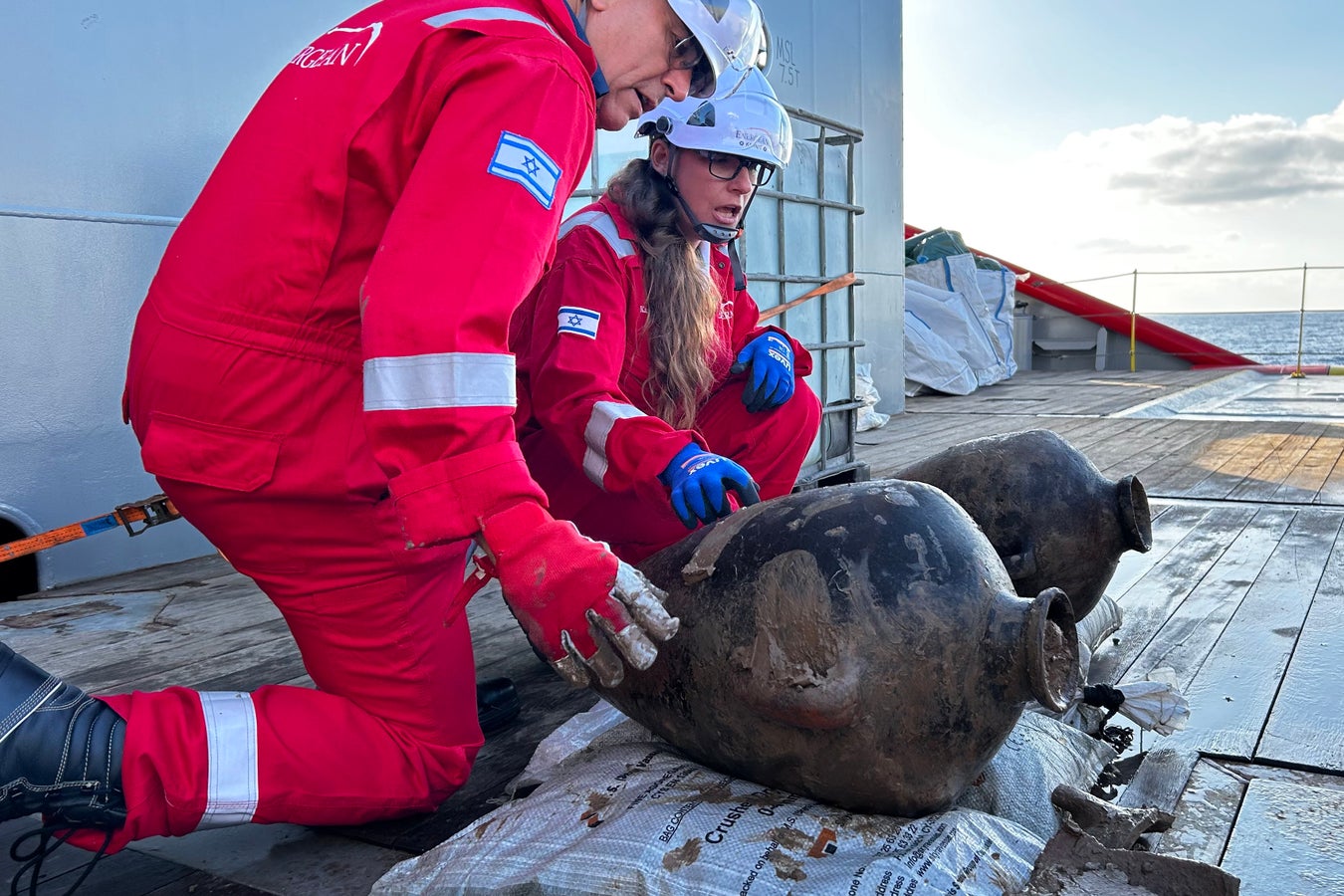
IAA archaeologist Jacob Sharvit (left) and Energean environmental lead Karnit Bahartan examine Canaanite storage jars retrieved from the seafloor of the Mediterranean on May 30, 2024. They are from the Bronze Age (which ran about 3300 to 1200 BC, according to Wikipedia). 

Judging from past comments here, we all like archaeology stories, especially those that explore the mysteries of shipwrecks. It must be something about realizing that nothing is ever completely lost.

At Scientific American, Ilan Ben Zion reports on the recent discovery of a Bronze Age shipwreck in the Mediterranean.

“Golden sunlight fell on the two amphorae, still caked in brown ooze, as they breached the Mediterranean’s waves. Their ascent from the seafloor, more than a mile down and 60 miles from land, had taken three hours. It was the first daylight they had seen in at least 3,200 years, and they came from the only Bronze Age shipwreck discovered in deep waters.

“Archaeologists retrieved these Canaanite storage jars, just two from a cargo of dozens located far off northern Israel’s coast in May.

” ‘It’s the only ship from this period that was found in the deep sea,’ one of the final frontiers of archaeology, says Jacob Sharvit, director of marine archaeology at the Israel Antiquities Authority. Only a handful of other Late Bronze Age ships have been discovered — all of them in shallow coastal waters of the Mediterranean Sea, including in the Aegean Sea.

“Sharvit helped spearhead a complex archaeological operation far offshore, along with the Israel Antiquities Authority (IAA) and offshore gas firm Energean to retrieve the jars from the seafloor.

“In the Bronze Age people shipped these storage jars across the Levant starting around 2000 B.C.E., when maritime trade in the Mediterranean exploded.

“ ‘They’re always either pointy or rounded at the bottom,’ so they rock with ship’s motion but don’t tip over and break, says Shelley Wachsmann, a nautical archaeology expert at Texas A&M University, who was not involved in the research.

“These workaday ceramics evolved so consistently over the centuries that they can be reliably dated with an examination of their shape and design. Based on the recently discovered jars’ neck, the pronounced angle of their shoulders and their pointed base, these amphorae are estimated to date to between 1400 and 1200 B.C.E., the IAA said in a recent press release.

“At that time, the ship and its crew sailed a world of prolific international trade, diplomacy and relative stability in the eastern Mediterranean, which was dominated by the Egyptian and Hittite empires. Merchant ships carrying olive oil, wine, ores, timber, precious stones and numerous other goods plied the seas between Greece, Cyprus, Anatolia, the Levant and Egypt.

” ‘This is the time that the Mediterranean is globalized,’ says Eric Cline, a professor of archaeology at George Washington University. ‘You’ve got lots of commerce, lots of diplomacy and lots of interconnections’ between the Egyptian, Hittite, and Assyrian empires and the lands between them, says Cline, whose newly published book, After 1177 B.C.: The Survival of Civilizations, explores the aftermath of the collapse of this Late Bronze Age international order.

In our own era of globalization, this disintegration draws particular interest among scholars looking for clues into how stable civilizations foundered in the past.

“The first signs of the shipwreck surfaced in 2023, during an environmental survey that Energean conducted ahead of its development of a new undersea natural gas field. The survey’s sonar scans were meant to locate and protect deep-sea ecological hotspots from undersea construction, says Karnit Bahartan, Energean’s environmental lead.

“Subsea surveys of the nearby Leviathan gas field conducted in 2016 by Noble Energy (now part of Chevron) reportedly turned up at least nine deep-sea archaeological sites, including a Late Bronze Age shipwreck. But details of the finds were never disclosed, and the sites were never excavated, according to a Haaretz report in 2020.

“ ‘What we were doing is looking for sensitive areas, sensitive habitats, anything that can be worth saving,’ Bahartan recalls.

“Closer examination of the sonar hits revealed that most were modern trash, Bahartan says as she flips through photographs taken by a remotely operated vehicle (ROV). The images show plastic bags, deck chairs, oil drums and a porcelain toilet, seat included. Occasionally, she says, she and her colleagues might find a solitary amphora or ceramic fragments.

“But one sonar blip turned out to be a large assemblage of jars jutting out of the seabed. ‘I didn’t know if it was something dramatic or not. I just sent it to the [Israel] Antiquities Authority,’ Bahartan says.

“Energean offered the IAA a ride onboard the Energean Star, an offshore supply and construction vessel. … Six hours out of Haifa’s port, the Energean Star hovered over the wreck’s coordinates, and a crane lowered a truck-sized, canary-yellow-and-black ROV into the sea. It took an hour to descend to the bottom. Nearing the seabed, operators released the ROV toward the site. …

“Dozens of jars, nearly identical and about half a meter long, clustered in an oblong patch roughly 46 feet long and 19 feet across. … The ROV circumnavigated the wreck, taking a high-resolution video that would be stitched into a photomosaic of the site. Sharvit picked out a couple jars from the fringes that could be extracted with minimal disturbance.

“Sharvit had hoped to find the ancient crew’s personal effects to help nail down the ship’s origin but spotted none. The IAA is running a so-called petrographic analysis of the ceramics to try to pinpoint where they came from; analyses of residue and trace elements could help identify their contents.

“Cline, who was not involved in the IAA mission or its preliminary study, says the proposed date ‘would place the wreck right in the middle of the most interconnected period of the Late Bronze Age in the Aegean and eastern Mediterranean, which is exciting.’ ”

More at Scientific American, here.
Read Full Post »

Photo: Espen Finstad/Secrets of the Ice.
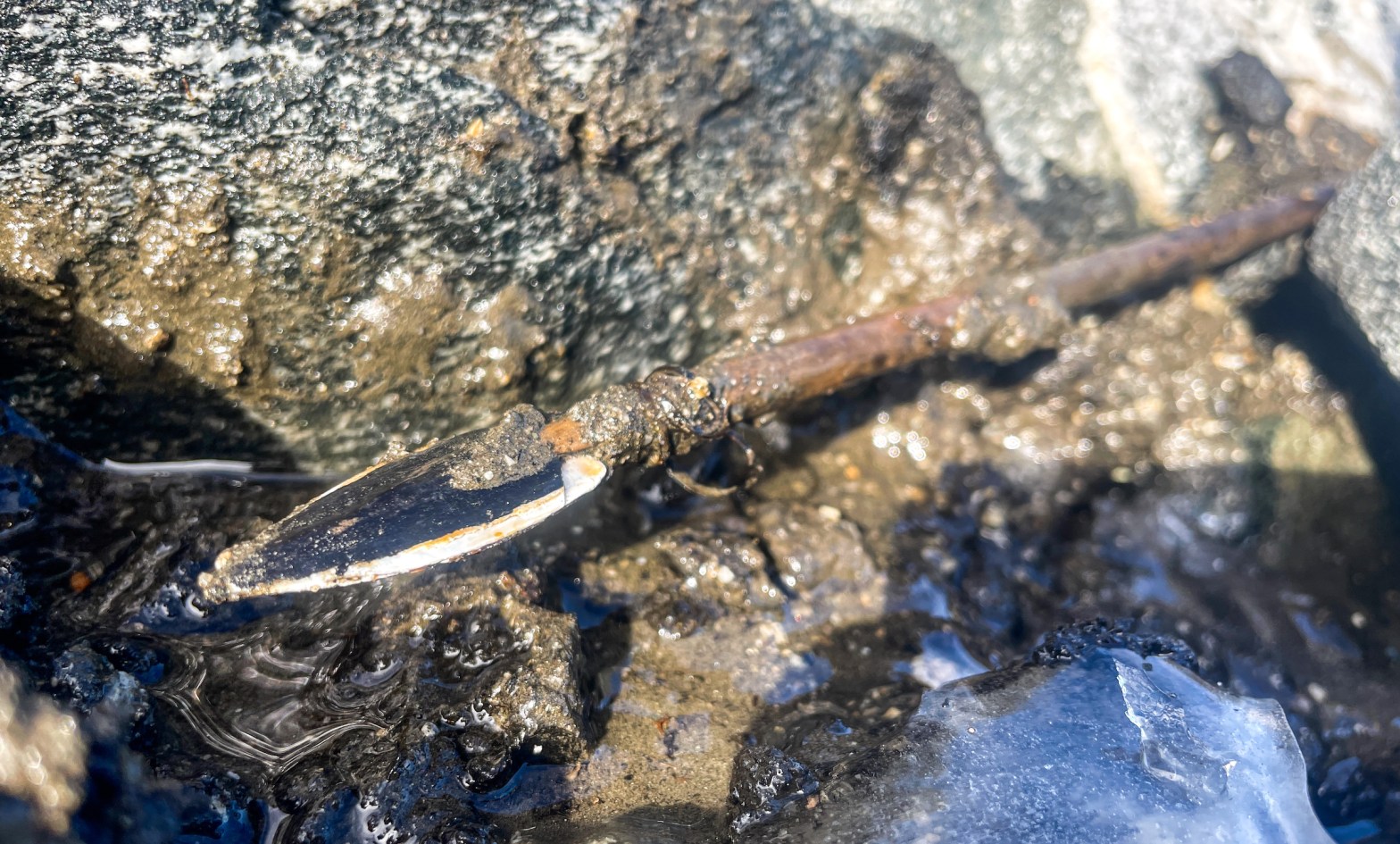
Melting glaciers are revealing older and older artifacts. Archaeologists discovered the arrow above in Norway’s Jotunheimen Mountains. Made out of freshwater pearl mussel, it’s one of the best preserved findings so far.

I hesitate to say that anything about climate change has an upside, but we might as well enjoy the things that keep being revealed — at least until we reach the more important goal of controlling global warming.

At Hyperallergic, Maya Pontone reports on melting glaciers in Norway and the latest Bronze Age discoveries.

“Archaeologists trekking through the Jotunheimen Mountains in Norway’s Innlandet County,” Pontone writes, “came across a remarkable find — an intact shell arrow dating back to the Early Bronze Age. Fastened with an arrowhead made of freshwater pearl mussel, the well-preserved hunting tool dates back 3,600 years and is one of eight shell arrows that have emerged from melting ice in Norway in recent years.

“On September 13, archaeologist Espen Finstad and his research team came across the artifact while checking a site as part of a routine monitoring job they typically run at the end of the field season. While the discovery of the ancient weapon was an unprecedented surprise that day, it is just one of hundreds that the Secrets of the Ice glacial archaeology team has uncovered over the past decade due to climate change.

“ ‘The glaciers and ice patches are retreating and releasing artifacts that have been frozen in time by the ice,’ Lars Holger Pilø, co-director of the archaeology program, told Hyperallergic. …

“The archaeologists have been continuously rescuing artifacts from Innlandet’s glaciers and ice patches since the fall of 2006, when the first ‘big melt‘ hit the Jotunheimen Mountains, located northwest of Oslo. [It’s the] home of the mythological jötnar, the rock and frost giants in Norse folklore. …

“ ‘Now the artifacts are exposed and deteriorating fast, so we are in a race against time to find and rescue the artifacts,’ Pilø said.

“So far, the Secrets of the Ice research team has mapped 66 ice sites and recovered approximately 4,000 finds including hunting gear and tools, textile remnants, transportation equipment, and clothing materials. The team has also found biological specimens such as antlers, bones, and dung.

“ ‘Arrows with shell arrowheads only became known in Europe when they started melting out of the ice in Norway,’ Pilø explained about the recent discovery. …

“As global warming transforms Norway’s mountainous landscape, Finstad, Pilø and their fellow glacier archaeologists are rushing to collect the exposed artifacts, which continue to get older as the ice continues to melt.

‘Most of the ice here in Norway will be gone in this century,’ Pilø said. ‘You can say that we are melting back in time.’

“Just last week, the team recovered another arrow, this one with an intact quartzite arrowhead, that is ‘probably 3000 to 3500 years old,’ according to Pilø. The team also found an iron horse bit with remnants of a leather bridle, a Medieval horseshoe, a Viking age knife, and an arrowhead for a crossbow bolt this month.

“ ‘The finds are incredible, but the reason they are melting out is sad,’ Pilø said, explaining how the ice melt will lead to drastic changes in Norway’s landscape, local wildlife, agriculture, tourism, and hydro-electrical power plants dependent on glacial water.

“ ‘It will be a very different world,’ he lamented.”

Feel free to revisit my February post about amateur archaeologists in Norway — the three buddies who under cover of darkness have found hundreds of previously unknown rock-carving sites. Click here.

More from Hyperallergic, here.

Read Full Post »

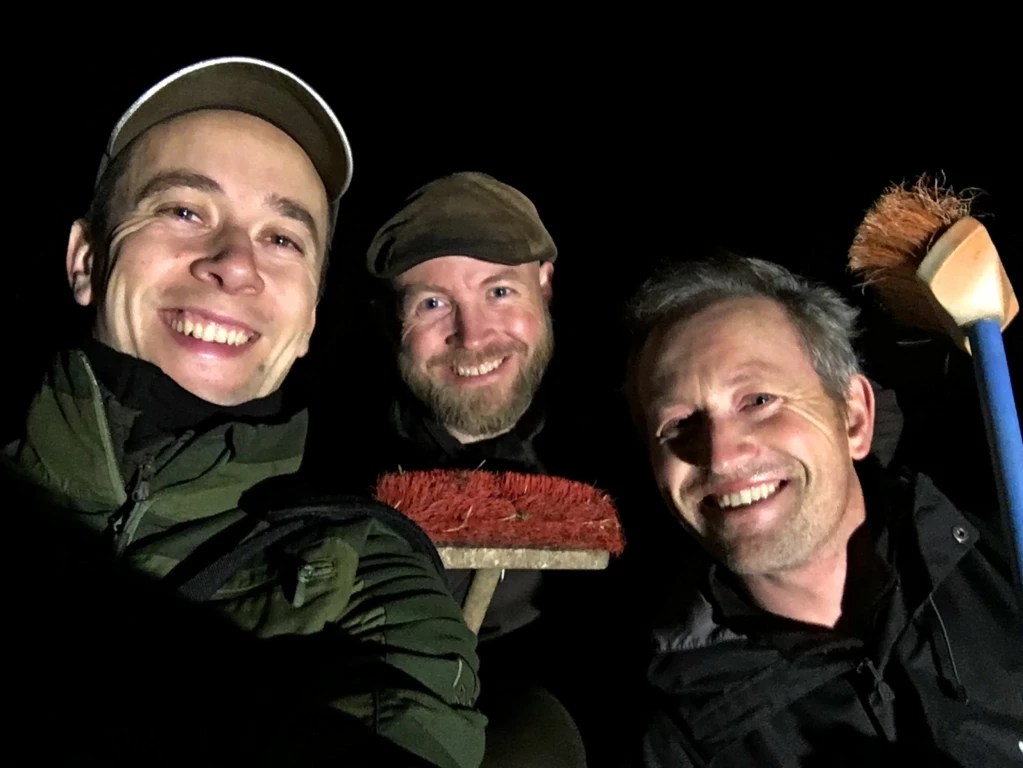
Photo: Science Norway.
According to Science Norway, all it took was a smart hypothesis and a few brooms. Together, the three friends have discovered hundreds of previously unknown rock carving sites in the Østfold landscape in the last 3-4 years.

Some good buddies hang out in a bar together. Some go bowling together or maybe running. The buddies in today’s story hunt Bronze Age petroglyphs. At night.

Lisa Abend writes at the New York Times, “It was December and the first snow of the season was falling when the three friends set out on their weekly hunt through the fields of Ostfold, in southeastern Norway. … Tromping across the blanketed farmland, the men came to a low outcrop of rock, a few feet wide. With a child-size plastic broom, they brushed away the newly fallen snow from the stone to reveal the outline of a ship, its curved keel carved into the granite roughly 3,000 years ago.

“It was just one of more than 600 Bronze Age rock carvings, known as petroglyphs, that Magnus Tangen, Lars Ole Klavestad and Tormod Fjeld have discovered. Since making petroglyph hunting their collective hobby in 2016, the three enthusiasts have transformed knowledge about prehistoric art in Norway, more than doubling the number of carvings known in their home region. And although they are motivated, in part, by the pleasures of friendship and the outdoors, their findings have also lent serious weight to theories about the mysterious petroglyphs’ meaning.

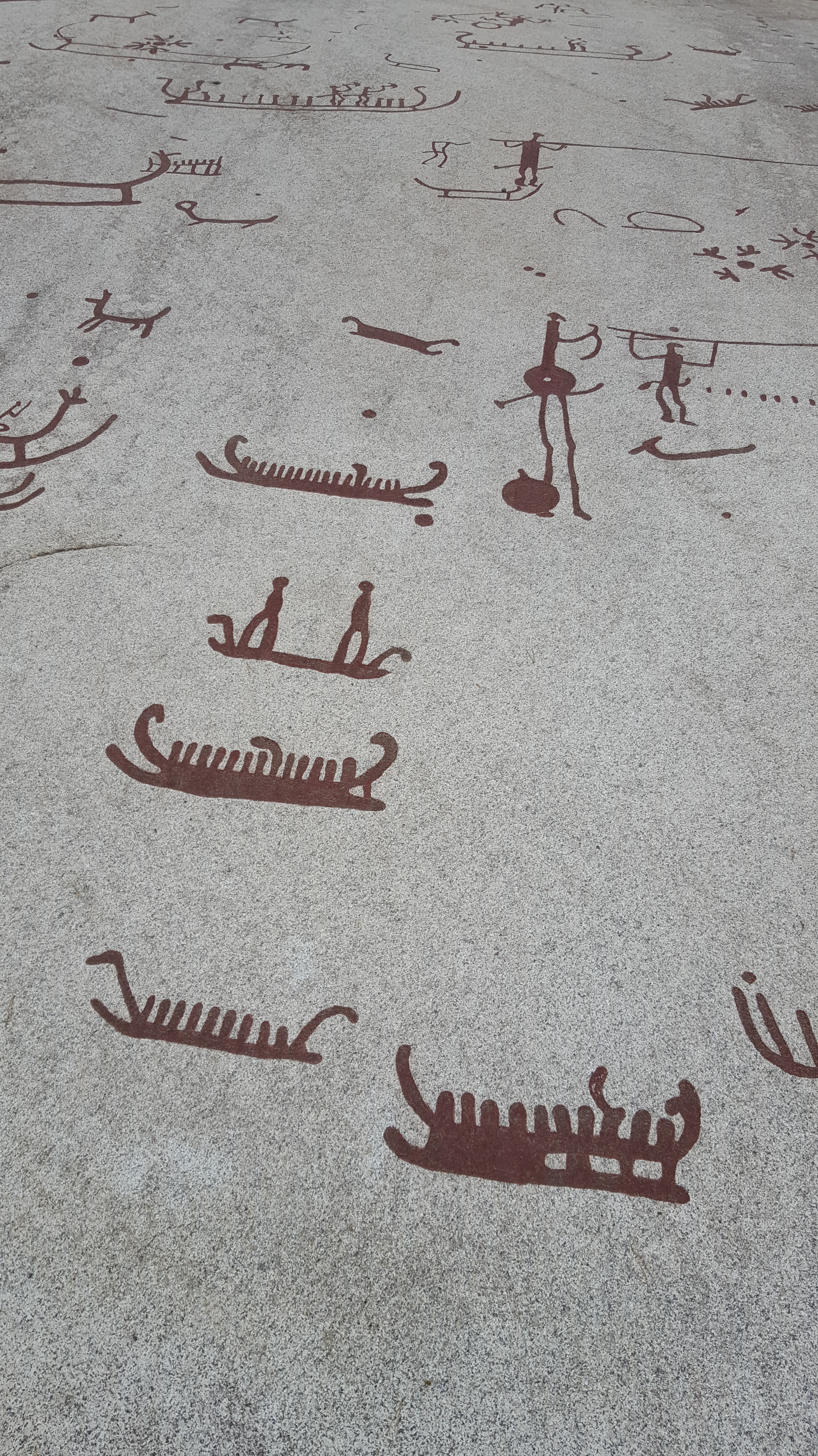
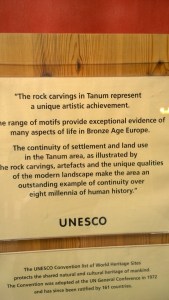
“Rock carvings from the Bronze Age (which in Scandinavia began around 2,000 B.C.) are common in parts of Sweden and Norway. Regions in both countries have been declared UNESCO heritage sites because of the density and the diversity of the images, which include human figures, animals, geometric shapes and, frequently, ships. Yet because they are commonly cut into granite that is low to the ground and easily obscured by leaves or snow, they often go unnoticed.

“Petroglyphs are also easier to see when the sun is not overhead — a realization that has been one of the keys to the three friends’ success. Because the hunt for them is a hobby rather than a career — Tangen is an archaeologist working in a different field, Fjeld a graphic designer, and Klavestad a landscape architect and artist — they make time for it at night. …

“The thrill of the hunt has naturally led them to speculate on the carvings’ meaning. Because the petroglyphs tend to be more visible in the slanted rays of dusk, or with angled artificial lights, Tangen said he believed that their creators had made deliberate use of shadow and light in their work. Thanks to the sun’s changing angle, petroglyphs can look different depending on the hour of the day, or season, he explained. ‘I think the images have to do with the awakening of people’s minds to time,’ he said.

“That is in keeping with findings from professional archaeologists about rock art and stone monuments, in places like British Columbia and Scotland, whose features are visible only at certain times of year. There is also evidence for another one of Tangen’s theories: that some of the images were meant to be seen in flickering light, so that they appeared almost animated.

“Kristin Armstrong-Oma, a professor of archaeology at the University of Stavanger, said that ‘in excavations around some carvings, archaeologists have found signs of burning or charcoal.’ That suggested fire was being used, almost like a movie camera. ‘The living flames give the carvings a feeling of movement,’ she said.

“The petroglyph-hunting trio got their start in 2016, when Fjeld, the graphic designer, was walking his dog in the countryside and found a strange mark in a rock. He wondered if it was made by humans, or nature. Trying to identify it online, he came across a website with photos of petroglyphs, and contacted its owner, Tangen, who suggested Fjeld’s find could be a Bronze Age cup mark — a simple, round carving that is a common motif in prehistoric art.

“His interest piqued, Fjeld started paying better attention on his walks, and soon found a carving that was unmistakably made by human hands: an image of a ship. ‘That was very, very fun,’ Fjeld said. ‘So I started going on a regular basis.’

“Tangen, who had made similar discoveries while walking his own dog, joined him, and before long suggested that they invite Klavestad, a local enthusiast who had found his first carving when he was 10.

“ ‘We didn’t know each other, but I hadn’t met anyone else with so much passion for it,’ said Klavestad. ‘We are, all three, very dedicated.’ “

More at the Times, here.

Petroglyphs I saw in 2017 at a UNESCO-protected World Heritage Site in Sweden. Some have been painted red to make them more visible for tourists, a practice which has drawn criticism.

060217-petroglyphs-by-Stuga40-Sweden

Read Full Post »

Photo: Crown Office Communications/PA
These Bronze Age objects were found buried underground by a Scotsman with a metal detector who was obliged to work near home during the pandemic.

And speaking of discoveries made when plague regulations keep folks close to home … how about this significant find by a Scotsman with a metal detector!

As Amy Walker reports at the Guardian, “Metal detectorists, it’s fair to say, have had a good lockdown. Last month it emerged that amateur treasure hunters had unearthed dozens of rare finds in their back gardens while restrictions kept them at home.

“Now a detectorist in the Scottish Borders has uncovered a haul of bronze age artefacts – including a complete horse harness and preserved leather and wood – in what is described as a ‘nationally significant’ discovery.

“Among items also pulled from the ground after Mariusz Stepien’s initial find in a field near Peebles was a sword dated from 1000 to 900BC.

“Stepien had been metal detecting with friends on 21 June when he came across a bronze object buried half a metre underground. As he received such strong signals from the earth around the object, he reported the find to the Treasure Trove unit.

“The moment of the find was emotional.

‘I felt from the very beginning that this might be something spectacular and I’ve just discovered a big part of Scottish history. I was over the moon, shaking with happiness,’ he said.

“Archeologists spent 22 days investigating the site, during which Stepien and his friends camped in the field. ‘We wanted to be a part of the excavation from the beginning to the end,’ he said. ‘Every day there were new objects coming out which changed the context of the find, every day we learned something new. I’m so pleased that the earth revealed to me something that was hidden for more than 3,000 years.’

“The archeologists found the sword, still in its scabbard, which had been adorned with straps, buckles and chariot-wheel axle caps, alongside remnants of a decorative ‘rattle pendant’ that would have hung off the horse’s harness – the first to be found in Scotland and only the third in the UK.

“Treasure Trove, which is overseeing the recovery and assessment of the find, said the soil had preserved the leather and wood found among the items, allowing experts to trace the straps that connected the rings and buckles together to make the harness, something that has ‘never been seen before in Britain.’ …

“With detecting in the open off limits between March and May, many amateurs looked closer to home during lockdown … Peter Reavill, a finds liaison officer from Shropshire, said: ‘With so many people spending so much more time in their gardens, there have been some really interesting finds. …’

“Simon Maslin, a finds liaison officer in Surrey and Hampshire, [said], “It’s the stuff that appears more humdrum that actually tends to be more archeologically important.’ ”

More at the Guardian, here.

Read Full Post »

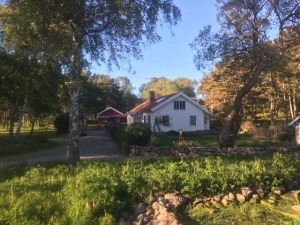
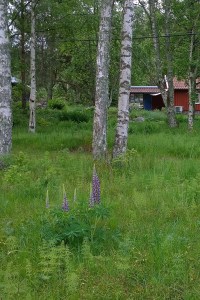
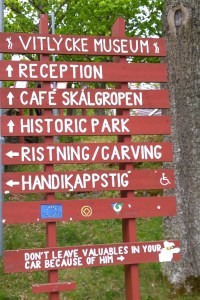
I love the family compound belonging to our hosts, with its birches, lupines, red cottages, and blue doors. Stuga 40 and I took photos there and at the nearby Vitlycke museum, a World Heritage site, where we saw ancient petroglyphs and a Bronze Age garden.

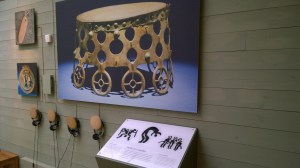
Near the garden were goats chewing their cud and two different kinds of shelters replicating life before 500 BC. It didn’t look luxurious. My photo of  Bronze Age instruments, below, is especially for Modern Age musician Will McC.

060217-staying-in-Sweden

060217-lupines-Veddo-Sweden


060217-birches-and-lupines

060217-hobbit-door-Sweden


060217-Vitlycke-Museum-Sweden

060217-about-the-rock-carvings


060217-petroglyphs-Tanum-Sweden

060217-Bronze-Age-instruments-Tanum-Sweden


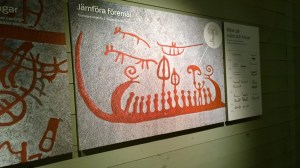
060217-petroglyphs-in-museum

060217-petroglyphs-by-Stuga40-Sweden


060217-Bronze-Age-garden-Sweden


Read Full Post »