Feeds:
Posts
Comments

Posts Tagged ‘brownfield’

Photo:  Patrick T. Fallon/AFP via Getty Images.
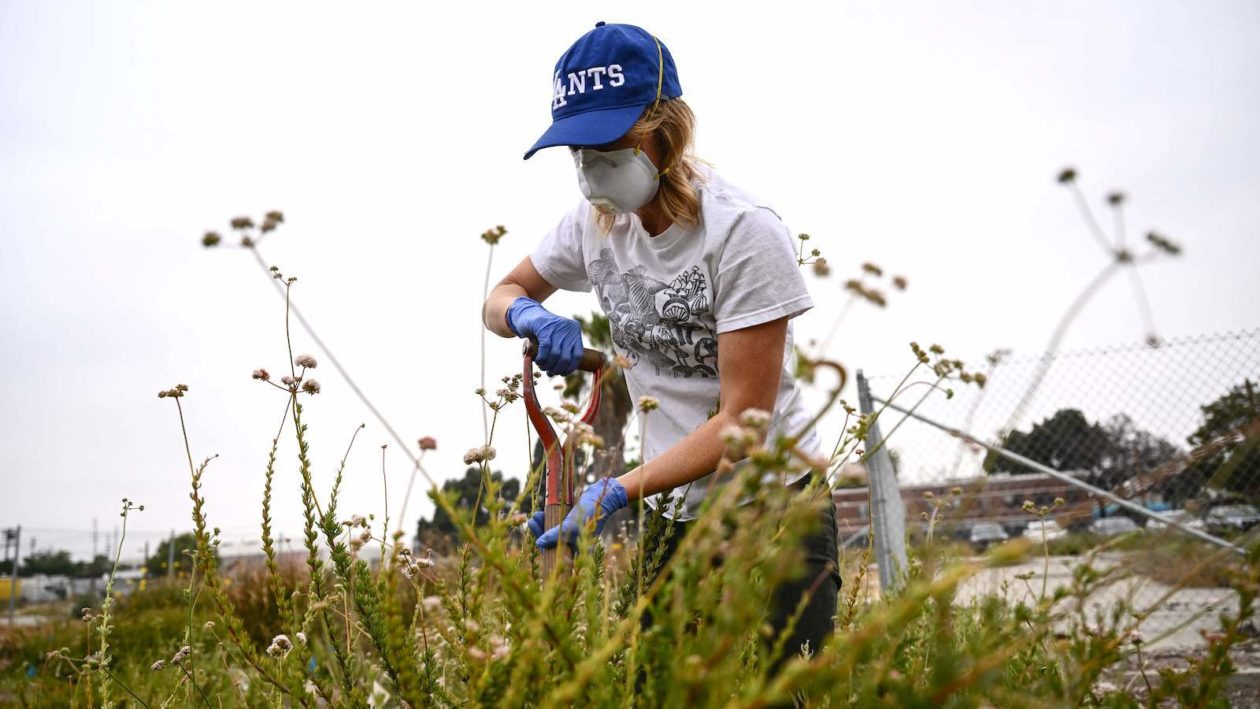
Researcher Danielle Stevenson digs up California buckwheat grown at a brownfield site in Los Angeles.

Given the mess we humans make of the environment, I have to be grateful that we can learn ways to clean things up. And to be fair, we don’t always realize we’re making a mess until it’s too late.

Richard Schiffman at Yale Environment 360, explains one new technique for cleaning things up: harnessing the power of fungus.

“The United States is dotted with up to a million brownfields — industrial and commercial properties polluted with hazardous substances. These sites are disproportionally concentrated near low-income communities and communities of color, according to the Environmental Protection Agency, and researchers predict that heavy rains and flooding due to climate change are likely to both spread and increase exposure to these contaminants.

“For more than 15 years, Danielle Stevenson, who holds a PhD in environmental toxicology from the University of California, Riverside, has been pioneering a nature-based technique for restoring contaminated land, using fungi and native plants to break down toxins like petroleum, plastics, and pesticides into less toxic chemicals.

“The usual way of dealing with tainted soil is to dig it up and cart it off to distant landfills. But that method is expensive and simply moves the problem somewhere else, Stevenson says in an interview with Yale Environment 360, ‘typically to another state with less restrictive dumping laws.’

“In a recent pilot project funded by the city of Los Angeles, Stevenson, 37, working with a team of UC Riverside students and other volunteers, significantly reduced petrochemical pollutants and heavy metals at an abandoned railyard and other industrial sites in Los Angeles. While her research is still in its early stages, Stevenson says she believes her bioremediation methods can be scaled up to clean polluted landscapes worldwide.

Yale Environment 360: I understand that you grew up on the shores of Lake Erie in a highly polluted area.

Danielle Stevenson: The Cuyahoga River, near Lake Erie, used to catch on fire from oil spills. There’s a huge amount of industrial agricultural runoff that leads to toxic algae blooms. The second-largest floating plastic island of the Great Lakes is in Lake Erie.

“But I was surprised to see abandoned oil refineries and factories with trees, plants, and mushrooms growing. I mean, they’ve found fungi growing in Chernobyl in a melted down nuclear reactor. I’ve been on sites that look so desolate and bleak, where the air smells like diesel. It looks like nothing could possibly live there. But when we sample the soil, we always find life, and we especially find fungi that are really resilient and have found a way to live in those conditions and get some sort of food from the pollution.

e360: So you became interested in fungi, eventually founding your own mycoremediation company, D.I.Y. Fungi. What are fungi?

Stevenson: They are their own kingdom of life. They are not bacteria, not a type of plant or animal. Some fungi form mushrooms [as their fruiting bodies], like the ones we like to eat. Other fungi do not form mushrooms but create these beautiful dynamic networks throughout forests and grasslands that connect to the roots of plants. Fungi are largely overlooked, but it is a really important kingdom without which we wouldn’t have soil or the carbon cycle or so many other really important functions in our ecosystems.

e360: How do fungi help restore contaminated soil?

Stevenson: Decomposer fungi can degrade petrochemicals the same way they would break down a dead tree. And in doing so, they reduce the toxicity of these petrochemicals and create soil that no longer has these contaminants or has much reduced concentrations of it. They can also eat plastic and other things made out of oil, like agrochemicals. …

e360: You worked at industrial sites in Los Angeles that were highly contaminated with heavy metals: How did the fungus help there?

Stevenson: Unfortunately, most metals don’t break down because they’re not carbon-based. In nature, it’s actually plants that pull metals out of soil. And so there are fungi, they’re called arbuscular mycorrhizal fungi, that can help plants do that better. And so on Taylor Yard [the Los Angeles railyard] and other sites, I’ve worked with a combination of decomposer fungi, arbuscular mycorrhizal fungi, and plants that we previously found to be able to pull metals like lead and arsenic out of the soil into their aboveground parts. These plants can then be removed from the site without having to remove all of that contaminated soil.

e360: How did the sites look different after the work that you did on them?

Stevenson: They became basically beautiful meadows of native plants that were flowering, and now there are bees and birds and all sorts of life coming through. We had a very high success rate. In three months we saw a more than 50 percent reduction in all [petrochemical] pollutants. And then by the 12-month period, they were pretty much not detectable.”

The rest of this article — on reusing some metals, on working with tribes — is fascinating. Read at e360, here. No paywall.
Read Full Post »

Photo: What Cheer Flower Farm.

Today’s story shows, among other things, that if you pick a really good name, you’re halfway to your goal. Who wouldn’t be drawn to a charity with a name like What Cheer Flower Farm?

And wait till you hear what it does! Frank Carini’s ecoRI News story was originally reported in 2018.

“The place was a complete mess, but a trio of determined women was going to buy it anyway, as soon as the seller removed about 50 tattered mattresses from the dilapidated building.

“The 2.7-acre property was covered with wind-blown trash. More than a year later, the three women are still picking up broken glass. … They ripped up poison ivy by gloved hand, and brought in a tractor to help tear down the overgrowth. The empty factory with a brick facade, largely vacant since the 1990s, has no running water or electricity, is covered in graffiti, has been the victim of arson, and has been gutted of all scrap metal.

“ ‘The property was neglected for years,’ said Shelby Doggett, who, at 25, is the youngest of the three buyers.

“The women, Doggett, her mother, Marian Purviance, and Anne Holland, bought the derelict property for $525,000, so they could give away flowers.

What Cheer Flower Farm was incorporated [in October 2017] and it acquired the former site of the Colonial Knife Co., forgotten industrial land in the heart of the city’s Olneyville neighborhood, not far from Route 6, this spring.

“After the sale became final, the first two essential items the women had delivered were a port-a-potty and a truckload of compost.

“This new urban farm, at 46 Atwood St., only began its growing season two months ago. The seeds were planted late in the season because there was plenty of other work to do first. For one, the property was covered in pavement.

“Some 4,000 square feet of parking lot was torn up and transformed into an organic raised-bed ‘field’ of flowers, both perennial and annual. Purviance, the farm’s horticultural director, has years of garden cultivation and management experience.

“ ‘I worked in the fine-gardening business for a long time, and I worked for very high-end clients. A lot of them really didn’t even appreciate what it was to have a garden and how much a flower really means,’ said Purviance, 57, a 30-year resident of Providence.

‘I get so much more satisfaction out of working on this project than I did working for people who take that for granted.’

“The nonprofit flower farm with two full-time farmers — Purviance and Doggett, who as the program director also handles the administrative side of things; Holland is the communications manger — and with support from volunteers, grows organic flowers on a brownfield site.

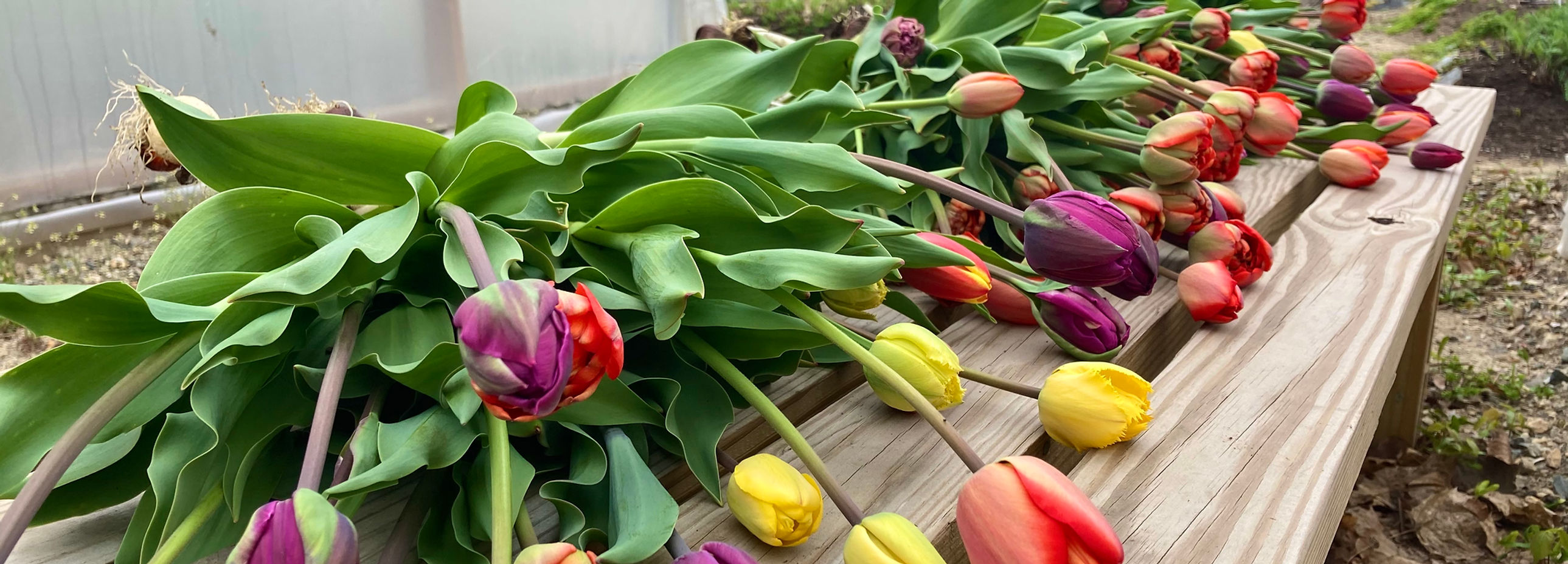
“They give their product away to ‘people who deserve flowers but don’t have access,’ Purviance said.

“To supply those people who deserve flowers, What Cheer Flower Farm has partnered with Amos House, the Ronald McDonald House of Providence, and Meals on Wheels of Rhode Island. The women deliver bouquets and buckets of cut flowers to these institutions and other partners.

“About 90 percent of the flowers currently being grown at the farm were started from seed by Purviance in her kitchen and in a friend’s basement. The rest of the plants were donated by Green Animals Topiary Garden in Portsmouth. …

“Besides brightening people’s lives with free flowers — 1,000 have so far been donated — the nonprofit’s mission also includes reversing urban blight, creating a job training center for Rhode Island residents to help them enter the state’s $2.5 billion ‘green’ economy, and making Providence famous for urban flower farming.

“Chicken manure from Scratch Farm and horse manure from a gentleman farmer in Rehoboth, Mass., have been used to build soil. … The farm rents a meter from Providence Water, which allows it to use a fire hydrant for watering. The water is stored in donated tanks of various sizes.

“Where the dilapidated building now stands, the co-founders envision a barn, classroom space, an office, and space for lease. …

“What Cheer Flower Farm has applied for a brownfield remediation grant with the Rhode Island Department of Environmental Management. An ongoing inventory assessment didn’t find elevated levels of polychlorinated biphenyls (PCBs). The owners have worked with the National Resources Conservation Service and David Foss of Wilcox & Barton Inc., a Vermont-based environmental consulting firm.

“The property is in better toxic shape than the new owners predicted, but there’s still much work to be done. Much of that work will revolve around fundraising. As a 501(c)(3), the organization will rely on grants, donations, volunteers, and kindness. They also plan to host fee-based workshops for hobby gardeners and amateurs.”

From the farm’s website: “Our staff are busy working on growing, rescuing and giving away flowers. You can visit as a volunteer, or as an artist who wants to work outside en plain air or as a group seeking a tour. …

“What Cheer Flower Farm is a nonprofit dedicated to bringing solace, joy and healing to the people of Rhode Island via flowers as well as supporting our local floral economy via job training.

“We grow, rescue and give away 100,000 flowers per year and are on track to expand to giving away 300,000 flowers per year in the next five years. We never sell flowers – all are given away freely via our network of local nonprofits and organizations serving Rhode Islanders including hospitals, senior services, recovery centers, shelters, hospices and food pantries. …

  ” 2022 Achievements

  • “92,000 flowers grown, rescued and given away
  • “$50,000 grant won from United Way/Social Enterprise Greenhouse
  • “Relaunched Flower Festival named ‘The Best Thing to Do in RI’ by The Boston Globe.”

More at ecoRI News, here. No firewall.

Read Full Post »

Here’s some good news about south Chicago.

Aaron Cynic writes at Shareable, ” ‘Communication, collaboration, cooperation—those are skills, not just words,’ said Salim Al-Nurridinn, founder of the Healthcare Consortium of Illinois, while standing at the gate of the Cooperation Operation (Coop Op). As the sun slowly began to set on Chicago’s South Side, more than 100 people were gathered in front of a fence surrounding a brand new community garden. …

“What was once a toxic vacant lot is now home to raised garden beds filled with kale, basil, tomatoes, cabbage, carrots, and even a few stalks of corn. Many of the beds are made from repurposed boats donated by a nearby marina, a partnership that another local community organization called Friends of Pullman helped to broker. …

“Since the group began building the garden, long-time residents of the Pullman Neighborhood have been a part of the process. Charles Winston, who has lived in the neighborhood for decades, said he began volunteering his time from the beginning.

“ ‘I just came on over,’ he said. ‘I saw people over here so much and said, “I should be over here volunteering my services too.” If we can get everybody to do that, it’d be a wonderful thing.’ ” More.

The Christian Science Monitor collects stories like these from all over the world — and there are lots of them — and features them in the Making a Difference section of the online paper.

Photo: Shareable
Salim Al-Nurridinn cuts the ribbon to open a new community garden created by volunteers on Chicago’s South Side.


Read Full Post »