Feeds:
Posts
Comments

Posts Tagged ‘Buddhist’

Photo: Tulsi Rauniyar.
Climate-ravaged monasteries in Lo Manthang, Tibet, have been meticulously restored by the local community with guidance from experts.

Tulsi Rauniyar wrote recently at the BBC about ordinary Tibetans learning to restore Tibetan monasteries, rescuing them from the consequences of climate change.

“Extreme weather is threatening these intricate 15th Century Tibetan monasteries,” Rauniyar reports, “but local people are rising to the challenge to preserve them.

“Tashi Kunga stands before the Kag Choede monastery, built into the Dhaulagiri mountain range on the Tibet-Nepal border. The monk’s carmine robes glint in the rain, as he recounts the ancient legend of Guru Rinpoche’s battle with a demon.

“The legend goes that centuries ago, a demon wreaked havoc on a monastery in Tibet. Guru Rinpoche chased it south to Upper Mustang in Nepal and defeated the demon following a ferocious battle, burying the demon’s remains across the mountain range. The people of Mustang hono The people of Mustang honoured the sacred grounds by building monasteries atop the demon’s body parts.

” ‘And right on the demon’s heart, the capital of Lo Manthang [was built] in 1380,’ says Kunga, pointing towards the narrow alleys, ancient monasteries, and flat roofs adorned with prayer flags of one of the last medieval walled cities in the world.

“For centuries, Lobas, the indigenous people residing here, have thrived in this remote region situated on top of the Tibetan Plateau. One thing that has remained constant is the monasteries, locally known as ‘Gonpas,’ the most treasured heritage of the region. But almost two decades ago, many of these monasteries, which date back to the 15th Century, started crumbling.

Experts sounded the alarm, attributing the collapse to the severe impacts of climate change. Data indicates a significant increase in the intensity of storms and rainfall across the region. Increased rainfall saturates the rammed-earth buildings, as moisture in the soil is drawn upward into the walls, leading to issues such as leaking roofs and rising damp.

” ‘For us, Buddhists, the paintings and the artifacts in the monasteries are embodiments of the gods themselves, and we can’t worship a half-damaged idol,’ says Kanga.

‘There was no one to repair it. Our heritage was slowly decaying away. We thought the deities were angry.’

“Buddhist monasteries have long been revered as the foundation of Tibetan culture, serving as a vital hub for the creation and safeguarding of both tangible artifacts and profound intellectual traditions. But as unprecedented weather patterns pose a threat to their cultural heritage, local community members have stepped up to restore them. Local people have gained diverse skills, from reinforcing walls to crafting metal statues and restoring paintings.

“Over the past 20 years, a team of local Lobas trained by Western art conservationists have replaced the old, leaky roofs of the temples with round timbers, river stones, and local clay for waterproofing, and have restored the wall paintings, statues, sculpted pillars and the ceiling decorations, giving these centuries-old monuments a new life.

“Luigi Fieni, the lead art conservator at Lo Manthang, has spearheaded the restoration project. Transforming a community of farmers into conservators has been challenging, he says. Most of the Lobas had never held a pen or a paint brush before, and undertook extensive training before they began restoring the 15th Century paintings.

” ‘But it all worked out,’ says Fieni. ‘Tourists visiting Mustang were keenly interested in religion. So we felt these sacred artifacts needed preservation not only for their historical significance but also for sustaining livelihoods here.’

“The team, initially made up of 10 members, has grown to 45 conservators, mostly women, although there was initial reluctance to accept any women in the group. According to local tradition, women are prohibited from touching sacred objects. However, women did eventually take part in the Lo Manthang restoration project.

” ‘It took years of discussion and negotiation with the local clergy and community, but we succeeded in including local women in the wall-painting conservation team,’ says Fieni. …

“Tashi Wangmo, 40, used to spend her time herding yak, collecting and selling herbs, and doing various odd jobs, but it never provided much income. When she received the opportunity to pursue new training and earn a daily wage in the restoration project, she jumped at it.

” ‘It enabled many of us [women] to break free from the limits of our homes, expand our skillsets, and find new opportunities,’ she says.”

More at the BBC, here. No paywall.

If you want to learn about Tibet through some wonderful fiction, check out the Tibet mysteries by Eliot Pattison, starting with The Skull Mantra.
Read Full Post »

Photo: AP.
A Buddhist community anchored by a temple in Hampton, Minnesota, is drawing dancers of all ages.

It’s interesting to see what draws people to a faith community — besides faith. When we moved to a town where we didn’t know anyone, I visited several churches and chose the friendliest one. As we got involved, we got acclimated. The children made friends, and I got to know parents who filled me in on the best public school teachers.

Other people may join for other reasons. Consider the dance opportunity in today’s story.

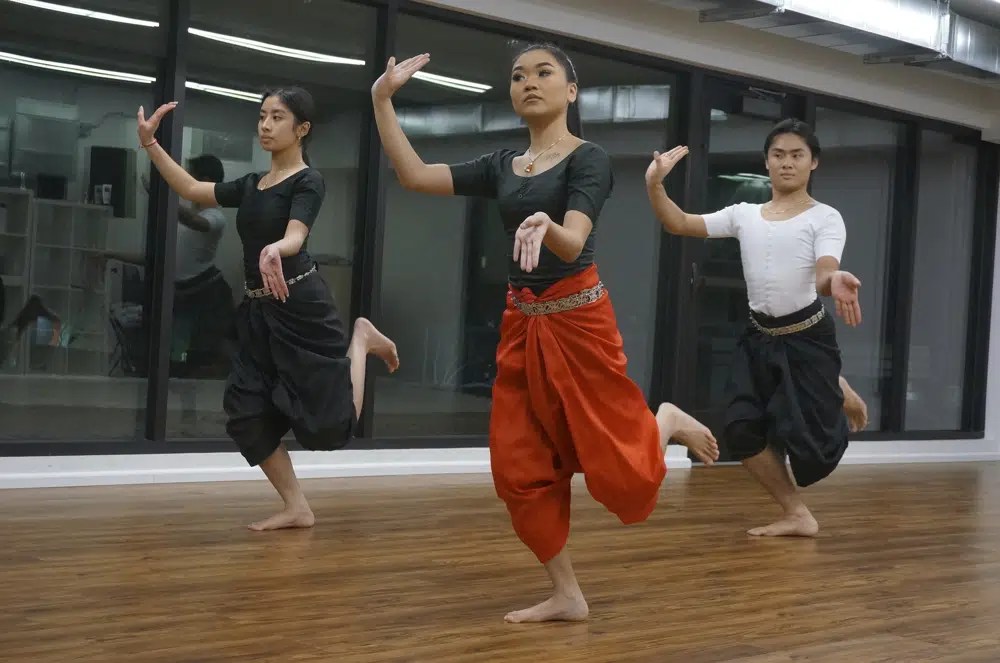
Giovanna Dell ‘Orto reports at the Associated Press (AP), “The Buddhist community anchored by an ornate temple complex here in the Minnesota farmland is trying a new way to ensure its faith and ancestral culture stay vibrant for future generations — an open call for the sacred dance troupe.

“Founded by refugees fleeing the Khmer Rouge regime, which sought to eradicate most religious institutions, Watt Munisotaram and its troupe hope that teaching young children sacred dance will strengthen their ties to both Buddhism and Cambodian traditions.

“ ‘The connection is stronger when I dance,’ said Sabrina Sok, 22, a Wattanak Dance Troupe leader. ‘The thing that stays in my head is this dance form almost disappeared with the Khmer Rouge.’

“During their 1975-79 regime, the Khmer Rouge caused the deaths of an estimated 1.7 million in Cambodia. Hundreds of thousands fled, first to neighboring Thailand and later the United States, where Southeast Asians are one of the largest refugee communities.

“They carried this sacred dance tradition with them. On a frigid early February evening, Sok rehearsed for the upcoming Cambodian New Year holiday with fellow troupe leader Garrett Sour and his sister Gabriella, whose parents were among those refugees. …

“While recruitment was by word of mouth, this winter’s enrollment — open to anybody eager to learn the dance form — brought in the highest number ever after being posted on the temple’s Facebook page.

“Clothed in traditional thick silk shirts and pants from Cambodia, the three dancers sinuously stretched and bent every part of their bodies, from joint-defying toe curls on up. …

“ ‘We’re never ourselves, we’re just physical embodiments of higher spirits,’ said Garrett Sour, 20, as he meticulously coached the poses, urging a smaller step here, a deeper calf tilt there. ‘Dance was seen not as entertainment but a medium between heaven and earth.’

“The marketing student at a Twin Cities university started dancing when he was six and has learned Khmer to better delve into the sacred storytelling. He will be one of the teachers for the incoming dancers – about 20, which nearly doubles the troupe, and most of them younger than teens. …

“In the temple’s ornate higher room, where the ten monks in residence chant and meditate daily surrounded by sacred books and large Cambodian-made paintings of Buddha’s life, the Venerable Vicheth Chum also highlighted the importance of what he called ‘blessed dance.’

” ‘Very important to have, and to keep our ancestral tradition even when moved to (Minnesota),’ said Chum, who came to the United States more than 20 years ago from Cambodia. ‘Buddhist teaching is practice for peace and happiness, no matter the nation.’

“Monks at Watt Munisotaram – which roughly means the place to enjoy learning from wise men – practice Theravada, one of the oldest forms of Buddhism rooted in Southeast Asian cultures. …

“Dozens of faithful in equally bright white outfits [met] to celebrate Magha Puja, a holiday marking the gathering of 1,250 of Buddha’s first disciples and the establishment of his rules for the new community.

“Chum and seven other monks in elaborately folded, bright orange robes led a candlelit procession multiple times past an altar with several golden Buddha statues, glittery decorations and a profusion of flowers including lotus blossoms – most artificial, though in more clement weather some are grown locally or shipped from Florida.

“Several children marched along, carrying the U.S. flag and Cambodia’s state and Buddhist flags, before everyone sat in neat rows on the carpeted floor for two hours of chanting in Khmer.

“Chum said the monks worry about young people’s growing disenchantment with religion but believe that life’s inevitable struggles will eventually bring most back to the temple for guidance from Buddha’s teachings. …

“ ‘The world is using them to educate the other communities, I keep on reminding them,’ Sophia Sour said. She hopes to take Garrett and Gabriella to Cambodia to learn even more about the roots of their spirituality, whose fundamental values she listed as respect for the elders and good deeds.

“ ‘If you do good, good will come to you,’ she said. ‘I’m not sure if that’s religion, or just life.’ ”

More at AP, here.

Read Full Post »

Image: Green Tara Protectress from Eight Fears; Tibet; 19th century; Pigments on Cloth; Rubin Museum of Art; Gift of Shelley and Donald Rubin. The Eight Fears are 1) water, (2) lions, (3) fire, (4) snakes, (5) elephants, (6) thieves, (7) false imprisonment and (8) ghosts.

When I was in New York this week visiting my sister, she suggested we go to the Rubin Museum on West 17th St. She told me that the museum, which opened in 2004, was notable not only for the founders’ Himalayan art collection but for its peaceful aura.

It really was a treat. Here’s what the website says about the current exhibit. “Gateway to Himalayan Art introduces visitors to the main forms, concepts, and meanings of Himalayan art represented in our collection. A large multimedia map orients the visitors and highlights cultural regions of a diverse Himalayan cultural sphere that includes parts of present day India, China, Nepal, Bhutan, and Mongolia. …

“In addition to sculptures and paintings, objects such as a stupa, prayer wheel, and ritual implements demonstrate that their patrons sought the accumulation of merit and hoped for wealth, long life, and spiritual gains, all to be fulfilled through the ritual use of these objects and commissioning works of art.

“Among the featured installations are a display that explains the process of Nepalese lost-wax metal casting and a presentation of the stages of Tibetan hanging scroll painting (thangka).”

At the base of the museum’s circular stair we encountered male and female lions with fire (I think) flaming from their mouths.

There was also an interactive table on which we were bidden to type our “intentions” (for the visit or perhaps for our lives). When we hit “enter,” our phrases whooshed up toward the ceiling, joining the flow of little star-like lights and other visitors’ “intentions” on the underside of the spiraling stairs. I typed “find light in shadow,” and my sister typed “experience peace.”

From the impressive collection we learned about the interconnection of Buddhist and Hindu culture and imagery. Among the highlights was a recreated Tibetan shrine where butter lamps were burning and visitors were enveloped in the deep, deep voices of monks chanting.

There were also two excellent art recreations, one showing how artisans make a sculpture (the museum hired contemporary artists in Nepal to create the different stages of the process to be displayed in a glass cabinet) and the other demonstrating the steps for making a painted cloth hanging, a thangka. At first my sister was puzzled by the hanging’s label because it said “2014,” and all the other labels had ancient dates!

She, in turn, showed me an amazing thing that I had passed right by. It was a kind of virtual-reality video of what the houses of the Buddhist gods might look like, but the most amazing part came when the video swooped in on an aerial view. By George, a mandala! A mandala can be an aerial view of the houses of the gods. Probably other people know that, but I didn’t.

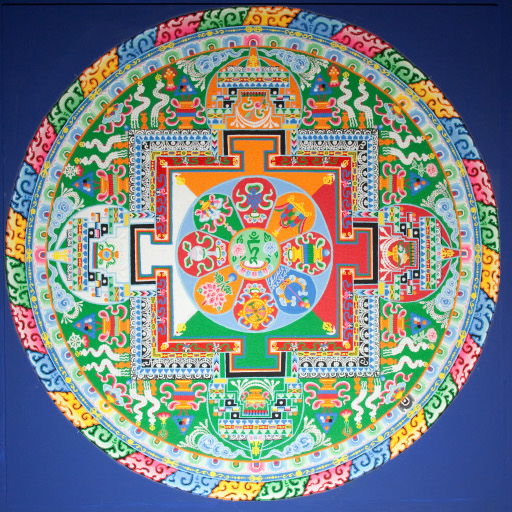
Here is a mandala that Melita showed me in process at MIT a few years ago. Colored sand was painstakingly dripped on a floor space by a visiting monk.

mg_8348sm

Read Full Post »

merlin_142430100_e8839457-7a73-4bdd-b80e-65b68ecfaa81-superjumbo

Photo: Jeffrey Gettleman/The New York Times
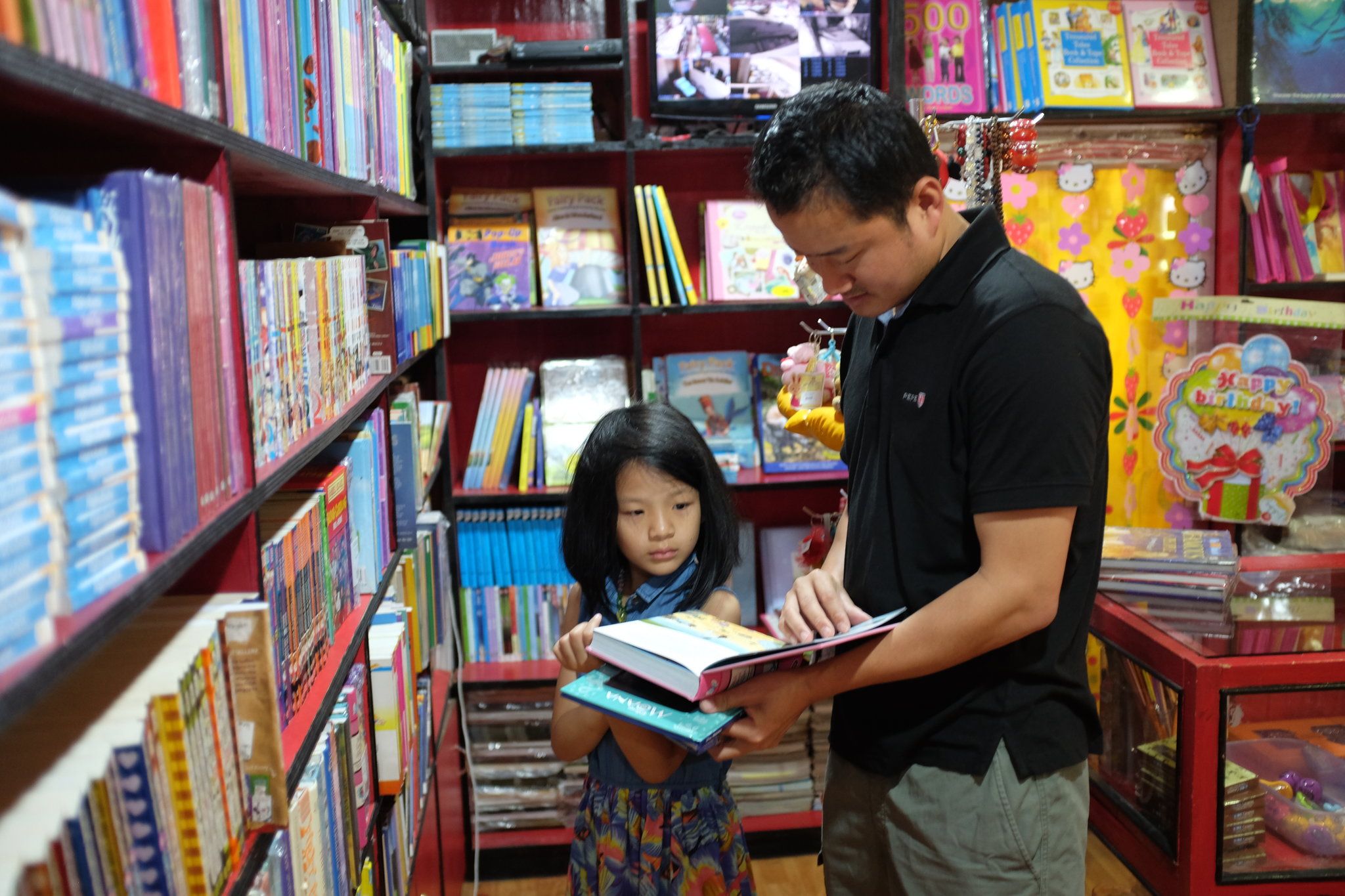
Customers browsing through books in Thimphu, Bhutan. Literacy is growing in the isolated Himalayan country.

Bhutan is a small Himalayan country best known for its focus on Gross National Happiness. I know two other things about it, and they are contradictory. One is that the Hindu Nepalese ethnic minority gets so little happiness there that many end up in refugee camps in India for decades.

But the other thing I know is that Suzanne found Bhutan to be a magical place when she traveled there after her time as vice president of Red Envelope and just before founding Luna & Stella. A Buddhist monk in Bhutan even provided her with a name for her first-born. (She translated it into Swedish and used it as a middle name.)

Nations are complicated.

Here is a recent article I liked about Bhutan’s growing literary culture. It’s by Jeffrey Gettleman at the New York Times. “Not long ago, when Bhutan’s government tried to enroll children in school,” he writes, “parents hid them in the attic and bribed government agents with butter and cheese to go away. Families needed their children as field hands. The last thing they cared about were books.

“But … literacy is taking root across these deep green mountain valleys — it’s now around 60 percent, compared to 3 percent in the 1950s — giving rise to a surprising underdog literary scene.

“The number of bookshops is increasing; there are around a dozen in the capital, Thimphu, and a few more in far-flung districts. Bhutanese writers are publishing books more than ever before — fantasy novels, poetry, short story collections and especially folklore. Each August, Bhutan hosts an international literary festival. …

“It’s a delicate dance of letting in outsiders without getting steamrollered. Historically, Bhutan has sealed itself off, a Shangri-La nestled in the highest, snow-capped mountain range in the world. Before the 1960s, few foreigners set foot here; it was only in 1999 that television was allowed in. …

“This new generation of Bhutanese writers and novelists see themselves as occupying a special role: as guardians of their nation’s culture. Many are relatively young, in their 30s and 40s, and love to reminisce about growing up in villages without radios or TVs or even roads, wearing traditional clothes and eating traditional foods (such as hard cubes of yak cheese the size of Starburst candies). They feel an urgency to write about the old ways deep in the mountain villages before that lifestyle totally disappears.

“ ‘Create?’ asked Tshering Tashi, a writer, journalist, tour guide and co-director of the Mountain Echoes Literary Festival. ‘That’s a luxury. Our foremost job is to record.’ …

“Mr. Tashi, 45, is determined to track down the last of the traditional shamans and spiritual hermits — the custodians of Bhutanese legends — and write their stories, not his, before they take them to the grave. On one mission, he hiked two weeks into the mountains where no roads reach; he finally found his target, an old hermit who had been living by himself for 70 years. …

“Gopilal Acharya, 40, is a poet with dark eyes, a natty beard, crisp plaid shirts and a slightly coiled vibe. He writes in English, like most Bhutanese writers, because that is what he studied in school. (Several indigenous languages are spoken in Bhutan but relatively few books are printed in them.) …

“Mr. Acharya is passionate about Bhutanese folklore. He wrote a book of children’s tales that celebrate a way of life rooted in isolated hamlets where even today, on windswept mountainsides, people till fields of buckwheat with yoked oxen and wooden plows.

“ ‘These stories are how we are anchored as a society,’ he said. ‘We don’t have military or economic power. Our culture is all we have.’ ” More here.

For yet another angle on Bhutan, check out this Washington Post article on why some residents hate the nasty politics of their new democracy so much, they are pining for the old days — and the “absolute monarchy under a beloved king.”


Read Full Post »