Feeds:
Posts
Comments

Posts Tagged ‘burial’

Photo: Maite Mascort i Roca and Esther Pons Mellado/University of Barcelona.
Above, the necropolis of Oxyrhynchus in Egypt, where a nonroyal mummy was found with some lines on papyrus from Book 2 of Homer’s Iliad.

Here’s an unusual story about the blending of Egyptian and Greek cultures in the Roman period. It involves a mummy and a recently opened tomb.

Franz Lidz writes at the New York Times, “Archaeologists working in Egypt have discovered a remarkable combination of Homeric epic and Egyptian ritual: a 2,000-year-old mummy with a papyrus fragment of the Iliad sealed in a clay packet outside its wrappings.

“It is the first time a literary work has been found playing a functional, spiritual role in the mummification process. And it suggests that for a Roman-era Egyptian, the Iliad — specifically some lines from Book 2’s ‘Catalogue of Ships’ — was perhaps as crucial for navigating the afterlife as a magical spell.

“ ‘The find is incredibly significant, primarily for the discovery of such a papyrus with Greek literary text in its original context,’ said Foy Scalf, an Egyptologist at the University of Chicago. ‘We have evidence that such Greek literary texts could be used as magical amulets and that Homer was frequently cited in such amulets. … The new find directly supports that indirect knowledge.’”’

“The mummy, a nonroyal male, was unearthed by the Mission of the University of Barcelona at a burial site known as Oxyrhynchus, as part of a project directed by Ignasi-Xavier Adiego of the university’s Institute of Ancient Near East. Leah Mascia, a specialist in the written and material culture of Greco-Roman and Late Antique Egypt at the Free University of Berlin, coordinated the collaborative breakthrough that finally brought the damaged text to light.

“Recognizing that the heavily degraded papyrus required careful analysis, Dr. Mascia worked with a conservator, Margalida Munar, to stabilize the artifact, and Dr. Adiego, an authority on the Carian language, to study the text.

Together, their combined expertise in preservation and linguistics allowed them to identify and read the document.

“After six years of painstakingly reconstructing tomb fragments, Dr. Mascia uncovered a rare moment of cultural alchemy: Roman Egypt, where foreign and local customs merged. Her analysis, which identified embalmer seals and folding patterns of the papyrus packet, suggests that classical Greek epics were not merely read but physically repurposed.

“Traditionally, mummified bodies were buried with sepulchral texts like the Book of the Dead and The Book of Breathing, formulaic manuals intended to protect and guide the deceased through the underworld. Yet, by the early Roman period, a major shift emerged: the introduction of sealed papyrus packets placed upon the dead. …

“The ruins of Oxyrhynchus were initially documented by Vivant Denon, a scholar during Napoleon’s 1798 Egyptian campaign. But they held a secret that remained buried for an additional century, until 1896, when British archaeologists dug up more than 400,000 fragments of papyri from the ancient trash heaps. The discoveries ultimately included lost masterworks by poets and playwrights like Sappho and Euripides, transforming millenniums-old refuse into a cornerstone of classical literature.

“In the 1990s, the Mission of the University of Barcelona and the University of Cairo began a joint project largely funded by the Spanish Ministry of Culture and the Egyptian Ministry of Tourism and Antiquities. This ongoing mission, directed by Maite Mascort i Roca and Esther Pons Mellado and staffed by archaeologists, epigraphists and papyrologists, focuses on various sectors of the necropolis, including No. 22, where experts are reconstructing the elaborate social and religious life of residents during the transition from the Ptolemaic to the Roman era.

“Researchers exploring the multichambered burial site have exhumed a remarkable trove of treasures, among them mummies adorned with golden tongues — gold foil placed over the mouth — and at least one with copper, ritualistic additions that may have ensured that the dead could confidently speak their case to Osiris, the god of death and resurrection, before judgment.”

Read more at the Times, here.
Read Full Post »

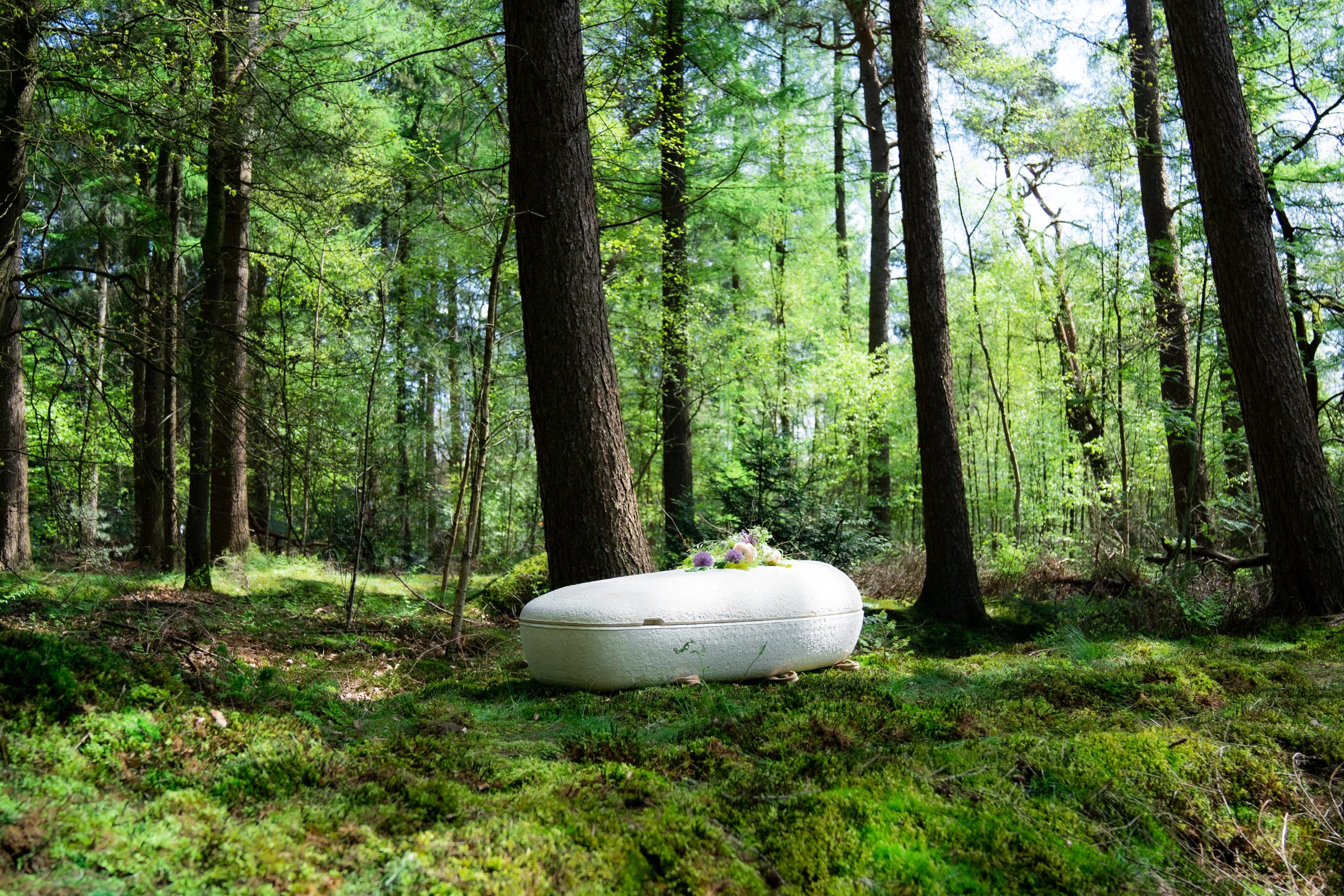
Photo: The Optimist Daily.
Website the Optimist Daily says, “Mushroom caskets offer an earth-friendly goodbye in North America’s first burial of its kind.”

Blogger Will McMillan at A Musical Life on Planet Earth gave me the lead for today’s story. And because my husband and I just recently entertained two mushroom enthusiasts from a recent conference, I decided today was a good day to tell you how some folks take their love of mushrooms to the end — and beyond.

“Traditional burials,” writes the Optimist Daily, “though deeply meaningful, often come at a steep environmental cost. The chemicals, hardwood, and land use involved can have long-term ecological impacts. But a quiet revolution in burial traditions is beginning to bloom and its roots are made of mushrooms.

“In a first for North America, a burial using a fully biodegradable mushroom casket took place on a serene hillside in rural Maine. The Loop Living Cocoon, developed by Dutch company Loop Biotech, is made entirely from mycelium, the intricate root system of fungi. The casket is grown in just one week, naturally breaks down within 45 days, and enriches the soil it returns to.

“ ‘My father always told me that he wanted to be buried in the woods on the property that he loved so much,’ said Marsya Ancker, whose father Mark C. Ancker was laid to rest in the pioneering casket. ‘He wanted his final resting place to nourish the land and plants he cherished.’ …

“Though this was a first for North America, Loop Biotech has already facilitated more than 2,500 burials across Europe using mushroom caskets. Green burials are an alternative that avoids embalming fluids, hardwood caskets, and steel-reinforced concrete vaults, and they’ve been steadily growing in popularity since the 1990s.

“ ‘Since 2005, the Green Burial Council has certified over 250 providers and recorded 400+ green cemeteries across the U.S. and Canada: a clear sign of growing demand for environmentally conscious end-of-life choices,’ said Sam Perry, president of the Green Burial Council.

“The statistics are striking. According to the Council, conventional U.S. burials consume roughly 20 million board feet of wood, 4.3 million gallons of embalming fluid, and 1.6 million tons of concrete each year.

“Bob Hendrikx, founder of Loop Biotech, believes funerals can be more than a final goodbye. ‘We created the Loop Living Cocoon to offer a way for humans to enrich nature after death. It’s about leaving the world better than we found it.’

The Global Green Burial Alliance, founded in 2022, is helping reshape global perspectives on death. Entirely volunteer-run, the organization connects families with green providers and empowers people to reclaim their voice in end-of-life decisions. …

“Ed Bixby, founder of the Global Green Burial Alliance, believes these choices create a legacy of compassion. … ‘To embrace the living with our death becomes the final act of kindness we can bestow upon our planet.’

“With innovations like the mushroom casket and a groundswell of interest in sustainable options, a cultural shift appears to be underway. It asks that we reimagine death not as an ending, but as a way to nourish new life.”

So there’s that.

Sometime I’ll tell you about our mycologist visitors. Theirs is a whole different world. And when you live in a retirement community and are in danger of too much sameness, “different” is especially welcome.

Consider for example, how we learned from these guys that truffles are actually all over the world but buried very deep. And how they might even have been the “manna” in the desert described in the Bible. They do grow in desert places like Saudi Arabia.

So says the CEO of MycoSymbiotics, William Padilla-Brown, who, we learned, was a speaker at the conference. His bio describes him as a “Multidisciplinary Citizen Scientist practicing social science, mycology, phycology, molecular biology, and additive manufacturing. William founded MycoSymbiotics in 2015, and has since developed it into the innovative practical applied biological science business it is today. William holds permaculture design certificates acquired through Susquehanna Permaculture and NGOZI, and a certificate from the Bigelow Laboratory for Ocean Sciences in algal culturing techniques. He has published the first English-language books on cultivating the cordyceps mushroom and regularly leads courses on their cultivation. William’s research has been sponsored by several organizations and his work has been featured in multiple publications, including Fantastic Fungi and VICE. He also founded and manages MycoFest, an annual mushroom and arts festival, now on its eleventh year.”

So many unusual pursuits in this world! I am not knowledgeable enough to recommend the ideas of any mycologists or herbalists, nor am I planning a mushroom burial, but I sure am a sucker for anything interesting.

Doesn’t curiosity keep us all going?

More at the Optimist, here.

Read Full Post »

vaklyrie

No sooner had I seen this Science article describing female DNA at a Viking burial site, than I learned there was a controversy about it. Was this a Viking with weapons and war horses — or not? (Turtle Bunbury tweeted the tip.)

Michael Price believes the researchers who analyzed the bones. “A 10th century Viking unearthed in the 1880s was like a figure from Richard Wagner’s Ride of the Valkyries: an elite warrior buried with a sword, an ax, a spear, arrows, a knife, two shields, and a pair of warhorses. And like a mythical valkyrie.”

A study published in “the American Journal of Physical Anthropology finds that the warrior was a woman — the first high-status female Viking warrior to be identified.

“Excavators first uncovered the battle-ready body among several thousand Viking graves near the Swedish town of Birka, but for 130 years, most assumed it was a man — known only by the grave identifier, Bj 581. A few female Viking soldiers have been unearthed over the years, but none had the trappings of high rank found in the Birka burial — not just weapons and armor, but also game pieces and a board used for planning tactics.

“In recent years, reanalysis of skeletal characteristics had hinted that the corpse might be female. Now, the warrior’s DNA proves her sex.” And you can see the study at Wiley Online Library, here.

Skepticism may be read here, at Ars Technica, where Annalee Newitz makes the point that 19th C. excavation was often careless and this one may have mixed up bones.

Sigh.

Read Full Post »