Photo: Maite Mascort i Roca and Esther Pons Mellado/University of Barcelona.
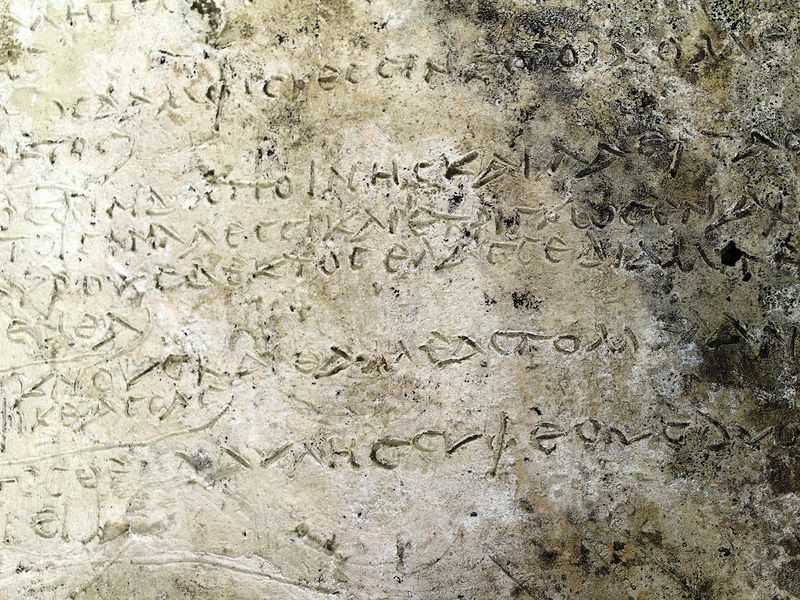
Above, the necropolis of Oxyrhynchus in Egypt, where a nonroyal mummy was found with some lines on papyrus from Book 2 of Homer’s Iliad.
Here’s an unusual story about the blending of Egyptian and Greek cultures in the Roman period. It involves a mummy and a recently opened tomb.
Franz Lidz writes at the New York Times, “Archaeologists working in Egypt have discovered a remarkable combination of Homeric epic and Egyptian ritual: a 2,000-year-old mummy with a papyrus fragment of the Iliad sealed in a clay packet outside its wrappings.
“It is the first time a literary work has been found playing a functional, spiritual role in the mummification process. And it suggests that for a Roman-era Egyptian, the Iliad — specifically some lines from Book 2’s ‘Catalogue of Ships’ — was perhaps as crucial for navigating the afterlife as a magical spell.
“ ‘The find is incredibly significant, primarily for the discovery of such a papyrus with Greek literary text in its original context,’ said Foy Scalf, an Egyptologist at the University of Chicago. ‘We have evidence that such Greek literary texts could be used as magical amulets and that Homer was frequently cited in such amulets. … The new find directly supports that indirect knowledge.’”’
“The mummy, a nonroyal male, was unearthed by the Mission of the University of Barcelona at a burial site known as Oxyrhynchus, as part of a project directed by Ignasi-Xavier Adiego of the university’s Institute of Ancient Near East. Leah Mascia, a specialist in the written and material culture of Greco-Roman and Late Antique Egypt at the Free University of Berlin, coordinated the collaborative breakthrough that finally brought the damaged text to light.
“Recognizing that the heavily degraded papyrus required careful analysis, Dr. Mascia worked with a conservator, Margalida Munar, to stabilize the artifact, and Dr. Adiego, an authority on the Carian language, to study the text.
Together, their combined expertise in preservation and linguistics allowed them to identify and read the document.
“After six years of painstakingly reconstructing tomb fragments, Dr. Mascia uncovered a rare moment of cultural alchemy: Roman Egypt, where foreign and local customs merged. Her analysis, which identified embalmer seals and folding patterns of the papyrus packet, suggests that classical Greek epics were not merely read but physically repurposed.
“Traditionally, mummified bodies were buried with sepulchral texts like the Book of the Dead and The Book of Breathing, formulaic manuals intended to protect and guide the deceased through the underworld. Yet, by the early Roman period, a major shift emerged: the introduction of sealed papyrus packets placed upon the dead. …
“The ruins of Oxyrhynchus were initially documented by Vivant Denon, a scholar during Napoleon’s 1798 Egyptian campaign. But they held a secret that remained buried for an additional century, until 1896, when British archaeologists dug up more than 400,000 fragments of papyri from the ancient trash heaps. The discoveries ultimately included lost masterworks by poets and playwrights like Sappho and Euripides, transforming millenniums-old refuse into a cornerstone of classical literature.
“In the 1990s, the Mission of the University of Barcelona and the University of Cairo began a joint project largely funded by the Spanish Ministry of Culture and the Egyptian Ministry of Tourism and Antiquities. This ongoing mission, directed by Maite Mascort i Roca and Esther Pons Mellado and staffed by archaeologists, epigraphists and papyrologists, focuses on various sectors of the necropolis, including No. 22, where experts are reconstructing the elaborate social and religious life of residents during the transition from the Ptolemaic to the Roman era.
“Researchers exploring the multichambered burial site have exhumed a remarkable trove of treasures, among them mummies adorned with golden tongues — gold foil placed over the mouth — and at least one with copper, ritualistic additions that may have ensured that the dead could confidently speak their case to Osiris, the god of death and resurrection, before judgment.”
Read more at the Times, here.