
Feeds:
Posts
Comments

Posts Tagged ‘odyssey’

Photo: David M Benett/Getty Images.
Poet Nikita Gill built a following on Instagram.

It’s funny but the poetry slams I’ve written about before — hip-hop-like, shouted performances that showcased new, nontraditional poets — already seem like a stage in literary history. And their significance seems to lie in their emphasis on connecting with audiences, getting “in your face.” No distancing “poet voice” for these folks!

Social media, too, is all about the need for connection, and that is where you’ll find the newest poets building audiences.

Ella Risbridger has some opinions at the Guardian.

“The death of poetry – much anticipated, much prematurely mourned – has been put off again, this time by the Odyssey. Thanks to Christopher Nolan’s film, sales of Homer’s epic rose 1,400% in the weeks around release – and it’s not alone. Poetry collections are once again sailing up the charts: Lucas Jones, Donna Ashworth and Nikita Gill, among others, have all burst forth on to the bestseller lists. …

“Poetry is a genre more often relegated to the adolescent, the academic, or the words inside sentimental birthday cards: either over-emotional or elitist, depending on which poet and which perspective. What it certainly is not is a money-spinner: nobody gets into poetry to make the big bucks. Nobody gets into poetry – not these days, anyway, not since Byron’s day – for the fame or the fortune.

“Poetry is the underdog of publishing and yet this year, according to a recent Guardian article, it is ‘expected to exceed £15m [$20 m] in annual sales for the first time since records began.’ … Even without the bolstering influence of Homer, poetry has been steadily climbing for the last three years, each one the best on record.

“In fact, reports of poetry’s surprising rise have been kicking around for more than a decade: Rupi Kaur’s million-dollar debut, Milk and Honey, set new records in 2014, and continues to sell. US magazine the New Republic named Kaur the ‘writer of the decade.’ And yet she came to stand not so much for great art, as for a kind of synecdoche for what was wrong with art: Kaur became the mockable face of ‘the new poetry.’ …

“A new audience is finding poetry, particularly (though not exclusively) through social media: a new generation of poets, particularly but not exclusively performance poets, have come to prominence through Instagram, TikTok, and other short-form video formats. These writers, while we can quote them on the page, lose something by being written down.

“ ‘At my funeral I’d like there to be sunflowers, a truly inconvenient amount / For I too will have spent a lifetime searching for the light,’ runs a couplet from Harry Baker’s ‘Sunflowers,’ but the poet’s charismatic presence somehow conveys something more of the full power of his meaning.

“Many of these poems, beginning on social media and ending in huge sold-out tours, rely on a connection between speaker and listener: a pause, a stillness, a sustained thread in the chaos of the internet, of singular attention to one poem through to the end.

“This is poetry for the social media age, for sure. But then, what is the Odyssey except social media [meant] to be read out loud; to be told; to be spread; to be shared. …

“It is tempting to think of these bestsellers as a new kind of poetry, but it is in fact a very old one. It is unafraid of emotion, of sentimentality, of faith and love; it is concerned less with the establishment of a brand new voice than with the need to give voice to a collective thought. It is not about originality. (Hence, perhaps, the accusations of self-help; banality; and even plagiarism that have been flung at some of these newly popular poets.) These are poems designed to resonate rather than to disturb. In times of division, these poems are made to connect.

“All writing is about connection, even when it’s not. But the immediacy of the connection between author and reader is somehow easiest in poetry: when it works, there’s a direct shot to the heart, a human-to-human hot-wiring together that compresses time and space to get to the point.

“What social media offers these poets is a new way to gather people round the fire – and, for some, a way to get to be the one speaking at last. If poets can reach their audiences directly, then different poets may be, perhaps, given a chance not just to speak but to be heard: working-class poets, queer poets, poets who don’t fit the … classical canon.”

Read up on “five bestselling poets you should know about” at the Guardian, here. No paywall.
Read Full Post »

homer

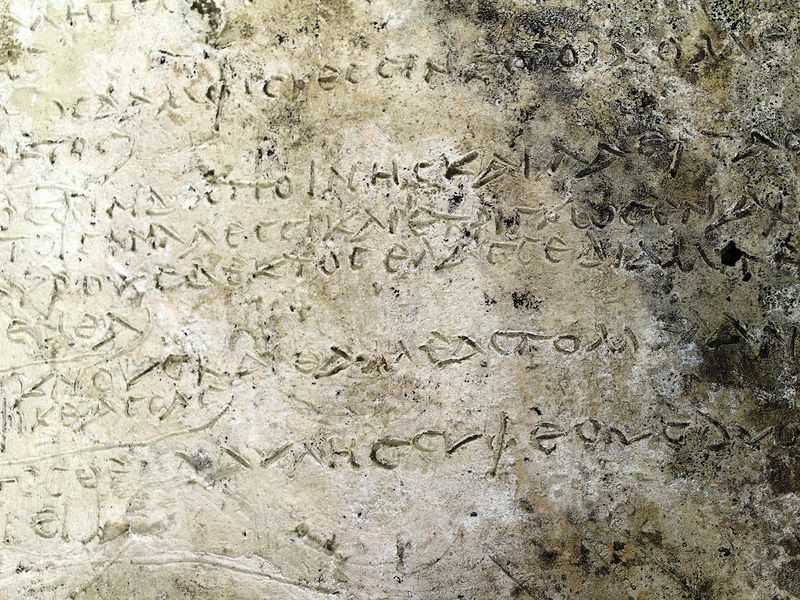
Photo: Greek Ministry of Culture
Recently discovered verses from Homer’s Odyssey are unusual both because they’re old and because they’re on clay. Most versions of the Odyssey perished early on, having been written on papyrus.

You would think that after studying Ancient Greek for five years in school, I would remember a little more of it than I actually do. But I retain an interest in all things Greek, especially literary selections that I once knew how to read in my stumbling way, like Herodotus, the great plays, and the Odyssey.

Recently I saw that a very early copy of 13 verses of the Odyssey had been found.

Jason Daley reports at the Smithsonian, “The epics of the Greek poet Homer, The Iliad and The Odyssey, have been recited around campfires and scrutinized by students for 2,800 years, if not longer. You might think that ancient copies of these books are dug up in Greece all the time, but that’s not the case. The ancient papyrus these books were written on rarely survives, meaning that ancient copies of Homer from the lands he wrote about simply don’t exist.

“But now, reports the BBC, archeologists in Greece have found 13 verses from The Odyssey chiseled into a clay tablet dating to the third century A.D. or earlier, representing the oldest lines of the poet found in the ancient land.

“The tablet was discovered near the ruins of the Temple of Zeus during three years of excavations in the ruins of the ancient city of Olympia on the Greek peninsula the Peloponnese. The verses are from the epic’s fourteenth book, in which Odysseus speaks to his lifelong friend Eumaeus, the first person he sees on his return from his decade away from home. …

“Any glimpse into Homer before medieval times is rare, and any insight into the composition of the epics is precious. It’s believed that The Odyssey and The Iliad come from an oral storytelling tradition. Whether the stories were composed by a blind poet named Homer is a source of debate. …

“There were many different versions of each work transcribed throughout the ancient world. That’s because, as Harvard classicist Gregory Nagy points out, the oral tradition of these poems was not a matter of rote memorization. Instead, bards would have told slightly different versions of the epics each time they recited them, using a technique known as composition-in-recitation. Scribes transcribing the recitations would have heard different versions depending on the storyteller, so there were likely various versions of the Homer epics works floating around the ancient world.

“The versions we know now come from medieval copies made of the complete works based on ancient sources that are now lost. After those texts were rediscovered during the Rennaissance, they became classics and have been translated endlessly. …

But not all of the earlier versions of Homer are lost. Archaeologists working in Egypt in the late 19th century began collecting scraps of papyrus containing lines, quotations and even complete chapters of the stories.

“Unlike in Greece, the dry conditions in Egypt mean some papyrus documents are preserved, including bits of Homer dating to the third century B.C. These scraps and chapters show that the medieval texts are not the only versions of the epics or even the authoritative versions — it turns out there is no one definitive Homer out there. That’s why the Homer Multitext Project is gathering all of those fragments together so they can be compared and put in sequence to provide a broader view of Homer’s epics.”

More  at the Smithsonian, here.

Read Full Post »

I’ve been wanting to share this remix of Disney’s Alice in Wonderland but hoped to add something beyond saying that I like it.

Then today, Asakiyume tweeted some comments on fantasy that science fiction writer Ursula K. Le Guin posted at the Book View Cafe blog.

Le Guin was reacting to a comment Kazuo Ishiguro made about his latest novel when he was interviewed by the NY Times: “Will readers follow me into this? Will they understand what I’m trying to do, or will they be prejudiced against the surface elements? Are they going to say this is fantasy?”

Le Guin launched into a spirited defense of fantasy in which she mentions the very story I had been thinking about for this post.

“Fantasy is probably the oldest literary device for talking about reality. ‘Surface elements,’ by which I take it he means ogres, dragons, Arthurian knights, mysterious boatmen, etc., which occur in certain works of great literary merit such as Beowulf, the Morte d’Arthur, and The Lord of the Rings, are also much imitated in contemporary commercial hackwork.

“Their presence or absence is not what constitutes a fantasy. Literary fantasy is the result of a vivid, powerful, coherent imagination drawing plausible impossibilities together into a vivid, powerful and coherent story, such as those mentioned, or The Odyssey, or Alice in Wonderland.” More here.

I love Le Guin’s characterization of fantasy. It reminds of something C.S. Lewis said about writing good fantasy. He said that, within the laws of its own realm, everything had to be plausible. Or words to that effect. And he wrote an essay with a splendid title, “Sometimes Fairy Stories Say Best What’s to Be Said.” (For a comparison of Tolkien’s and Lewis’s ideas about fantasy, check this essay.)


Read Full Post »