Feeds:
Posts
Comments

Posts Tagged ‘cafe’

Photo: Christopher Smith/For the Washington Post.
Mackenzie Cannon works at the café/post office in Bucyrus, Kansas, where residents of the tiny town were determined to keep their Zip code.

When I was a kid in New York State, a friend of my parents who was an artist and weaver decided he ought to also have a job with benefits and became postmaster of a tiny rural post office. His name was Earl. Today I’m drawn to an article about the creation of a coffee shop called Earl’s that saved a rural post office in Kansas from the chopping block.

Annie Gowen writes at the Washington Post, “ There was no ribbon cutting. No balloon arch. When the clerk threw open the doors of the post office in this tiny Kansas town, she got right to business, handing out P.O. box keys and selling stamps.

“ ‘Welcome to the new post office!’ Mackenzie Cannon, the clerk, called out this week to one of the new customers. …

“Bucyrus —population: 168 — is only about 35 miles south of Kansas City, but enough farmland and red barns sit between the last suburban subdivision and the town’s quiet main street that it still feels like country. It offers little in the way of excitement, unless you count Fourth of July fireworks and the time that an F5 tornado narrowly missed the town in 1957. But for people like Cannon, 29, the close-knit place is home — the word she had tattooed on her shoulder.

“ ‘The older I get the more I realize how special it is,’ Cannon said.

“Two years ago, the U.S. Postal Service decided to shutter its decrepit outpost here. It was so old, ‘the ceiling fell in while I was working,’ Cannon recalled. The plan was to transfer mail operations to a nearby town, and locals feared they would lose their Zip code, which they felt was akin to wiping Bucyrus off the map.

“ ‘That ain’t happenin’,’ Greg Foote, the scion of a local ranching family, said when he heard the news. He and his colleague Aaron Kuhlmann hatched a plan to build a new post office in a building that would also house the town’s only cafe in decades.

“A spokesman for the U.S. Postal Service praised this ‘unique arrangement’ that has allowed the agency to keep delivering the mail in town. They said removing a Zip code was a rare occurrence.

“ ‘I just felt like it was the right thing to do for the area, to keep that Bucyrus pride going and keep that Zip code alive,’ Foote said.

“Foote’s family has farmed here since the ’40s, starting with a small dairy operation and then corn and soybean farm owned by his grandfather, Earl, the founder and first president of the Kansas Corn Growers Association.

“Foote’s father, Bob, founded Foote Cattle Company in 1985, which has grown to become one of the largest feedlot and ranching operations in the country.

“Bob, who died in 2022, and his wife, Gail, saved the Bucyrus post office once before. When the 1921-era building was first threatened with closure in 1991, the couple stepped in, rehabbed it and leased it back to the Postal Service for 30 years. But by 2024, it was beyond repair.

“The post office ‘was always a gathering space,’ Gail Foote said this week. It was the center of the community she calls ‘the best place on Earth, really.’

“Behind the counter Tuesday, Cannon recounted how when she was a child growing up in Bucyrus, she spent most of her time in the backyard making mud pies or collecting cicadas. …

“ ‘Is there stuff going on?’ she said of life in Bucyrus. ‘There’s tractors going down the road — that’s something!’

“Trains barrel by, too, horns blaring, just steps from the post office. The Union Pacific doesn’t stop there anymore. …

” ‘Foote named the cafe Earl’s Coffee Company after his grandpa, whose pictures adorn the walls alongside images of local ranch hands like Tubby, who died recently. The steak burrito is named ‘the Tub’ after him, and his daughter can’t come in without crying.

“The cafe sold out of food the first five days, Kuhlmann said, and he had to buy three new refrigerators to keep up with demand.

“On Tuesday, a steady stream of customers came by. The cafe smelled like espresso and fresh lumber. New ‘Earl’s’ T-shirts were neatly folded in the merchandise corner.

“The sleeves read 66013 — the Zip code they helped save.”

More at the Post, here.

Read Full Post »

Photo: Hannah Hoggatt/Midcoast Villager.
The Villager Cafe in Camden, Maine, serves as a newsstand and events space for the Midcoast Villager. It allows locals to mingle comfortably with reporters — and maybe share news.

Blogger Laurie Graves in Maine had a fantasy podcast at one point that involved a café/sandwich shop run by elves. I couldn’t help thinking about it as I read today’s story.

Mackenzie Farkus, a staff writer at the Christian Science Monitor, reports, “Inside the Villager Cafe, the scent of freshly brewed coffee lingers, and chatter is sporadically interrupted by chirps from a cafégoer’s walkie-talkie. Three women settle into a window-side table. They’ve known each other since high school, and they regularly meet to discuss politics.

“It’s an apt place to do so. Print copies of the Midcoast Villager — an online daily and weekly print newspaper covering midcoast Maine — are displayed near the cash register. … Just upstairs, a small, bustling newsroom is rushing to meet the weekly print deadline.

“The Villager Cafe, which opened in April, isn’t just a café. It’s a newsstand and events space for the Midcoast Villager. The newspaper wants the café to be a ‘third space for community engagement,’ in the words of deputy editor Alex Seitz-Wald. …

“Last year, 130 newspapers shut down at a rate of almost 2 1/2 per week, according to a report from Northwestern University’s Local News Initiative. As of last October, 206 counties across the U.S. don’t have a local news outlet at all. … The loss of local newspapers is ‘really damaging to civic life and civil discourse, and the ability of average people to be informed about their community,’ says Meg Heckman, an associate professor of journalism at Northeastern University in Boston.

“ ‘It’s a lot harder to know what’s going on in town hall, [or] what changes to federal environmental policy might mean to rural farmers or fisheries or tourism,’ she adds.

“Reade Brower has long been regarded as Maine’s ‘media mogul.’ In 2019, he owned six of Maine’s seven daily newspapers, more than 20 weekly publications, and three printing presses. In 2023, he sold the vast majority to the National Trust for Local News, a nonprofit. Four of the papers he held onto … became the Midcoast Villager. It published its first issue in late 2024. …

“U.S. newspapers earned $49 billion in advertising revenue in 2006; that number dropped to less than $10 billion in 2022.

“Around 85% of U.S. adults believe that local news outlets ‘are at least somewhat important to the well-being of their local community,’ according to a 2024 Pew Research Center survey. But only 15% say they’ve paid or given money to any local news source in the past year, which has largely remained unchanged since 2018.

“People have been curious to check out the café, says Aaron Britt, publisher … says Mr. Britt. ‘And I’ve just heard like nothing but great things. People like the food, people run into everybody that they know. … Community members can feel like, “Oh, this is my spot.” ‘ …

“ ‘I think a lot of where we are today is due to the perception that there are editors and writers away in this tower who are covering issues, but they’re not fully connected with readers,’ [Kathleen Fleury Capetta, co-founder of the Midcoast Villager] says. ‘We’re trying to shift that perspective.’ …

” ‘The café’s goal at the very start has been, “How do we connect our community and create a respectful place of dialogue?” ‘ says Mr. Brower. ‘We believe we’re achieving that.’ …

“Staffers at the Midcoast Villager have already fielded calls from other media organizations interested in the approach.

“ ‘Anybody is welcome to call us up and steal our idea if they like it,’ Mr. Brower says.”  More at the Monitor, here.

In my town, we have a community paper, too. It’s doing very well thanks to donations and ads. As delightful as the Villager Cafe sounds, I hope our paper will stick to what it knows best and not try to get into the food business. The rents alone would guarantee failure here.

Read Full Post »

gvgge5aoc4i6viugdtzaidlqoy

Photo: Jonathan Wiggs/Globe Staff
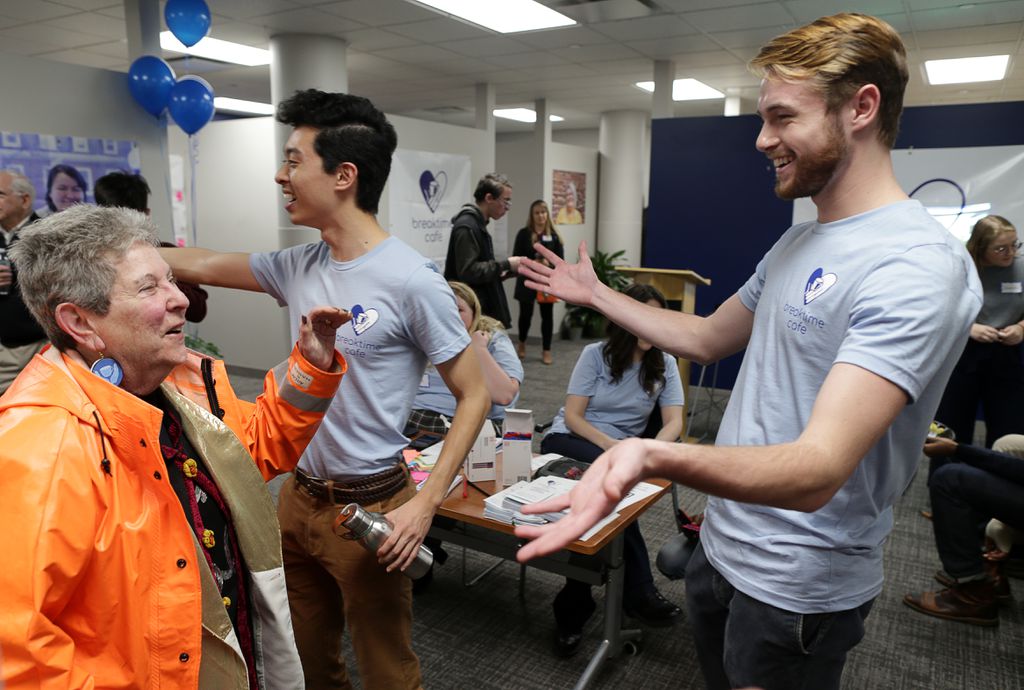
Breaktime Café cofounders Tony Shu (left) and Connor Schoen hosting a kickoff launch party in Boston for a nonprofit that helps homeless youth learn job skills.

Not sure why so many recent posts have had a food angle. I’ve certainly been drawn to stories about food. In this article, a couple young guys who volunteered with homeless youth saw a way to help them move beyond homelessness with a bit of skills training and lots of moral support.

Back in December, as Max Jungreis wrote at the Boston Globe, the nonprofit was just getting set up.

Breaktime Cafe doesn’t look like much. It’s 1,500 square feet of typical office space on Portland Street, with gray carpeting, off-white walls, and tables shoved into corners. But by the time the cafe opens in the spring, its founders hope to transform the office into a resource for Boston’s homeless youth.

“The opening will mark a major expansion of a six-month pilot program founded last year by a pair of Harvard University undergraduates. It offered a handful of homeless youth on-the-job training as baristas, with the goal of bringing them into the workforce and out of homelessness. …

“The plan is to employ up to 15 homeless youth at a time. They’ll serve sandwiches, seasonal drinks, and coffee made from ethically sourced beans. That will be triple the number served in the pilot program, and a small but meaningful chunk of the estimated 325 people between the ages of 18 and 24 who were sleeping in Boston’s shelters and streets in January.

“Schoen said Breaktime has raised about $145,000, with much of the money coming from corporate sponsors and charitable trusts, such as Cambridge Trust and the Harnisch Foundation. He said the cafe also has attracted hundreds of individual donations through crowdfunding campaigns. Donated legal advice, accounting, and other services have helped defray costs. …

“Employees will earn $15 to $18 an hour. Aside from learning how to brew coffee, Schoen and Shu want to teach them financial literacy and professional skills, like writing a resume, personal budgeting, and interview techniques. Part of that will come through one-on-one mentorships with professionals from the cafe’s sponsors, many which are financial institutions like BlackRock and Eastern Bank.

“The cafe will occupy ground-floor space at 170 Portland St. Shu and Breaktime cofounder Connor Schoen, 21, are renting it from Community Work Services, the local branch of the national job-training nonprofit Fedcap, at a ‘very competitive rate,’ Schoen said. …

“The project dates to when Schoen and Shu met as volunteers at Y2Y Harvard Square, a homeless youth shelter run by Harvard students. Shu was inspired to volunteer by his mother, who as a young immigrant to Kansas from China often slept in her car.

‘I knew that it was my duty and my opportunity to use the skills and the resources that I have in front of me in order to pay it forward,’ Shu said. …

“[Schoen] learned that up to 40 percent of homeless adults identify as LGBTQ, according to one study.

“ ‘It just immediately became something I was really passionate about, and indignant about,’ Schoen said. ‘The fact that people are being kicked out of their homes for just coming out just doesn’t make any sense to me.’

“The two men realized that for many struggling young people trying to gain a foothold, there is a tricky period between the end of a work-training program and when they land a paying job.

“ ‘[Where] do they go after that to bridge them to the broader work force and sustainable careers?’ Shu said. ‘That’s what Breaktime does.’

“The business partners, who plan to run the cafe full time after graduating, impressed Brittany Butler, who runs the Harvard Kennedy School’s Social Innovation and Change Initiative, a student mentorship program that birthed Breaktime’s pilot. …

“Erica Grube-Grumt, 26, who graduated from the pilot program in March 2019 and now serves in the Navy — as well as on the new cafe’s advisory board — said it helped to build her self-confidence.

“ ‘A lot of people who are homeless, they feel unheard,’ Grube-Grumt said. ‘They feel like they’re in their own little corner on the street just begging for change, or begging for something to change. To finally be able to step on the pedestal and tell people what it’s like firsthand . . . can really make a provocative change.’ ”

More at the Globe, here.

You may also be interested to read about Land of a Thousand Hills in Lynn and Breaking Grounds (“changing lives one cup at a time”) in Peabody, doing similar work with young people and people with disabilities.

Read Full Post »