Feeds:
Posts
Comments

Posts Tagged ‘cairo’

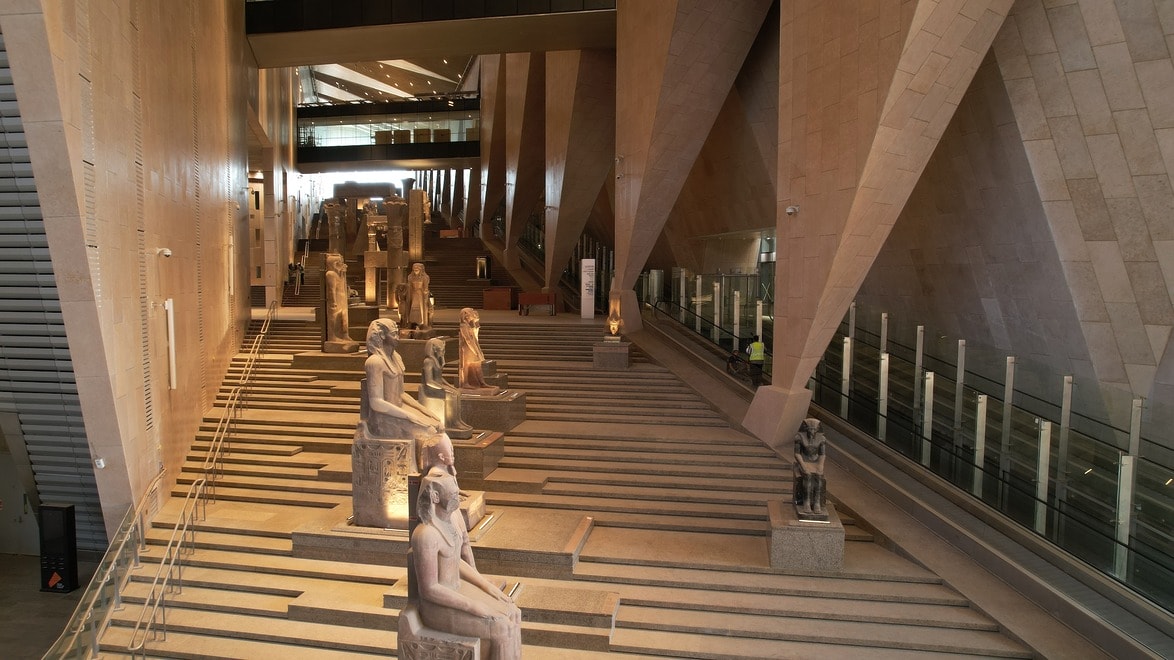
Photo: Grand Egyptian Museum via Galerie magazine.
Grand Staircase at the Grand Egyptian Museum, opened in 2025 after decades of work.

One thing that struck me when I read this article on the opening of the Grand Egyptian Museum was that even though it took many years to build and the original architects left the project in 2014, “the building’s overall structure and dynamic has prevailed.” How many people who departed from such a massive project could say that?

Caroline Roux has a review at Galerie magazine.

“It takes a while to drive past the Great Egyptian Museum (GEM), which officially opened at the beginning of November, and runs alongside the busy main road from Giza to Cairo. As its soaring slanting facade — an elegant tessellation of triangles in stone and glass — comes into view, there’s plenty of time to snap a few pictures. The structure is a staggering 2,600 feet long.  

“Like the Great Pyramids, which stand majestically behind it on the Giza Plateau, the museum has also been constructed as a mighty treasure house for Egyptian artifacts. Designed to house 100,000 objects with 17 specialized laboratories dedicated to their conservation, GEM is the world’s largest archaeological museum dedicated to a single civilization.

“For the first time since their excavation in 1923, all 5,000 objects taken from Tutankhamun’s tomb are reunited here. Among them is the king’s iconic gold mask, with its decoration in blue and black, that has endured as the de facto symbol of ancient Egyptian civilization. In the grand entrance hall presides the 3,200-year-old statue of Rameses II, which stands 36 feet high and is carved from 83 tons of ancient red granite. The entire site covers five million square feet — roughly equivalent to nine soccer fields. It’s all about scale. 

“The museum has also, rather famously, taken years to complete. The Irish-American architecture practice Heneghan Peng, based between Dublin and Berlin, won the international competition for the building in 2003, against over 1,500 applications from 82 countries. Now, over 20 years and $870 million later, it is open to the public, showing off the vast trove of breathtaking objects dating from 3100 BCE to 410 CE.   

“Two tumultuous decades go a long way to account for the delay. Disruptions included the Arab Spring of 2011; the coup d’etat of 2013; the pandemic; economic collapse and raging inflation; and at least five changes at the top. …

“The space, though cavernous, is not wasted. Crowds course up the stupendous six-story staircase, flanked by escalators that create an upward-sloping landscape dotted with heroic statuary and architecture installed on the steps in a genius act of display. There are ten statues of King Senusret 1, a beautiful black granite sculpture of the Sphinx of King Amenemhat III, and the perfectly preserved doorway to his grandfather’s tomb. All are striped with dazzling slashes of sunlight that glimmers across the exhibits from skylights many feet above. 

“At the top, an enormous window frames breathtaking views of the Great Pyramids of Giza, and to the right is the entrance to the twelve galleries housing the thousands of objects that reveal the complexities of the ancient Egyptian world.

Among the regulations posted on the door are ‘In an earthquake, stay away from large objects.’ …

“It is the minutiae of daily life that enchants the most. There are sets of bronze tools to thrill even today’s DIY enthusiast, models of hairstyles from bobs to up-dos designed to show elaborate earrings, travertine vessels that most likely contained make-up, and hundreds of beetle-shaped seals. Intricate plaster models reveal the tiniest details of boats and their oarsmen. A dollhouse-sized grain store comes complete with workers. On the grander side are the breathtaking spoils of burial: luxurious jewelry in glass beads and gold, leather garments, elaborately painted sarcophagi, porcelain shabtis (figurines), and gold-and-jade amulets. 

“Tutankhamun commands his own gallery, starting with a fleet of bronze-and-gold chariots so sophisticated that one can only wonder why it took modern civilization another 2,000 years to invent the motorcar. State-of-the-art screens detail the tomb’s discovery, but the objects prove to be the biggest draw: the golden throne, the king’s own armor of overlapping leather scales. …

“The architects, Róisín Heneghan and Shih-Fu Peng, … perhaps would notice myriad changes. Was the monotony of material on the interior — acres of the same Egyptian marble — in their original plan? Or the ground floor’s airport-like procession of Starbucks and [pastry shops]? Still, the clever skylights, slanting walls, and direct axial relationship to the pyramids beyond feel firmly in place. …

“According to Dr. Zahi Hawass, Egypt’s minister of tourism and antiquities, the museum is still incomplete. ‘I need three objects to come back,’ he told the BBC. ‘The Rosetta Stone from the British Museum, the Zodiac from the Louvre, and the Bust of Nefertiti from Berlin.’ Even without them, the value of Egypt’s extraordinary ancient history remains as appealing as ever.”  
Great photos at Galerie. More pictures at ArchDaily, here.

Read Full Post »

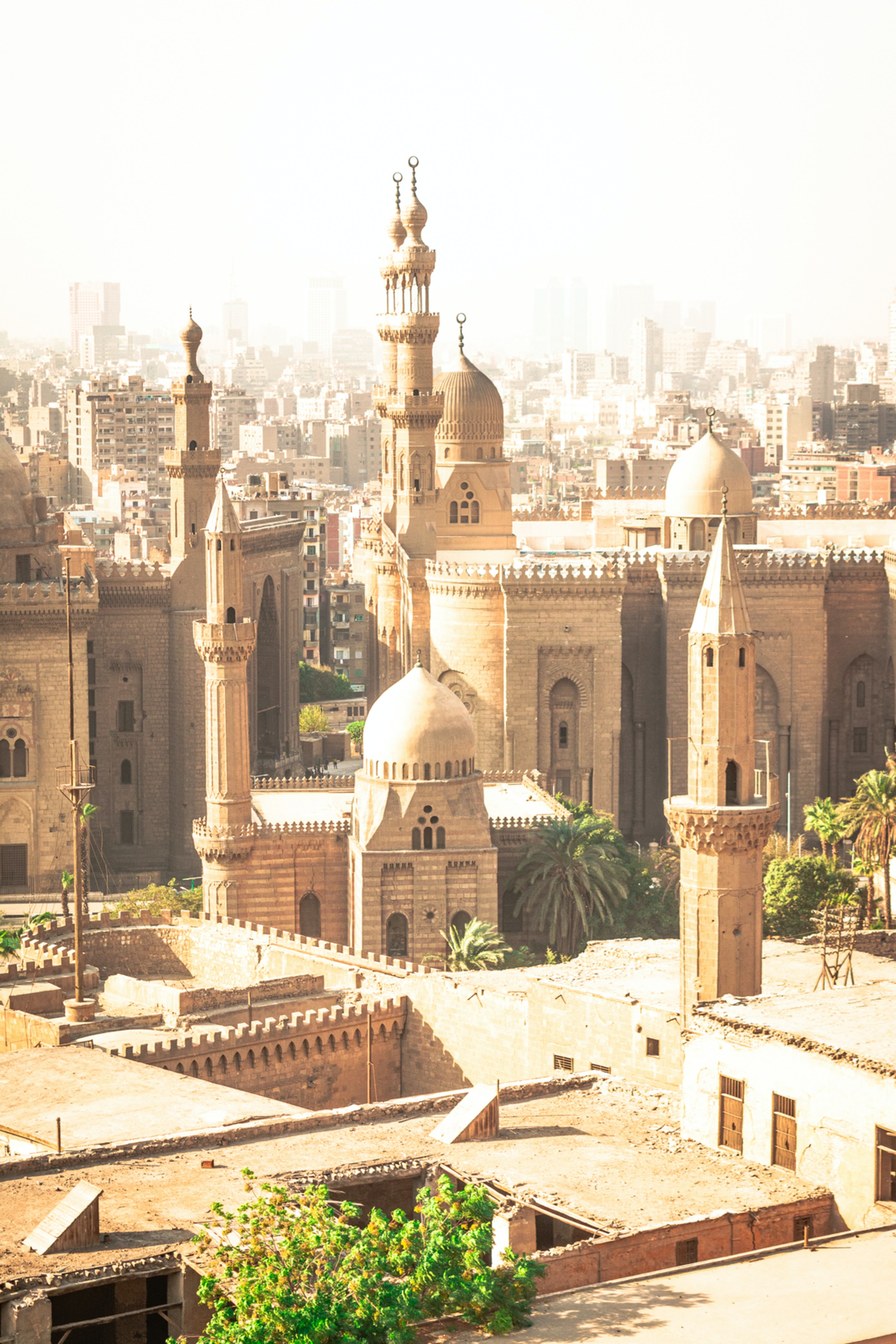
Photo: Omar Adel via Unsplash.
The Al-Rifa’i Mosque in Cairo. The city’s redevelopment highlights every kind of culture, from mosques to belly-dancers.

Members of my extended family were in Egypt recently, and judging from the videos and photos, they had a fantastic time. It made me think of an article I saw back in January about Cairo.

Donna Abu-Nasr at Bloomberg CityLab had a report on how the city’s “revival blends ancient Egypt with modern tastes.”

She wrote, “When Egyptian ballerina Amie Sultan decided to go into belly dancing, she raised eyebrows among her friends and fellow professionals. Why switch from an art form that’s highly respected to one that’s often scorned in her home country and the rest of the Arab world?

“Six years later, Sultan wants to elevate a dance focused on shaking hips and torsos in low-end cabarets to the theater. It’s just one of the ways Egyptians are trying to establish a contemporary cultural identity in Cairo that taps into their heritage.

“The renaissance of traditions spans everything from new museum exhibits to artisans integrating old crafts into modern furniture and designers selling handmade jewelry, bags and shoes online. There’s also the redevelopment of buildings to champion Egyptian identity. For her bit, Sultan says her goal is to preserve, document and revive the performing arts. Egypt is the spiritual home of belly-dancing, which traces its roots back to ancient times. …

“Perhaps the most striking example of the cultural resurrection was when 22 mummies were transported through central Cairo [in April 2021] to their latest resting place at the new National Museum of Egyptian Civilisation. The multi-million dollar spectacle was broadcast live on state television. …

“Some parts of the sprawling metropolis are being refurbished in an attempt to recapture more of the tourism market. … One of those areas is central Cairo, also known as Khedival Cairo in reference to Khedive Ismail, the ruler under whom downtown Cairo was built in the late 19th century. The country’s sovereign wealth fund plans to redevelop the mid-20th century Mogamma building, a hulking government office complex. …

“Private entrepreneurs, like Karim Shafei, 48, have also for years been actively working on restoring that part of town. … The vision that he and his partner, Aladdin Saba, an investment banker, have for downtown is to make it a real city center that reflects Egyptian identity: a meeting point for Cairenes from all walks of life and a platform for innovation and creativity.

“ ‘There’s nowhere in Cairo where tourists can go and experience the contemporary Egyptian lifestyle, unlike many other cities such as Beirut, Istanbul, Paris and New York,’ said Shafei. ‘Today, there’s a big portion of tourism that’s intended to experience a country in its modern form. You want to experience the way cuisine is, the way people live, how they dress.’ 

“One thing that Shafei has noticed is a change in the government’s attitude toward restoration. In the past, authorities would just focus on painting a wall or fixing a sidewalk. In the past year, the discussions have become deeper.

“Sultan, the dancer, has likewise found a sympathetic ear for her project, which she is doing through her company Tarab Collective. When she has approached government officials with her idea, ‘there’s some shock, but then as they listen they actually see that this is a serious project.’ . …

“Belly-dancing has been associated with smoky cabarets where alcohol is served. … It’s also informally performed by people at home, at picnics or celebrations. …

“Last year, Tarab Collective produced a tribute to the golden age of Egyptian cinema and the dance’s divas from 1940 to 1960. It featured 12 performers and premiered at the closing of the Gouna Film Festival in October.

“[Sultan’s] company is also working on setting up an institute to teach the dance, register it with UNESCO as intangible heritage and change its name from one that comes from the French danse du ventre to ‘Egyptian dance.’

“ ‘At the end of the day, this dance represents Egypt,’ she said. ‘It’s how we show ourselves to the world, just like we identify Spain with flamenco.’ “

More at Bloomberg CityLab, here. I know I’ve told you that there was a wonderful belly-dancer at our son’s wedding — with flaming candles in her hair, no less. If I can get into my old computer, I’ll post a picture.

Read Full Post »

Photo: Reuters/Mohamed Abd El Ghany
Visitors play music and talk together in a Cairo, Egypt, bookshop where the new “scream room” is found.

There’s a rather unusual bookstore in Cairo: one that offers customers a room where, if they feel the need to scream, they can just let it rip. No charge for ten minutes.

“Visitors to a bookshop in Cairo are being invited into a dark, soundproof room to scream at the top of their lungs in an effort to relieve their frustrations and escape from the stresses of daily life.

“The new ‘scream room’ is tucked away in the ‘The World’s Door’ bookshop and is also equipped with a full drum kit allowing customers to let go of their worries …

“Owner AbdelRahman Saad offers each visitor ten minutes inside the private scream room, free of charge. He believes it is the first room of its kind in the Middle East.

” ‘I entered it at a time when I was really stressed and came out much more relaxed,’ said frequent visitor Mohamed el-Debbaby. ‘What’s even better is that I was able to find solutions to the problem I was facing.” More here.

(Reporting by Reuters Television; Writing by Adela Suliman; Editing by Patrick Johnston/Jeremy Gaunt)

Photo: Reuters/Mohamed Abd El Ghany
Mohamed el-Debbaby, a dentist, screams in a soundproof room inside a bookshop in Cairo in an effort to escape from the stresses of daily life.

Read Full Post »