Feeds:
Posts
Comments

Posts Tagged ‘camel’

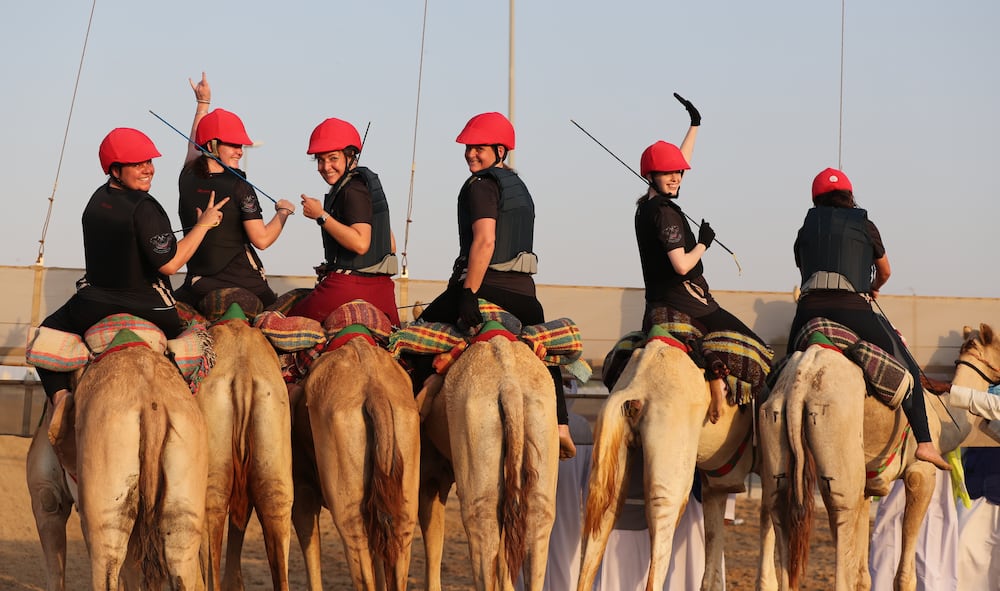
Photo: EPA/Ali Haider via the National News.
Female camel-racing event in Dubai, October 2021. Of the eight women who took part, seven were trained at the Arabian Desert Camel Riding Centre, the first in the region dedicated to teaching women to race camels.

For some reason, I’ve been hearing about camels a lot lately. Not just how long they can travel without refueling but how nutritious their milk is, how lovely their hair. Today we learn about racing camels.

Stacey Vanek Smith reports at PRI’s (Public Radio International’s)The World, “It was a scorching hot day at the Al Marmoom Camel Racing Track located just outside of Dubai in the United Arab Emirates. …

“On a typical morning, [the] arenas are packed with hundreds of enthusiastic fans placing bets on the early-morning camel races (early morning because temperatures are often in the triple digits by 10 a.m.). …

“Camel racing is an ancient sport — its roots stretch back to at least the 7th century on the Arabian Peninsula. But the races at Al Marmoom are a modernized version. Instead of riders, small robots sit atop the camels’ humps and control them with reins. The robots are controlled remotely by men who speed alongside the racetrack in cars, directing their camels. But the people gathered on this hot afternoon had come for something different but also far more traditional: The season’s first women’s race. 

“Though the crowd was undoubtedly smaller than the hundreds who regularly show up for the men’s races, the women’s team — a part of the Arabian Desert Camel Riding Center — has started to get real traction in the last few years. News outlets covered the race, and Jeep sponsored the event, along with a handful of local businesses, including Camelait, a company that sells camel milk.

” ‘It’s high in calcium,’ the emcee informed the crowd. …

“Meanwhile, the four women riders led their camels to the racetrack. One of the racers, 31-year-old Linda Krockenberger, is the reason behind the rise of women’s racing — she founded the women’s camel racing team. 

“Krockenberger came to Dubai in 2015 to work in the hospitality industry. She had raced horses back in Germany and decided to try her hand at camel riding. She was instantly hooked and was determined to learn how to race camels. The only problem was she couldn’t find anyone to train her. For years, she was told the sport was not for women. …

“But Krockenberger kept trying until she found a willing trainer, Obaid Al Falasi, a highly respected community member.  As soon as she felt comfortable with her skills, Krockenberger and Al Falasi decided to open a school. …

“Before she knew it, local and tourist women were flocking to her for lessons. Krockenberger emphasized the support she has gotten from the camel-riding community. … Still, Krockenberger added, there have been many skeptics.

“ ‘Critics sometimes say, “Oh, do we really need a German to teach us an Arabic tradition?” Of course, these comments do get to me because I don’t want to impose myself on the culture,’ she said. ‘But I try to calm these thoughts by saying, “Well if you’re such a great teacher, there’s nothing that stops you from teaching as well.” ‘

“Krockenberger’s riding school emphasizes the Bedouin camel riding tradition. The racers ride barefoot and don’t use saddles, just Bedouin blankets. 

‘Barefoot, it’s more freeing,’ racer Rawan Salah explained. ‘You feel everything. You can feel the belly of the camel. You can feel if they’re nervous. Everything.’

“ ‘The Bedouin didn’t have shoes, so we don’t have shoes,’ racer Yanna Schmiel added. …

“While the racers led their camels to the start line, a group of spectators got into their nearby cars and drove up beside the camel track where the riders mounted their camels. Spectators may watch the races from their vehicles or stand at the finish line.

“The women perched just behind the hump on their single-humped Dromedary camels, sitting on blankets. They clung to the camels with their legs, wearing riding helmets and team jerseys.

“Salah said that she feels that all-women racing is a special experience. ‘It feels empowering,’ she said.”

More at PRI’s The World, here.

Some additional fun: “Camels and Riders will be disqualified for the following reasons:

  1. “Belts used to strap rider to camel.
  2. “Electric shockers found mounted to the camel or used in whips, overusage of the whip.
  3. “External influence of camel owner on camel during race beyond vocal cheering on.
  4. “Interference with gear of competitor camels and riders
  5. “Riding gear that has not been tested and approved prior to the race.”

Read Full Post »

Photo: CNRS / MADAJ / R. Schwerdtner
Mysterious 2,000-year-old camel carvings found in Saudi Arabian desert.

The lure of space travel notwithstanding, there’s still a lot to discover and puzzle out on Planet Earth. In this story, archaeological adventurers ask why life-size camels might have been carved 2,000 years ago in a Saudi Arabian desert.

Ruth Schuster explores the mystery at Haaretz. “About a dozen life-sized stone sculptures and reliefs of camels have been found in a markedly inhospitable site in northern Saudi Arabia. While camelid art has existed in the region going back millennia, nothing quite like this has been found before.

“The somewhat eroded statues are tentatively dated at around 2,000 years old, give or take a century or more, according to a collaboration between the French National Center for Scientific Research and the Saudi Commission for Tourism and National Heritage reported [in] the Cambridge journal of Antiquity. …

“No associated artifacts were found at Camel Site that could give clues about origin – no hammers, picks or anything.  …

“For all the art, Camel Site seems not to have been inhabited. As the authors write, it ‘does not seem propitious for permanent human settlement.’ However, they point out, the fact that ‘this isolated and seemingly uninhabitable site attracted highly skilled rock-carvers is striking testimony to its importance for surrounding populations.’

“For instance, it might have been a place of veneration going back generations. … Or the site could have been a boundary marker. Or a rest stop for caravans. …

“The camels were carved in proportion. Muscles and heads, particularly the muzzles and eyes, and the thickness of the legs were individual. These were lovingly depicted camels.”

More about the work to uncover the story of the carved camels may be found here. I was surprised to learn camels actually emerged first in North America.

By the way, I once rode a camel briefly. I was five months pregnant with John. I think I pretty much just got on and then got off.

Read Full Post »

It’s amazing what you can learn from DNA. Recently, scientists have been collecting insights from camel DNA about how camel ancestors were used on ancient trade routes.

Victoria Gill writes at the BBC, “Scientists examined DNA samples from more than 1,000 one-humped camels. Despite populations being hundreds of miles apart, they were genetically very similar. Scientists explained that centuries of cross-continental trade had led to this ‘blurring’ of genetics.

“The findings are published in the Proceedings of the National Academy of Sciences.

“One of the team, Prof Olivier Hanotte, from Nottingham University, explained that what made the dromedary so biologically fascinating was its close link to human history.

” ‘They have moved with people, through trading,’ he told BBC News. ‘So by analysing dromedaries, we can find a signature of our own past. … Our international collaboration meant we were able to get samples from West Africa, Pakistan, Oman and even Syria.’ …

” ‘People would travel hundreds of miles with their camels carrying all their precious goods. And when they reached the Mediterranean, the animals would be exhausted.

” ‘So they would leave those animals to recover and take new animals for their return journey.’

“This caused centuries of genetic ‘shuffling’, making dromedaries that are separated by entire continents remarkably similar.

“Crucially, this has also ensured that the animals maintained their genetic diversity — constantly mixing up the population. This means that dromedaries are likely to be much more adaptable in the face of a changing environment. …

” ‘The dromedary will be our better option for livestock production of meat and milk. It could replace cattle and even sheep and goats that are less well-adapted.’ ”

More at the BBC website, here.

Photo: Mark Payne/Gill/NPL
Ships of the desert: camels provide transport, milk and food in arid, hostile environments

Read Full Post »

First there was the photo, which was tweeted with a link to tumblr. But tumblr offered no story and no credit. I did some searching and found the story at The Trumpet. It reminds me of this post on Sam and Leslie’s Uni, a pop-up library that has traveled from New York to Kazakhstan and many places in between.

At The Trumpet, Jeremiah Jacques reports on a Mongolian Andrew Carnegie (without the fortune). “What do you do if you are a young book lover? You go to the library. But what if you live in the rural regions of the Gobi desert? Your situation would be bleak — were it not for Dashdondog Jamba. He has devoted his life to writing, translating, publishing and transporting books to children all over Mongolia with his Children’s Mobile Library.

“ ‘I can’t remember how many trips I have made—I have lost count,’ Mr. Jamba said. ‘Sometimes we travel by camel, sometimes on horseback, and with horse carts or ox carts; we now also have our van.’

“Over the last 20 years, his library has traveled 50,000 miles through every province of Mongolia — mostly before the van was part of the operation. Jamba’s assistants are his wife and his son. They often spend several days in one place to give as many children as possible a chance to read their books.

“ ‘[It] is a little different from other libraries,’ Jamba says. ‘The walls of this reading room are made of mountains covered with forest, the roof is blue sky, the floor is a flower-covered steppe, and the reading light bulb is the sun.’

“Jamba created his library in the early 1990s, shortly after Mongolia abandoned communism and adopted free-market economics. Life in Mongolia changed dramatically, mostly for the good. But organizations focused on children’s literature fared badly. They were viewed as profitless, so no private investors wanted to take them over. Most children’s libraries were converted into banks.

“Jamba tried to keep the libraries alive. … Ever since, he’s been writing children’s books, translating foreign youth literature into Mongolian, and bringing books to children who would otherwise never read them. Several of his original books have earned the Best Book of Mongolia award. Some of his stories have been put to song. Some have been made into movies. In 2006, his mobile library won the prestigious ibby-Asahi Reading Promotion Award.” More here.

Photo: Dashdondog Jamba
Dashdondog Jamba has traveled more than 50,000 miles through every province of Mongolia with his Children’s Mobile Library.

Read Full Post »