Feeds:
Posts
Comments

Posts Tagged ‘caregiver’

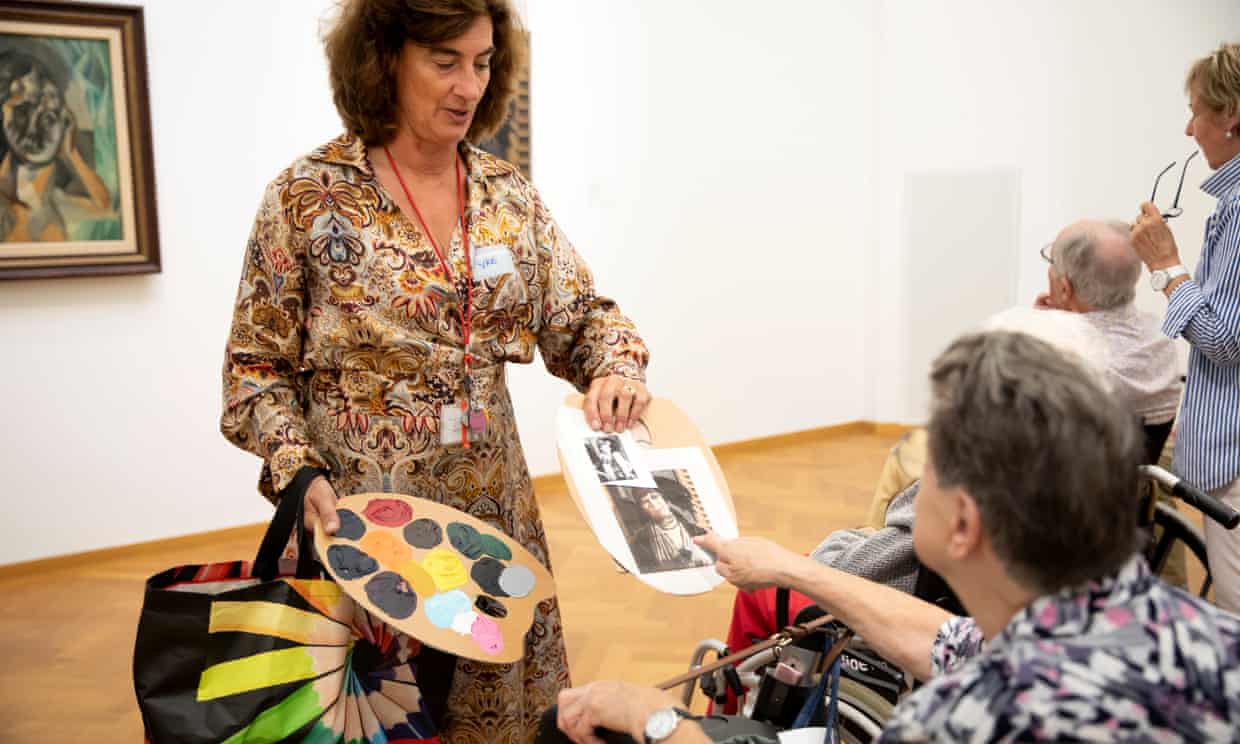
Photo: Judith Jockel/The Guardian.
As part of outreach to people in the Netherlands with dementia, Yke Prins uses a paint palette and spinning tops for a demonstration about colors.

About a year ago, I saw a meditation and breathing exercise that involves focusing on one’s five senses. Very interesting. (Click here.) Just as we don’t think about our breathing all the time, we don’t always think about how important each of our five senses is either.

Now I’m reading that one approach to reaching people with dementia also taps into the five senses. That is happening in the Netherlands, which is generally ahead of the curve on senior care. It’s from there that Senay Boztas reported today’s story for the Guardian.

“Eight people approached a fragrant carpet of lavender in the Kunstmuseum Den Haag gallery,” she writes. “Four of them had dementia and four were their relatives and carers. ‘Put your nose nearer the ground and smell it, it’s wonderful!’ called Annie Versteeg, 88, to Bwieuwkje Bruinenberg-Haisma, 90, in her wheelchair nearby.

“ ‘This tour is about color and here we have a color and it goes with a smell,’ said Yke Prins, the museum guide. ‘Do you know what it is? It is lavender. What does it make you think about?’

“This was no ordinary gallery tour, but a dedicated effort to welcome visitors with dementia and their carers. The new Art Connection tour ran for the first time [in June] and is scheduled for the last Friday afternoon of every month.

“ ‘The heart does not get dementia,’ said Maaike Staffhorst, the museum’s spokesperson. ‘People with dementia still have feelings [that] can give a sense of fulfillment. For the carer, this brings a level of equality. You can talk about the same thing.’ …

“On the inaugural tour, the residents of the Nebo care home and their carers looked at four artworks. … Prins opened up a bag of tricks: she whipped spinning tops to demonstrate how dots of color blend in front of the eye; pulled out palettes of color and, at the last work, coloring-in sheets.

“Bruinenberg-Haisma, who, her son Harry said, had been in the care home for four months after it became too difficult for him to look after her, wore a constant smile. ‘Beautiful!’ she said, several times.

“Another visitor, Jeroen Smit, 74, who was diagnosed with dementia after falling from his bicycle two years ago, said over tea before the tour that he struggled with daily life. ‘I can’t do it any more – I’m rudderless,’ he said. As the afternoon progressed, he visibly relaxed.

“The free art tours in The Hague– organized thanks to a bequest – were inspired by the Museum of Modern Art in New York’s Alzheimer’s Project. They are part of a larger push to adapt Dutch society as the population ages and one in three women and one in seven men will be diagnosed with dementia.

“This was a priority for Conny Helder, the last minister of long-term care. ‘It’s vital that we keep working to ensure that people with dementia are treated as valued members of society,’ she told the Guardian. … ‘Science shows that this can enhance cognitive functioning in many people with dementia, effectively giving them their lives back. All this requires a major change in thinking.’

“One driving force towards a ‘dementia-friendly‘ society is Alzheimer Nederland. The charity has helped create free, online training videos so everyone can recognize and respond correctly to signs of Alzheimer’s. …

“ ‘This is hugely urgent,’ said the director, Gerjoke Wilmink. ‘Right now, about 300,000 people are living with dementia in the Netherlands and this number will rise explosively to around half a million in 2040. But care and carers are not growing in tandem. It is essential that people with dementia can continue to participate … and this needs to be systematically embedded in our society.’ …

“Rotterdam’s deputy mayor for care, Ronald Buijt, described initiatives such as multilingual awareness programs for city workers and taxi drivers, and Alzheimer’s cafes for old and young. ‘The most important thing is for us to learn that these people should live as good a life as possible, and as normal a life,’ he said. ‘Let them do what they can still do.’ …

“Elsewhere in the Netherlands, a ‘participation choir‘ initiative matches singers with dementia with two supportive buddies, who pick them up and help them find their way in the songbook. ‘The musical memory stays intact for the longest time,’ said the choir’s founder, Erik Zwiers. ‘Caregivers, the audience, musicians all see that people with dementia can reach a higher artistic level than they often think. It gives a completely new view on how to deal with people with dementia – and it’s fun.’ ”

More at the Guardian, here.

Read Full Post »

After 46 years of marriage, I can say I have a husband who is the same guy he always was, just with more life experience. But among my small circle of friends, including my blog friends, many women are dealing with extraordinary changes.

It may be true that, overall, women are as likely to develop dementia as men (see study) and present their husbands with unexpected caregiving challenges, but so far those stories are not the ones I’m hearing.

A college friend married to a brilliant scientist who has known for some time he was developing Alzheimer’s recently told me, “I finally realized he is completely dependent on me.” She is biting the bullet, reaching out for more helpers and planning an altered future.

Another friend whose husband has dementia made the decision to leave behind all her East Coast activities and relocate to Minnesota, where there is a network of family members. She intends to keep her husband in their new home, which has become a safe place in his mind. When her husband no longer recognizes anyone at all, she says, she will get full-time care, move herself out, and come visit him.

I reconnected last month with a high school friend who suffered a bitter divorce decades ago. She told me her ex’s wealthy girlfriend has been able to provide high-quality care for him for the 15-plus years since he was diagnosed with dementia. Although the divorce is still raw enough that there are topics my friend can’t discuss with her children, she goes to the Alzheimer’s facility regularly to read to her ex. She wants to become a better person.

Dementia has not been the only challenge for women I know. In one case, after a relative discovered her husband’s multiyear dalliance with a blackmailing call girl (and he then suffered a physical and emotional collapse), the wife made heroic efforts to rebuild the shattered relationship. A year later, they are both enjoying life together a little more every day.

Then there is the friend whose husband’s rare disease progressed to the point that he can no longer be left alone. She has had friends come in for an hour or two so she can shop for groceries and walk the dog, but the cost of a few hours coverage from a trained home-health-care aide has to be parceled out frugally as this friend has lost one income, is trying to build a home-based career, and needs to pay for two children’s colleges.

I can’t say enough about how much I admire these women who are rising to meet unanticipated disruption despite their sorrow and fear.

Art: William Utermohlen
In 1995, U.K.-based artist William Utermohlen was diagnosed with Alzheimer’s disease. He created a series of self-portraits over five years, before his death in 2007. (Caution: This is the first in the series. The others may be painful.)

alzheimers-disease-self-portrait-paintings-william-utermohlen-1

Read Full Post »

William Wegman is known for photographs of his weimaraners dressed as humans and posing like humans. (See funny video.) Sacha Goldberger, a 44-year-old French photographer, has his own unique subject: his 93-year-old grandmother, dressed as a superhuman and demonstrating how to be one.

Judith Graham writes about the dynamic duo in a New York Times blog post, “The New Old Age: Caregiving, Laced with Humor.”

“Their unusual collaboration began after Frederika retired from her career as a textile consultant at age 80 and fell into a funk.

“ ‘I was very depressed because I lived for working,’ she told me in our Skype conversation.

“Sacha had long dreamed of creating what he calls a ‘Woody Allen-like Web site with a French Jewish humor,’ and he had an inspiration. What if he took one of the pillars of that type of humor, a French man’s relationship with his mother and grandmother, and asked Frederika to play along with some oddball ideas? …

“ ‘It was like a game for us, deciding what crazy thing we were going to do next, how we were going to keep people from being bored,’ said Sacha, who traces his close relationship with his grandmother to age 14, when she taught him how to drive and often picked him up at school. ‘Making pictures was a very good excuse to spend time together.’ …

“People responded enthusiastically, and before long Sacha had cooked up what ended up becoming the most popular character role for Frederika: Super Mamika, outfitted in a body-hugging costume, tights, a motorcycle helmet and a flowing cape.” More.

One of Goldberger’s books is Mamika: My Mighty Little Grandmother. I features a broad array of Mamika’s personae.

Note this Frederika quote: “I like everything that my grandson does.”

That’s how I feel about my grandchildren.

Photograph: Sacha Goldberger

Read Full Post »