Feeds:
Posts
Comments

Posts Tagged ‘Chagall’

Photo: Besançon Museum of Fine Arts.
“The Acrobat with the Violin,” Marc Chagall, 1924.

I wonder how a painting by a famous artist could languish in customs in France for decades. Didn’t anybody wonder where it was? At any rate, the snafu turned out to be lucky for a town on the French-Spanish border. Customs has given the local museum a present.

Min Chen writes at Artnet, “Twenty years after being detained at the Franco-Swiss border, a Marc Chagall artwork has finally reemerged from customs.

“The etching, ‘L’Acrobate Au Violon’ (1924), arrived in 2005 at the roadside border as one of a truckload of artworks bound for Switzerland. French officials found two of the works—the Chagall and a 1959 drawing by Russian sculptor Ossip Zadkine—were not authorized to leave the country, customs authorities said. They arrested the two Swiss nationals transporting the art, charging them with hiding cultural goods, according to the London Times.

“The perpetrators were fined, and the two artworks were confiscated and stored at a customs warehouse in eastern France. There, they languished, forgotten until their rediscovery two years ago. …

“The Chagall has been gifted to the Museum of Fine Arts and Archaeology of Besançon, France. Following the official handover on Monday, the Chagall etching will go on view at the institution in September.

“ ‘The customs service has really honored us,’ Besançon‘s mayor Ludovic Fagaut told the Times. ‘It’s the first Marc Chagall to enter the museum.’

“Granted, it’s not a major Chagall. Paintings by the Russian-born French artist regularly fetch millions at auction (his record stands at $28.4 million for a lush canvas from 1928). Still, L’Acrobate au Violon is quintessential Chagall, with its titular acrobat balancing atop a violin — a recurring motif in the artist’s work — while appearing to juggle a chicken and another acrobat.

“ ‘You can easily recognize Chagall with this somewhat dreamlike style,’ Maël Vandewalle, the museum’s curator, told Besançon Ici. ‘It’s this dream world so detached from reality.’

“Chagall’s most famous etchings emerge from his decades-long partnership with French dealer Ambroise Vollard, who commissioned the artist for illustrated books such as Nikolai Gogol‘s Dead Souls (1948) and The Fables of La Fontaine (1952). L’Acrobate originated from another Vollard commission focused on painters who had become engravers, and was issued in an edition of 150.” More at Artnet, here.

Are you familiar with Chagall’s floating people? The chickens? The violins?

This is from wikipedia: “Marc Chagall (born Moishe Shaga) … was a Russian and French artist of Jewish ancestry. An early modernist, he was associated with the École de Paris, as well as several major artistic styles and created works in a wide range of artistic formats, including painting, drawings, book illustrations, stained glass, stage sets, ceramics, tapestries and fine art prints.

“Chagall was born in 1887, into a Jewish family near Vitebsk, today in Belarus, but at that time in the Pale of Settlement of the Russian Empire. Before World War I, he travelled between Saint Petersburg, Paris, and Berlin. During that period, he created his own mixture and style of modern art, based on his ideas of Eastern European and Jewish folklore. He spent the wartime years in Vitebsk and Petrograd, becoming one of the Russia’s most distinguished artists and a member of the modernist avant-garde, founding the Vitebsk Museum of Modern Art and People’s Art School. He later worked in and near Moscow in difficult conditions during hard times in Russia following the Bolshevik Revolution, before leaving again for Paris in 1923. During World War II, he escaped occupied France to the United States, where he lived in New York City for seven years before returning to France in 1948.” More at wikipedia, here. (I removed wikipedia’s footnotes.)
Read Full Post »

Photo: Carlos Gonzalez/The Minnesota Star Tribune.
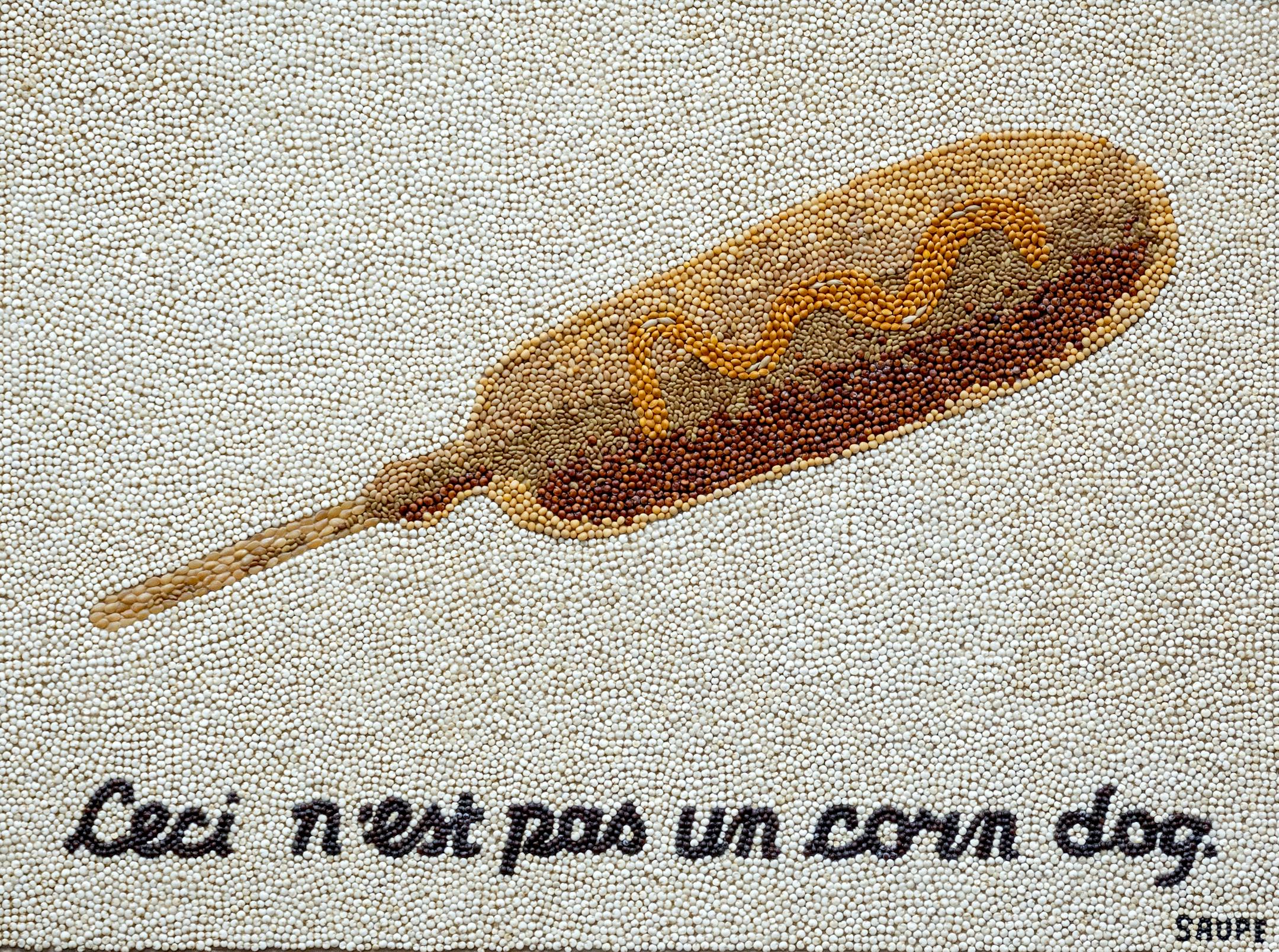
Crop art by Amy and Steve Saupe at the Minnesota State Fair, inspired by Magritte’s 1929 work, the “Treachery of Images.”

Crop art uses seeds and other agricultural produce to create “paintings.” In Minnesota, crop artists take the work very seriously and spend many painstaking hours on it.

At the Minnesota Star Tribune, Alicia Eler writes that in September, the Minneapolis Institute of Art opened its first juried exhibition of crop art from the State Fair. The works shown at “Cream of the Crop” were inspired by artists like Hokusai, Magritte, Chagall, and van Gogh.

“MIA director and president Katie Luber, associate curator of European art Galina Olmsted, and associate curator of global and contemporary art Leslie Ureña made the selections in two categories: best interpretation of an artwork at MIA and best interpretation of a Minnesota landmark, story or figure. …

“ ‘Crop art engages with this really rich tradition of mosaic and beadwork and embroidery that exists in all cultures in perpetuity,’ Olmsted said. … ‘But then it’s this hyperlocal Minnesota form.’ …

“Amy and Steve Saupe’s the ‘Treachery of a Pronto Pup’ won best interpretation of an artwork at MIA. The father-daughter team has been making seed art since 2017.

” ‘I loved it because it’s an art history in-joke ― you have to know the Magritte painting to get it ― and then it’s also this specifically Minnesota State Fair in-joke,’ Olmsted said. … ‘The way the artists built up the background … you can tell was this real attention to detail.’ …

“Honorable mentions include ‘Vincent Van Grow Olive Trees’ by Jill Osiecki, ‘All the Eternal Love I Have for the Crop Art’ by Jill Moe (a reference to Yayoi Kusama), ‘Under the Wave off Kanagawa’ by Amanda Cashman … and ‘Crop Art study of Alice Neel’s “Christy White, 1958” ‘ by Ursula Murray Husted.

” ‘Reimagining van Gogh’s Olive Trees through the textures and natural colors of seeds has been such a joy and to see that creation displayed in one of the nation’s finest museums is truly a dream come true,’ artist Osiecki of Eagan said of her entry that earned an honorable mention. …

“Crop artist Jeanne Morales’ ‘My Chagall Dream’ won for best interpretation of an artwork at MIA. The artist referenced the flying woman, a motif in Chagall’s paintings, and in Morales’ artwork, it flies over Minneapolis.

“ ‘It’s my love letter to the Twin Cities,’ said Morales of Longfellow. ‘All the places I chose are places of community gathering points.’

“Marc Chagall is her favorite artist. She first saw his work in Paris, and she appreciated his whimsical paintings and the way figures in his paintings often float above their towns.

“ ‘We just thought that was a really creative take and required a deep dive into art history but was also really carefully and beautifully done and impressive,’ Olmsted said.

“Honorable mentions include ‘Goat’ by Annmarie Geniusz, ‘Broken Pinky, Unbroken Justice’ by Juventino Meza, ‘Star Gazing’ by Nancy Rzeszutek and ‘Old Dutch and Top the Tater’ by Kaela Reinardy.

“Meza, who curated the exhibition ‘Seeds of Justice’ in April, used crop art to honor former Minnesota State Supreme Court justice Alan Page. Meza was a recipient of a Page Education Foundation Scholarship as an undocumented high school student and it helped him pay for college.

“ ‘It feels incredible to be recognized with this honorable mention,’ Meza of Minneapolis said. ‘Crop art has become a way for me to tell stories that connect my personal journey with broader struggles for justice.’

“In 2004, MIA hosted a crop art exhibition of work by Minnesota legend Lillian Colton. The current exhibition marks the first juried crop art exhibition with work from the Minnesota State Fair’s crop art show.”

More at the Strib, here. (You can get a limited free subscription to the paper by providing your email, but if you’re often interested in the Twin Cities, a paid subscription is like a donation to freedom of the press in Minnesota.)

Read Full Post »