
Feeds:
Posts
Comments

Posts Tagged ‘change’

Photo:  Ken Yoshida at CarterJMRN.
Gen Z Japanese men are leading a cultural change that the government is fully supporting.

When my husband worked in Rochester, New York, we knew several coupes from Fuji Xerox who settled there for a period of years. I remember the laughs my friend Yuriko had over the effects of a different culture on Japanese men. She couldn’t get over the memory of a Japanese husband in a laundromat doing his own laundry. That would not happen at home in the 1970s.

Other cultural changes have been taking place since then.

Patrick Winn reported at Public Radio International’s The World about fatherhood in Japan, where traditionally, dads were not engaged with the daily lives of their children.

Winn writes, “Yuko Kuroda and her husband, Takashi Kuroda, live in a modest, two-story home in Tokyo’s outskirts. Both in their early 40s, Yuko Kuroda works at a daycare center, while Takashi Kuroda has a white-collar job. …

“In contemporary Japan, roughly one-third of women under the age of 50 do not have children. Couples who choose to raise kids usually stop at one. …

“Takashi Kuroda, his face streaked with black marker, just emerged from a rolling-on-the-floor play session with his son and daughter, aged 3 and 6, on a Sunday afternoon. The children drew whiskers on his cheeks while shouting, ‘Neko! Neko!’ (Japanese for ‘cat’). 

“ ‘I really recommend this lifestyle,’ he said. ‘Raising five kids is fun.’ …

“Officials warn that if the birth rate doesn’t rise, Japan could become unrecognizable in decades to come: less affluent, less vibrant and less powerful.

“What currently is deterring couples from raising children is being associated with overwork and sky-high housing prices. 

“But one of the major factors concerns dads ‘doing too little around the house,’ according to Mary Brinton, a Harvard University sociologist who has studied Japanese demographics for decades and has even advised Japanese officials.

“Traditionally, when Japanese couples have children, ‘women do most the housework and child care,’ Brinton said, and for working moms, the idea of holding down what is essentially a second, unpaid full-time job is ‘not very attractive.’ …

“Among the world’s high-income countries, including the US, fathers average more than two hours of daily housework and child care. In Japan, the average is only about 40 minutes. 

“But what erased Yuko Kuroda’s reluctance in raising five kids was that Takashi Kuroda wasn’t afraid to wipe a butt or wash a dish. 

“ ‘If one of the kids falls ill, he’ll immediately ask for a day off from work,’ she said. …

“Takashi Kuroda believes raising Japan’s birth rate requires a revolution in fatherhood. More than a decade ago, the government launched a social engineering campaign urging fathers to become ikumen, a Japanese word that loosely translates to ‘super dads.’ 

“Through public service announcements, namely posters, websites and online videos, Japan promoted this ideal of fatherhood. The ikumen eagerly burp babies, change diapers and walk toddlers to the park. …

“Fathering Japan, a nonprofit organization, contracted with the government to promote an ‘ikumen boom’ and teach fathers, through in-person classes, how to care for kids and do chores. 

“Manabu Tsukagoshi, a director with the group, believes it has successfully shifted fathers’ mindsets across Japan. But workplace culture is much harder to change. 

“Plenty of dads now want to live as ikumen, Tsukagoshi said, but — especially in white-collar jobs — they might toil for old-fashioned bosses who pressure workers to stay late and, after hours, bond over beer and sake. 

“Japan’s paternity-leave policies are now among the best in the world, but too many fathers fear taking time off work and risking the disapproval of their bosses or colleagues.

“ ‘I’m actually a bit ashamed of our Japanese men,’ Tsukagoshi said. ‘As employees, we have rights, but men hesitate to break from the norm. If other guys in the office aren’t taking paternity leave, they won’t feel keen to be the first.’

“But Takashi Kuroda is hopeful. He believes the revolution in fatherhood — in which dads stand up to corporations and put family first — is on the horizon. 

“Fifteen years ago, the rate of fathers taking paternity leave was almost zero. Only in recent years, it’s edged up to roughly 15% while by the decade’s end, Japan’s government hopes to up the rate to 85%.

“[Takashi Kuroda] credits Gen Z fathers for helping redefine what it means to be an attentive dad, unlike their own fathers, who often stuck with a corporation their entire working lives.

“ ‘Younger Japanese dads don’t feel like they have to belong to one company. So, they’re not so terrified of their bosses … and will stand up for themselves,’ he said.

“The COVID-19 pandemic, which saw more parents working at home, spurred a higher number of fathers to refocus on family, Takashi Kuroda said. He’s among the fathers who not only demanded paternity leave but took an entire year off for his third child, also insisting on remote work. …

“By late afternoon, Yuko Kuroda read to her children from a storybook while Takashi Kuroda was in the kitchen, elbows deep in dirty dishes. The sink was full of bowls used for breakfast, and water-logged noodles swirled around the drain. He looked silly — the cat whiskers remaining on his face — as he radiated joy.

“ ‘I’m very, very, very happy,’ he said.

“When asked if he’d be happy to have a sixth child, he answered maybe, as Yuko Kuroda popped in to end the questioning.

“ ‘No way,’ she said. ‘Our car only seats seven people. This is it.’ ”

More at The World, here. Lovely pictures. No firewall.
Read Full Post »

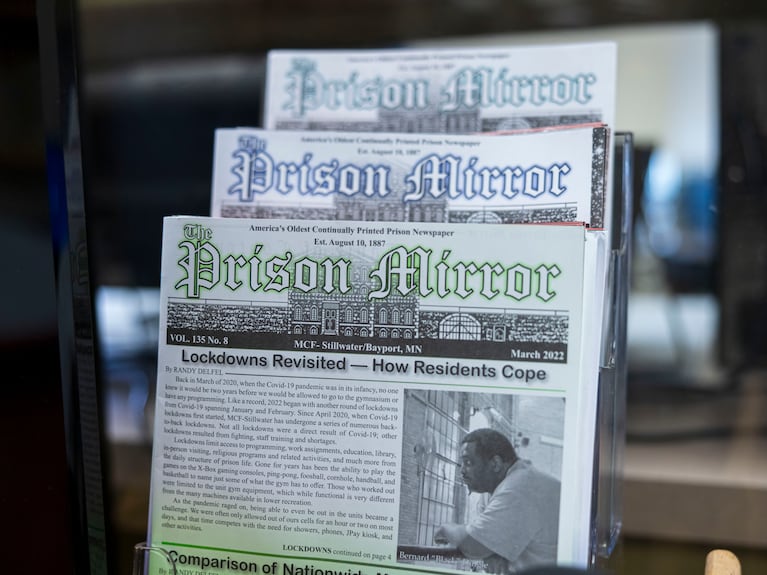
Photo: Kerem Yücel/MPR News via Oregon Public Broadcasting.
Previous issues of the Prison Mirror, which has been publishing since 1887, sit on display in the Minnesota Correctional Facility in Stillwater.

From time to time I like to run a story about interesting prison programs or ex-offenders trying to make good. I’m pretty sure we don’t have the right kind of prisons in the US. You may recall me writing about the system in Norway, which is completely different. (Click here and here.)

Meg Anderson (Minnesota Public Radio NPR) wrote recently about a longtime enrichment program at a prison in Minnesota.

“Inside a state prison near Stillwater, Minn., past the guards and the wings of cells stacked one on top of another, tucked in the corner of a computer lab, Richard Adams and Paul Gordon are fervently discussing grammar.

“Both men are on staff at the Prison Mirror, a newspaper made by and for the people held at the Minnesota Correctional Facility – Stillwater. Gordon had written a profile on the prison art instructor. He read it aloud to Adams. …

“Conversations like this have been happening in this prison for more than a century. The Prison Mirror is one of the oldest prison newspapers in the country, running since 1887. Publications like this aren’t common, but in an era where many journalism outlets in the free world are struggling to thrive amid scores of layoffs, journalism behind bars is actually growing.

“ ‘Overall we do see a growth and a lot of interest in starting publications, starting podcasts even. And so that’s really quite exciting,’ says Yukari Kane, CEO of the Prison Journalism Project.

“Thirty years ago, she says there were estimated to be only six prison newspapers. Today, there are more than two dozen. That doesn’t take into account the hundreds of incarcerated writers submitting work to publications on the outside, like The Marshall Project’s Life Inside series.

“Kane says this kind of work can offer a window into what prison is actually like, one that prison administrators aren’t necessarily going to offer up freely. … Even if a newspaper doesn’t circulate far beyond the prison yard, it can offer a sense of empowerment for its writers. …

“The Stillwater prisoners write book reviews, legal explainers, and summaries of local, national and international events for the monthly newspaper. One man recently submitted an essay on homesickness. Another wrote an editorial criticizing lockdowns. The men on staff — there are only three of them — had to apply for these unpaid jobs, and they’re highly sought after.

“Adams says the job requires a lot of reading and research about what’s going on around the world and the prison. There are challenges. They don’t have the internet, for instance, so they have to rely on print media and articles printed out by prison staff.

“The prison also has to approve everything the paper publishes. The men say that can limit what they write about, especially if they want to report on the harsher aspects of their lives.

“ ‘I am limited in the sense of, they’re not going to let me print all types of crazy things about the water or the lockdowns or getting restrained or anything like that, which is understandable to a degree,’ Gordon says.

“Last fall, around 100 Stillwater prisoners refused to return to their cells. Gordon says the disobedience was their way of protesting extreme heat, poor water quality, and staffing shortages, which he says often result in lockdowns. He plans to write about it, but says he has been retaliated against in the past for sending reporting to outside publications.

“ ‘I was a lot more aggressive in my writing back then, and that was a learning experience for me,’ he says.

Brian Nam-Sonenstein, a senior editor at the Prison Policy Initiative, says punishment for doing journalism behind bars is common. ‘You can lose what are called good time credits, which are essentially time off of your sentence based on good behavior. You could go to solitary confinement. You could have your privileges revoked,’ he says. …

“Marty Hawthorne works at the Stillwater prison and oversees the Prison Mirror.

“ ‘They have a lot of freedom. My philosophy is: It’s their newspaper. It’s not my newspaper,’ he says. ‘I believe they have a right to do what they’re doing.’ He says if the men plan to publish something critical, he makes sure whoever they’re writing about has an opportunity to respond. But he says he also pushes back when leadership tries to censor stories he believes are fair.”

More at NPR, here. No firewall.

Read Full Post »

When I worked at the Fed magazine, I attended a couple conferences on housing for seniors and learned about a thing called universal design. Universal design espouses the notion of making all architecture accessible so expensive alterations aren’t needed later. Someday, you might be using a wheelchair or crutch in the home you love, and wouldn’t it be nice if you didn’t have to reconfigure it for a ramp, flat thresholds, wider doors, handrails, higher toilet seats, etc.?

Similarly during the coronavirus pandemic, architects have been rethinking design so we don’t need too many adjustments in pandemics. Think of all the light switches, doorknobs, and elevator buttons you’re careful not to touch these days! Think of the store ventilation systems you wonder about! What if you didn’t have to worry?

Recently, Carolina A. Miranda addressed this topic in a long feature at the Los Angeles Times.

“In another time, not long ago, an elevator was a conveyance to reach a higher floor, an open office was a spot to clock eight hours while hoping your boss didn’t catch you checking Facebook and a doorknob was one of those banalities of architecture that seemed to warrant attention only when it needed replacing.

“What a difference a virus makes. …

“ ‘If you take the great architectural inventions of the 20th century: the airport, the high-rise, the freeway — those are the things that are challenged the most right now,’ says Brett Steele, dean of UCLA’s School of the Arts and Architecture. ‘They have great density or they promise movement at high speeds. Those are exactly the things that sit at the crux of the crisis we are going through.’

‘It’s a reset button for the entire world,” says Mark Lee, co-founder of the Los Angeles firm Johnston Marklee and chair of the architecture department at Harvard’s Graduate School of Design. …

“ ‘I’m working on a synagogue, and that is a crazy problem,’ says Barbara Bestor, founder of Bestor Architecture, a 25-person firm based in Silver Lake. ‘How do you do High Holidays after COVID with 2,000 or 3,000 people?’ …

“The solution may involve segmenting larger spaces and segregating the most vulnerable in a separately ventilated environment. … Or it may involve designing a physical space that, Bestor says, features ‘a robust video component so that people can watch remotely.’

“Gatherings via videoconference could become a way of life. Architects could find themselves designing spaces just for that purpose. …

“First, architecture firms, like all other businesses, must weather the pandemic. … The economics are dire. And yet there is a determination to not waste the moment.

“ ‘Every crisis is an opportunity,’ says Hernán Díaz Alonso, director of the Southern California Institute of Architecture (SCI-Arc). ‘The optimist in me believes that this will force us to reevaluate everything that we do.’

“This is a time, he says, to ask ‘the big metaphysical questions’ about architecture and its purpose. It’s also about considering the nuts and bolts. ‘If we don’t get a vaccine, what does that mean? What does that mean in terms of physical space? What do you do with a doorknob?’ …

“ ‘Densities of offices will change,’ [says Bob Hale is partner and creative director at L.A.-based RCH Studios].

“This raises questions about one of the most popular — and widely reviled — workplace designs: the open-plan office, in which rows of workers are jammed around long bench desks.

“These are settings that have a poor track record when it comes to producing actual work. They also, according to a Danish study from 2011, account for significantly higher rates of sick leave — a phenomenon that played out in a study published by the Korea Centers for Disease Control and Prevention in April, which showed the ways coronavirus hopscotched around an open-plan call center in Seoul. …

“Instead, many of the architects I spoke with visualize once-cavernous spaces segmented into more intimately scaled settings with small clusters of desks. ‘We work in teams, so it’s easy to think of people in groups,’ says Paul Danna, a design partner in the L.A. office of Skidmore Owings & Merrill, a global firm at work on an office development in Pasadena. ‘It’s a matter of putting barriers between groups as opposed to every individual.’ ”

The future of airports, affordable housing, and density of cities are among the many other design challenges addressed in the article, here. Enjoy.

Photo: Tara Wujcik
“Is there anyone out there who does not like fresh air and cross-ventilation or views?” asks Lawrence Scarpa in an article at the
Los Angles Times. The photo below is from a Brooks + Scarpa housing development for disabled vets that maximizes light and air.

bfnstr9bxputejec7ij9

Read Full Post »

img_4528-800x600-1

Photo: Filip Noubel
Tiles representing Uzbekistan’s huge cotton industry at the Paxtakor metro station. The  ornamentation of various subway stops portrays the accepted history of the moment.

As we struggle today with our nation’s history and painful, long-suppressed facts come to the fore, let’s turn off the television and think about Uzbekistan.

Back in the day, the Uzbeks thought it would be a beautiful thing to build something Stalin really wanted. They eventually completed a mighty subway system full of the kind of history their now discredited leader would have liked.

Filip Noubel reports at Global Voices, “For many years, it was strictly prohibited to photograph the ornate stations of the Tashkent metro in the Uzbek capital. The Soviet-era system had also been constructed with nuclear attack in mind, and could serve as a fallout shelter in wartime. But ever since that ban was lifted in early 2018, visitors from abroad have started to show heightened interest in Central Asia’s oldest subway system. And with good reason.

“Tashkent’s metro system is so much more than just a means of transportation. Over the decades of its existence, the design and names of the metro’s 29 ornate stations have changed to reflect the turbulent trends of Uzbekistan’s history. …

“Back in November 1920, electricity was a taste of the bold promises of progress to come; it embodied the new innovations now made accessible to the masses. Just 12 years later, the Soviet leadership pronounced yet another strategic and futuristic priority: the construction of the metropolitan, as Europe’s subway systems had come to be known in the second half of the 19th century. On May 25, 1932, the Sovnarkom, the then executive body of the Soviet government issued a decree …

‘The construction of the metropolitan must be considered a project of the utmost importance to the state, with its provision of timber, metal, cement, transportation, etc, and as a key priority in matters of superproductivity at the national level.’ …

“The development of the metro also marked a key turning point in the development of the Soviet economy: while the first five-year plan (1928–1932) emphasised heavy industrialisation, the second five-year plan focused on urbanisation. As a result, the metro became a major cultural symbol, present in films, children’s books, poetry and songs. It was hailed as testament to the success of Stalinism in official songs, such as this one from 1936:

” ‘We believed, we knew, That by digging a pit,
” ‘We would, Comrade Stalin, Make your plan come true.

” ‘They will describe it for centuries on, And not with just one pen
” ‘And they will tell the children, How they fought for the metro!’ …

“The people of Tashkent had to wait several decades for their metro, which was the first in remote and comparatively underdeveloped Soviet Central Asia. Planners faced several challenges: the Uzbek capital had experienced a crushing earthquake in 1966, which destroyed half the city. The city lacked trained engineers and metro workers. Uzbekistan’s long and scorching summers posed problems for ventilation. Which was precisely why the Soviet authorities had to demonstrate that they were up to the task.

“Mobilising human resources and special construction material from all across the Soviet Union, the first metro pits in Tashkent were dug in 1973. Just four years later, in a Stakhanovite spirit which set a record, the metro’s first line was opened in November 1977. The date was chosen to coincide with the 60th anniversary of the Russian revolution. Accordingly, as news footage from that day shows, all local politicians were present at the opening, where a message of congratulations from Soviet leader Leonid Brezhnev was read out before the crowd. …

“As in other Soviet metro systems, each station of the Tashkent metro was assigned a particular political and cultural message to illustrate key messages of Soviet ideology.  …

“Of the 29 stations operating today (a third line was opened in 2001), five metro stations are particularly revealing in what they tell us about Uzbekistan’s changing narratives around national identity.

“[One] station is an emblematic example. Known as Friendship of the Peoples during the Soviet period, its previous name reflected Soviet ideology’s extensive attempts to emphasise its supposedly peaceful international role during the Cold War, in opposition to western imperialism. …

“[The Cotton Grower] station’s name symbolises the Uzbek economy’s everlasting dependency on cotton production. During the Soviet period, Moscow assigned each of the 15 Soviet republics a particular crop to produce en masse. This focus on cotton monoculture has been continued by all subsequent Uzbek governments at a high price for the country’s population. The cotton sector has used forced labor, including that of children.”

Forced child labor, huh? Bet they’re not proud of that now. Read more about the stations and (how the accepted history keeps changing) here.

Hat tip: Arts Journal.

Read Full Post »

When a do-gooder from the nonprofit Kounkuey Design Initiative told poor farmworkers at a California trailer park she wanted to work with them to build a place to relax and play, they didn’t think much would come of it.

Patricia Leigh Brown writes at the NY Times why the community is happy to have been proved wrong.

“When Chelina Odbert, the 36-year-old co-founder of the nonprofit Kounkuey Design Initiative, based in Los Angeles, showed up two years ago and asked residents to propose ideas for a park that they might design and build collaboratively, most assumed she was yet another do-gooder bearing ‘muchas promesas’ that would come to naught.

“And yet, after more than a year of drawing, debating, hauling rocks and waiting out bureaucratic delays, the residents had a fiesta recently to celebrate the opening of the park, a public space built out of railroad ties and other simple materials. It has a playground, a community garden, an outdoor stage and a shade structure where neighbors can gather and gossip even on 110-plus-degree days.

“The park, which doubles as a zócalo, or traditional town square, exemplifies a new phase for both Kounkuey (KDI for short) and the field of public-interest design, which tries to put design tools into the hands of neighbors who can create local change. …

“Alberto Arredondo, 51, lives across from the garden and has become its keeper. … Before, he said, he would come home after a day in the fields picking grapes and collapse on the sofa. The park, he added, has ‘de-stressed the women.’

“His theory was borne out by Rosa Prado, whose commitment to the park never wavered. ‘It helps with depression,’ she said. ‘You go out your door, and you see a lady in the park and sit next to her.’ She added, ‘Then a few minutes later, you forget what you’re worried about.’ ”

More here.

Photo: Monica Almeida/The New York Times
Residents of all ages turn out for the opening of a new public space, by the Kounkuey Design Initiative, in St. Anthony’s Trailer Park, home to farmworkers east of Palm Springs, Calif. 

Read Full Post »

I had just cut out this story for the blog, when a colleague from northern China stopped by my office. He said it was the fifth time he had come upstairs to see if he could find another friend who was getting laid off. He wanted to give her a hug. I said, “Hug? Look at this.”

Didi Kirsten Tatlow, who writes dispatches from China for the NY Times, had just filled me in on a change among my friend’s former countrymen: “Of all the changes to sweep China since the death of Mao Zedong in 1976 — stock markets, private cars, fashion — one thing seemed not to have changed: No hugging. Chinese were physically reserved. That’s changing now.

“Recently, it seems like everyone is hugging. Friends are hugging. Family members are hugging. In hugging between Chinese and non-Chinese, it was non-Chinese who once foisted physical affection on the Chinese. Today it may be a Chinese initiating contact. The tables are turning. …

“Teachers are joining in. In Nanjing, the Liuhe District Experimental Elementary School began a class in emotional intelligence last fall, concerned that children lacked it and would thus be held back in the world, the newspaper Modern Express reported.

“The third graders’ homework: Hug your parents tonight. Sixty schools in the district now have emotional intelligence classes, the newspaper said.”

My co-worker’s first reaction to the news clipping was, “They are always trying to copy Americans.” But then he got a funny look on his face.

“Actually, the last time I went home, my uncle hugged me. I was really surprised. He’s my father’s generation. We were always taught to show more respect for older people.”

I’m happy to see hugs are catching on with nontraditional huggers. As they say of chicken soup, “It wouldn’t hurt.”

(A thank you to John’s family for all the hugs this morning!)

Photo:  Ng Han Guan/Associated Press

Read Full Post »