Feeds:
Posts
Comments

Posts Tagged ‘childhood’

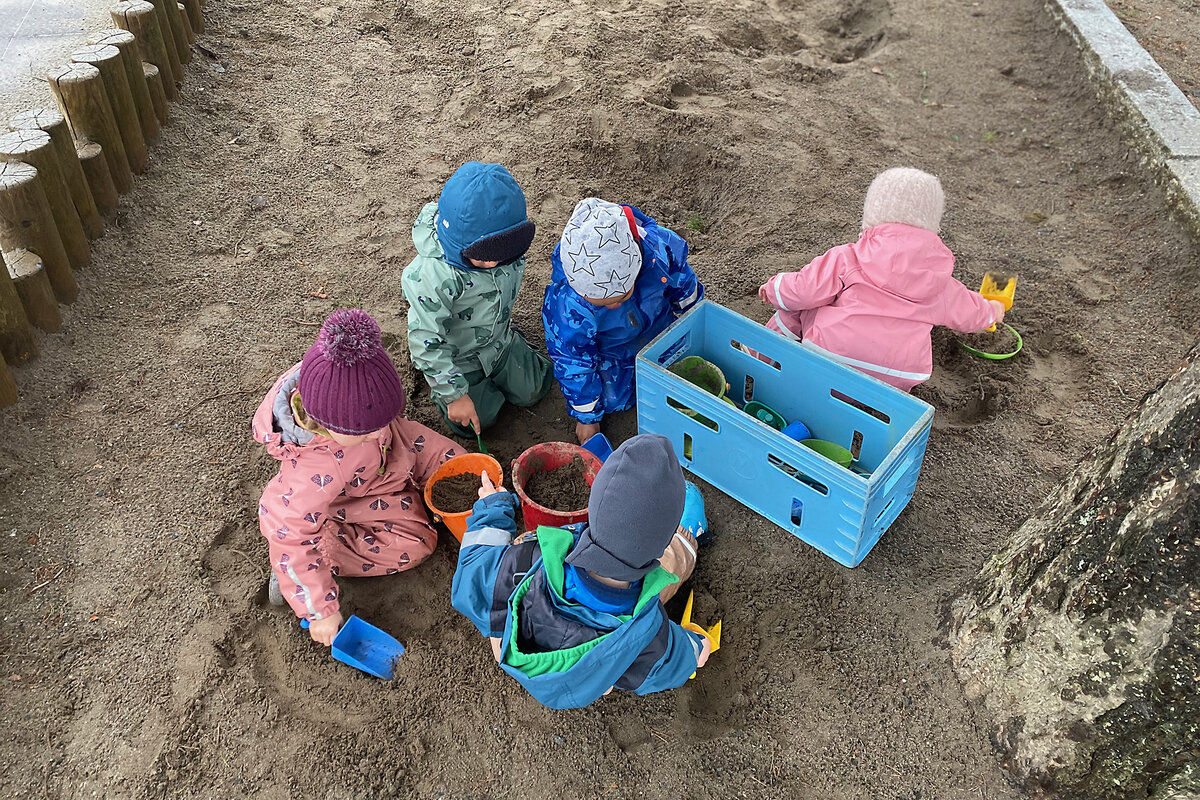
Photo: Jackie Mader/The Hechinger Report.
In Norway, a joyful, secure childhood is a legal right.

I was intrigued by today’s story on Norway’s approach to childhood. One point that made me smile was that the children in early-education programs take naps outdoors, bundled up in sleeping bags. My younger grandson took naps that way. Maybe because he’s half Swedish. Those Northerners don’t believe in bad weather.

Jackie Mader writes at the Hechinger Report via the Christian Science Monitor, “Just north of Oslo, Sylvia Lorentzen’s two child care programs straddle a narrow, winding road that leads up to the lush forests that encircle parts of Norway’s capital.

“In Norway’s system of universal child care, children ages 5 and under immerse themselves in nature. In the winter, those in Ms. Lorentzen’s care learn to ski and sled. In the summer, they swim, canoe, and rock climb – and then rest in hammocks.

“Around age 4, they learn how to safely use a knife. Then they huddle together outside, whittling wooden figures out of sticks to practice. By age 5, they are cutting logs with a saw and building fires. Toddlers nap outside, bundled inside puffy, miniature sleeping bags affixed to their strollers.

“Universal child care is ‘both seen as an investment for the society and an investment for the child,’ says Kristin Aasta Morken, a program leader in the city of Oslo. Public funding covers 85% of operating costs for child care programs in Norway. Parents pay about $182 per month.

“In the United States, it’s parents, mostly, who cover the costs for this care – though some employers and local jurisdictions may offer partial reimbursement.

‘Social differences are something Norway does not accept.’

“ ‘Kindergarten is so important to level out social inequities,’ says Robert Ullmann, head of a consortium of child care centers. ‘In Norway, we think it’s democratic that everyone can have the same opportunities and move out of being poor. Social differences are something Norway does not accept.’ …

“ ‘A really important pillar of Norway’s early ed philosophy is the value of childhood in itself,’ says Henrik D. Zachrisson, director of the Centre for Research on Equality in Education at the University of Oslo. ‘Early ed is supposed to be a place where children can be children and have the best childhood possible.’

“It’s an idea that undergirds Norway’s nationalized approach to its ‘kindergartens,’ which here serve children age 5 and younger, including toddlers and infants. …

“On a drizzly morning earlier this year at Preståsen Kanvas-barnehage, one of Mr. Ullmann’s kindergarten programs in south Oslo, children roam around an expansive play yard, building sandcastles under the canopy of a large pine tree. Others zoom down a hill on bikes.

“In another playground on campus, children shriek as they splash through a large puddle. This draws more children hoping to play. Rather than caution the children about getting wet, a teacher walks over and hands them buckets to have at it.

“Children with disabilities, who are often segregated in American child care programs, are included in activities. Some of them have a city-funded aide who attends to their needs.

“In some rooms, posters on the wall show pictures of common items or common requests, so children still learning Norwegian can point to what they need. In one room, children are learning about the Muslim holiday, Eid al-Fitr. …

“Ironically, Norway’s policies have been inspired in part by American studies that found troubling language skills gaps between higher- and lower-income children. Other influential American scholarship also revealed high educational returns from investing in early childhood programs.

“ ‘The argument I’ve heard is that if you don’t send your children to kindergarten, then you steal some possible experiences from them,’ says Adrian Kristinsønn Jacobsen, a doctoral candidate at the University of Stavanger in Norway who studies early childhood science education rooted in experiencing nature.

“There are important contexts affecting each country’s approach, however. Norway is home to about 5.5 million people, and about 82% are ethnically Norwegian. This population lives in an area roughly the size of Montana. Norway is also a top producer of oil, which helped generate a per capita household income that was over $104,000 in 2022, according to the International Monetary Fund.

“The U.S., on the other hand, has 62 times the number of residents that Norway has and a far more diverse population. In 2022, per capita household income in the U.S. was about $77,000.

“In Norway, nearly 1.4% of the country’s gross domestic product goes toward early childhood programs. The U.S. spends less than 0.4% of its GDP, according to the Organization for Economic Cooperation and Development.

“Public funding covers 85% of operating costs for child care programs in Norway. As of this summer, the tuition parents pay has been capped at about $182 per month. This applies to both public and private programs, and includes in-home kindergartens, which preserve a certain amount of choice for parents. Programs receive funding on a per-child basis. Kindergartens that care for children under 3 years old receive twice the funding of those ages 3 to 5, since toddlers and infants require more individualized care.

“Norwegian children are guaranteed a spot in a kindergarten after they turn 1 year old – about the time many parents’ paid leave ends. If parents decide not to send their children to a kindergarten, they receive financial assistance to stay home.

“Norway’s understanding of kindergarten is deeply ingrained in its culture. But these benefits, signed into law in the Kindergarten Act of 2006 – which repeats the word ‘play’ 56 times – also express some of the country’s deeply held values.

“Child care programs must acknowledge ‘the intrinsic value’ of childhood, according to the 63-page law. ‘The Kindergarten must be based on fundamental values in the Christian and humanist heritage and tradition, such as respect for human dignity and nature, on intellectual freedom, charity, forgiveness, equality and solidarity, values that also appear in different religions and beliefs and are rooted in human rights,’ the law declares. …

“The law proclaims, too, that kindergartens should ‘promote democracy and equality and counteract all forms of discrimination.’ ”

More at the Monitor, here.

Read Full Post »

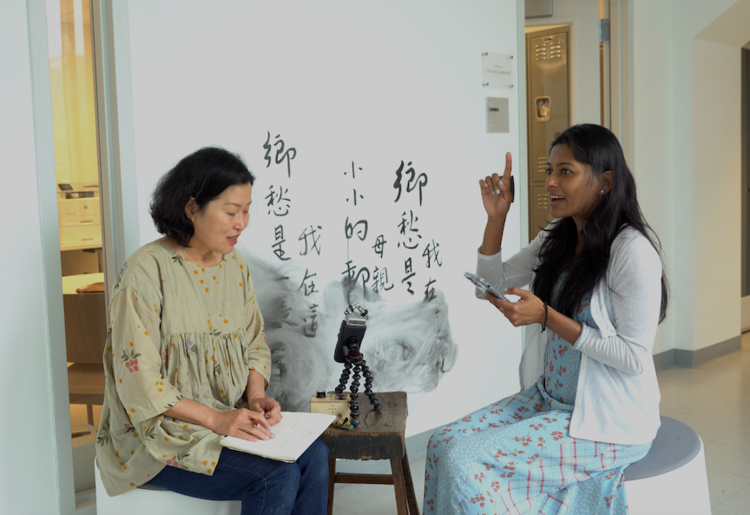
Photo: Wen-hao Tien.
Taiwan-born artist Wen-hao Tien (left) started inviting people from around the world to teach her songs from their homelands as part her exhibit on immigration experiences at the Pao Arts Center in Boston, Massachusetts.

Singing a new language can be a good way to learn that language, but even if you are not trying to learn it, you can experience the emotion in it. Consider all the choruses around the world learning the Ukrainian national anthem these days. Who is not moved by the feeling of solidarity, whether you are a Ukrainian, a singer, or a listener?

It may take an artist, perhaps an immigrant artist like the one in this story, to explore the mysterious, emotional side of the phenomenon.

As Patrick Cox reports at Public Radio International’s the World, “Opera divas sometimes have to sing in languages that aren’t their native tongue. So do popular singers. The Beatles sang in German in their early years. Today, BTS sings in Japanese as well as their native Korean.

“Is it easier to sing than speak in a foreign tongue? And what is the difference between singing and speaking?

“Taiwan-born artist Wen-hao has put that to the test as part of her exhibit ‘Home on Our Backs,’ about the immigrant experience, at Boston’s Pao Arts Center.

“Tien, who has lived in the US for 33 years — much of that time in Boston — wanted to explore the sound of homelands as part of the exhibit.

So, she started inviting people from around the world into the exhibition space to teach her songs from their places of origin.

“Among the musical numbers she learned: a Dutch Indonesian song, a Sanskrit chant, a Shaker hymn, a French song, and the ‘Happy Birthday’ song sung in Brazilian Portuguese (which Tien now considers far superior to any other version).

“For Tien, learning to sing these songs — even when she didn’t fully understand the lyrics or the cultural context — was a highly emotional experience.

“That didn’t surprise William Beeman, emeritus professor of anthropology at the University of Minnesota. He said singing is ‘enhanced communication.’ …

“He knows this in a personal way [as] Beeman was an opera singer for a time. He said that learning to sing can be a bit like becoming a young child again — and it often sparks childhood memories. 

“ ‘The first thing that a teacher has to do in order to be able to get a person to sing is to kind of regress to the time when they were 4 or 5 years old,’ he said. That is usually a time when people can sing ‘freely and openly without any inhibition.’ 

“Which is also what Wen-hao Tien taps into with her ‘Teach Me a Song’ project. The songs tend be old ones — learned at a young age. …

“Tien’s exhibit also features her artwork, including an elaborate dress made of red plastic bags. The inspiration sprang from a family visit and a clutch of red plastic bags from a grocery store nearby to the exhibition space, where her parents always shopped. 

“ ‘My parents used to visit me from Taiwan,’ Tien said. ‘The first thing they would do when they arrived is to take the subway and go to Chinatown.’ They’d go to a grocery store in Boston’s Chinatown and buy a ton of food. Tien remembers the last time they did this was not long before her father died.

“ ‘I was in my apartment and it was getting dark,’ she recalled. ‘I looked out the window and saw two old people. Both were carrying as many bags as they could possibly hold.’  She knew it was her parents because of the bags. …

“ ‘That’s my last memory of my parents visiting me from far away,’ she said. ‘The image of them carrying many, many red plastic bags.’ … 

“Tien filed this in the back of her mind for years until these memories eventually resurfaced. She decided to make a dress out of about 35 of those bags, stitched and branded together in the style of a ball gown. …

“Tien has made a second dress out of red plastic bags. She hopes to give that one to Boston’s new mayor, Michelle Wu. Like Tien, Wu was born to Taiwanese parents.

“For more on Tien’s ‘Teach Me a Song’ project, check out ‘Subtitle,’ a podcast about languages and the people who speak them.” More at the World, here.

Read Full Post »

I just went back to bathe in the golden glow of blogger KerryCan’s early summer memories here. I’ve been planning to take her up on the idea of sharing a childhood summer photo and letting train of thought take over.

KerryCan says she and her cousins had “absolutely nothing to worry about except breaking a plastic flip flop or getting sticky drips of Popsicle running down an arm,” which doesn’t quite fit my childhood. But I was always looking forward and believing something nice was coming.

I began dreaming of Fire Island in January or so — creating a paper pocket on our front door with Ocean Beach postcards tucked in and badgering grown-ups with “When are we going?”

And goodness knows, I dearly loved the ocean, swimming every day in my early teens unless there was a red warning flag. On choppy mornings, I might be the only one out there in front of the lifeguards.

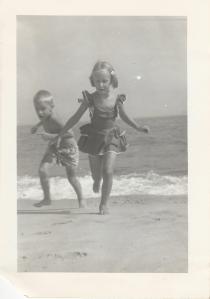
Here I am at about age 10 with the older of my two brothers, probably competing for who could run fastest.

I didn’t learn until I was practically a grandmother that some kinds of competition with him might be ill-advised — like the time I tried to bend back my thumb the way his joints allow him to and ended up with a trigger finger and a hand operation! Ha, ha. Laughing now.

On this Atlantic beach, we used to dig for the tiny armadillo-like mole crabs that we called “jumpies.” Where are they now?

Fire-Island-in-the-50s

Read Full Post »

serious-truck-driver


Play is important for all kinds of reasons in childhood, including testing out skills and experiencing the satisfaction of creativity.

John Poole at National Public Radio focused on the socialization aspects of play in a recent report.

He began, “Why do we humans like to play so much? Play sports, play tag, play the stock market, play duck, duck, goose? We love it all. And we’re not the only ones. Dogs, cats, bears, even birds seem to like to play. …

“The scientist who has perhaps done more research on brains at play than any other is a man named Jaak Panksepp. And he has developed a pretty good hypothesis.

“In a nutshell, he, and many others, think play is how we social animals learn the rules of being social.  …

“Play seems so deeply wired by evolution into the brains of highly social animals that it might not be a stretch to say that play is crucial to how we and they learn much of what we know that isn’t instinct. …

“Not surprisingly, Panksepp and others think the lack of play is a serious problem. Especially at younger ages. And particularly in school settings. …

” ‘It’s not just superfluous,’ says Panksepp. ‘It’s a very valuable thing for childhood development. And we as a culture have to learn to use it properly and have to make sure our kids get plenty of it.’ ” More here.

More still from Jon Hamilton, another reporter in the NPR series on play, here.

Photo: David Gilkey/NPR
Deion Jefferson, 10, and Samuel Jefferson, 7, take turns climbing and jumping off a stack of old tires at the Berkeley Adventure Playground in California. The playground is a half-acre park with a junkyard feel where kids are encouraged to “play wild.” 

Read Full Post »

Art: Cicely Mary Barker (thank you, Lili Matthews, for the correction)

I happened to hear from Hannah this week. We went to the same schools from age 4 through age 13. We’re in touch from time to time but not regularly, so I was pleasantly surprised.

Hannah mentioned she remembered “playing fairies in the wonderful fields behind your house.” Although I don’t have a mental picture of the two of us playing fairies there, I am not surprised to learn we did. Fairies were a big part of my childhood. Even now, I occasionally catch myself wondering if they could be real.

Hannah got me thinking of other imaginative play in childhood: tea parties with cinnamon toast in an attic closet with Carole, the woodland path where Patsy and I walked without speaking because of deep magic, plans with Ursula to perform “Snow White and Rose Red” before the movie at the Lafayette Theater (if only our brothers would cooperate and play their assigned roles), nefarious scheming with the Jukes kids on the roof of a small building, outdoor theatricals with the Cummings kids.

You will say we must not have had television, but in fact we had the first tv in the neighborhood, and kids from all around gathered to watch Disneyland on a tiny black & white screen on Saturdays. And you can bet that whatever magic Walt dreamed up was magic I believed.

Read Full Post »

I remember many days with Carole on the playground at recess playing house and gathering “grain,” which we pulled off a common weed and sometimes pretended to eat and sometimes buried — in case we might need extra food someday. Carole was a great kid to play with.

Asakiyume, whom I met in adulthood, is the kind of person I would have wanted to play with in childhood. She has a wild imagination that seems to fire on all burners 24/7. And now that she is old enough to carry out some wishes from age 10 or so, she is going right ahead with them.

For example: acorn cake. At Asakiyume’s blog, followers watched her leach the tannin out of her acorns over a period of days, changing the water repeatedly. We kept tabs as she next roasted the acorns, made acorn flour, and finally baked a cake.

“Today I baked an acorn cake,” she wrote on Nov. 3. “I used my ground-up, leached acorns, and a recipe from Hank Shaw (posted here). The body of this cake is equal parts acorn flour and wheat flour.

“And–it tastes fabulous. It has a flavor like molasses with a hint of ginger, and your tongue tingles a little afterward, like when you eat something peppery. …

“It’s a tiny childhood dream come true–feasting on the abundance of acorns! (Okay, helped by honey, oil, and eggs, not to mention that wheat flour, but still.)”

Read more here.

Photo: Asakiyume
Acorn cake with sugar outlining an oak leaf.

Read Full Post »

Author-illustrator Jarrett Krosoczka knows the power of a kind word. He found his calling largely because of two words from a children’s book author who visited his elementary school class.

And he got through a difficult childhood nourished on the kindness of strangers, including lunch ladies, an unjustly maligned species he has honored in a superhero series. (“Serving justice! And serving lunch!)

Linda Matchan has a lovely story at the Boston Globe about Krosoczka.  (I want to call your attention to how nicely she describes him, here: “with impossibly spiky hair that looks as though he penciled it in himself.”)

“Until recently,” writes Matchan, “Krosoczka was very guarded about his childhood. That changed last October when he got a call from the organizer of a TEDx program at Hampshire College, modeled after the TED Talks series. …

“Scrambling for a topic, his wife urged him to talk candidly about his childhood. With no time to come up with other options, he delivered a moving talk about his early years and the people who inspired and encouraged him. The talk caught the attention of the TED editorial team, which featured it in January on TED.com.

“He spoke in his talk about his mother — ‘the most talented artist I knew’ — who was addicted to heroin and often incarcerated. ‘When your parent is a drug addict it’s kind of like Charlie Brown trying to kick the football … Every time you open your heart, you end up on your back.’ …

“Third grade was the year something ‘monumental’ happened. Children’s book author Jack Gantos came to his school to talk about what he did for a living. He wandered into the classroom where Krosoczka was drawing, stopped at Krosoczka’s desk and studied his picture.

“ ‘Nice cat,’ Gantos said.

“ ‘Two words,’ said Krosoczka, ‘that made a colossal difference in my life.’ ”

More.

Photo: Bill Greene
Jarrett Krosoczka declared May 3 (his favorite lunch lady’s birthday) “School Lunch Superhero Day.”

Author-illustrator Jarrett Krosoczka knows the power of a kind word. He found his calling largely because of two words from a children’s book author who visited his elementary school class.
And he got through a difficult childhood nourished on the kindness of strangers, including lunch ladies, an unjustly maligned species he has honored in a superhero series. (“Serving justice! And serving lunch!)
Linda Matchan has a lovely story at the Boston Globe about Krosoczka.  (I want to call your attention to how nicely she describes him, here: “with impossibly spiky hair that looks as though he penciled it in himself.”)
“Until recently,” writes Matchan, “Krosoczka was very guarded about his childhood. That changed last October when he got a call from the organizer of a TEDx program at Hampshire College, modeled after the TED Talks series. …
“Scrambling for a topic, his wife urged him to talk candidly about his childhood. With no time to come up with other options, he delivered a moving talk about his early years and the people who inspired and encouraged him. The talk caught the attention of the TED editorial team, which featured it in January on TED.com.
“He spoke in his talk about his mother — ‘the most talented artist I knew’ — who was addicted to heroin and often incarcerated. ‘When your parent is a drug addict it’s kind of like Charlie Brown trying to kick the football … Every time you open your heart, you end up on your back.’ …
“Third grade was the year something ‘monumental’ happened. Children’s book author Jack Gantos came to his school to talk about what he did for a living. He wandered into the classroom where Krosoczka was drawing, stopped at Krosoczka’s desk and studied his picture.
“ ‘Nice cat,’ Gantos said.
“ ‘Two words,’ said Krosoczka, ‘that made a colossal difference in my life.’ ”

Read Full Post »

I took a taste of local strawberries, and they brought back the little wild strawberries of my childhood. And how a friend might come over, and I might tell her in whispers that I had found a secret place.

I wouldn’t say where exactly until we got close, and she would have to promise not to tell anyone. Then, checking around that no one was watching, I would lead her into a stand of pine trees and out into a clearing in the middle. And there we would sit down and pick wild strawberries, which are always sweeter than any in the supermarket.

Today I was asking my boss about his vacation with his wife’s family in France. He said his four-year-old had such freedom there to run outside and play with cousins. It reminded him of the freedom of his own childhood, and he thought his daughter was only just now experiencing the way childhood is supposed to be. Where he lives, in the city, his little girl could never just run out  like that.

(If you are interested, here is one of many studies on the importance of nature and play in childhood.)

Read Full Post »

I have been reading about Michelle Obama’s latest efforts to encourage good nutrition in childhood.

“Executives from Wal-Mart, Walgreens, SuperValu and other stores joined Michelle Obama at the White House on [July 21] to announce a pledge to open or expand a combined 1,500 stores in communities that have limited access to nutritious food and are designated as ‘food deserts.’

“With the pledges, secured by the Partnership for a Healthier America, which is part of Mrs. Obama’s campaign to reduce childhood obesity, the stores aim to reach 9.5 million of the 23.5 million Americans who live in areas where finding affordable healthy foods can be difficult. In those areas, many people turn to fast food restaurants or convenience stores.” Read the New York Times article here.

On a related note, John sent me a really interesting link from photographer Mark Menjivar, who documents the insides of people’s refrigerators. He includes a one-line insight into the person whose food he is photographing. Unsurprisingly, the fridge with the least food in it belongs to a “street advertiser” who lives on a $432 fixed monthly income.

See the fascinating photo essay here.

Read Full Post »