Feeds:
Posts
Comments

Posts Tagged ‘chinese’

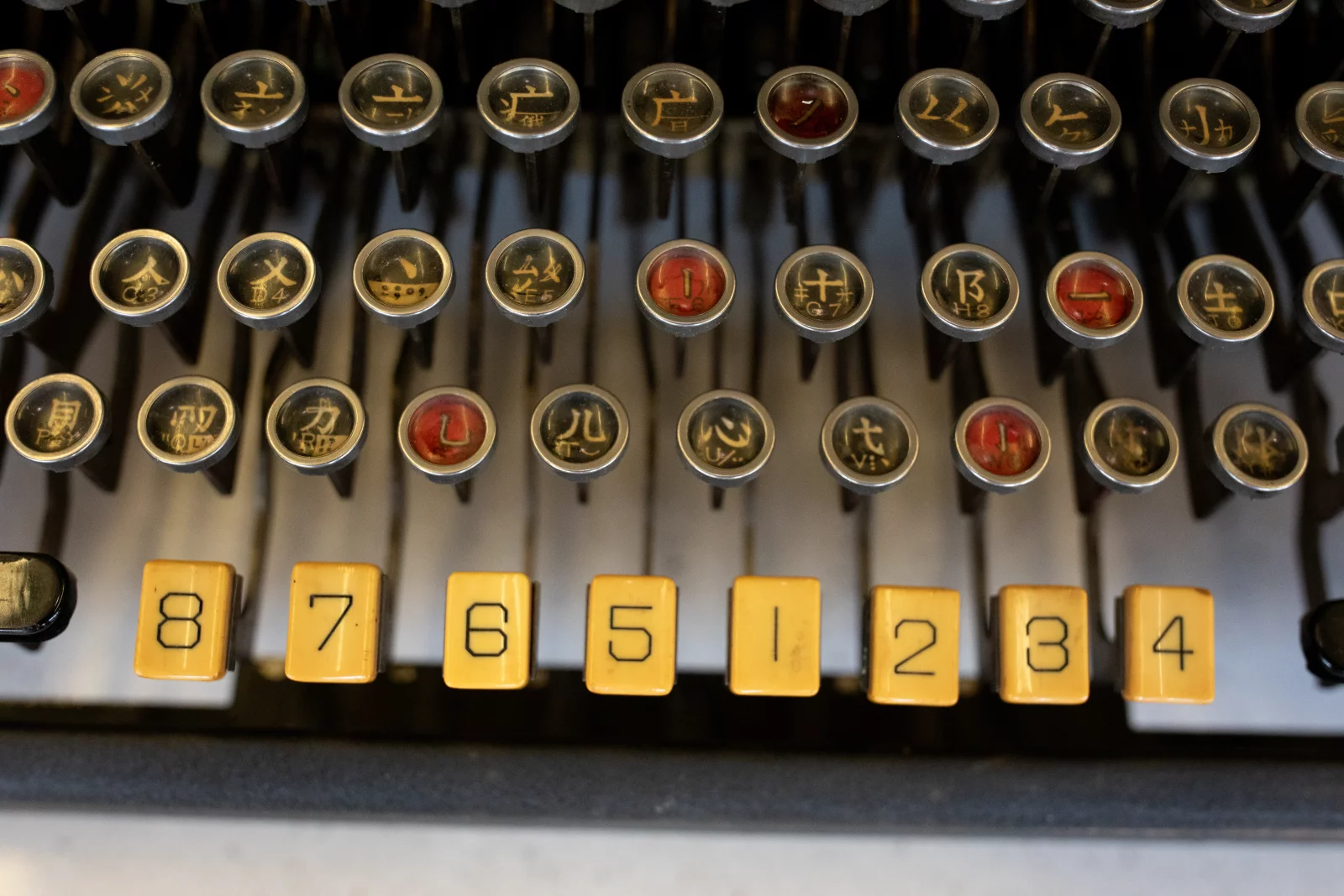
Photo: Elisabeth von Boch/Stanford.
The MingKwai typewriter, crucial to the development of modern Chinese computing, has resurfaced. Its keys enable the typist to find and retrieve Chinese characters.

I love stories about finding long-lost treasures. The story of this old typewriter, the only one of its kind ever made, fits that category.

Emily Feng writes at National Public Radio (NPR), “Scholars in the U.S., Taiwan and China are buzzing about the discovery of an old typewriter, because the long-lost machine is part of the origin story of modern Chinese computing — and central to ongoing questions about the politics of language.

“China’s entry into modern computing was critical in allowing the country to become the technological powerhouse it is today. But before this, some of the brightest Chinese minds of the 20th century had to figure out a way to harness the complex pictographs that make up written Chinese into a typewriter, and later, a computer.

“One man succeeded more than any other before him. His name was Lin Yutang, a noted linguist and writer from southern China. He made just one prototype of his Chinese typewriter, which he dubbed the MingKwai. …

“Detailed U.S. patent records and diagrams of the typewriter from the 1940s are public, but the physical prototype went missing. Scholars assumed it was lost to history.

” ‘I had really, truly thought it was gone,’ says Thomas Mullaney, a history professor at Stanford University who has studied Chinese computing for two decades and is the author of The Chinese Typewriter.

Mullaney was at a conference last year when he got a message that someone in upstate New York had found a strange machine in their basement and posted a picture of it on Facebook.

” ‘It was a sleepless night.’ …

“Eventually, the owner reached out to him. They had acquired the typewriter from a relative who had worked at Mergenthaler Linotype, once of the most prominent U.S. makers of typesetting machines. The company helped craft the only known prototype of the MingKwai typewriter. …

” ‘It’s like a family member showing up at your doorstep and you had just assumed you would never see them,’ Mullaney says.

“The story of why such a typewriter even exists runs parallel to the political upheaval and conflict over Chinese identity and politics in the 20th century.

“Lin, its inventor, was born in 1895 in southern China during the tail end of a failing Qing dynasty. Student activists and radical thinkers were desperate to reform and strengthen China. Some proposed dismantling traditional Chinese culture in favor of Western science and technology, even eliminating Chinese characters altogether in favor of a Roman alphabet.

” ‘Lin Yutang charted a path right down the middle,’ says Chia-Fang Tsai, the director of the Lin Yutang House, a foundation set up in Taiwan to commemorate the linguist’s work. …

“Typing Chinese was a monumental challenge. Chinese has no alphabet. Instead, it uses tens of thousands of pictographs. When Lin started his work in the early 20th century, there was no standardized version of Mandarin Chinese. Instead, people spoke hundreds of dialects and languages, meaning there was no singular phonetic spelling of the sound of each word.

“Lin had financial backing from the American writer Pearl S. Buck to create the typewriter, but he also sunk much of his own savings into the project as costs ballooned.

” ‘He’d spent a lot of money. A lot,’ says Jill Lai Miller, Lin’s granddaughter. …

“The typewriter’s ingenuity comes from the way Lin decided to break down Chinese pictographs: by their shapes, not sounds. The typist can search for certain combinations of shapes by pressing down on the ergonomic keyboard. Then, a small screen above the keyboard (Lin called it his ‘magic eye’) offers the typist up to eight possible characters that might match. In this way, the typewriter boasts the ability to retrieve up to 90,000 characters. …

“Encoded in the machine’s engineering was an ambitious globalism. Lin’s way of breaking down languages by the shape of their words rather than their sounds or alphabets meant his machine theoretically can type English, Russian and Japanese as well, according to the typewriter’s manual.

” ‘One thing that was very interesting … in Li Yutang’s thinking about Chinese-ness and Chinese culture is that it must not be insular. It must have this porous border, it must be capacious and be able to communicate and talk with other cultures,’ says Yangyang Cheng, who first wrote about the typewriter’s discovery. …

“Mullaney is now researching the typewriter full-time, trying to understand how its mechanical innards work, with the far-off dream of one day replicating it. He recently found the typewriter’s ink spool was still fully intact inside.

” ‘You would need the sort of technology that they used on, like, discoveries of the Dead Sea Scroll and stuff like that, but you’ll notice that the ink spool is still there,’ he points out, using a dental mirror to peer inside the machine.

“The ink spool could contain traces of the last words Lin or his daughter typed on the machine — meaning perhaps the inventor’s own words are in his magical machine too.”

More at NPR, here. The New York Times also has a story on the typewriter. Read it here.

Read Full Post »

Photo: Safeed Rahbaran/New York Times via the Las Vegas Sun.
“George Lee at the Four Queens Hotel and Casino in Las Vegas, on Jan. 16, 2024. Lee was the original Tea in ‘George Balanchine’s The Nutcracker,’ ” says the New York Times. “A documentary filmmaker found him and a lost part of ballet history in Las Vegas.”

Several of my good friends from college are Chinese. I don’t know if I am stereotyping my friends, but having come from a throughly impractical family, I was impressed at once with what seemed to me a startling level of practicality. Practicality about what kinds of courses to take for what kind of well-paying jobs; even practicality about potential marriage partners.

So one of the things that struck me about the mother in today’s lovely story was the way she helped her son earn rice during the Japanese occupation of China and her advice to him when they headed to America.

Siobhan Burke reports at the New York Times, “Among the blaring lights and all-hours amusements of downtown Las Vegas, in a sea of slot machines at the Four Queens Hotel and Casino, George Lee sits quietly at a blackjack table, dealing cards eight hours a day, five days a week, a job he’s been doing for more than 40 years.

“Lee, 88, was likely in his usual spot when the filmmaker Jennifer Lin was sifting through old photos at the New York Public Library for the Performing Arts in 2022, wondering what had become of a dancer with a notable place in ballet history. Pictured in a publicity shot for the original production of ‘George Balanchine’s The Nutcracker,’ in the role known as Tea, was a young Asian dancer identified as George Li.

“For Lin, a veteran newspaper reporter turned documentarian, the picture raised intriguing questions. In 1954, when the photo was taken, it was rare to see dancers of color on the stage of New York City Ballet, the company Balanchine co-founded. Who was this young man, this breaker of racial barriers, this pioneer? Was he still alive? And if so, what was he up to?

“ ‘I became absolutely obsessed with trying to find out what happened to George Li,’ Lin said in a video interview.

“In just over a year, that obsession has blossomed into a short film, Ten Times Better, that chronicles the unexpected story of Lee’s life: from his childhood in 1940s Shanghai, where his performing career began; to a refugee camp in the Philippines, where he fled with his mother, a Polish ballet dancer, in 1949; to New York City and the School of American Ballet, where Balanchine cast him in ‘The Nutcracker’; to Flower Drum Song on Broadway, his first of many musical theater gigs; and ultimately, to Las Vegas, where he left dance for blackjack dealing in 1980. (He changed the spelling of his last name in 1959, when he became a United States citizen.) …

“ ‘So many years I haven’t done ballet,’ Lee said over coffee at the Four Queens on a recent Sunday, after his shift. ‘And then suddenly Jennifer comes and tries to bring everything up.’ …

“Lin was not the only one who had been searching for Lee. In 2017, while organizing an exhibition on ‘The Nutcracker,’ Arlene Yu, who worked for the New York Public Library at the time and is now Lincoln Center’s head archivist, was puzzled by the relatively few traces of him in the library’s vast dance collection. ‘Whereas if you look at some of his peers in ‘The Nutcracker’ in 1954, they went on to careers where there was a lot more documentation.’ …

“Lee, in his heyday, was a dancer to know. At just 12, he was already winning public praise. In a preview of a recital of the King-Yanover School in Shanghai, the North China Daily News called him an ‘extremely promising young Chinese boy, whose technique is of a very high standard.’ A reviewer wrote that he ‘already may be said to be the best Chinese interpreter of Western ballet.’ (Lee saved these newspaper clippings and shared them with Lin.) …

“Lee’s mother, Stanislawa Lee, who had danced with the Warsaw Opera, was his first ballet teacher; as a child, he would follow along with her daily barre exercises. Shanghai had a significant Russian population, and with that a robust ballet scene. To earn money, Stanislawa arranged for her son to perform in nightclubs — ‘like a polka dance, or Russian dance, or sailor dance,’ Lee said. The clubs would pay them in rice. …

“In 1951, an American friend of Lee’s father sponsored them to come to New York, where he introduced Lee to the School of American Ballet, City Ballet’s affiliated school. As Lee narrates these twists and turns in the film, one memory anchors his recollections. Before they immigrated, his mother issued a warning. ‘You are going to America, it’s all white people, and you better be 10 times better,’ he recalls her saying. ‘Remember that: 10 times better!’

“The footage of Lee in his 20s suggests he took that advice to heart. In television appearances — with the company of the ballet star André Eglevsky, and in a number from Flower Drum Song on the Ed Sullivan Show — his power and precision dazzle.

“ ‘He was good; he was really good,’ [Phil Chan, cofounder of Final Bow for Yellowface, an initiative focused on ending offensive depictions of Asians in ballet] said. ‘Clean fifth, high jump, polished turns, stick the landing — the training is all there. He’s already 10 times better than everybody else.’ …

“In a 1979 interview heard in the film, the former City Ballet soloist Richard Thomas, who took over the role of Tea, raves about Lee’s peerless acrobatic jumps: ‘He was wonderful! Balanchine choreographed a variation for him that none of us have ever been able to equal.’

“As Lee remembers it … the City Ballet makeup artist put him in full yellowface, and Balanchine insisted he take off the makeup. ‘He is Asian enough! Why do you make him more?’ he remembers Balanchine saying. Lee was costumed in the Fu Manchu mustache, queue ponytail and rice paddy hat often associated with the role, now widely critiqued as racist caricatures. But he said he didn’t take offense. ‘Dancing is dancing,’ he said. …

“He pieced together jobs for more than 20 years, often unsure of what would come next. He was dancing in a Vegas revue, ‘Alcazar de Paris,’ now in his 40s, when a blackjack dealer friend suggested he go to dealer school. ‘I can’t dance all my life,’ he remembers thinking.” More at the Times, here.

Read Full Post »

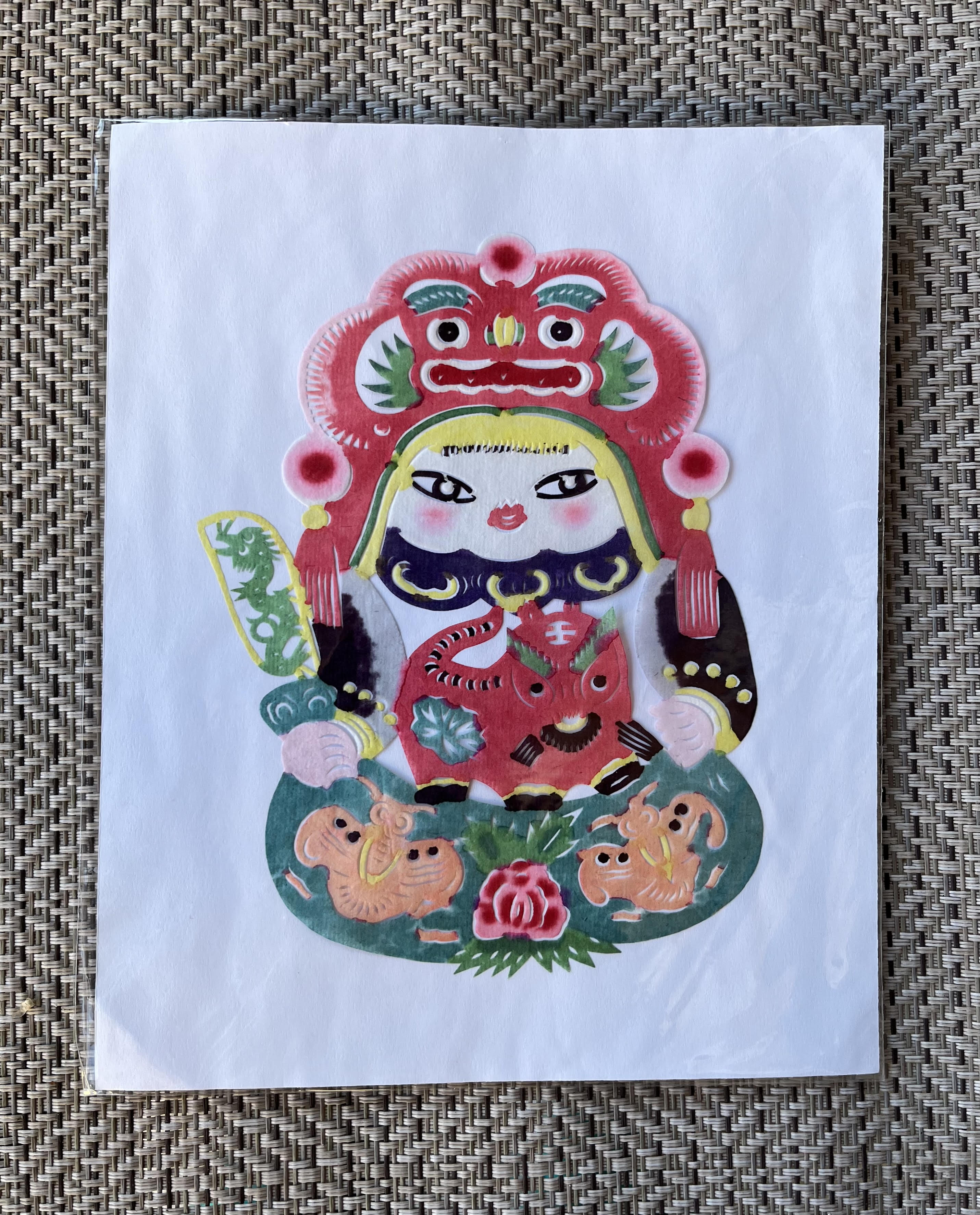
Photo: Suzanne and John’s Mom.
I’ve had this Chinese paper cut-out for years. I no longer remember where it came from.

Happy Year of the Dragon! The Wood Dragon to be specific. (In case you’re wondering, the other Chinese zodiac dragons are Water, Metal, Earth, and Fire.)

As China and much of the world celebrate the traditions of Lunar New Year, I want to share an article about a woman in China who is keeping another ancient tradition alive — paper cutting.

Ann Scott Tyson reports at the Christian Science Monitor, “With uncanny precision and attention to form, Yu Zeling snips away at the thin red paper. Her scissors seem to glide magically into place. After several minutes, she unfolds her creation: a bold and smiling Chinese zodiac pig.

“An award-winning master of the ancient Chinese folk art of paper cutting, Ms. Yu fills her studio with cutouts of animals, people, and scenes so vivid that they seem to leap from the walls. Rich with symbolism, her art embodies village life in Ansai, a rural district in Shaanxi province on China’s rugged Loess Plateau. Ansai is a center of paper cutting – recognized in 2009 by UNESCO as an Intangible Cultural Heritage of Humanity. …

“Ms. Yu and others are working to keep the folk art alive, even as it evolves away from its roots as adornment for farmhouses and local celebrations. Indeed, the Ansai native is serving as a rare bridge between the most skilled paper-cut artists of the 1980s – a golden era in paper cutting – and a new generation of heirs. …

“Growing up in a hamlet deep in an Ansai valley, surrounded by terraced fields, Ms. Yu came to paper cutting in the late 1970s as naturally as she breathed the earthy air. ‘We were very poor, and when it was time to celebrate the [Lunar] New Year, we all put paper-cuts in the windows,’ she says, recalling the holiday at her childhood home – a cave dug from a hillside – where her family of 10 eked out a living growing corn, beans, and sorghum. …

“The art originated in China in the centuries after paper was invented in A.D. 105. … Full of auspicious symbols from peasant life, the decorations heralded good weather, many offspring, long life, wealth, and happiness. …

“Just as Ms. Yu was beginning to learn paper cutting, after she left elementary school in 1978 at the age of 12, China’s shift toward market economics and social opening began allowing for a revival of traditional culture. Using discarded newspaper, Ms. Yu first practiced cutting the image of a Chinese national flag that she saw in a school textbook. She says she ‘cut it 100 times’ before she was satisfied. Then her aunt took over, introducing her to increasingly complicated traditional motifs. …

“Meanwhile, a research scholar named Chen Shanqiao began trekking from Ansai’s county seat into the hills and valleys to rural villages, rediscovering the true meanings embedded in the paper-cuts. Their power astonished him. In the mid-1980s, he recruited a few older village women who were masters in the craft to come teach at Ansai’s Cultural Center.

“Ms. Yu married farmer Jiang Zhicheng, who admired her passion and skill. Inspired, Mr. Jiang took a few of his wife’s works to the local market in 1987, but he couldn’t sell them. So he went farther, riding his bicycle more than 25 miles to Ansai’s Cultural Center. Seeing the fine pieces, Mr. Chen immediately bought the paper-cuts and invited Ms. Yu to come train with the master artists. …

“After years of training, Ms. Yu became a master in her own right, winning one award after another. Her works are on display in museums. But she’s humble about her achievements. ‘I was, and still am, a farmer,’ she says with a smile. … ‘I make paper-cuts based on life,’ she says. ‘Here in northern Shaanxi, we feed the pigs and till the land and care for the children.’

“Hoping to carry on and grow the folk art, Ms. Yu volunteers to teach at free community training sessions. Paper cutting is also taught in Ansai’s public schools. … As Chinese villages empty out and rural rituals fade, Ms. Yu is aware of the need to go beyond perpetuating traditions and embrace new paper-cut experiments. …

“The most elaborate paper-cut in her studio is a large and ornate circular design that weaves together layer upon layer of significance: In the center, a snake (man) encircles a rabbit (woman), symbolizing marriage. Surrounding them is a ring of pomegranates (the seeds of which represent many children), peaches (the Chinese name for ‘peach’ is also the word for ‘longevity’), and Buddha’s hands (a kind of citrus fruit representing bliss). A final outer rim, resembling a woven flower basket, also signifies longevity.”

More at the Monitor, here. Check out photos of the cutting process. No firewall.

Read Full Post »

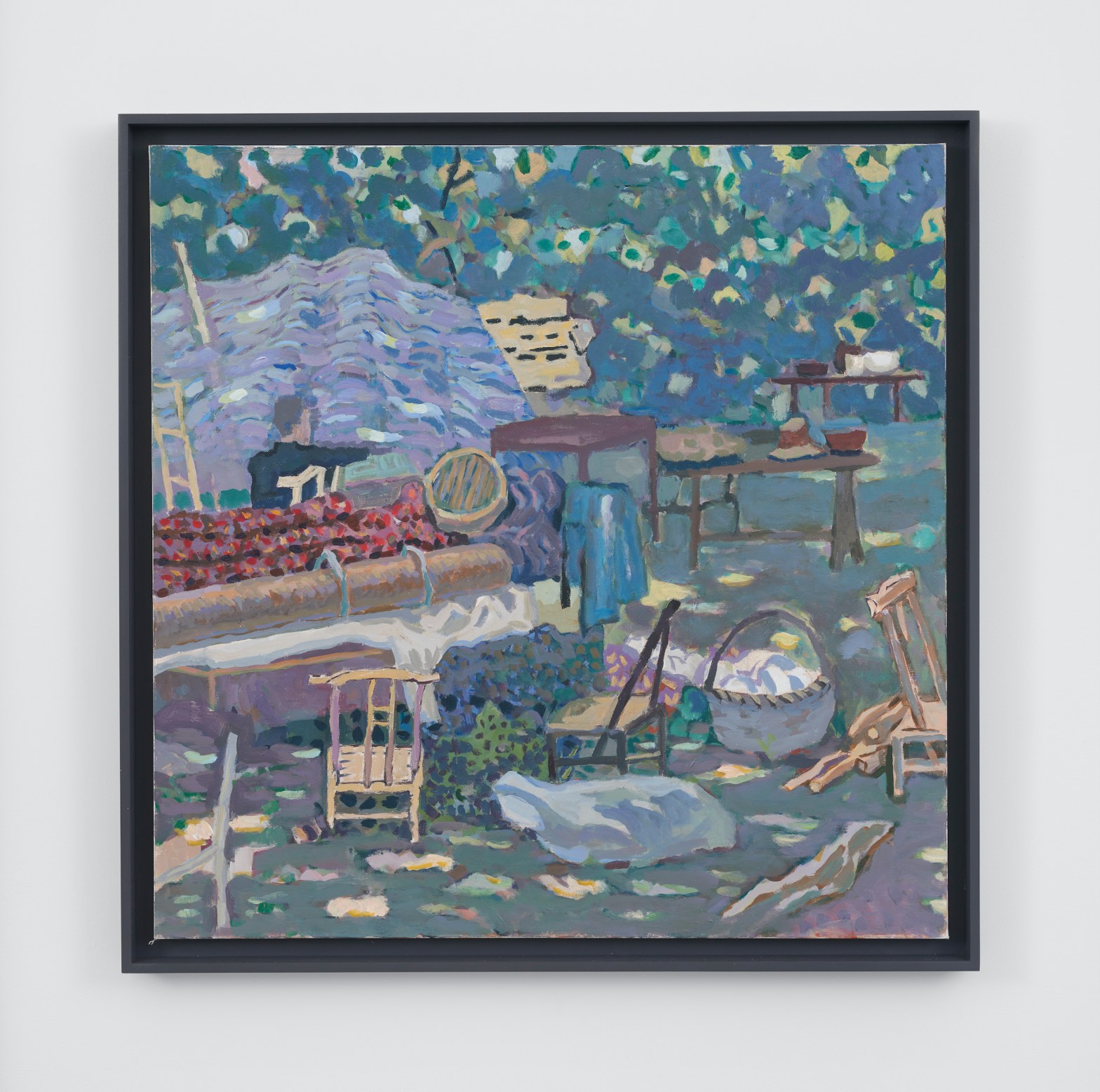
Art: Yun-Fei Ji via James Cohan Gallery.
Yun-Fei Ji, “Everything Moved Outside” (2022), acrylic on canvas.

The daughter of my mother’s college friend visited us in about 1980. Her family had been deeply traumatized by the anti-intellectual fervor of the Cultural Revolution in China. She couldn’t speak much English at the time, but I understood constant repetitions of “very painful, very painful.”

When I read today’s article about an artist who evolved from the Socialist Realism he was taught at the time, I thought of Ching and the way she grew, never completely shedding the deep hurt of totalitarian madness turned against friends and neighbors.

John Yau writes at Hyperallergic about Yun-Fei Ji, a Chinese painter who learned the state-sanctioned style of Socialist Realism “and then elected to unlearn it in order to reinvent himself.

“Yun-Fei Ji was born in Beijing in 1963, three years before the start of the Cultural Revolution (1966–76). Launched by the demagogue Mao Zedong, who distrusted intellectuals, the Cultural Revolution was an attempt to turn China into a utopian paradise run by and for workers. … 

“Ji belongs to the generation that studied at the Central Academy of Fine Art (CAFA) in Beijing in the first years after it reopened. Like the other painters in this group, he learned the state-sanctioned style of Socialist Realism and then elected to unlearn what he had absorbed in order to reinvent himself. … He secretly studied calligraphy — which was considered intellectual, bourgeois. …

“He opened it up and used it to respond to current events, such as post-revolutionary China’s massive Three Gorges Dam Project and the consequent displacement of more than 1.5 million people. …  

“As long as Ji continued to work in the tradition of Chinese landscape painting, Western audiences may have seen his views of displacement and protest, wayfarers carrying all their possessions, and melancholic ghosts as foreign to their experience. 

“This is why Ji’s change is radical. He decided to take on the Western tradition of painting in order to suggest that his subject matter is global, rather than local to China. … While the traumatic social upheaval caused by the Three Gorges Dam Project is still very much on Ji’s mind, as evidenced by painting titles such as ‘Migrant Worker’s Tent,’ ‘Satellite Dish on a Bed,’ and ‘Everything Moved Outside,’ new things are happening in his work.

“Three paintings signal a departure for Ji: two depictions of flowers (‘Sunflower Turned Its Back’ and ‘Early Spring Bloom 2020’) and a three-quarter-length view of a standing man — and my favorite work — ‘The Man with Glasses.’ … 

“Against a mottled brown, violet, and gray-blue abstract ground Ji has depicted an elderly man in blue pants and a long blue jacket over a pale blue shirt. The man is looking down, his hands in his pockets, and we cannot see his eyes. His head seems too large for his body, a deliberate choice by the artist. The shirt becomes a series of dry brushstrokes near the bottom and the gray-blue pants are largely unpainted. The jacket’s color reminds me of the blue surgical scrubs worn by doctors, which folds another level of feeling into the painting. The fact that the portrait resists a reductive reading is important to the change in Ji’s work and thinking. 

“The premier coup approach is in keeping with ink painting, which cannot be revised or layered, but in his use of paint he works differently, as seen in the mottled background and single dry brushstroke used to separate the front pockets of the shirt. The incompleteness of the man set against a dark, fully painted abstract ground seems both a formal and emotional decision. The man is ephemeral, while the dark, inanimate ground is permanent. The evocation of change and transience is also inherent to Ji’s paintings of sunflowers and blossoming branches. In these works, he meditates on the relationship between forced change and inescapable transformation.”

More paintings at Hyperallergic, here. No firewall. Subscriptions welcomed.

It was interesting to me that “Everything Moved Outside” (2022) makes this reviewer think of the migrant life. For me “everything moved outside” means Covid. Would love to hear more reactions to the paintings shown at Hyperallergic.

Read Full Post »

Art: Liu Xiaodong
“Thank you 2020.4.9” (2020), watercolor on paper, at New York City’s Lisson Gallery.

People from around the world often perceive New Yorkers as brash, rude. But if you have spent any time in the city, you know there’s another side, a side that is helpful and kind, that will drop everything to give a stranger detailed directions to the Empire State Building or a place to buy the freshest lychee nuts.

During the height of the pandemic, artist Liu Xiaodong seems to have seen the generosity, humanity, and vulnerability of New Yorkers and to have captured it in his watercolors.

John Yau writes at Hyperallergic, “Charles Baudelaire said in his 1863 essay that the ‘painter of modern life’ is the ‘passionate observer’ who can be ‘away from home and yet […] feel at home anywhere.’

“Among contemporary artists, the Chinese observational painter Liu Xiaodong is the closest embodiment of Baudelaire’s ideal that I know. For years, he has been, in the words of Baudelaire, an ‘independent, intense, and impartial spirit’ who observes the ‘ebb and flow’ of the world around him. This has led him to set up a temporary studio near an orphanage in Greenland and one among Uyghur jade miners in China’s harsh northwest. …

“In 1978, when Liu was 15, his family sent him to live with his uncle, who had studied Western painting at the Jilin Academy of Fine Arts and had gone on to become the art editor of a magazine. His uncle taught him watercolor, and showed him the books he had about English watercolors, European oil painting, and the Peredvizhniki, a group of late 19th-century Russian realists who believed that Russia and its people possessed an inner beauty.

“The date of 1978 is significant: it is two years after the death of Mao Zedong, the end of the Cultural Revolution, and the Tangshan earthquake, which devastated the region where he and his family lived. Born in 1963, Liu belongs to a generation that has both witnessed and been directly affected by the convulsive social, political, and economic changes that China has undergone during Mao’s lifetime, and since his death. …

“His instinct to respond to what is directly in front of him with whatever medium he has on hand endows his views with an unrivaled propinquity. He is, to cite Baudelaire, at the very center of the world he is depicting, and unseen by it. …

“[A recent exhibition provided] a visual and written record of a specific area of Manhattan, determined by what he can walk to.

Liu made his watercolors during an extreme period in New York’s history, starting with the empty streets during the first months of the COVID-19 quarantine, and including the Black Lives Matter protests and demonstrations in response to the video-recorded murder of George Floyd.

“Even in this acute moment in our history, he is able to slow down his looking to find and celebrate the beauty of human determination, as well as recognize feelings of wariness and displacement. …

“The watercolor ‘Kitchen Paper cannot be flushed down the Toilet, right, 2020’ [is] a wonderful tonal view of a roll of paper towels resting on a toilet tank, a quick yet careful placing of pale yellows, blues, off whites, and grays. …

“[But] the range of subjects and views underscores a person who is remarkably open to the world, from a blooming tree, to children’s toys left at a park, to an evening view of the top of the Empire State Building, seen between two buildings, to a homeless man’s legs sticking out of a doorway. … You never get the feeling that he is looking for something; there is no hierarchy to what he chooses. …

“As Manhattan transitioned from the largely empty streets of the quarantine to demonstrations and large groups of police, Liu kept looking, kept going out, and kept making watercolors and taking photographs, to work on later.  His attention to detail, to the color and light, is masterful and precise. … The merging of mark and color, and his sensitivity to light and dark, feel effortless, though we know they are not. This is Liu’s genius; there are no signs of hesitation in his work.

“In Liu’s watercolors and painted-over photographs, the viewer encounters scenes in which hand, eye, and intelligence work in astonishing tandem. … We are the lucky beneficiaries of a vision at once candid and sophisticated, open and sincere, witty and compassionate — an unlikely combination in this dark, nerve-fraying, and isolating period in history.”

To see an array of Liu Xiaodong’s New York paintings, go to Hyperallergic, here. And fall in love with that city all over again.

Read Full Post »

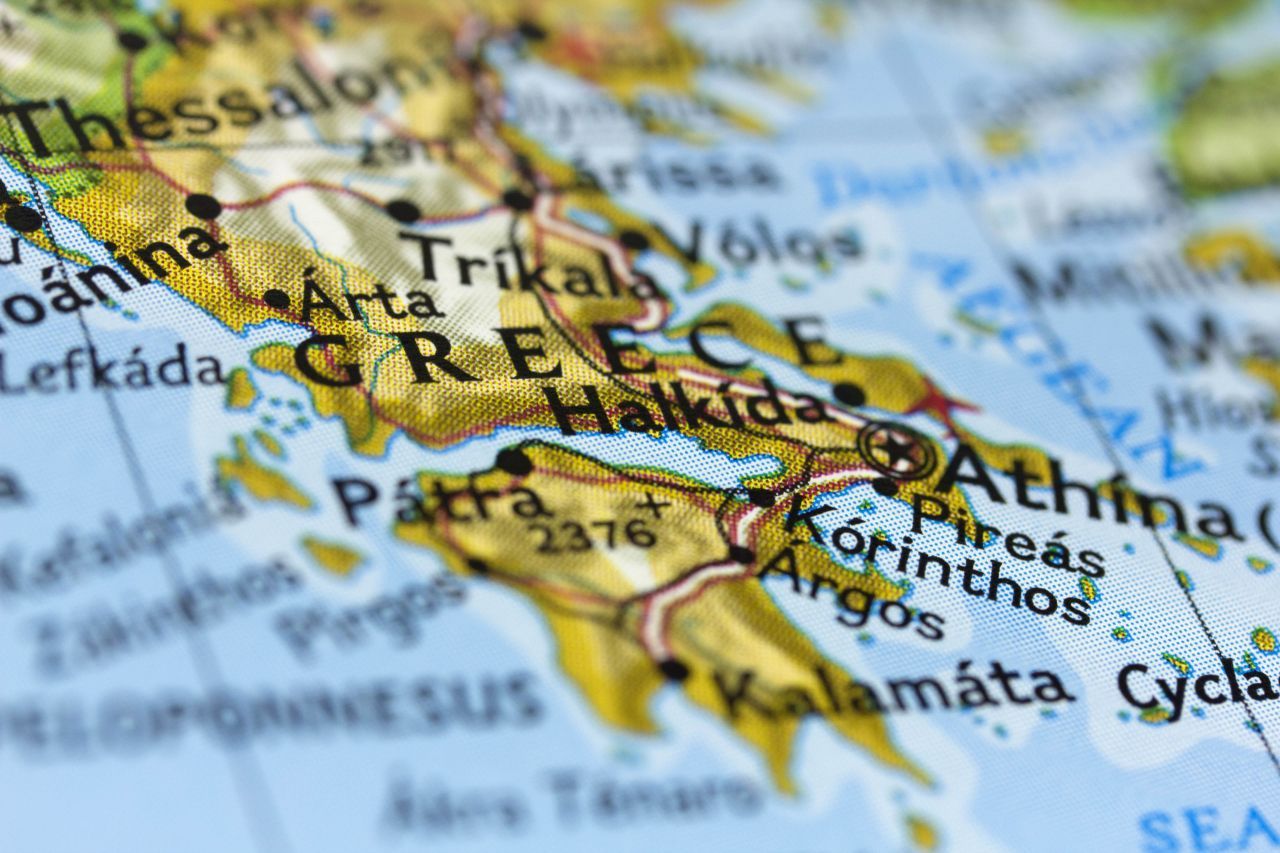
greece-map-1280

Photo: Greeka.com
In every language people use some expression to indicate they think certain words are impossible to understand. Many say, “It’s all Greek to me.”

In the early 2000s, I worked at a magazine that was going through a redesign. Having not been involved in anything like that before, I was startled when the designer used the word “Greek” to refer to dummy text that helped illustrate the layout.

“That’s not Greek,” I found myself blurting out. “That’s Latin”! Turns out that in the design field any incomprehensible dummy text is called “Greek” because everyone is supposed to know that means you’re not expected to understand it.

(Except that I read Greek. Or used to to.)

Today’s post is on the notion that every language has some expression for the impenetrable, and many use “Greek.” A runner up is “Chinese.”

Dan Nosowitz wrote about this phenomenon at Atlas Obscura.

“It’s a curious thing when there is an idiom — structured roughly the same way and meaning essentially the same thing — that exists in a large number of languages. It’s even more curious when that idiom, having emerged in dozens of different languages, is actually … about language. That’s the case with ‘It’s Greek to me.’ …

“These idioms all seek to describe one person’s failure to understand what the other is trying to say, but in a particular, dismissive way. It’s not just, ‘Sorry, I can’t understand you.’ It’s saying, ‘The way you’re speaking right now is incomprehensible.’ And it specifically compares that incomprehensibility to a particular language, a language agreed upon in that culture to be particularly impenetrable.

“Sometimes that original cultural peg has been lost. In English, the phrase doesn’t really indicate anything about the way modern English-speakers feel about the Greek language or Greece in general. … So where did the phrase come from, and why is its sentiment so universal?

“One theory ties it to medieval monks. In Western Europe at this time, the predominant written language was Latin, but much of the writing that survived from antiquity was in Greek. The theory holds that these monks, in transcribing and copying their texts, were not necessarily able to read Greek, and would write a phrase next to any Greek text they found: ‘Graecum est; non legitur.’ Translated: ‘It is Greek; it cannot be read.’ …

“Shakespeare’s version is a lot more literal than most of the uses of this idiom. In Julius Caesar, the Roman character Casca describes a speech made by Cicero, a scholar of Greek. Casca, one of the conspirators who assassinates Caesar, does not speak Greek. So he says, ‘Those that understood him smiled at one another and shook their heads; but, for mine own part, it was Greek to me.’ …

“English is not the only language to rely on Greek as a shorthand for gobbledygook. Spanish, Portuguese, Swedish, Norwegian, Dutch, and Afrikaans do as well. You’ll notice those are all European languages except for Afrikaans, and Afrikaans is Germanic in origin.

“Harry Foundalis, a cognitive scientist who studies Greek linguistics, says many Greek people know that in English and other languages, Greek serves as an indecipherable tongue, and many Greek people, especially young ones, speak English anyway, so they’ve encountered it before. ‘How do we feel about it? We find it funny,’ says Foundalis. …

“There are, however, an awful lot of other languages that have some version of this phrase that doesn’t use Greek. Some of these are weird in their own right. What’s up with the Baltic countries, which think Spanish is so impenetrable? Why do the Danish use Volapük, a short-lived Esperanto-type constructed language created by a German in 1880? When a Bulgarian says ‘Все едно ми говориш на патагонски,’ which uses ‘Patagonian’ instead of Greek ,,, do they mean some extinct indigenous Chonan language, or Spanish, which is the dominant language there, or Patagonian Welsh, which also apparently exists?

“And what, you might ask, do the Greeks say?

“ ‘Εμένα, αυτά μου φαίνονται Κινέζικα.’ … ‘To me, this appears like Chinese.’ Chinese happens to be the most common replacement for Greek in the idiom around the world — and the language that tops polls as the most difficult natural language to learn. …

“In Chinese, for what it’s worth, there are a couple of different sayings in the ‘It’s Greek to me’ family. A Mandarin speaker might describe incomprehensible speech as Martian, or being like the sound of birds. The way you can tell you’ve reached the peak of language difficulty is when you don’t even bother with a human language in your version of the phrase.”

It’s a long article with lots more curious factoids. Check it out here.

Read Full Post »

I had just cut out this story for the blog, when a colleague from northern China stopped by my office. He said it was the fifth time he had come upstairs to see if he could find another friend who was getting laid off. He wanted to give her a hug. I said, “Hug? Look at this.”

Didi Kirsten Tatlow, who writes dispatches from China for the NY Times, had just filled me in on a change among my friend’s former countrymen: “Of all the changes to sweep China since the death of Mao Zedong in 1976 — stock markets, private cars, fashion — one thing seemed not to have changed: No hugging. Chinese were physically reserved. That’s changing now.

“Recently, it seems like everyone is hugging. Friends are hugging. Family members are hugging. In hugging between Chinese and non-Chinese, it was non-Chinese who once foisted physical affection on the Chinese. Today it may be a Chinese initiating contact. The tables are turning. …

“Teachers are joining in. In Nanjing, the Liuhe District Experimental Elementary School began a class in emotional intelligence last fall, concerned that children lacked it and would thus be held back in the world, the newspaper Modern Express reported.

“The third graders’ homework: Hug your parents tonight. Sixty schools in the district now have emotional intelligence classes, the newspaper said.”

My co-worker’s first reaction to the news clipping was, “They are always trying to copy Americans.” But then he got a funny look on his face.

“Actually, the last time I went home, my uncle hugged me. I was really surprised. He’s my father’s generation. We were always taught to show more respect for older people.”

I’m happy to see hugs are catching on with nontraditional huggers. As they say of chicken soup, “It wouldn’t hurt.”

(A thank you to John’s family for all the hugs this morning!)

Photo:  Ng Han Guan/Associated Press

Read Full Post »

The website of radio show “Studio 360,” here, offers a glimpse into an intriguing new graphic novel. Check out the slide show illustrating:

(1) “The covers of Gene Luen Yang’s two-part graphic novel Boxers & Saints.

(2) “A page from the book. The author describes the Boxers, depicted here, as poor villagers who believed they could summon the Chinese gods from the skies, who would grant them superpowers. ‘I grew up reading superhero comic books,’ Yang says. ‘And that was one of the ways I found a connection with these Boxers.’

(3) “Boxers transformed for a battle.

(4) “Four-Girl, who isn’t accepted by her family, converts to Catholicism — but she has many questions about the new religion.

(5) “Yang, a practicing Catholic, says he ‘grew up within a tension of Western belief systems and Eastern culture.’ Aspects of the book reflect ‘an ambivalence I have about my own identity.’

(6) “American Born Chinese is Yang’s semi-autobiographical story of a kid desperate to fit in. At one point, the story turns into a sitcom with a laugh track and comic relief courtesy of the grossly stereotypical Chin-Kee. Yang says he wanted make his readers squirm.”

I heard the radio interview with the artist. He said it worried him when people told him they loved the character Chin-Kee in American Born Chinese. Kind of made me want to see the show — and figure out how his message could have gone so wrong. Find the whole interview here.

Photo: First Second Books
The covers of Gene Luen Yang’s two-part graphic novel Boxers & Saints.

Read Full Post »