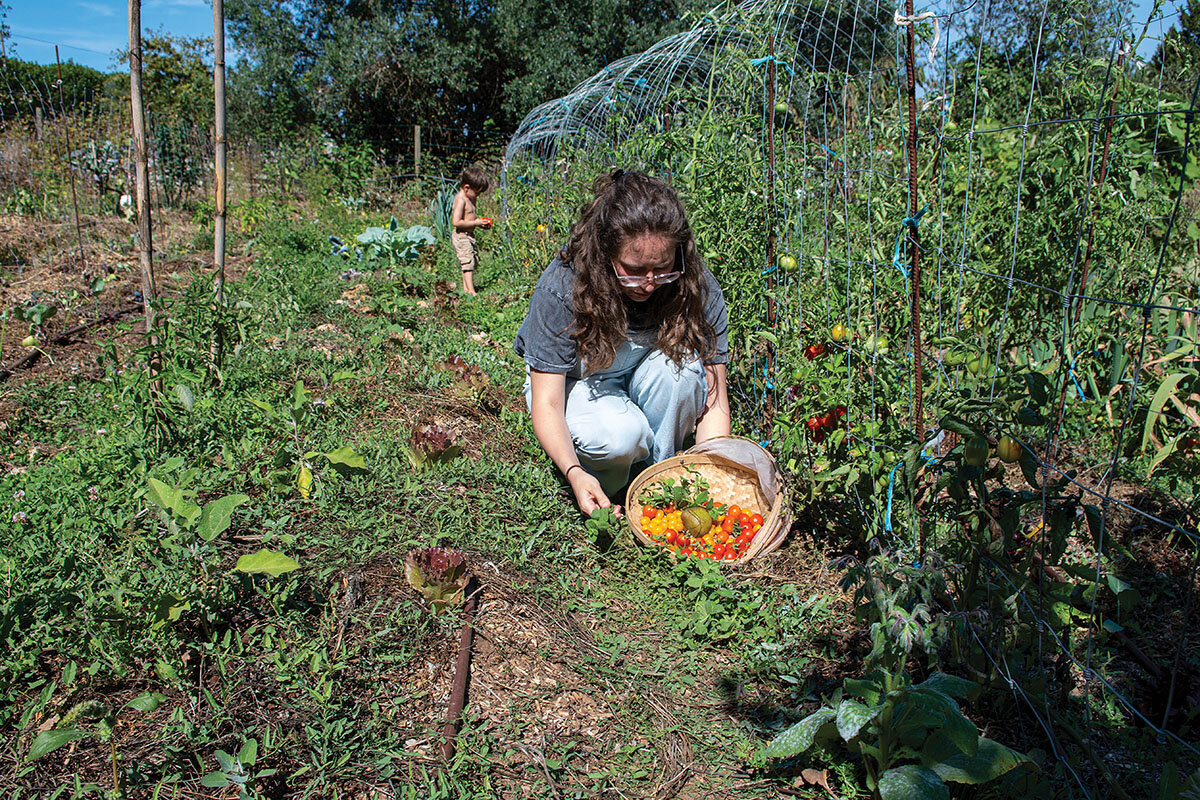
Photo: Alfredo Sosa/CSM Staff.
Rute Gabriel and her 3-year-old son, Isaac, pick tomatoes on their regenerative farming homestead, Projeto Liberta-te, in Porto de Mós, Portugal.
I’m impressed with the many young couples in today’s story who have chosen a life that is more friendly to the earth. My only question: how do people who are not 30 incorporate some of these principles into their daily lives?
Stephanie Hanes writes at the Christian Science Monitor, “For Rute Gabriel and Pipo Vieira, it was the tomato plant on their 25th-floor balcony in Toronto that convinced them to return home.
“The couple, sweethearts ever since high school in this Portuguese region of stone-fenced fields and olive groves, were sharing an apartment with Ms. Gabriel’s grandmother. Their friends back home thought they had hit the jackpot. They had managed to move from the country to the city. They had immigrated to a higher-income country. And in the middle of the 2010s, they had jobs at a time when the global financial crisis – known here simply as ‘the austerity’ – was still hitting Portugal hard.
“But the couple had a sense that something was wrong. They were in their 20s and working constantly in jobs they did not love. They missed the bright sunlight and rosemary-fresh scent of home, and had a growing unease about what felt like an unsustainable lifestyle – not only in their balance of life and work, but also in their lives and the environment. …
“Then one day, browsing the internet, Ms. Gabriel came across a YouTube video about ‘permaculture’ … a philosophy that focuses on re-integrating humans into their habitats in a way that’s mutually beneficial for people, the land, and animals.
“Ms. Gabriel was fascinated, she recalls. This was the sort of lifestyle she and Mr. Vieira were craving. They tried to implement bits and pieces of permaculture at their high-rise apartment, putting a little tomato plant on their balcony, and then trying out ‘companion planting,’ in which they added peppers and carrots to the same container. …
“In 2016, they did what generations of young Europeans have avoided: They moved back not only to their homeland, but also to the countryside and an agrarian life. Their plan was to build a homestead and run Portuguese-language permaculture classes – to support themselves, to regenerate the land, and to help others create sustainable lifestyles. …
“Many of their friends thought they were crazy. … Over the past decades, some rural villages have dwindled to five, eight, or 20 people; schools have closed, and health clinics have shuttered. Portuguese farmers are the oldest in the European Union, with 51.9% above age 65, according to government data. Only about 6.4% are under the age of 40.
“But some in the Climate Generation – as we’re calling the cohort that was born since 1989 and into a world of accelerating impacts from a heating atmosphere – are bucking this trend. Government data shows a small but clear uptick in young people entering the agricultural sector over the past few years. And some are coming back to rural areas in Portugal to intentionally step onto the front lines of their country’s climate struggle, trying out new methods of climate-friendly food production.
“The full size of this movement is hard to quantify because many of these young people hold other jobs and may not identify themselves as farmers for government statistical purposes. But it is recognizable. … The Climate Generation knows that what we eat, and how we grow it, has huge climate implications. Everything from shipping feed to making fertilizer to throwing wasted food in a landfill contributes to greenhouse gas emissions. But by focusing on rebuilding soil’s natural fertility, ‘regenerative’ farming practices can sequester carbon – a potential climate solution. …
“But food systems reflect something even more for the Climate Generation. Food is a tangible, everyday doorway into larger questions about how we relate to the earth and how we consume and share resources. Look at food closely, and it illuminates questions about how and why we work. It brings a tangible practicality to philosophical theories – about whether we keep demanding more by expanding and growing, about modern consumption and lifestyles, about what it means to continue extracting from a planet showing its limits in the form of wildfires, droughts, storms, and heat waves. …
“ ‘This is the future of humanity,’ says João Rodrigues, a 34-year-old artist-turned-farmer, standing by his tomato plants in the interior of Portugal. ‘To go small.’ ”
More at the Monitor, here. No firewall. The article has a lot of interesting detail.

 Suzanne's Mom's Blog