Feeds:
Posts
Comments

Posts Tagged ‘regenerative’

Photo: Annette Hornischer/American Academy in Berlin.
Kate Brown, MIT Professor and author of Tiny Gardens Everywhere.

It’s reassuring to think that small actions of many people can have a significant influence on what happens in the wide world.

In April, Kendra Nordin Beato of the Christian Science Monitor interviewed Kate Brown, a woman used to thinking very big, about how small improvements to improve urban living can play a role in saving the planet.

“Kate Brown, a professor of environmental history at the Massachusetts Institute of Technology and an award-winning author,” says Beato, “has examined the wake of large-scale disasters and the massive challenges they create.

“On a smaller scale, Dr. Brown is also an avid gardener. Her most recent book, Tiny Gardens Everywhere: The Past, Present, and Future of the Self-Provisioning City, probes gardens as small patches of resilience, resistance, and regeneration.

“By studying histories of select European and North American urban gardens, she explores how these spaces helped to build communities centered on cooperation and mutual support. They also hold a promise, she says, for cities as places of sustainable food production. …

Kendra Nordin Beato
“What drew you, as an environmental historian, to this subject of urban gardening?

Kate Brown
“I wrote two big nuclear histories – and then about the environmental and health effects of Chernobyl, which were profound. As I worked on these big histories, I would think, once people find this out, it is going to change everything. And then it doesn’t.

“Countries are threatening each other as if it is the Cold War all over again with nuclear weapons. And then I started to think that maybe part of the problem, maybe these big histories – problems on a planetary scale – add to our sense of anxiety, apathy, you know, that we can’t do anything about it. I can’t get a U.N. resolution passed. So what can we do? We can do something on a very local level; we can do something in our own backyards.

“I love to garden. As you see in the book, my friend and I decided to plant a food forest around this mothballed school. And there I was, out in the street, and I got to know my neighbors in this really amazing way. I had lived there for 15 years and all it took was just to be out with a shovel in my hand to meet the guy who is always a porch sitter and get to know the kids who are running around. So that’s where I started to connect the simple act of planting a garden – especially in a visible place, whether that’s a front yard or public land – with community.

Beato
“One theme in your book explores how regenerative it is to extract life from seemingly little pockets of wasteland. …

Brown
“We call gardening recreation for a reason: because it’s fun. Gardeners find it fascinating to go out, mess around, see what happens, see what works. And it’s the small scale of it that makes it enjoyable, not drudgery. 

“Gardeners work with the environment. You treat your soil well; every worm is sacred. I abandon my garden every summer here in Cambridge [Massachusetts] for two months. I pack in the seeds, I set up a sprinkler that goes off at 5 every morning, and I have a lot composted from my kitchen compost. And when I come back, there’s really no space for weeds because all these plants – the beans are growing in the squash, the melons I didn’t even plant are vining their way around the potatoes and the garlic – all I have to do is come back and harvest, because this little space is self-propagating. …

Beato
“Why do you think gardens can strengthen, as you call it, civil societies?

Brown
“Not all community gardens are the same. [For instance, consider 19th-century factory workers in Berlin who] go to the edge of the town and they see all these sand dunes, basically. And so they take manure and the scraps from the brewery and the scraps from the sugar beet factory, all this organic material, and they build soils. … First it’s these miserable little gardens on sand, these poor little struggling plants. But then, within 10 years, they’re quite lush. And then, in another 10 years, most of the infrastructure is botanical. And so, people come together in these self-actuated communities, and they are living there, too. They start to build the sinews of what we would now call a social security network. They take up collections for people whose shacks burned down, unemployment collections, microloans to one another, and these places become very resilient. They weather war and famine. …

“We just did a YouGov Poll and asked a cross section of Americans what they do with their front-yard gardens. And 16% of Americans use their front yards to grow food. Then we asked: Did you get a lot of pushback? Did your neighbors complain? … Most of them – well over 60% – said, ‘Oh, my neighbors just compliment me. And a lot of them ask for advice because they want to do the same.’ So we found that these front-yard gardeners clustered together. Once somebody broke the mold, others wanted to follow. And so, we’re thinking there’s a quiet revolution against the institution of the American lawn that’s going on regardless of political affiliation. 

“In case you are thinking, ‘Oh, this can’t happen in a big country. This can’t be part of modern life,’ think of the Soviet Union [when it was a] nuclear superpower. By the 1990s, 96% of the potatoes people were eating were coming from tiny garden plots. We can go a long way toward feeding ourselves with these tiny urban spaces.”

More at the Monitor, here.
Read Full Post »

Photo: Alfredo Sosa/CSM Staff.
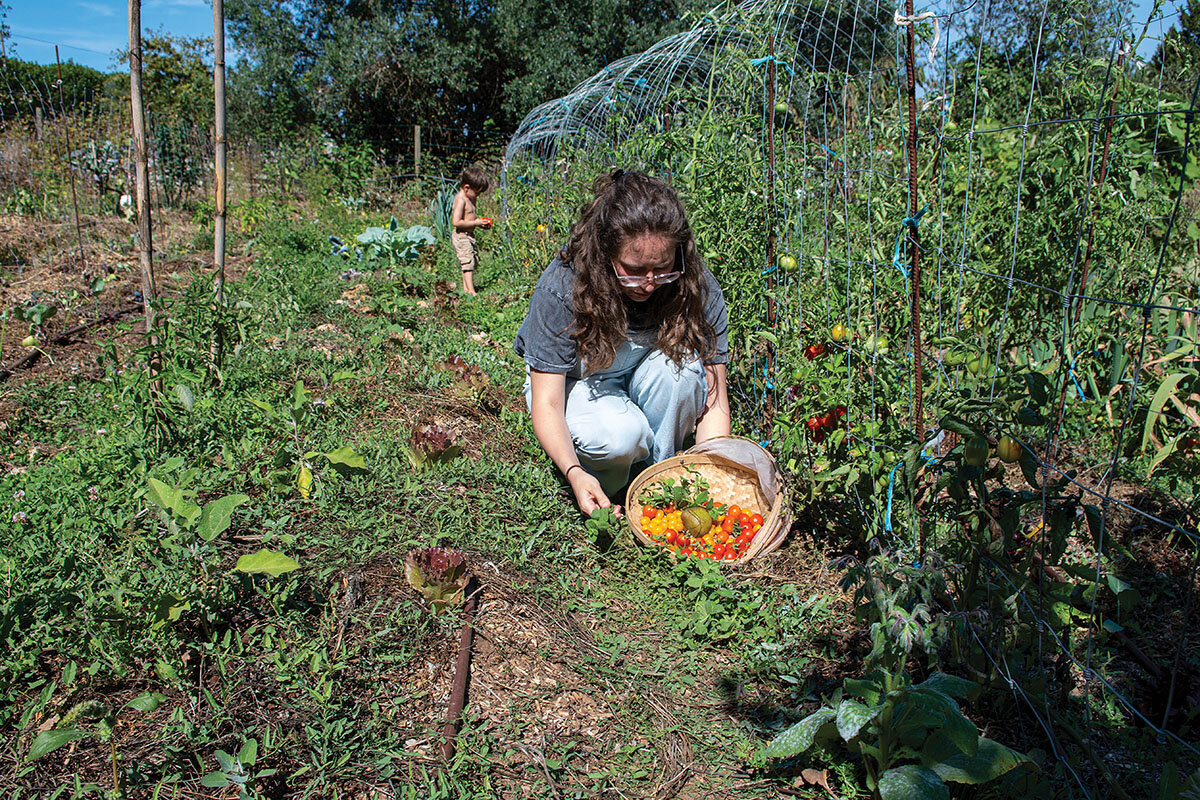
Rute Gabriel and her 3-year-old son, Isaac, pick tomatoes on their regenerative farming homestead, Projeto Liberta-te, in Porto de Mós, Portugal.

I’m impressed with the many young couples in today’s story who have chosen a life that is more friendly to the earth. My only question: how do people who are not 30 incorporate some of these principles into their daily lives?

Stephanie Hanes writes at the Christian Science Monitor, “For Rute Gabriel and Pipo Vieira, it was the tomato plant on their 25th-floor balcony in Toronto that convinced them to return home. 

“The couple, sweethearts ever since high school in this Portuguese region of stone-fenced fields and olive groves, were sharing an apartment with Ms. Gabriel’s grandmother. Their friends back home thought they had hit the jackpot. They had managed to move from the country to the city. They had immigrated to a higher-income country. And in the middle of the 2010s, they had jobs at a time when the global financial crisis – known here simply as ‘the austerity’ – was still hitting Portugal hard. 

“But the couple had a sense that something was wrong. They were in their 20s and working constantly in jobs they did not love. They missed the bright sunlight and rosemary-fresh scent of home, and had a growing unease about what felt like an unsustainable lifestyle – not only in their balance of life and work, but also in their lives and the environment. …

“Then one day, browsing the internet, Ms. Gabriel came across a YouTube video about ‘permaculture’ … a philosophy that focuses on re-integrating humans into their habitats in a way that’s mutually beneficial for people, the land, and animals.

“Ms. Gabriel was fascinated, she recalls. This was the sort of lifestyle she and Mr. Vieira were craving.  They tried to implement bits and pieces of permaculture at their high-rise apartment, putting a little tomato plant on their balcony, and then trying out ‘companion planting,’ in which they added peppers and carrots to the same container. …

“In 2016, they did what generations of young Europeans have avoided: They moved back not only to their homeland, but also to the countryside and an agrarian life. Their plan was to build a homestead and run Portuguese-language permaculture classes – to support themselves, to regenerate the land, and to help others create sustainable lifestyles. …

“Many of their friends thought they were crazy. … Over the past decades, some rural villages have dwindled to five, eight, or 20 people; schools have closed, and health clinics have shuttered. Portuguese farmers are the oldest in the European Union, with 51.9% above age 65, according to government data. Only about 6.4% are under the age of 40.

“But some in the Climate Generation – as we’re calling the cohort that was born since 1989 and into a world of accelerating impacts from a heating atmosphere – are bucking this trend. Government data shows a small but clear uptick in young people entering the agricultural sector over the past few years. And some are coming back to rural areas in Portugal to intentionally step onto the front lines of their country’s climate struggle, trying out new methods of climate-friendly food production. 

“The full size of this movement is hard to quantify because many of these young people hold other jobs and may not identify themselves as farmers for government statistical purposes. But it is recognizable. … The Climate Generation knows that what we eat, and how we grow it, has huge climate implications. Everything from shipping feed to making fertilizer to throwing wasted food in a landfill contributes to greenhouse gas emissions. But by focusing on rebuilding soil’s natural fertility, ‘regenerative’ farming practices can sequester carbon – a potential climate solution. …

“But food systems reflect something even more for the Climate Generation. Food is a tangible, everyday doorway into larger questions about how we relate to the earth and how we consume and share resources. Look at food closely, and it illuminates questions about how and why we work. It brings a tangible practicality to philosophical theories – about whether we keep demanding more by expanding and growing, about modern consumption and lifestyles, about what it means to continue extracting from a planet showing its limits in the form of wildfires, droughts, storms, and heat waves. …

“ ‘This is the future of humanity,’ says João Rodrigues, a 34-year-old artist-turned-farmer, standing by his tomato plants in the interior of Portugal. ‘To go small.’ ”

More at the Monitor, here. No firewall. The article has a lot of interesting detail.

Read Full Post »

Photo: Tablas Creek.
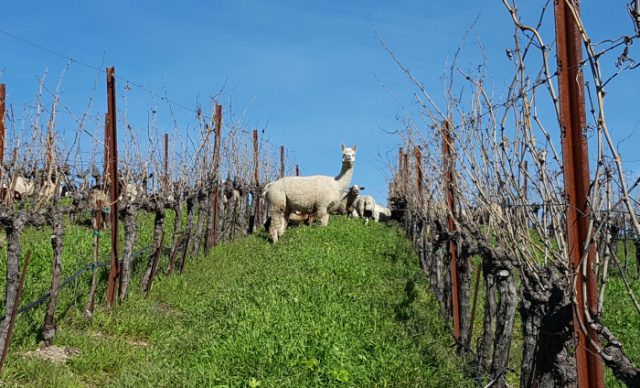
Sheep and alpaca graze among dormant vines in the Tablas Creek vineyard, Paso Robles, California.

Contemporary consciousness has come to a supremely traditional way of life: winemaking.

Patrick Schmitt writes at the Drinks Business, “Moët Hennessy, Jackson Family Wines and Torres are adopting a ‘regenerative’ approach to viticulture – but what does it involve, and why are these famous producers making the move?

“[The] the main aim of regenerative viticulture is to increase the amount of carbon held in the ground, and to do this, farmers must ditch the tilling, because the best way to destroy carbon in the soil is to turn it.

“In short, disturbing the ground exposes it to UV light, which is an oxidizing force, and breaks down the organic matter in the soil. And a soil with less organic matter is less sponge-like, and less able to absorb and hold water and nutrients. … Tilling the soil also disrupts the soil microbiome, killing the good microbes and insects that help fight pests and diseases. …

“For Justin Howard-Sneyd MW, who, heads up courses on Sustainable and Regenerative Viticulture at the UK’s Dartington Trust, a regenerative approach is vital to reverse the damage done to agricultural soils, and make viticulture sustainable, without detrimental effects on grape quality.

“Speaking last month at the IMW Symposium in Wiesbaden, he told more than 500 attendees at the three-day event that the world has … ‘just 60 harvests left,’ should current rates of soil erosion continue.

“[He said] that the origin of the regenerative movement was the Dust Bowl of the 1930s in the US, where deep ploughing and drought saw the destruction of virgin topsoil in the Great Plains of central North America, forcing tens of thousands to abandon the land. …

“For Justin, a regenerative approach to viticulture carries additional advantages of being applicable to any farming philosophy, with no strict practices, while being ‘science-led.’

‘It is about trying as much as possible to create a complex, balanced, diverse ecosystem of life in the vineyard by working with natural forces.’ …

” ‘If you are organic but plough a lot and use a lot of copper, then you can actually have fairly unhealthy soil.’

“To promote the techniques and benefits of regenerative approaches to wine production, a little over 18 months ago the Regenerative Viticulture Foundation was established. …

“[Justin] mentioned at the symposium that Jackson Family Wines had committed to converting all its vineyards to regenerative techniques by 2030, while Torres was moving towards the approach on more than 500 hectares of organic vineyards, and Moët Hennessy was also adopting the philosophy, most notably at its Provençal property, Château Galoupet. … Concha y Toro is experimenting with regenerative approaches in Chile. …

“The approach can improve soil health, reduce the need for increasingly expensive inputs, be they organic or synthetic fertilizers, as well as create a vineyard that is more resistant to weather extremes – particularly periods of heat and drought. …

“Mimi Casteel [said] that permanent ground cover in her vineyards had kept her soils wetter and therefore cooler during a recent period of extreme heat in Oregon. … Antoine Lespès – who heads up R&D at [Domaine Lafage in Roussillon] – told the Drinks Business in December last year, ‘Because we have a low amount of rainfall, every drop that falls from the sky needs to be cultivated.’

“To ensure this, Lespès said that a permanent ground cover was key for increased infiltration, and a high-level of organic matter was important to retain the moisture. He also said that the ground cover, which can be rolled or mulched, prevents water loss by shading and protecting the soil.

“Other techniques are necessary too, however, from planting to follow the contours on sloping ground to prevent run-off during heavy rainfall, to the use of agroforestry for shade, along with biochar for increased water infiltration and retention, and, finally, a good combination of rootstock and grape variety. …

“But it was also an emphasis on applying regenerative viticulture to large-scale production that was stressed at the IMW Symposium, and particularly by Jamie Goode, who, as the author of Regenerative Viticulture, also spoke on the farming philosophy. …

“ ‘If this approach to farming is going to make big impact, then it’s not just something we want rich people to do on a small vineyard for wines selling for $100 a bottle – it’s also for big farms selling wine at €1 per litre.’ [And it’s] important that wine producers ‘say goodbye to herbicides. … Clear earth is a major problem, not so much the chemicals. It’s the same problem with organic herbicides: nothing is growing there.’

“However, should one leave a permanent ground cover, and ditch the tilling, the plants that sprout in the vineyard do need to be kept in check. … California’s Tablas Creek, which is a pioneer in regenerative viticulture, has a herd of 250 sheep that it successfully uses to keep weeds at bay in its vineyards.”

More at the Drinks Business, here. No paywall.

Read Full Post »