Photo: Dominique Soguel.
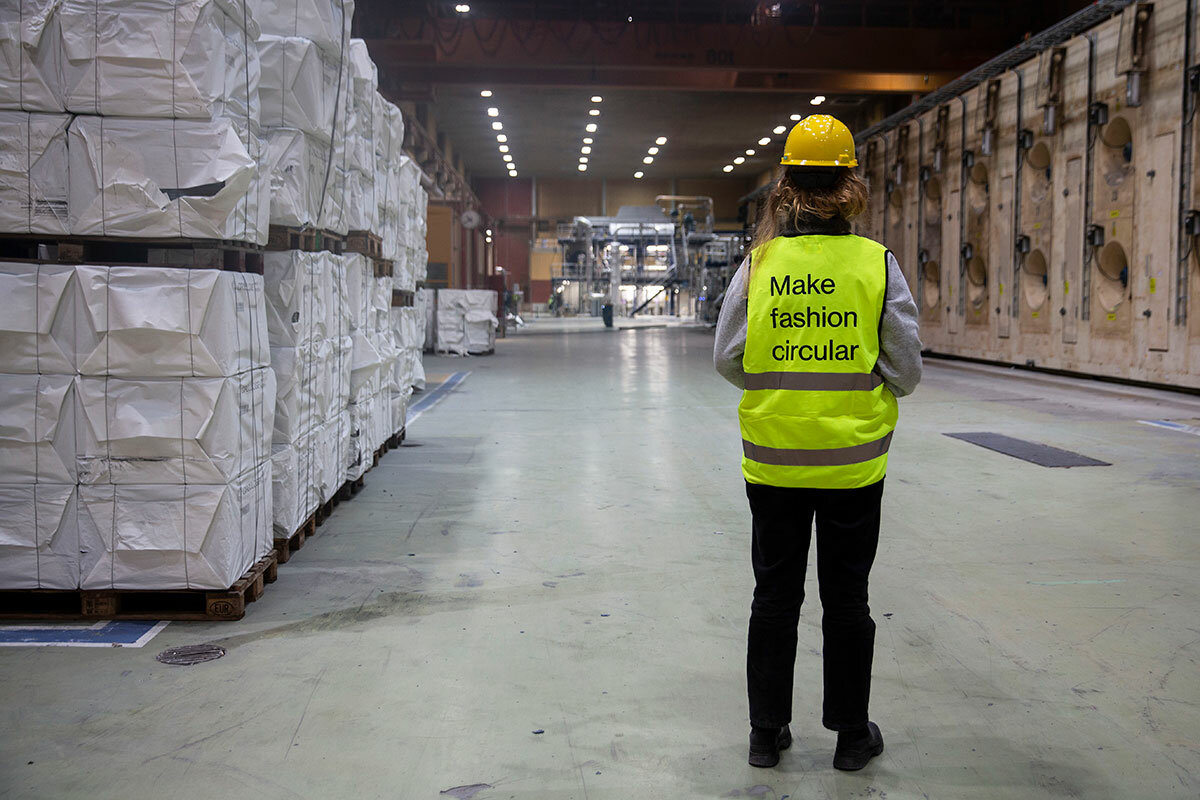
An employee stands in the industrial-scale plant of textile-to-textile recycling company Renewcell in Sundsvall, Sweden, Feb. 7, 2023.
After my youngest granddaughter toured a recycling facility in Rhode Island, she told me that one thing the state recycles is textiles. But in Massachusetts, where a new law forbids putting textiles in landfills, there are few towns that offer services for recycling worn-out clothes. At least there are plenty of outlets for reusable clothes.
In Sweden, some folks are trying to make all clothes — and the materials that go into them — reusable. That’s according to today’s article from the Christian Science Monitor.
Dominique Soguel writes, “Discarded, sorted clothes arrive by ship on the shores of Sundsvall, in the Gulf of Bothnia inlet of the Baltic Sea. But they aren’t bound for a landfill.
“Rather, they are destined for the city’s Renewcell plant, where they will be dissolved and processed into a new substance: Circulose. This material looks like white cardboard, feels like watercolor paper, and – most importantly – can be spun into yarns for textile manufacturers. …
“Renewcell’s patented technology, now available commercially, and successful launch of the world’s first industrial-scale textile recycling plant in Sweden offer a beacon of hope to brands and consumers who care about environmental sustainability.
“ ‘From an environmental perspective, it means that every year, instead of huge swaths of forest being cut down, millions of old jeans and T-shirts are being used rather than them degrading into methane in landfill,’ says Nicole Rycroft, director of the environmental nonprofit Canopy.
“The fashion industry relies primarily on three fibers – polyester, cotton, and viscose rayon – each of which is problematic for the environment.
“Polyester, made from plastic, takes hundreds of years to break down. … Soft-to-touch cotton is grown on vast, water-intensive monoculture farms using large quantities of fertilizers and pesticides. The Aral Sea, once the world’s fourth-largest lake, dried up almost completely, drained by cotton fields in Uzbekistan and Kazakhstan. …
“Viscose rayon is made from tree wood, which sometimes comes from ancient forests. Ms. Rycroft points to the 300 million trees cut down yearly to make viscose rayon, among other textiles. That consumption is slated to double within the next decade.
“On top of all this, much of what the fashion industry produces with these materials ends up as waste. Global production of textile fibers and all apparel creates 110 million metric tons of waste. On average, Europeans produce 33 pounds per year per capita, and Americans about 70 pounds per year.
“Solutions for controlling fashion’s consumption rate range from reducing overproduction and overconsumption to making longer-lasting clothes and embedding circularity into product design. But experts consider fiber-to-fiber recycling – converting textile waste into new fibers that can be used to make clothes or other textile goods – as one of the most sustainable and scalable levers available. …
“The Nordics stand out in Europe for their efforts to reduce the fashion industry’s impact on the planet. Copenhagen Fashion Week imposes sustainability requirements on brands before they hit the runway. Multiple Nordic brands offer recycling options and sell used clothes on their shelves at reduced prices.
“Sweden boasts an impressive secondhand clothes market scene; the world’s first recycling mall, Retuna; and innovative companies like Nudie. Nudie offers customers free repairs on their jeans and a 20% discount on new ones if they trade in old ones. It’s a much-loved service.
“ ‘I really like clothes, but I don’t think it’s necessary for me to buy something new to get the kind of clothes that I like to wear,’ says Tomas Persson after bringing his jeans in for repair to the Nudie shop in Gothenburg. Apart from underwear, he says has not bought a new item of clothing in years – not an uncommon claim in Sweden.
“The development of sustainable textiles is also part of Sweden’s national strategy. That keeps the Swedish School of Textiles and Science Park Borås, both part of the University of Borås, abuzz with the development of high-tech prototypes and design experiments focused on recycling, reuse, and upcycling.
“ ‘We have to find more efficient production processes … and ways of consuming garments,’ says Susanne Nejderås, textile strategist at Science Park Borås. ‘The mean use of a clothing item is around two years. We need to add another eight years to that.’ ”
I’ll just add that consumers are not only demanding sustainability these days, but human rights. There is widespread concern about China using Uyghur forced labor for cotton products. That’s why I buy cotton towels at Patagonia and fair trade cotton clothes from Fair Indigo in Peru (thanks to blogger Rebecca).
More at the Monitor, here. No firewall. Subscriptions welcomed.



 Suzanne's Mom's Blog