Feeds:
Posts
Comments

Posts Tagged ‘competition’

image

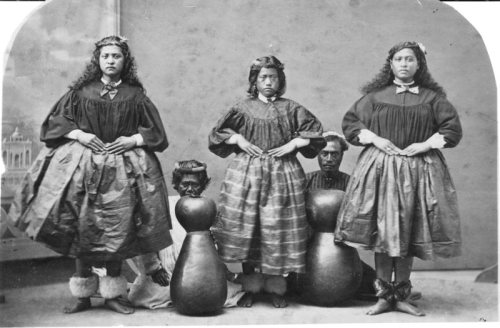
Photo: J. J. Williams/Public domain
Hawaiian hula dancers photographed in J. J. Williams’s photo studio, circa 1885. The art form was suppressed for many years but is now celebrated around the world.

I was thinking recently that I’d love to learn some new dance forms. I took lots of ballet as a kid, and I keep reading that dancing is good for your health when you’re older. Essentrics, an exercise program I love, has taught me to focus on moves that are beneficial, not contorted. So what kind of dance would be good? Someone I know teaches salsa. Should I try that?

The following article got me wondering if hula might be good for me.

Ligaya Malones writes at Atlas Obscura about Hawaiʻi’s Merrie Monarch hula festival, “arguably the most prestigious event of its kind.

“Every spring, thousands of hula fans descend upon the Hawaiian town of Hilo and line the bleacher seats at Edith Kanaka’ole stadium. Thousands more across the islands — those unable to make it to Hilo themselves — watch live broadcasts on their televisions or computer screens. All these people are showing up and tuning in for the beloved Merrie Monarch Festival, sometimes referred to as ‘the Olympics of hula.’ …

“The three-day competition is part of several week-long events held throughout Hilo, home of Merrie Monarch since 1963. … Much credit is given to King Kalākaua, the last of Hawaiʻi’s kings, for reclaiming hula’s place in Hawaiian society. He was elected to the throne in the 1870s by the Hawaiian legislature, and often hosted hula-filled celebrations, including at his coronation. Merrie Monarch was Kalākaua’s endearing nickname and it is his contribution to hula that the competition honors every year.

“ ‘It’s electrifying,’ says Robert Ke’ano Ka’upu IV, who grew up in Hilo. Ka’upu has participated in the invitation-only competition for the last 30 years as a spectator, dancer, chanter, costumer, and now as kumu hula. … ‘I don’t get excited like this for any other competition,’ he says.

“During the festival, every inch of a performance is scrutinized. Dancers are evaluated and earn points for the way they enter and exit the stage, their facial expressions, posture, costume, lei, and adornment, says Ka’upu. However, the bulk of scoring is placed on the kumu’s interpretation of a song, known as a mele, and how well dancers interpret their kumu’s vision of the performance.

“To assist in deliberations, every competing group provides judges with a fact sheet that corresponds to each performance. These fact sheets, which are due before the competition, explain everything from a mele’s background to the meaning of the lei that dancers wear ‘so [the judges] get a better understanding of what each halau is doing,’ says Ka’upu. He adds that his halau will submit more than 70 pages of fact sheets to the judging panel for the competition this year. Judges bestow high scores to those who best personify technical excellence, and ultimately the expression of Hawaiian identity through chant and dance. …

“Hawaiian culture existed without the written word until western contact, so Hawaiians passed down knowledge orally and through dance. Through chant and movement, hula narrates place; honors goddesses and gods, such as Pele, goddess of fire; celebrates nature’s surroundings, from birds to waterfalls; and records genealogy and human emotion. ‘Kaulilua,’ for example, is one of Merrie Monarch’s most performed ancient hulas. The mele likens a woman to the island of Kauaʻi’s verdant Mount Waiʻaleʻale. …

“As Western influence grew and Hawaiʻi’s fate approached annexation and eventual U.S. statehood, so did the need for local manpower to fuel its new sugar economy. In 1858, missionaries with a keen interest in sugar’s profits pursued legislation to suppress hula even further, citing lethargy in sugar cane fields, promiscuity, and attrition from Sunday service. Records show a code of conduct published in 1859 required a license for ticketed, public hula performances. Yet hula persisted under the mesh of legal restrictions and moral shaming. Hawaiians still danced, particularly in more rural areas where government oversight trickled, missionary presence was scarce, and police all the more so. ‘Hula was never lost,'” says Dr. Taupouri Tangarō, director of Hawaiian culture and protocols at University of Hawaiʻi at Hilo.

For more on the competition and for more-contemporary hula photos, check out Atlas Obscura.

Read Full Post »

Photo: Cliff Owen/Associated Press
The Afghan team at the opening ceremony of the First Global robotics competition in Washington in July.

Did you read about the ups and downs of the young Afghan girls who ran into the travel ban when they tried to come to July’s robotics competition in Washington?

Emily Cochrane wrote about it at the NY Times.

“It took an international outcry and intervention from President Trump and other officials to allow [six] girls from an Afghan robotics team to receive visas after two rejections, letting them travel to the United States for participation in First Global, an international robotics contest.

“For three days in the Daughters of the American Revolution Constitution Hall, where an African-American woman was once denied the right to sing before an integrated audience in the 1930s, the Afghan girls in head scarves were stars on an international stage, with cameras, lights and whispers trailing them from practice to competition. …

“Wai Yan Htun, 18, a member of Myanmar’s team who stopped to get the Afghans’ signatures on his shirt, said: ‘We love them. They’re like superheroes in this competition.’ …

“In the competition, teams of three, equipped with kits that included wheels, gears and two video game controllers, chased down blue and orange balls, which represented clean and contaminated water. In two-and-a-half-minute rounds, teams guided the robots to sweep the balls into openings based on their color.

“ ‘It’s way more fun, way more exciting than bouncing a ball,’ said Dean Kamen, one of the organization’s founders and inventor of the Segway. ‘That’s not a competition out there. That’s a celebration.’ …

“The six students were chosen from an initial pool of 150 applicants. They built their robot in two weeks, compared with the four months some of their competitors had, because their kit’s shipment was delayed. …

“While the team did not place in the top ranks overall, their final performance, they agreed, was better than they had hoped for. …

“ ‘I am so happy and so tired,’ Alireza Mehraban, an Afghan software engineer who is the team’s mentor, said after the competition concluded.

“Mr. Mehraban said the contest had been an opportunity to change perceptions about the girls’ country. ‘We’re not terrorists,’ he said. ‘We’re simple people with ideas. We need a chance to make our world better. This is our chance.’ …

“ ‘God made this planet for something like this, all the people coming together as friends,’ said Alineza Khalili Katoulaei, 18, the captain of the Iranian team, gesturing to the Iraqi and Israeli teams standing nearby. ‘Politics cannot stop science competitions like this.’ ”

More at the NY Times, here.

Read Full Post »

The Arab world is divided on whether Jennifer Grout is an interloper or the reincarnation of their beloved Egyptian chanteuse Umm Kalthoum. Last night she placed third in the Beirut-based “Arabs Got Talent.”

You will be hearing a lot about this young American singer of classical Arabic songs, who is wowing judges without being able to speak a word of Arabic. If nothing else, she is giving the show international recognition. This story is from Agence France Presse (AFP).

Having taught herself to sing “the Arab world’s best-known, most difficult songs,” says AFP, Grout gave contestants in “Arabs Got Talent” a run for their money.

In early December, “Her blonde hair loose and without a sign of make-up, the 23-year-old appeared before a panel of judges to audition for the ‘Arabs Got Talent.’

“When Egyptian film star and panel member Ahmed Helmy asked her in Arabic what her what her name was, she didn’t have a clue what he was saying.

“But then she began to play the oud and sing a classic by Egyptian diva Umm Kalthoum, ‘Baeed Annak’ (Far From You).

“She stunned the audience, enunciating every word to perfection as her voice effortlessly navigated the quarter-notes that make Arabic music so distinctive. …

“As a 20-year-old student in Boston, Grout says she ‘came across an online article about Fairouz” [a Lebanese singer often referred to as ambassador to the stars].

” ‘I listened to her and watched a video of her, and I was just really intrigued and mesmerised by her voice. So I decided to start exploring Arabic music more,’ Grout told AFP.”

Read more about her discovery of Arab music and the classical instrument called the oud three years ago and how she ended up competing on a show in Lebanon, here.

Photo: Joseph Eid/AFP
Jennifer Grout, a contestant in the pan-Arab TV show “Arabs Got Talent”, poses for a photo at the MBC television station studios in Zouk Mosbeh, north of Beirut, on December 4, 2013.

Read Full Post »

Thousands of languages are becoming extinct as the last of the people who speak them die off.

In a race against time, some determined souls who value the richness and insights that individual languages provide are making efforts to save as many minority languages as possible. We posted about that here.

Today National Public Radio had a feature on another approach to preservation, the Liet International Song Contest.

“Auditions are now underway for next May’s Eurovision Song Contest — that often-ridiculed television spectacle that has drawn millions of viewers around the world every year since 1956. In 2012 the host country will be Azerbaijan, since that country fielded last year’s winner. The show’s performers rely on outlandish costumes, dance moves and gimmicks to grab attention because most viewers can’t understand what they’re singing. But language is at the heart of another Eurovision-sponsored song and performance competition this weekend in Italy. The Liet International Song Contest is a very serious attempt to keep some of the continent’s neglected languages alive.”

Read more.’


Read Full Post »

« Newer Posts