Feeds:
Posts
Comments

Posts Tagged ‘computer’

Photo: Elisabeth von Boch/Stanford.
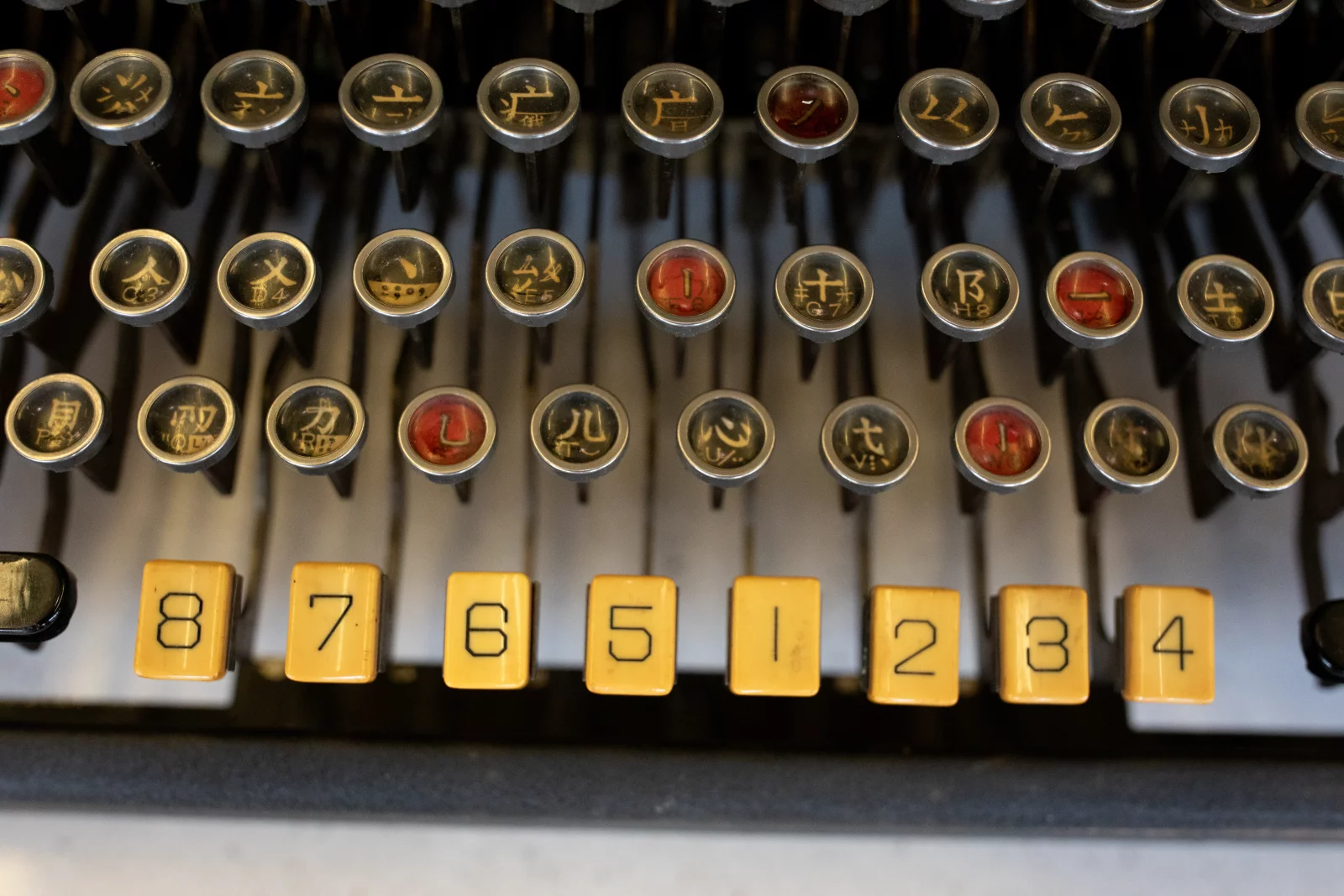
The MingKwai typewriter, crucial to the development of modern Chinese computing, has resurfaced. Its keys enable the typist to find and retrieve Chinese characters.

I love stories about finding long-lost treasures. The story of this old typewriter, the only one of its kind ever made, fits that category.

Emily Feng writes at National Public Radio (NPR), “Scholars in the U.S., Taiwan and China are buzzing about the discovery of an old typewriter, because the long-lost machine is part of the origin story of modern Chinese computing — and central to ongoing questions about the politics of language.

“China’s entry into modern computing was critical in allowing the country to become the technological powerhouse it is today. But before this, some of the brightest Chinese minds of the 20th century had to figure out a way to harness the complex pictographs that make up written Chinese into a typewriter, and later, a computer.

“One man succeeded more than any other before him. His name was Lin Yutang, a noted linguist and writer from southern China. He made just one prototype of his Chinese typewriter, which he dubbed the MingKwai. …

“Detailed U.S. patent records and diagrams of the typewriter from the 1940s are public, but the physical prototype went missing. Scholars assumed it was lost to history.

” ‘I had really, truly thought it was gone,’ says Thomas Mullaney, a history professor at Stanford University who has studied Chinese computing for two decades and is the author of The Chinese Typewriter.

Mullaney was at a conference last year when he got a message that someone in upstate New York had found a strange machine in their basement and posted a picture of it on Facebook.

” ‘It was a sleepless night.’ …

“Eventually, the owner reached out to him. They had acquired the typewriter from a relative who had worked at Mergenthaler Linotype, once of the most prominent U.S. makers of typesetting machines. The company helped craft the only known prototype of the MingKwai typewriter. …

” ‘It’s like a family member showing up at your doorstep and you had just assumed you would never see them,’ Mullaney says.

“The story of why such a typewriter even exists runs parallel to the political upheaval and conflict over Chinese identity and politics in the 20th century.

“Lin, its inventor, was born in 1895 in southern China during the tail end of a failing Qing dynasty. Student activists and radical thinkers were desperate to reform and strengthen China. Some proposed dismantling traditional Chinese culture in favor of Western science and technology, even eliminating Chinese characters altogether in favor of a Roman alphabet.

” ‘Lin Yutang charted a path right down the middle,’ says Chia-Fang Tsai, the director of the Lin Yutang House, a foundation set up in Taiwan to commemorate the linguist’s work. …

“Typing Chinese was a monumental challenge. Chinese has no alphabet. Instead, it uses tens of thousands of pictographs. When Lin started his work in the early 20th century, there was no standardized version of Mandarin Chinese. Instead, people spoke hundreds of dialects and languages, meaning there was no singular phonetic spelling of the sound of each word.

“Lin had financial backing from the American writer Pearl S. Buck to create the typewriter, but he also sunk much of his own savings into the project as costs ballooned.

” ‘He’d spent a lot of money. A lot,’ says Jill Lai Miller, Lin’s granddaughter. …

“The typewriter’s ingenuity comes from the way Lin decided to break down Chinese pictographs: by their shapes, not sounds. The typist can search for certain combinations of shapes by pressing down on the ergonomic keyboard. Then, a small screen above the keyboard (Lin called it his ‘magic eye’) offers the typist up to eight possible characters that might match. In this way, the typewriter boasts the ability to retrieve up to 90,000 characters. …

“Encoded in the machine’s engineering was an ambitious globalism. Lin’s way of breaking down languages by the shape of their words rather than their sounds or alphabets meant his machine theoretically can type English, Russian and Japanese as well, according to the typewriter’s manual.

” ‘One thing that was very interesting … in Li Yutang’s thinking about Chinese-ness and Chinese culture is that it must not be insular. It must have this porous border, it must be capacious and be able to communicate and talk with other cultures,’ says Yangyang Cheng, who first wrote about the typewriter’s discovery. …

“Mullaney is now researching the typewriter full-time, trying to understand how its mechanical innards work, with the far-off dream of one day replicating it. He recently found the typewriter’s ink spool was still fully intact inside.

” ‘You would need the sort of technology that they used on, like, discoveries of the Dead Sea Scroll and stuff like that, but you’ll notice that the ink spool is still there,’ he points out, using a dental mirror to peer inside the machine.

“The ink spool could contain traces of the last words Lin or his daughter typed on the machine — meaning perhaps the inventor’s own words are in his magical machine too.”

More at NPR, here. The New York Times also has a story on the typewriter. Read it here.

Read Full Post »

Art: Mary Cassatt.
One of these young women is supposedly the grandmother!

Today I thought I’d post this story on a very nice way for a mother to spend a few hours. It’s about a library specially designed for parents.

Casey Parks writes at the Washington Post, “Janelle Witcher thinks of the library as her second home. She’s a single mom who lives in Richmond [Virginia], and a few times a week, she drives her four children to Henrico County’s Fairfield branch. It’s a place where her children can learn and she can use a computer or socialize with other parents. Plus, she said, the books calm her children down.

“ ‘I go there just to let them see a different view, a peaceful view,’ she said.

“When Witcher’s oldest children were younger, they used to visit a different branch on the other side of town. She’d sign up for one of the computers in the lab, and she’d hold one baby or two as she tried to answer emails or look for job opportunities. Using the computers always felt difficult, though. As soon as Witcher started to type, one of the babies would reach over and mash the keys.

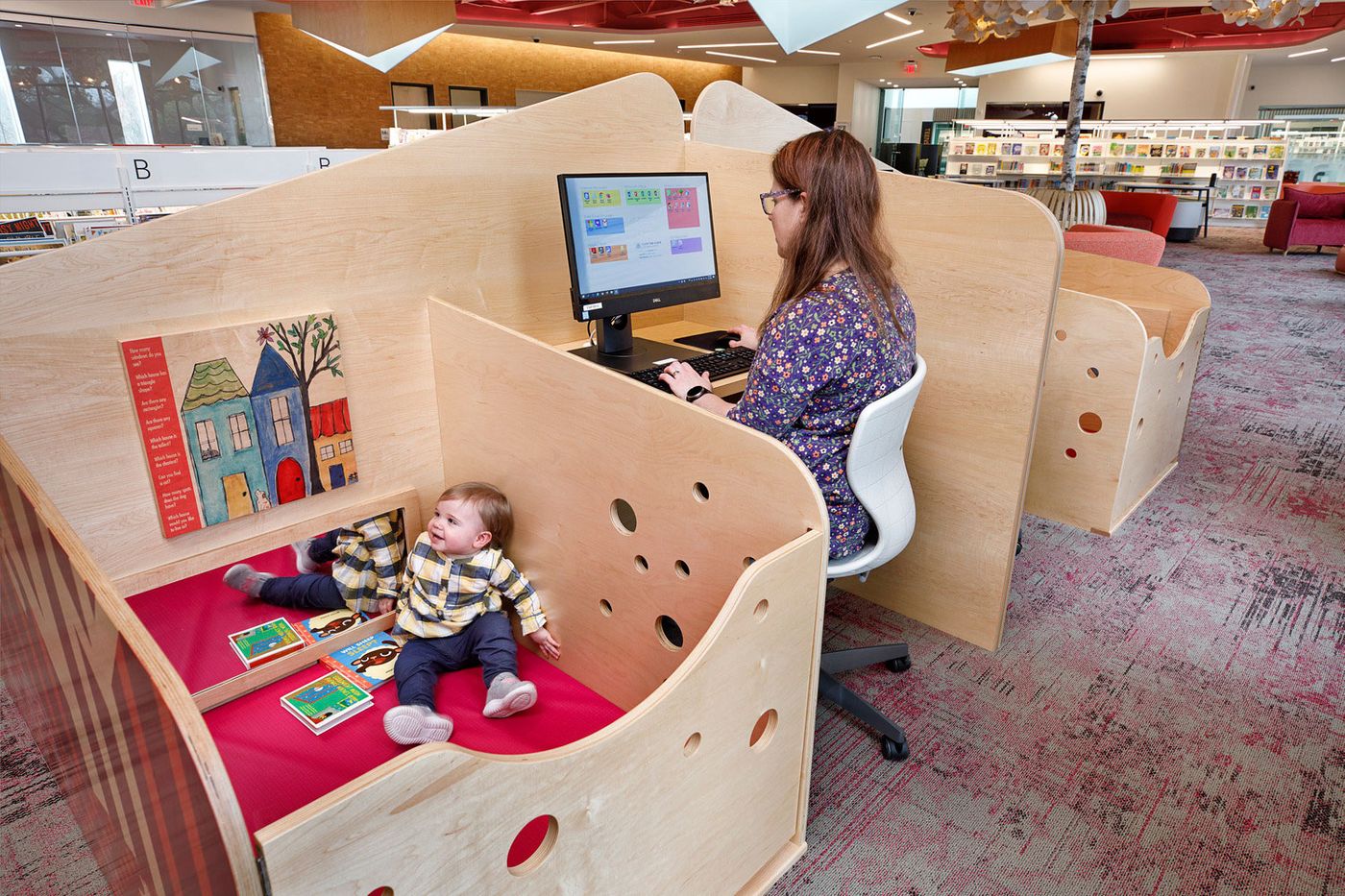
“Eventually, multitasking wore Witcher down. She cut back on her visits, but she missed the calming stacks, and her oldest children needed a place to do their virtual schooling. She started going to the new Fairfield branch last year, and the first time she visited, she noticed that someone had fixed her most vexing library problem. They’d installed a second computer lab in the children’s section, and this one had adult desks with a playpen attached.

They’d installed a second computer lab in the children’s section, and this one had adult desks with a playpen attached. …

“The Henrico County Public Library system installed the workstations as part of a $29 million rebuild of the Fairfield branch. Voters overwhelmingly supported a bond to pay for the facility, and as library administrators began designing it, they asked families what they wanted to see in the new 44,800-square-foot space.

“Immediately, said Barbara Weedman, the library director, one trend emerged: People no longer viewed the library as just a place to pick up a book. The branches were places to gather, and families needed them to be more kid-friendly.

“Weedman worked with architects at Quinn Evans, which has offices in D.C., Baltimore, Detroit, Ann Arbor, Mich., and Richmond. Together, they designed a children’s section with arts-and-crafts rooms, collaboration spaces and furniture short enough to allow parents to see their children across the room. They added rocking chairs and a lactation room, and then, as the architects finalized their plans, they asked Weedman whether community members needed anything else.

“Weedman was also once a single mom, and she and other library staff had long noticed mothers like Witcher trying to work on the computers while holding a child. …

“The old computer lab model didn’t work for those parents, Weedman told Shannon Wray, a senior interior designer at Quinn Evans. And it didn’t work for other patrons, either, who needed a quiet place to work or apply for jobs. …

“Wray searched, but she couldn’t find any ready-made furniture that addressed the need, so she asked a small company in Ann Arbor to build something new.

“Blake Ratcliffe and his wife, Sherri, have been designing children’s furniture for 25 years. They work with education experts from New York University and Montessori groups to create pieces that facilitate early learning. When Wray called, the Ratcliffes knew they wanted to come up with a new kind of work carrel — one that suited parents, but was also safe and educational for babies and toddlers up to 2 years old.

“The result is something they now call the Fairfield Parent+Child Carrel. It has a maple veneer plywood desk with privacy panels on one side and a crib on the other. They built the carrels from nontoxic materials durable enough to sustain the kind of frequent cleanings library workers do now, and in the crib, they installed a soft, vinyl mat made of health-care-grade materials. The inside play space has a mirror and interactive panels that librarians can switch out when babies need new distractions. …

“When the library opened in October 2019, mothers ‘made a beeline’ for the four carrels, Weedman said.”

More at the Post, here.

Photo: Chris Cunningham via Curbed
The Fairfield carrel was designed by Sherri Moore and Blake Ratcliffe to help caregivers with young kids in tow better access their local library.

Read Full Post »

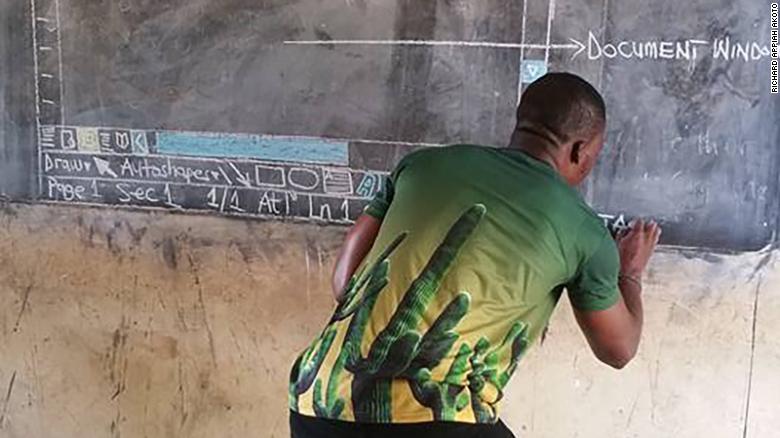
Ghanian teacher Richard Appiah Akoto drawing Microsoft Word on a blackboard because he has no computer to help his students pass exams.

Over here in the Land of Plenty it’s hard to imagine some of the stratagems teachers in less favored regions must employ to help their students learn.

And although this particular story is about Africa, I don’t mean Africa only. There are many parts of the United States where meager school funding pushes dedicated teachers to extraordinary feats of creativity.

At CNN, Gianluca Mezzofiore reports on a teacher in Ghana who needs to teach kids computer usage — without a computer. How does he do it? He draws a screen image of Microsoft Word on a blackboard.

“Richard Appiah Akoto is a Ghanaian teacher who faces a pretty discouraging dilemma. His students need to pass a national exam that includes questions on information and  communication technology (ICT) — but the school hasn’t had a computer since 2011.

“So Akoto had an ingeniously simple idea: he drew computer features and software on his blackboard, using multicolored chalk.

” ‘I wanted them to know or see how the window will appear if they were to be behind a computer,’ Akoto told CNN. …

“Images of Akoto — who on social media uses the nickname ‘Owura Kwadwo Hottish’ — drawing a diagram of Microsoft Word for his pupils at Betenase M/A Junior High School in the town of Sekyedomase went viral after he posted them on Facebook. …

“Akoto’s 100-plus students were happy about the drawing because it made the explanation about launching Word simple for them, he said. And this is not the first time he has illustrated IT technology on the board.

” ‘I have been doing this every time the lesson I’m teaching demands it,’ he said. ‘I’ve drawn monitors, system units, keyboards, mouse, formatting toolbar, drawing toolbar, save as dialog box and so on.’

Quartz, which first reported on the teacher’s story, says the written exam is a requisite for 14- and 15-year-olds in Ghana to progress to high school.” More here.

Read Full Post »

Erik passed along this story from the NY Times about a mini computer that outgrew its original purpose of teaching computer science students. Goes to show that it’s customers who tell inventors what the market for an invention is.

“The story of the Raspberry Pi begins in 2006,” writes John Biggs, “when Eben Upton and other faculty members at the University of Cambridge in Britain found that their incoming computer science students were ill-prepared for a high-tech education. While many students in the previous decade were experienced electronics hobbyists by the time they got to college, these freshmen were little more than skilled Web designers. …

“The Raspberry Pi — about 3 inches by 2 inches and less than an inch high — was intended to replace the expensive computers in school science labs. For less than the price of a new keyboard, a teacher could plug in the Pi and connect it to older peripherals that might be lying around. But because Pi initially ran only Linux, a free operating system popular with programmers and hobbyists, students would have a learning curve.

“The Raspberry Pi Foundation began selling the computers in February of last year. They soon could not keep them in stock.

“ ‘We honestly were thinking of this as a 1,000- to 5,000-unit opportunity,’ Mr. Upton said. ‘The thing we didn’t anticipate was this whole other market of technically competent adults who wanted to use it. We’re selling to hobbyists.’

“One Pi owner, Dave Akerman, of Brightwalton, England, even sent a Raspberry Pi to the upper atmosphere, floating it 40,000 meters up using a weather balloon.

“There he was able to take live video, photos and measurements.

“ ‘Now every primary school in the world can take pictures from near space,’ Mr. Upton said. ‘You give people access to this tool and they do great things.’ ”

More.

Photograph: Adafruit.
A Raspberry Pi computer, which is about the size of a credit card, was created to teach computer science students.

Read Full Post »

John knows a good blog topic when he sees it. This tip he gave me is about minimally invasive education, which brings learning to the poorest of the poor.

According to wikipedia, “Dr. Sugata Mitra, Chief Scientist at NIIT, is credited with the discovery of Hole-in-the-Wall [HiWEL]. As early as 1982, he had been toying with the idea of unsupervised learning and computers.

“Finally, in 1999, he decided to test his ideas in the field. On 26th January, Dr. Mitra’s team carved a ‘hole in the wall’ that separated the NIIT premises from the adjoining slum in Kalkaji, New Delhi. Through this hole, a freely accessible computer was put up for use.

“This computer proved to be an instant hit among the slum dwellers, especially the children. With no prior experience, the children learned to use the computer on their own. This prompted Dr. Mitra to propose the following hypothesis: ‘The acquisition of basic computing skills by any set of children can be achieved through incidental learning provided the learners are given access to a suitable computing facility, with entertaining and motivating content and some minimal (human) guidance.’ ”

More at Hole-in-the-Wall.com. Also at the Christian Science Monitor.

And of course, I have to say a word about the program’s appearance in Bhutan, since Suzanne loves Bhutan.

“One of the major projects that HiWEL is in the process of executing is for the Royal Government of Bhutan. The project is part of a large Indo-Bhutan project formally known as the Chiphen Rigpel (broadly meaning ‘Enabling a society, Empowering a nation’). Chiphen Rigpel is an ambitious project designed to empower Bhutan to become a Knowledge-based society.” Read more.

Photograph: HiWEL
Playground Learning Stations in Dewathang Gewog of Samdrup Jongkhar District in Eastern Bhutan.

Read Full Post »