
Feeds:
Posts
Comments

Posts Tagged ‘confidence’

Photo: Barbara Lowing/Common People Dance Project.
Goofing around on stage is the whole point at Australia’s Common People Dance Eisteddfod.

You could pull many different lessons from today’s story, but one that stands out to me is the way that a mother’s insecurity can warp a young child’s self-image, making a revolution necessary. The revolution may turn out playful and silly, a childlike release like a new dance style in Australia.

Dee Jefferson interviews an enthusiast called Bryony Walters, whose mother used to shame her about her weight. Bryony tells Jefferson it “affected her relationship with exercise, and movement in general. ‘It always seemed like a punishment that I was inflicting upon myself. … It wasn’t a thing you were engaging with to have fun or to feel good.’

“But when she saw a post in her community Facebook group about dance classes for a DIY eisteddfod, Bryony’s curiosity was piqued. …

“Neridah Waters and her Facebook post set off the amateur dance revolution known as Common People Dance Eisteddfod. Now in its seventh year, the project invites people of all ages, abilities and bodies to dance together – to 80s and 90s music, while wearing leotards, sequins, sparkles and glitter – culminating in a dance-off as part of the Brisbane festival. ….

“Waters, a stalwart of Brisbane’s alt cabaret scene, describes the project as a mix between Young Talent Time, sports carnivals, 80s gameshow ‘It’s a Knockout’ – and, of course, the Australian Rock Eisteddfod Challenge: a nation-wide high school competition that was popular in the 80s and 90s.

“Bryony, who has performed in five Common People Dance Eisteddfods, says it’s a ‘rare and special’ opportunity to ‘engage in really joyful movement in circumstances where the concern isn’t how you look.’ …

“Like Bryony, Amanda [Dell] came to Common People with an unfulfilled childhood dream of dancing. This year, she is dancing for Southside, one of seven teams of between 30 and 65 people competing in the eisteddfod, each performing their own routine of around five minutes – featuring moves with names like Jazz on Ya Face, Chicken Chicken Pelvis and Aunty Pat’s Christmas Trifle.

“Waters, who came up with the idea for the eisteddfod during a middle-of-the-night burst of inspiration, had no idea it would snowball into an annual juggernaut attracting hundreds of participants. Back in 2019, she was experiencing a lull in her career after becoming a mother. She’d been teaching community dance classes that were attracting middle-aged men and shy people who ‘wanted me to teach them seriously, from scratch, how to dance,’ she says.

“ ‘I wanted to do something more theatrical. I wanted participants who were as silly [as me].’

“As soon as she posted her alternative rock eisteddfod idea ‘it went nuts.’ she says. ‘People understood immediately the sense of humor behind it.’

“Starting off in her local community hall, the project spiraled into classes and teams in different suburbs. Brisbane festival came on board to host the eisteddfod as part of their program, and before the inaugural event the dancers of each team marched through the streets of South Bank to converge in a dance battle outside the festival’s Spiegeltent – set to Survivor’s ‘Eye of the Tiger.’

“Amanda, who was part of the march – wearing a leotard for the first time, not to mention in public – remembers it being nerve-racking. ‘The way that women think about their bodies, that’s a big thing to do,’ she says. ‘But you’ve got the power of the group. And that day is one of the best days of my life – it was just such joy and excitement.’

“Waters says, ‘We had women who were size 20 or 24 in leotards who looked like superhero versions of their suburban selves.’ …

“From the get-go, Common People Dance Eisteddfod has predominantly attracted middle-aged women. … Some are former dancers looking to let their hair down, most are amateurs or people who have never danced. Whatever their reasons for coming, they stay for the sense of community, the confidence boost – and the endorphins.

“Amanda, who describes the last few years of her personal life as ‘a shocker,’ rarely misses a class. ‘I know that no matter how I’m feeling beforehand, I will feel better afterwards,’ she says. ‘Having people that you meet with regularly, who you can rely on for that emotional support and friendship and fun – those things are invaluable.’

“For some, the eisteddfod is life-changing. Waters tells me about Zak, a shy teenage boy who slowly came out of his shell doing Common People’s living-room dance parties during lockdown. When IRL classes resumed, Waters encouraged him to take more of a leading role – culminating in him dancing and lip-syncing to a packed house for the eisteddfod.

“A couple of months later, Zak decided he wanted to run for school captain. ‘His mum said “Are you sure?” and he said, “Mum, look, I stood in front of 1,500 people and did the dance battle. I can do anything now,” ‘ Waters says. ‘And so he did it – and he ended up becoming school captain.’ “

More on the Brisbane Dance Festival at the Guardian, here. The Guardian has no paywall, but please consider donating to them — any amount.

Read Full Post »

Photo: Music & Youth.
The Music Clubhouse, one of several music-focused hangouts for teens in Massachusetts, opened unexpected doors for Kristiana — forming a band, participating in a music event with the Red Sox, being accepted to the Berklee College City Music Program.

Teens always need a place to hang out with other teens. The centers in today’s story offer a lot more than hanging out.

Catherine Hurley writes at GBH radio, “Eden Troderman knew where she wanted to spend her first afternoon as a student attending the Berklee College of Music: at BTC Records, the music production space at the Brookline Teen Center that she knew well. …

“The Brookline High School graduate, who releases songs under the name Aruna, has been playing music her whole life — which included writing some ‘really cringey songs in sixth grade,’ she said. But [Aruna] didn’t start releasing music until receiving some help from BTC Records.

“Founded in 2013, the Brookline Teen Center offers a community hub for teenagers who live or go to school in Brookline. It’s one of more than 800 active youth development nonprofits in Massachusetts, according to ProPublica’s Nonprofit Explorer.

“On that cold and icy afternoon in January, the center was active with teens playing basketball in the gym and huddling around small tables with snacks after school. Others were working on music in the BTC Records studio space. …

“Bri Skywall, teen technology coordinator at the Boston Public Library, said the library’s Teen Central aims to ‘provide what we call the “third space”: a space that isn’t their home and isn’t school or work, that they can come and just be themselves.’ A space where teens ‘don’t have to pay to exist,’ she said.

“Third spaces, which broadly include include free and publicly available spaces, social services organizations and low-cost commercial establishments, are known to strengthen communities. But research shows third spaces are declining, and disparities are more present along income, race and geographic lines.

“Connections in these spaces are informal, but the plans to expand them are in writing. Strengthening the BPL’s role as a third space is listed in the city’s Imagine Boston 2030 plan. And Boston’s Third Spaces Lab, in collaboration with New Urban Mechanics, aims to ‘make it easier for grassroots organizations and individuals to grow and nurture community-based third spaces from the bottom up,’ according to the program’s website.

“BTC Music Coordinator Pablo Muñoz said the center’s goal has always been to develop a space where teens can make music, whether they have big dreams in mind or are looking to express themselves day-to-day. …

“ ‘Whenever they’re having maybe not the best week, they’ll come in here and they’ll be like, “I want to do a song. I want to talk about this.” … They’ll get it out, and then they feel better, and they’ll work on their craft,’ Muñoz said. …

“With 60-70 hours of work, Troderman writing and Muñoz producing, she released her first song, ‘Crave‘ last May, which recently surpassed 1,000 streams.

“ ‘It’s a small milestone, but it means a lot to me. If people are even listening to my music, that’s crazy,’ Troderman said.

“Tom Goldberg, a junior at Brookline High School, started taking a music production class with Muñoz in early November. He’s still learning the basics, he said, but Muñoz has already helped him create a vocal-less track, teaching him how to establish a beat.

“ ‘I think I’m more confident in myself,’ Goldberg said. … [He] said if he were to show people at school the music he likes, there would be a different reaction than at BTC Records. ‘Here, [it’s] way more welcoming,’ he said. ‘Like the sense of community is way bigger here.’ …

“Teens at the center that day milled in and out of the control room, pushing open the heavy, soundproof door in search of Muñoz, their admired teacher and collaborator. Muñoz himself started at BTC in 2022, about a year after he graduated from Berklee. …

“The next day, on a colder and icier afternoon in Back Bay, four teens huddled around computers and small keyboards. They were there for Music Production with Hamstank, a weekly digital music creation session at the Boston Public Library. Somerville-based record producer Tony ‘Hamstank’ Hamoui has led the program for the last seven years. …

“Hamstank’s routine during the hourlong sessions differs from week to week. Sometimes he’s helping teens get started — like a participant that day who opened the music software for the first time and was already making a song — but he also supports kids with more advanced music skills.

“Hamstank glanced over to another teen, calling him a ‘master-level composer and vocalist.’ The student was working on a song he started the week prior, this time re-recording vocals in the space’s audio booth. …

“Hamstank said some kids come to the session with their headphones on, wanting to work solely on their own projects. ‘And that’s fine, but you always find them slowly taking the headphones off and listening and asking questions and talking to other teens,’ he said.”

More at GBH, here. No firewall. [Note: I may have used the wrong pronouns for Troderman. The GBH article was inconsistent.]

Read Full Post »

Photo: Camilla Forte/The Hechinger Report via CSM.
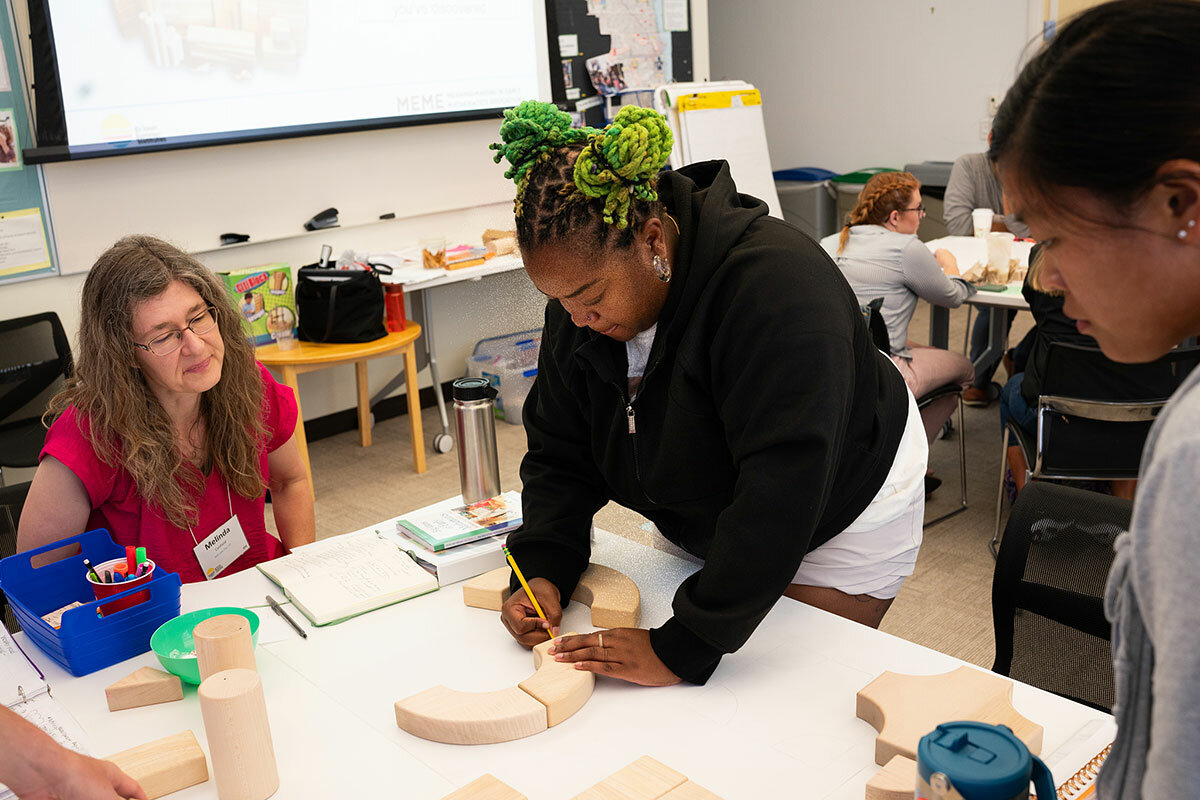
Ivory McCormick (center) attends a math conference July 12, 2023, in Chicago. The Atlanta teacher says her school’s math specialist helped change the way she feels about teaching the subject.

I can identify with the teachers in this story who have a math phobia. I had to teach all subjects to 10-year-olds for a couple years and was relieved that my school offered a math consultant. I had never trusted my math — although that had a lot to do with parental perceptions.

Ariel Gilreath, of the Hechinger Report, researched an interesting program designed to help teachers of young students gain confidence in the critical foundations of math. The story is shared at the Christian Science Monitor.

“In July, in a packed classroom in downtown Chicago, a group composed mostly of early elementary teachers and child care workers read a story about ‘Wendi,’ a fictional preschool teacher who loves reading but struggles in math. 

“Even though Wendi was drawn to early education where ‘math was so easy,’ she still felt unsure of her skills. In the story, she decided to skip math concepts, leaving them for the teachers her students would have next year. 

“Across the room, people nodded their heads as they listened.

“ ‘I am Wendi. Wendi is me,’ said Ivory McCormick, a kindergarten teacher from Atlanta. Several educators in the classroom identified with Wendi, and that was the point. Decades of research shows that math anxiety is a common problem for adults, and surveys show it particularly affects women, who make up nearly 90% of elementary teachers in the United States.

“Put simply, a lot of elementary school educators hate the prospect of teaching math, even when the math concepts are beginner level. 

“Researchers at the Erikson Institute, a child development-focused graduate school in Chicago, started the Early Math Collaborative 16 years ago to provide educators with research-backed professional development to help them better teach young students math. One of the goals of Erikson’s annual four-day summer math conference, where the teachers read Wendi’s story, is to assuage their anxiety by exploring how young children learn math and strategizing activities they can do in the classroom. 

“Because math competencies build on each other, with skills like counting and learning shapes forming the basis of later knowledge, it’s critical that students receive a solid foundation in the subject, education experts say. The U.S. has long trailed many other developed countries in terms of student math performance, and then scores tanked during the pandemic. …

“ ‘If you look at how a child is doing with math when they enter kindergarten, that’s the best way to predict how they’re going to be doing with math later, all the way up through eighth grade,’ says Jennifer McCray, an associate research professor at Erikson. …

“When Ms. McCormick started teaching preschool five years ago, she felt anxious about teaching a subject she didn’t feel confident in. ‘Math was something I always had to work really hard at, and it seemed like I never really got that much better at it,’ she says. 

“Teachers who doubt their math ability often worry they will transfer their math aversion onto impressionable students, educators say. There are studies that validate this fear: First grade students who were taught by teachers with heightened anxiety about math performed worse in the subject than their peers who were taught by less anxious teachers, one study from 2020 found.  

“Math specialists say it is a pervasive issue in elementary classrooms, where educators are typically expected to teach every subject, and it often leads to teachers spending less classroom time on math content. …

“At the Erikson Institute’s summer conference, teachers gained practice on concepts they’d use in their classrooms. They drew maps to describe directions: Rosie the hen traveled over the fence, and under the tree branch, and through the river, for example. They built large 10-sided shapes out of colorful blocks. The exercises benefited their own math skills, too. 

“ ‘There’s a misbelief that in order to teach early childhood math, you don’t really need to know math well,’ Lauren Solarski, a consultant and coach with the Early Math Collaborative at Erikson, told the group of educators. ‘But having that deep content knowledge, research finds, makes you then able to draw out what’s happening in a child’s play around math – what they’re doing – and know those trajectories, know the math inside and out so that you can be that expert when you’re with the child.’

“That doesn’t necessarily mean early childhood teachers need to be experts in advanced geometry or algebra, says Lisa Ginet, director of program design and operations at Erikson. But it does mean they need to know how different lessons that may not seem to be related to math are connected to mathematical thinking and to topics students will learn as they get older. …

“For Ms. McCormick, the early ed teacher from Atlanta, attending Erikson’s professional development conference was the next step in her journey to building up her math confidence. This year, Ms. McCormick moved up to teaching first grade at the Galloway School in Atlanta after teaching preschool and kindergarten classes at the school for several years. She credits her school’s decision to hire a math specialist last year with helping change the way she feels about teaching the subject. …

“ ‘This past year, I have kind of revamped my thoughts about what math can be and the ways that we teach it in order to make kids want to learn about it and be enthusiastic about it. Because the way we present it to them holds so much more weight than I think I ever realized.’ ”

More at the Monitor, here. No paywall, but your subscription will support good journalism.

Read Full Post »

aq2zizce_400x400

Photo: twitter.com
Much to her surprise, Finnish soprano Karita Mattila found a community on Twitter that helped her regain confidence after a painful divorce.

You may say that on Twitter we each live in a bubble of like-minded people and that no good can come of that. But sometimes like-minded people can support someone who is down and out. Consider the case of Finnish soprano Karita Mattila, who was suffering doubts after a painful divorce.

Joshua Barone writes at the New York Times, “At 58, [Karita] Mattila, who is currently onstage here at [France’s] Aix Festival in Weill and Brecht’s ‘Rise and Fall of the City of Mahagonny,’ is having something of a late-career renaissance: a newly expanding repertoire and newfound celebrity on Twitter, where she is beloved by some of opera’s most ardent fans.

“And she loves them right back. …

“On Twitter — where few opera stars, when they’re present at all, are active beyond blandly promoting their performances — she posts, often with an abundance of emoji, about everything. She reacts to the news, never shying from being political; she participates in polls; she shares her thoughts (and horror stories) about restaurants in Aix-en-Provence. …

” ‘I’ve decided to be me. … I used to be so overprotective of myself,’ she said. ‘It’s time to start having faith. … Twitter was — maybe it’s dramatic — it was my lifesaver,’ she said. ‘It really became my rescuer.’

“Before the divorce from Tapio Kuneinen, who was also her manager, Ms. Mattila wasn’t present on social media. … A girlfriend warned her, she recalled: ‘There will be people who hate you. And if there aren’t, it means you don’t have enough followers yet.’

“But Ms. Mattila gave it a try. And as followers came, she began to interact with them, more and more — engaging with fans and music scholars from around the world who also repost many of her tweets.

“ ‘I “met” so many of these people, and I cried so much because it moved me, how they analyzed music and what I was doing. Of course I have that music-training background, but it had been so long since I have had conversations about music, what I do for a living,’ she said, waving her arms for emphasis.

“When she was in New York this spring for a production of Poulenc’s ‘Dialogues des Carmélites’ at the Metropolitan Opera, Ms. Mattila began to meet some of her Twitter followers in person and was, she said, ‘totally in awe.’ …

“Twitter has also redefined Ms. Mattila’s relationship with music. As a busy international artist, she had long thought she didn’t have the time to listen recreationally. But now, she said: ‘There are these guys that send me what they are listening to. It’s re-established my appreciation toward my own field.’ …

“Throughout her career, Ms. Mattila has been famous for her dramatic prowess and visceral physicality, ingrained, she said, since her education at the Sibelius Academy in Finland. But Esa-Pekka Salonen, her fellow student at the academy and the conductor of the Aix ‘Mahagonny,’ described her theatricality as more extraordinary than schooling alone could produce.

“ ‘She is totally committed to the material, whatever it is,’ he said. ‘Things can be raw, they can be intense, they can be funny. But she’s always in it, totally.’ …

“During rehearsals, Mr. Salonen said, she had a talent for energizing the musicians, which then showed once the audience was added to the mix. She even appeared in good spirits on the night of the dress rehearsal, as she posted selfies on Twitter.”

More here.

Read Full Post »

Actor Finn Wittrock wrote recently at the New York Times about helping to start a mini Shakespeare company in the 1990s to entertain his parents and other theater professionals. He recalls with wonder his young self’s confidence of success.

“I was born in the Berkshires in Western Massachusetts. I lived there until I was 6, then moved to Evanston, Ill., and later to Los Angeles. But every summer for most of my youth, I would go back East with my brother, my mom and my dad, who most summers was acting or teaching for Shakespeare & Company. I would often be cast as a page or an altar boy in one of the professional productions.

“I went in lieu of a summer camp; I went to romp in the Berkshires, see old friends, get out of the city. But mostly I went for the Very Young Company.

“Starting at the age of 8 and until I was 16, my oldest friends and I would get together every summer: Rory, Reilly, Wolfe, and later my brother, Dylan, and Wolfe’s brother, Tiger (yes, their real names) would arrange five or six scenes from Shakespeare, rehearse them on our own time in the sun-drenched Berkshire afternoons and perform them for the adult company after one of their Mainstage shows. We began the company ourselves and it ended when we were no longer ‘very young.’

“For a kid, it was an epic undertaking; an outlet for pre- and post-adolescent energies. We were totally self-motivated; nobody told us to do it, which was in itself an incentive. We’d choose a scene based on our own criteria: Had the company done it before? Could we make fun of them for it? Could we put Reilly in a wig and have him play a girl? And, most important: Did it end in a sword fight? …

Sometimes I yearn to have the boldness of one who knows nothing, who jumps onstage for no other reason than because he is young and has a loud voice.”

Later in his essay, Wittrock recalls something the celebrated director Mike Nichols once said about his own early years: ” ‘Why was I so confident back then? I had no business being that confident.’ And yet he attributed most of his early success to that unreasonable confidence. …

“No one gave us permission to do the Very Young Company; no one ordered us to do it, and no one had to boost our confidence to do it. We just did it. We were just kids howling Shakespeare to the Berkshire trees, and our readiness was all.” More at the New York Times, here.

At one point in my  childhood, I, too, was confident. I thought, if my parents would only call the movie theater and set it up, four of us kids — the Gordons, one of my brothers, and I — would be a smashing success performing our version of “Snow White and Rose Red” before the feature. The grownups didn’t quite believe in it.

Some neighbors and I did perform an original play about a snowman for family members. One of the actors returned a copy of the pencil-scrawled script to me at my aunt’s funeral in 2002, decades later.

Photo: Lauren Lancaster for the NY Times
Finn Wittrock, right, and Rory Hammond, enacting the killing of Lady Macduff and her son in a mini-“Macbeth.” The young actors formed their own company more than 20 years ago to entertain their parents and other professionals at Shakespeare & Company in Lenox, Mass.

Read Full Post »