Feeds:
Posts
Comments

Posts Tagged ‘copper’

Photo: University of St Andrews.
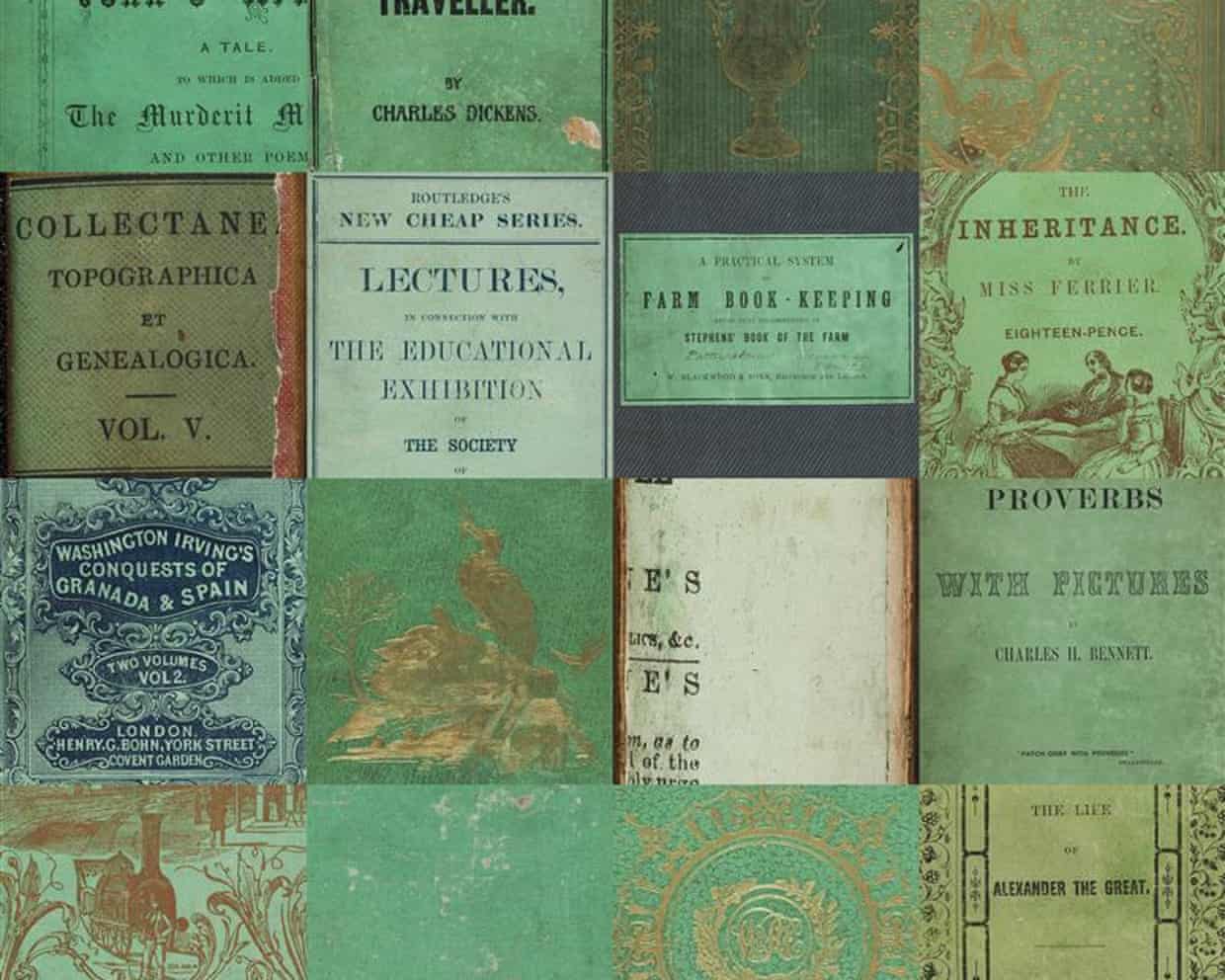
Books bound with potentially toxic green covers. 

With all the benighted book banning going on these days, you would think that the vigilantes had learned the written word would land people in the hospital. But reading is not lethal, and thinking about new ideas won’t kill anyone.

Having said that, I admit there is some reading material that may be dangerous to touch. Ella Creamer reports at the Guardian that “arsenic was historically mixed with copper to create a vivid green for book covers.”

“A new tool to quickly identify books that are poisonous to humans has been developed by the University of St Andrews,” Creamer writes. Historically, publishers used arsenic mixed with copper to achieve a vivid emerald green color for book covers. While the risk to the public is ‘low,’ handling arsenic-containing books regularly can lead to health issues including irritation of the eyes, nose and throat along with more serious side-effects. The toxic pigment in the book bindings can flake off, meaning small pieces can easily be inhaled.

“In recent years, many libraries have prevented access to all suspect green books as a precaution, as testing has until now been costly and time-consuming. … The new device can quickly and cheaply detect the presence of toxic pigment.

“ ‘A device used in the School of Earth Sciences to detect minerals in rocks was the starting point,’ said Pilar Gil, who led the research. ‘The Eureka moment was discovering the unique reflectance pattern from emerald green pigment in the visible spectrum. The idea was then to apply this discovery to an instrument which we could use and share with the sector.’

“Two scientists from the university’s astronomy and physics school, Graham Bruce and Morgan Facchin, developed a portable tool. ‘Our device shines different colors of light on to the book,’ said Facchin. ‘The amount of light reflected at each color is like a fingerprint of the pigment in the book.’ …

“The handheld device can screen books to test for the pigment in a fraction of a second. ‘Our team has been asked to look at thousands of books, of which more than 100 have been identified as containing emerald green pigment,’ said Bruce.

“At St Andrews, emerald green books are stored in Ziploc polythene bags. ‘When the books are used, we check first if there are any other copies available which are not bound in emerald green,’ reads the university’s website. ‘If not, the book is handled with special precautions such as the use of nitrile gloves.’ …

“ ‘The retention of green books from public view is not only a matter of safety, but it also restricts access to the information contained,’ said conservator Erica Kotze, who instigated the project. ‘This means that the books which have been tested and found not to contain the pigment can remain available to users.’

“A free exhibition exploring the project, Poisonous books – Dangers from the past, is running at the Wardlaw Museum in St Andrews until the end of July.”

More at the Guardian, here. No paywall, but please consider donating to support factual news.
Read Full Post »

Photo via the Guardian.
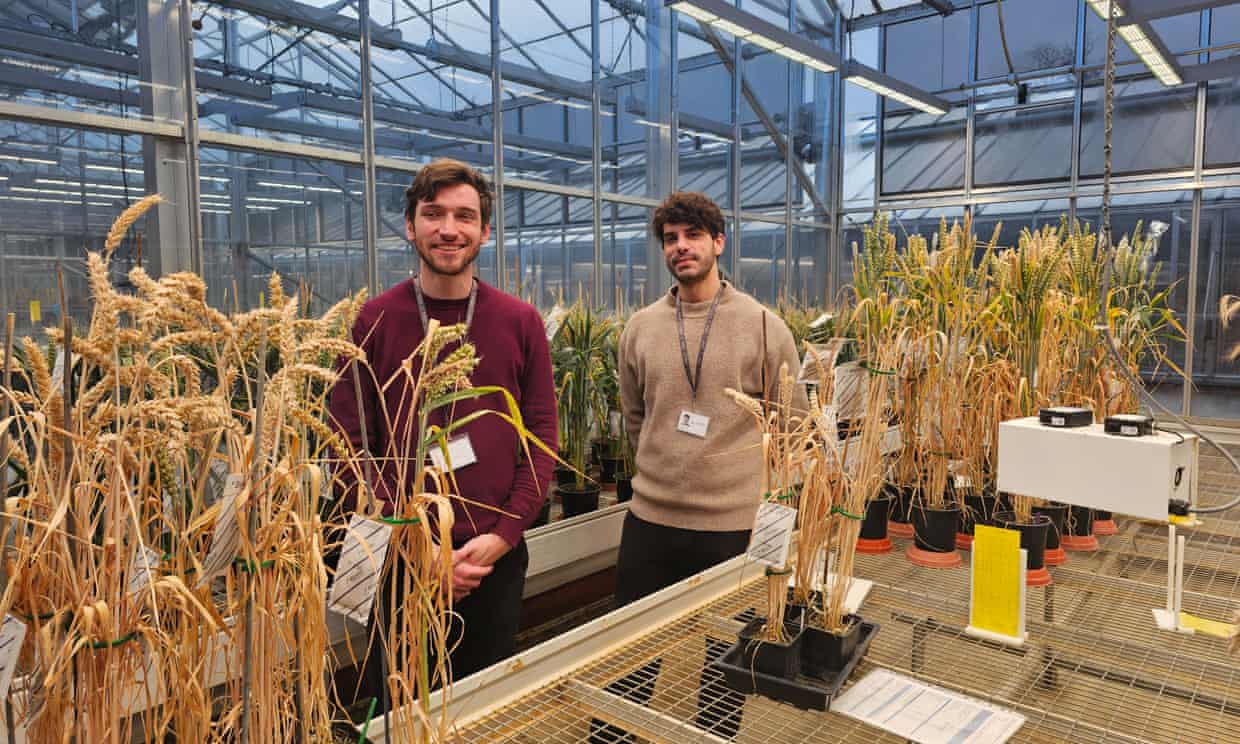
Imperial College researchers Franklin Keck, left, and Ion Ioannou are seeking a biological approach to mining copper with less danger to the environment. 

Can mining be made greener? I know it sounds implausible, but you have to love people who will tackle questions like that. Especially as the modern world is demanding more and more metals.

Robin McKie writes at the Guardian that copper “faces an uncertain future as manufacturers prepare to expand its use to make the electric cars, renewable power plants and other devices that will help the planet move towards net zero. Unrestricted extraction could cause widespread ecological devastation, scientists have warned.

“The issue is to be the prime focus for the new Rio Tinto Centre for Future Materials, based at Imperial College London in partnership with several international university groups. …

“ ‘The world needs to electrify its energy systems, and success will absolutely depend on copper,’ materials scientist and Imperial vice-provost Prof Mary Ryan, one of the centre’s founders, told the Observer last week. ‘The metal is going to be the biggest bottleneck in this process. So, in setting up the centre, we decided copper would be the first challenge that we dealt with.’ …

“Copper has become essential for powering devices ranging from smartphones to electric vehicles because it transmits electricity with minimal loss of power and is resistant to corrosion. Around 22m tons of copper were mined in 2023, a 30% increase from 2010, and annual demand will reach around 50m tons by 2050, say analysts.

“Such an output will have enormous environmental consequences because copper mining uses acids that poison rivers, contaminate soil and pollute the air. Producers such as Peru, Chile and the Democratic Republic of the Congo have seen natural habitats destroyed, wildlife populations wiped out and human health damaged near mines. Deep-sea mining has been proposed, but the idea horrifies marine biologists, who say such enterprises would devastate sea life.

“The aim of the new centre is to find ways round these problems and help provide the materials the world will need to reach net zero. It is funded by the mining group Rio Tinto and hosted by Imperial College London in partnership with the University of British Columbia in Vancouver, the University of California, Berkeley, the Australian National University and the University of the Witwatersrand, Johannesburg.

“One key project is seeking new ways to mine copper. ‘We typically extract it from minerals that have crystallized out of very saline, copper-rich brines,’ said Professor Matthew Jackson, chair in geological fluid dynamics at Imperial College. ‘However, this process requires huge amounts of energy to break open the rocks and bring them to the surface and also generates a lot of waste as we extract copper from its source ores.’

“To get round this issue, Jackson, working with international partners, has been searching for underground sites where copper-rich brines are still in liquid form. These brines are created by volcanic systems which can, crucially, provide geothermal energy for extraction.

“ ‘That means we can extract the copper by pumping the brines to the surface via boreholes – which is relatively easy – and also use local energy to power the mine itself and possibly provide excess energy for nearby communities,’ Jackson said. ‘Essentially, we are seeking to build self-powered mines and have already pinpointed promising sites in New Zealand, and there is potential to explore conventionally barren areas such as Japan.’

“A different approach is being followed by another Imperial project where a company, RemePhy, has been started by Imperial PhD students Franklin Keck and Ion Ioannou.

“They have used GM technology to develop plant-bacterial systems that have an enhanced ability to extract metal from the soil. ‘Essentially, you will be able to grow these crops on land contaminated by waste left over from the mining of metals such as copper, and they will extract that metal,’ said Keck.

“The importance of these techniques was stressed by Ryan. ‘The world will need more copper in the next 10 years than has been mined in the whole of the last century. [We] need to both reduce our demand for copper and work out how to extract it in the most sustainable way possible.’ “

More at the Guardian, here. No firewall. Donations support reliable journalism.

Read Full Post »

A couple weeks ago, I wrote that I was reading Jason Elliot’s book on Iran. That was my post about the rediscovery of the “extinct” Caspian horse.

Elliot slams through millenia of history in that part of the world kind of like the comedy troupe that purports to perform “The Complete Works of Shakespeare” in 90 minutes. He is very good at it, I think. But maybe that’s because I know so little about the endlessly shifting borders of Central Asia and the Middle East.

Among other interesting tidbits in the book is this one on the Baghdad Battery. In Mirrors of the Unseen, Elliot writes that this ancient form of battery was “constructed of an earthenware shell containing an iron rod insulated by an asphalt plug from an outer copper sleeve. A modest electric current is produced when the housing is filled with an electrolytic solution such as lemon juice.”

Wikipedia has more. “The Baghdad Battery, sometimes referred to as the Parthian Battery, is the common name for a number of artifacts created in Mesopotamia, during the dynasties of Parthian or Sassanid period (the early centuries AD), and probably discovered in 1936 in the village of Khuyut Rabbou’a, near Baghdad, Iraq. These artifacts came to wider attention in 1938 when Wilhelm  König, the German director of the National Museum of Iraq, found the
objects in the museum’s collections. In 1940, König published a paper speculating that they may have been galvanic cells, perhaps used for electroplating gold and silver objects … This interpretation continues to be considered as at least a hypothetical possibility. If correct, the artifacts would predate Alessandro Volta’s 1800 invention of the electrochemical cell by more than a millennium.”

Read Full Post »