Feeds:
Posts
Comments

Posts Tagged ‘coral’

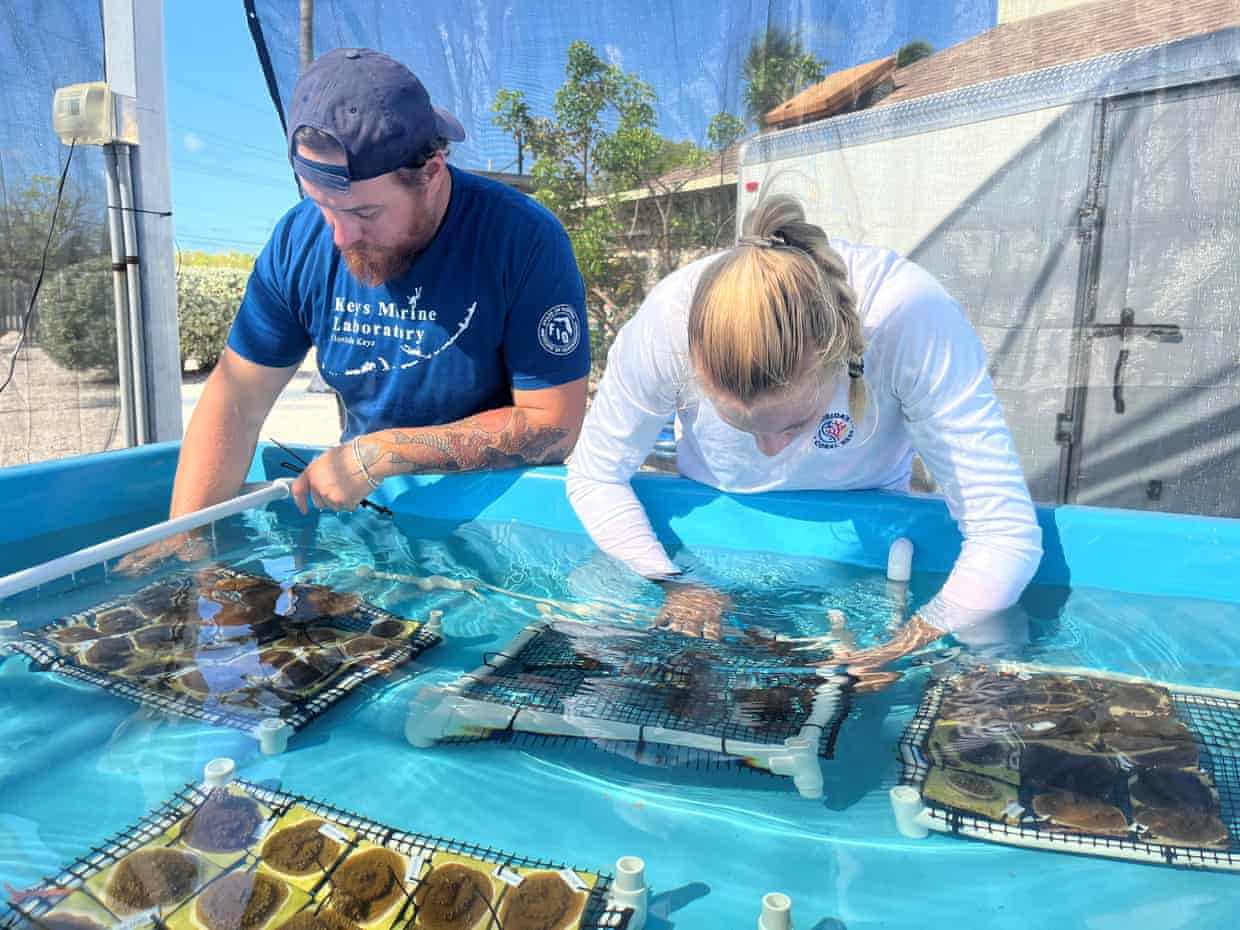
Photo: Keys Marine Lab.
Experts inspect nursery-grown juveniles from the reef-building elkhorn coral species.  They’re testing them to withstand warmer temperatures.

Scientists don’t give up, do they? They will surely have a harder time without federal grants, but I hope they will find ways to keep improving life on Planet Earth.

Take this effort to address the damage that global warming poses to coral. Richard Luscombe reports at the Guardian that a group pf experts are seeking “to save Florida’s dying reefs with hardy nursery-grown coral.”

“A taskforce of experts looking into the mass bleaching and decline of Florida’s delicate coral reefs is planting more than 1,000 nursery-grown juveniles from the reef-building elkhorn species in a new effort to reverse the tide of destruction.

Record ocean heat in 2023 hastened the death spiral for reefs in the Florida Keys, which have lost 90% of their healthy coral cover over the last 40 years, largely because of the climate emergency, according to the National Oceanic and Atmospheric Administration (NOAA).

“Marine biologists from the Keys Marine Laboratory of the University of South Florida (USF) partnered with scientists from Tampa’s Florida Aquarium to develop a large-scale restoration project involving elkhorn coral, which is critically endangered but also one of the fastest-growing and most resilient species.

“[In May], the USF facility in Long Key, halfway along the ecologically fragile Florida Keys island chain, took delivery of 1,050 young elkhorn corals spawned between 2022 and 2023 at the aquarium’s conservation and research center in Apollo Beach.

The corals are acclimatizing in temperature-regulated seawater beds in Long Key.

“They will be distributed to research partners including the Coral Restoration Foundation, the Mote Marine Laboratory, Reef Renewal USA, and Sustainable Oceans and Reefs for planting at seven designated offshore sites around the Keys during the next two months.

“Teams will monitor their progress over the following months and years. While project managers say not all will survive, they hope some of the juveniles will thrive and grow, and the knowledge gleaned will help better inform future recovery efforts.

“ ‘Maybe there will only be 100 out there a year from now, but even if it’s only one out of a hundred that survives that’s particularly tough, we can propagate that one,’ said Cindy Lewis, director of the Keys Marine Laboratory. …

“ ‘The coral juveniles we just transferred are made up of many new mother and father combinations that we hope will be more resilient to future stressors,’ Keri O’Neil, director of the [Florida Aquarium] coral conservation program, said.

” ‘Without human intervention, these parent corals would not be able to breed due to the extent of the loss. They’re a sign that, even during a crisis, we can make a difference. By working together we’re protecting a reef that’s essential to our environment, our economy and the thousands of species that call it home.’

“Lewis said the elkhorn project was a small component of a vast wider effort by numerous universities, environmental groups, and state and federal partners to try to restore as much lost coral as possible. …

“ ‘All these different organizations produced over 25,000 pieces of coral this winter to put out on the reef that are going to make a difference, along with our elkhorn.

“ ‘Even though it seems dismal and depressing, the ray of hope is that we can produce these corals, we can get these corals out there, and that everybody has banded together to work together. No one organization is going to do it all. We need everybody, and we need everybody’s ideas.’ “

More at the Guardian, here. No firewall.
Read Full Post »

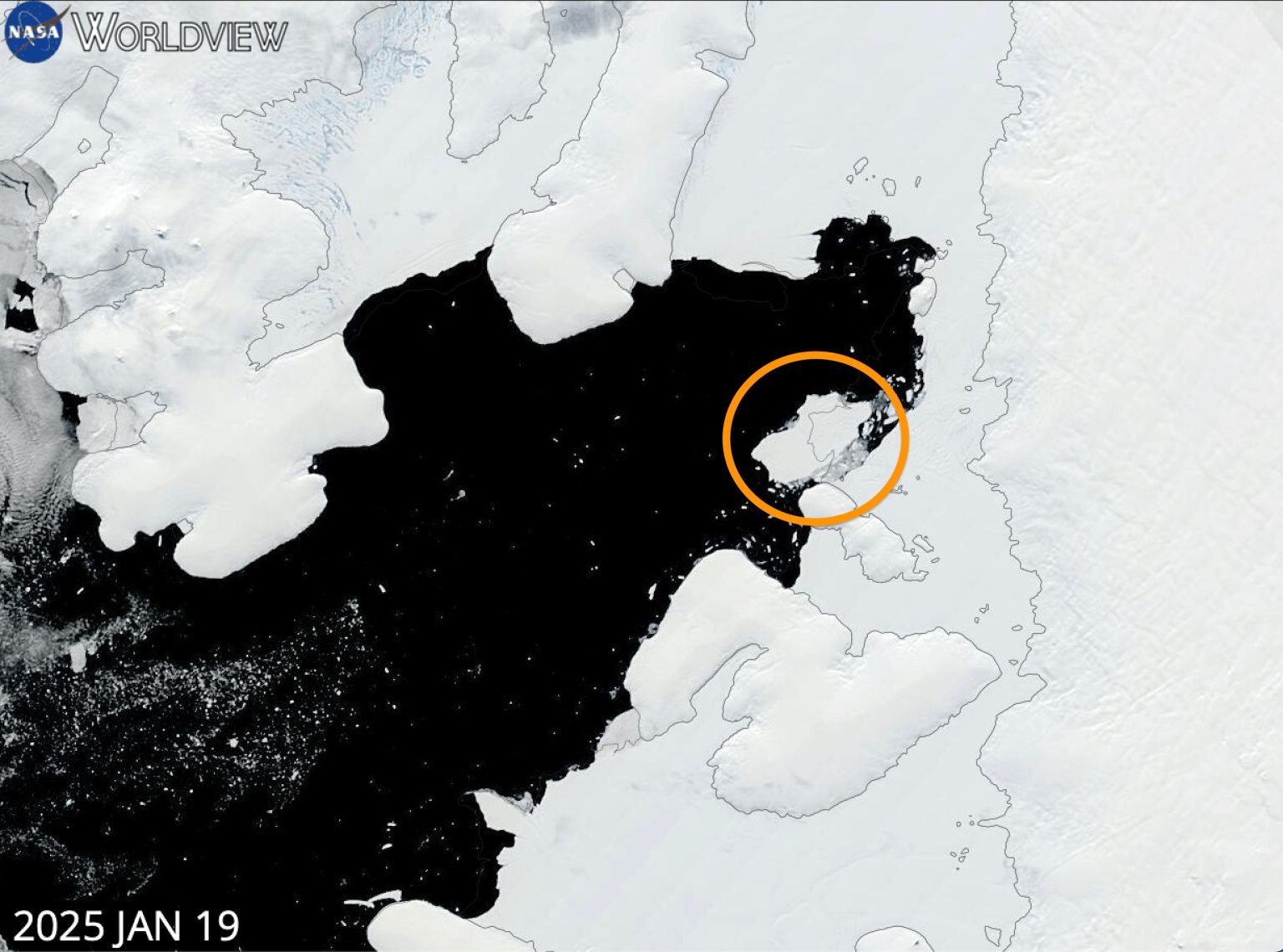
Photo: NASA Worldview, NASA Earth Science Data and Information System.
Satellite imagery showing the iceberg calved from George VI Ice Shelf in the Bellingshausen Sea, Antarctica, on 19 January 2025.

Not much of a recompense for ruining our planet, but it’s true that global warming is giving scientists a chance to study previously unknown places.

At Schmidt Ocean Institute, we learn about some unexpectedly vibrant communities of ancient corals and sponges in Antarctica.

“An international team on board Schmidt Ocean Institute’s R/V Falkor (too) working in the Bellingshausen Sea rapidly pivoted their research plans to study an area that was, until last month, covered by ice. On January 13, 2025, an iceberg the size of Chicago, named A-84, broke away from the George VI Ice Shelf, one of the massive floating glaciers attached to the Antarctic Peninsula ice sheet.  The team reached the newly exposed seafloor on January 25 and became the first to investigate an area that had never before been accessible to humans.

“The expedition was the first detailed, comprehensive, and interdisciplinary study of the geology, physical oceanography, and biology beneath such a large area once covered by a floating ice shelf. The ice that calved was approximately 510 square kilometers (209 square miles), revealing an equivalent area of seafloor.

“ ‘We seized upon the moment, changed our expedition plan, and went for it so we could look at what was happening in the depths below,’ said expedition co-chief scientist Dr. Patricia Esquete of the Centre for Environmental and Marine Studies (CESAM) and the Department of Biology (DBio) at the University of Aveiro, Portugal. ‘We didn’t expect to find such a beautiful, thriving ecosystem. Based on the size of the animals, the communities we observed have been there for decades, maybe even hundreds of years.’

“Using Schmidt Ocean Institute’s remotely operated vehicle, ROV SuBastian, the team observed the deep seafloor for eight days and found flourishing ecosystems at depths as great as 1300 meters. Their observations include large corals and sponges supporting an array of animal life, including icefish, giant sea spiders, and octopus. The discovery offers new insights into how ecosystems function beneath floating sections of the Antarctic ice sheet. …

“The team was surprised by the significant biomass and biodiversity of the ecosystems and suspect they have discovered several new species.

“Deep-sea ecosystems typically rely on nutrients from the surface slowly raining down to the seafloor. However, these Antarctic ecosystems have been covered by 150-meter-thick (almost 500 feet) ice for centuries, completely cut off from surface nutrients. Ocean currents also move nutrients, and the team hypothesizes that currents are a possible mechanism for sustaining life beneath the ice sheet. The precise mechanism fueling these ecosystems is not yet understood.

“The newly exposed Antarctic seafloor also allowed the international team, with scientists from Portugal, the United Kingdom, Chile, Germany, Norway, New Zealand, and the United States, to gather critical data on the past behavior of the larger Antarctic ice sheet. The ice sheet has been shrinking and losing mass over the last few decades due to climate change.

“ ‘The ice loss from the Antarctic Ice Sheet is a major contributor to sea level rise worldwide,’ said expedition co-chief scientist Sasha Montelli of University College London (UCL), United Kingdom, also a 2019 Schmidt Science Fellow. ‘Our work is critical for providing longer-term context of these recent changes, improving our ability to make projections of future change — projections that can inform actionable policies. We will undoubtedly make new discoveries as we continue to analyze this vital data.’

“In addition to collecting biological and geological samples, the science team deployed autonomous underwater vehicles called gliders to study the impacts of glacial meltwater on the physical and chemical properties of the region. Preliminary data suggest high biological productivity and a strong meltwater flow from the George IV ice shelf. …

“ ‘The science team was originally in this remote region to study the seafloor and ecosystem at the interface between ice and sea,’ said Schmidt Ocean Institute Executive Director, Dr. Jyotika Virmani. ‘Being right there when this iceberg calved from the ice shelf presented a rare scientific opportunity. Serendipitous moments are part of the excitement of research at sea – they offer the chance to be the first to witness the untouched beauty of our world.’ ”

More at Schmidt Ocean Institute, here, and at radio show The World, here. No firewalls.

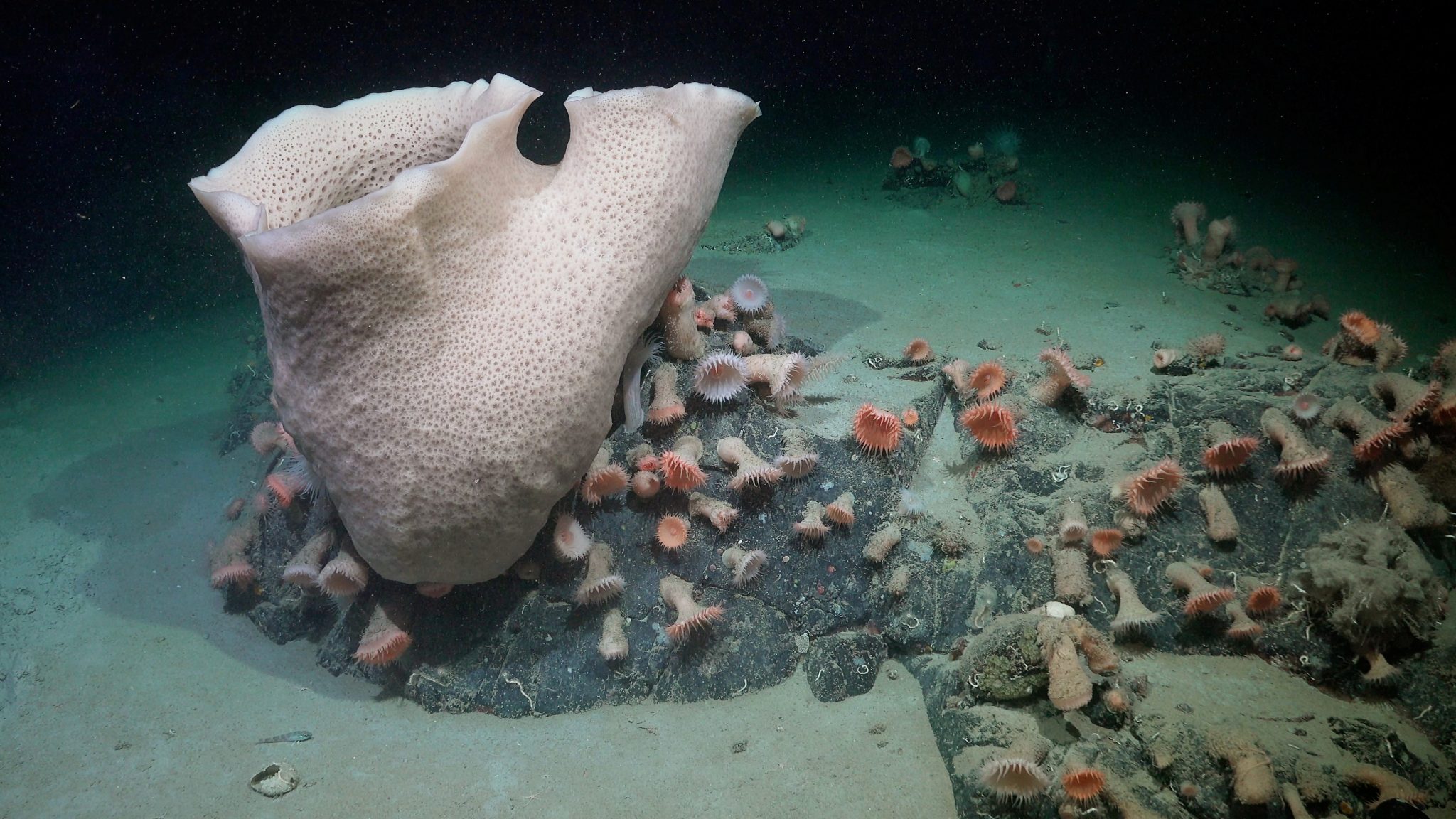
Photo :A large sponge, a cluster of anemones, and other life is seen nearly 230 meters deep at an area of the seabed. Sponges can grow very slowly, and the size of this specimen suggests this community has been active for decades, perhaps even hundreds of years.

Read Full Post »

Photo: Okinawa Institute of Science and Technology.
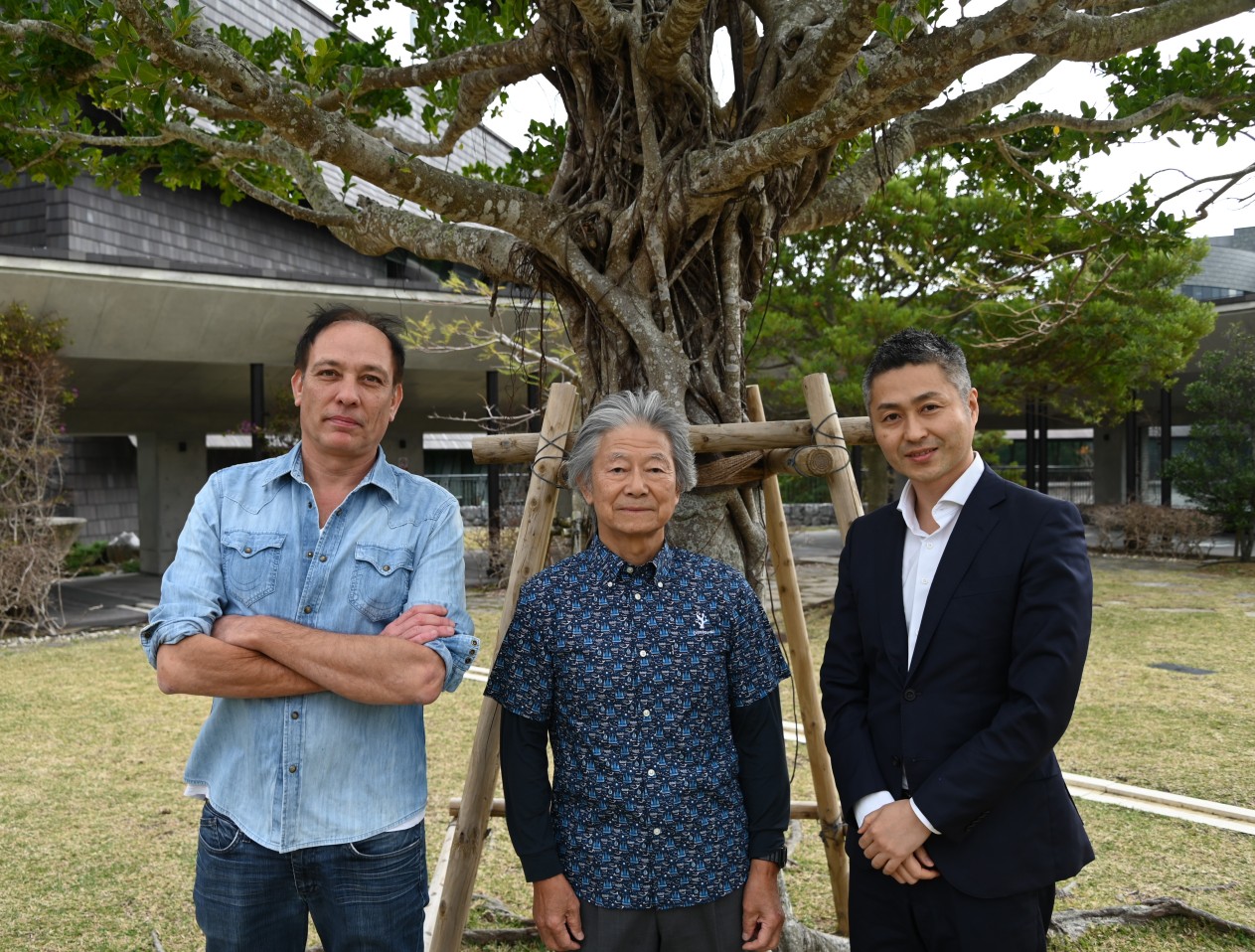
Prof. Timothy Ravasi, Prof. Noriyuki Satoh, and Shimon Sato (L-R) lead the Coral Project at OIST, a nonprofit initiative helping conserve coral biodiversity in Okinawa. 

It is now generally known that corals are important for ocean biodiversity but are in danger from climate change. If you search on “coral” at this blog, you will find a variety of stories about what people are trying to do to help.

Today we look at an organization in Japan that merges the work of local people to that of scientists.

The website of the Okinawa Institute of Science and Technology (OIST) says, “Unlike many global reef locations requiring a boat ride, Okinawa’s reefs are accessible directly from the beach — a simple walk to a nearby beach, a quick dip into the crystal-clear waters, and within moments, you are immersed in a lively ocean community. 

“Yet elders in Okinawa remember a time when coral-filled waters were more abundant, a contrast to the significant coral decline observed in recent years, especially near shorelines. Worldwide, human activities have resulted in an alarming decrease in coral populations in the last decade. Consequently, efforts to plant corals are gaining momentum. 

“The OIST Coral Project, an initiative focused on studying and preserving coral biodiversity in Okinawa, was launched in July 2023 at the Okinawa Institute of Science and Technology (OIST). To date, the project has successfully enlisted the support of 20 companies in Okinawa and mainland Japan. …

“In January 2023, Prof. Noriyuki Satoh, head of OIST’s Marine Genomics Unit, sat down with Shimon Sato, an experienced fundraiser and Advancement Officer at OIST. They came up with an ambitious idea: to use knowledge of genomics and eDNA in a new project to plant and conserve coral in Okinawa. This was the start of an innovative effort to protect local marine life by connecting with locals and companies in Okinawa and Tokyo to establish potential collaborations. 

“Prof. Satoh and his team at the Marine Genomics Unit achieved groundbreaking milestones by decoding the genomes of corals in 2011, zooxanthellae (symbiotic organisms that coexist with corals) in 2013, and the crown-of-thorns starfish (known for devouring corals) in 2017. …

“Using this knowledge, Prof. Satoh identified the best types of coral that can be planted at specific sites in Okinawa. … Permission was granted by Okinawa Prefecture and planting is done by professional vendors, following Japan’s strict coral planting regulations.

Each planting site is overseen by a different fishermen’s organization, each with its own unique team and structure.

“Before planting, Prof. Satoh engages in negotiations with the fishermen’s organizations, explaining the project’s objectives and benefits. These fishermen, who have a deep understanding and respect for the sea, are important allies. …

“Yet this project is not just about planting corals — scientists also conduct eDNA monitoring of corals and study the fish that arrive after the planting, observing which species are on the rise or decline. …

“Cause-related marketing is one of the unique aspects of this project. This is an approach where businesses associate themselves with societal issues or values by working with non-profit organizations to promote a specific cause. …

“ ‘We began with 8 companies, including Japan’s largest mobile company NTT Docomo in Tokyo and several others in Okinawa.’ … Supporting companies can use the project’s [logo]. Ryukyu Cement Co., Ltd., the largest cement company in Okinawa, displays the logo on their cement bags and donates a portion of their cement sales to the project. Another notable supporter is Majun, the leading Kariyushi wear company in Japan. Majun has created an original 100% cotton Kariyushi t-shirt embroidered with the Coral Project logo. …

“In 2018 Onna Village, where OIST is located, was declared a ‘coral village’ or ‘sango no mura’ in Japanese, and in 2019 the Government of Japan declared the village a ‘Sustainable Development Goals Future City.’ Impressively, the practice of coral planting in Onna Village began two decades ago. In 2004, a local organization, Team Churasango, was established by community members with participation from both local and mainland companies. On average, they plant 1,000 corals annually, in response to the observed decline in coral numbers. …

“The project team has recently welcomed a third person – Prof. Timothy Ravasi, leader of the Marine Climate Change Unit at OIST. Prof. Ravasi’s unit uses the latest methods in genomics to study how marine organisms adjust to warmer and more acidic oceans. …

“Shimon attributes the success of the project to two main factors. First, Prof. Satoh’s expert knowledge of corals and excellent people skills. Second, the project has secured the support of numerous stakeholders. … ‘Okinawan people value coral, and they want to return the coral reefs to their previous beautiful and healthy state. We want to support those hopes using the power of science,’ he said.”

More at the Okinawa Institute of Science and Technology, here. And you can click here to read about how OIST got the Isawa Award for this work.

Read Full Post »

Photo: Coral Restoration Foundation.
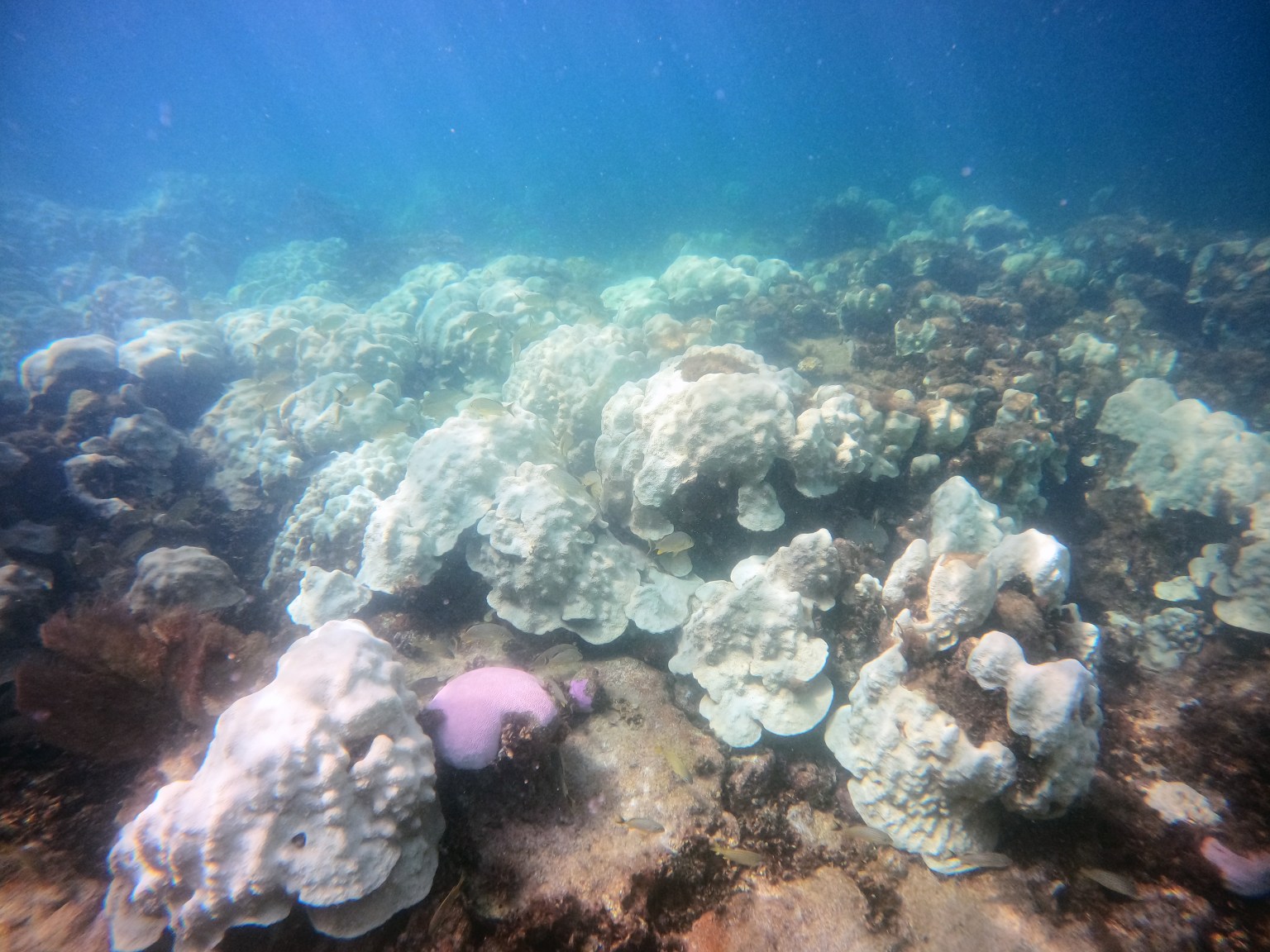
Severe bleaching and mortality in the Middle Florida Keys. Photo taken on July 24th.

One doesn’t always think of television news as going deep on a serious and complex problem, but I have to give credit to Florida’s WFLA for taking on dying ocean reefs. The sad tale makes me think we humans are like lobsters who don’t notice the water is boiling until it’s too late.

“Once colorful coral cities overflowing with marine life, transforming into ghost towns, or better stated, ‘Ghost reefs’ seemingly overnight.

“ ‘We are surprised by the pace. It is unprecedented what we have seen,’ said Scott Atwell the communications and outreach manager for the Florida Keys National Marine Sanctuary.

“Atwell told WFLA Chief Meteorologist and Climate Specialist Tuesday: ‘We’ve never seen anything like this. Some are not even bleaching, they are going straight to dead.’

“ ‘Straight to dead’ illustrates just how extreme the marine heatwave is and how quickly it’s evolving. When under stress, typically coral bleach first, expelling their symbiotic algae partners which give them their vibrant hues, and turn white. Then sometime later, if the heat persists, the coral can succumb and die.

“But right now in the Florida Keys, there are reports of rapid mortality. Coral is dropping like dominoes across much of the reef tract from Key Largo to Key West – the third largest tract in the world and the only shallow water reef system in the U.S. mainland.

“About 25% of marine life depends on coral reefs during some stage of their life. If coral reefs vanish it will have cascading consequences across ocean ecosystems and the life that it supports. …

Mission: Iconic Reefs, a large-scale NOAA-led coral restoration initiative reports that the most recent seafloor temperature at Sombrero Key (off Marathon) is 93.4F and at Looe Key (off Big Pine Key) is 89.6F. According to Mission: Iconic Reefs the ‘optimal’ temperature for reef-building corals maxes out at 84 degrees.

“Although tropical corals live in warm water, they are very sensitive to just a couple of degrees Fahrenheit spike in sea surface temperatures, especially if it lasts for too long. NOAA Coral Reef Watch says at four weeks, coral can begin to show signs of stress. If the heat last eight weeks, a bleaching event becomes likely. [In July, we passed] the eight-week mark. …

“Bill Precht is a coral reef scientist in South Florida. In his 45 years studying coral, he’s never been so concerned about the Keys’ iconic reefs, ‘If things progress as they have started … the likelihood of catastrophic levels of mortality are high.’

“As a result of this unprecedented event, NOAA Mission: Iconic Reefs and their partner organizations are racing against the clock to rescue coral from the reefs and bring specimens into the lab where they can buy some time until the ocean cools back down.

“So the natural question is, when the coral die, can they recover? Dr. Katey Lesneski, the Coordinator of NOAA Mission: Iconic Reefs was asked that question by PBS News Hour and here’s what she said, ‘Once they die there are other reef organisms that will settle on that skeleton, take up space, and the coral tissue cannot grow back, unfortunately.’

“So the teams are taking drastic measures to gene bank two fragments from each unique genetic individual of staghorn and elkhorn corals, listed as threatened under the Endangered Species Act. In other words, they are preserving the genetic material so that if much of the coral is lost, there is a way to restore it.”

More at WFLA, here. Startling graphs. No firewall.

Read Full Post »

I’ve been reading a compelling fantasy novel about travel to different worlds that, like other fantasies I’ve read recently, underscores something important about the real world. We are destroying it.

A New York Times article by Catrin Einhorn and Christopher Flavelle focuses on a group in Mexico saving one beautiful piece of our planet, using a different way of funding the work. It’s controversial, but see what you think.

“When Hurricane Delta hit Puerto Morelos, Mexico, in October, a team known as the Brigade waited anxiously for the sea to quiet. The group, an assortment of tour guides, diving instructors, park rangers, fishermen and researchers, needed to get in the water as soon as possible. The coral reef that protects their town — an undersea forest of living limestone branches that blunted the storm’s destructive power — had taken a beating. Now it was their turn to help the reef, and they didn’t have much time.

“ ‘We’re like paramedics,’ said María del Carmen García Rivas, director of the national park that manages the reef and a leader of the Brigade. When broken corals roll around and get buried in the sand, they soon die. But pieces can be saved if they are fastened back onto the reef. …

“The race to repair the reef is more than an ecological fight; it’s also a radical experiment in finance. The reef could be the first natural structure in the world with its own insurance policy, according to environmental groups and insurance companies. And Hurricane Delta’s force triggered the first payout — about $850,000 to be used for the reef’s repairs. …

“When the Brigade laid eyes on their reef, which runs 28 kilometers south of Cancún and is home to critically endangered elkhorn coral, it looked ransacked. Structures the size of bathtubs were flipped upside down. Coral stalks lay like felled trees. Countless smaller fragments of broken coral coated the seafloor.

“On the boat, cement mixers prepared a special paste that snorkelers ferried down to divers who spent hours underwater carefully fastening pieces back on the reef. They used inflatable bags to turn over large formations rolled by the storm and collected fragments to seed new colonies. …

“Back in 2015, Kathy Baughman McLeod, who was then director of climate risk and resilience at the Nature Conservancy, asked a profound question: Could you design an insurance policy for a coral reef?

“On its face, the idea might have seemed absurd. For starters, nobody owns a reef, so who would even buy the policy? And it’s not easy assessing the damage to something that’s underwater.

“But Ms. Baughman McLeod, along with Alex Kaplan, then a senior executive at Swiss Re, a leading insurance company, came up with workarounds. First, the policy could be purchased by those who benefit from the reef — in this case, the state of Quintana Roo, which is also home to Cancún and Tulum and has a tourism economy estimated at more than $9 billion. …

“Second, rather than basing the payout on reef damage, it could be triggered by something far easier to measure: The storm’s wind speed. The stronger the wind, the worse the assumed damage to the reef.

“The idea of putting a dollar value on a reef or ecosystem by identifying a ‘service’ that it provides has become increasingly popular. For example, coastal salt marshes protect from flooding — offering economic benefits on top of environmental ones. Peat bogs store vast amounts of carbon, keeping it out of the atmosphere where it would worsen global warming. And coral reefs reduce the energy of waves by 97 percent, protecting coastal properties.

“But this notion of ‘ecosystem services’ is controversial in some circles.

“ ‘It’s a popular concept because it commodifies nature and it allows people to put a dollar value on nature,’ said Terry Hughes, who directs a center for coral reef studies at James Cook University in Australia. ‘But it’s very anthropocentric and it’s certainly not about protecting nature for nature’s worth. It’s almost kind of selfish.’

If you look at it from the reef’s perspective, Dr. Hughes said, hurricanes are the least of its problems. Climate change, coastal pollution and overfishing are far greater threats.

“But given the scale of the planet’s intertwined environmental emergencies — not only climate change but the collapse in biodiversity — conservationists say they must be pragmatic. More than a million species are at risk of extinction, including many coral species.

“And in Puerto Morelos, monetizing the reef had the almost ironic consequence of helping some in the community understand that it is actually invaluable. ‘My experience with the Brigade has changed my thinking so much,’ said Alejandro Chan, who takes tourists sport fishing and snorkeling. ‘I have to help the reef.’ …

“ ‘If the insurance money had been available in a timely manner,’ said Claudia Padilla, a researcher at the National Fisheries and Aquaculture Institute in Mexico, which developed the Brigade’s hurricane response protocols and trained its members, ‘the results of the rescue effort could have been greatly multiplied.’

“Still, the money will be put to its intended purpose of restoration, funding longer-term projects like seeding of new colonies and replenishment of reef biodiversity. And Mr. Secaira of the Nature Conservancy believes that the rest of the world will use Quintana Roo as proof of concept.

“Indeed, as the Brigade was at work in Puerto Morelos, a bill in Guam’s Legislature sought to evaluate insuring a reef there. Training is underway in other locations in Mexico, Belize and Honduras.”

Hat tip: Hannah. More at the New York Times, here.

Read Full Post »

2048

Photo: Erika Fish/QUT/AAP 
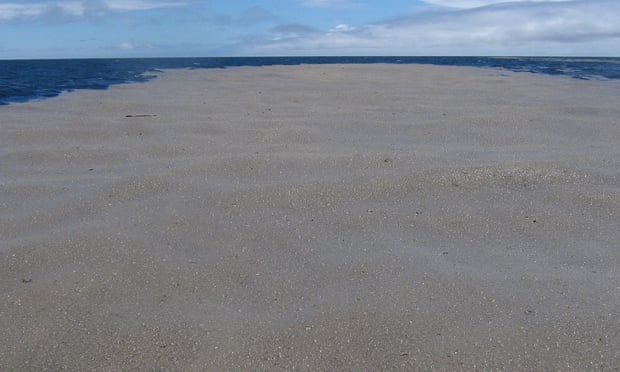
A pumice raft in the southwest Pacific in 2012. It is similar to the one now floating toward Australia. Pumice is a porous rock extruded by volcanoes. It can carry marine life, including coral, across the ocean and can help to replenish reefs.

Sometimes Nature works miracles that can leave a person breathless. So I feel a need to reach into Greek mythology for an explanation of the following.

The Great Barrier Reef suffered an 89% collapse in new coral after bleaching incidents in 2016 and 2017, according to the Guardian. But now from the sea bottom comes a repair kit. A message must have been sent through some mysterious channel to Poseidon, and he responded with roughly 37,000 acres of floating pumice carrying help.

Reports the Guardian, “A giant raft of pumice, which was spotted in the Pacific and is expected to make its way towards Australia, could help the recovery of the Great Barrier Reef from its bleaching episode by restocking millions of tiny marine organisms, including coral.

“The pumice raft, which is about 150 sq km, was produced by an underwater volcano near Tonga. It was first reported by Australian couple Michael Hoult and Larissa Brill, who were sailing a catamaran to Fiji, on 16 August.

” ‘We entered a total rock rubble slick made up of pumice stones from marble to basketball size,’ the couple said in a Facebook post. ‘The waves were knocked back to almost calm and the boat was slowed to 1 knot. The rubble slick went as far as we could see in the moonlight and with our spotlight.’ …

“Since then, the pair have been working with Queensland University of Technology geologist Scott Bryan by providing pictures and samples of the volcanic rock.

“Bryan said the raft will be the temporary home for billions of marine organisms. Marine life including barnacles, corals, crabs, snails and worms will tag along as it travels toward Australia and become a ‘potential mechanism for restocking the Great Barrier Reef. … Based on past pumice raft events we have studied over the last 20 years, it’s going to bring new healthy corals and other reef dwellers to the Great Barrier Reef.’ …

“Pumice forms when frothy molten rock cools rapidly and forms a lightweight bubble-rich rock that can float. The pumice raft comes from an unnamed but only recently discovered underwater volcano that satellite images reveal erupted about 7 August.

“[It] should begin to hit Australian shores in about seven months’ time, passing by New Caledonia, Vanuatu and reefs in the eastern Coral Sea along the way as coral begins to spawn. …

“Bryan said, ‘Each piece of pumice is a rafting vehicle. It’s a home and a vehicle for marine organisms to attach and hitch a ride across the deep ocean to get to Australia.’ ”

More here.


Read Full Post »

new20reef201

Photo: Valeria Pizarro
The Varadero reef has survived in Colombia’s Cartagena Bay despite toxicity from heavy shipping. The corals grow twice as fast as similar corals elsewhere, but their skeletons are less dense, which may have something to do with their success.

The news about coral reefs has not been good for a long time. Rising temperatures and too much carbon dioxide have been killing off these delicate creatures worldwide, with dire consequences for the marine life that depends on their intricate communities.

But what is going on in Cartagena Bay? Elizabeth Svoboda has a fascinating story at the Christian Science Monitor.

“For the coastal communities that have harvested its bounty for centuries, and for the scientists who officially discovered it five years ago, there is no reef like Varadero. Locals call it ‘the improbable reef,’ and for good reason: It has persevered in the midst of intensive coastal development, streams of toxic runoff from the nearby Canal del Dique (Dike Canal), and waters so warm they’d turn many reefs into lifeless skeletons.

“Scientists like Lizcano-Sandoval and Pennsylvania State University’s Mónica Medina are working to uncover the secrets of Varadero’s striking resilience – secrets they can use to help other threatened reefs around the world.

“But just as Varadero begins to yield its tantalizing scientific bounty, it’s looking as if the reef may be damaged or even destroyed. A group of government officials, port authorities, and businesspeople is planning to dredge a channel so Cartagena’s harbor can accommodate more container ships – a move they say will boost the nation’s economy. However, the researchers who study Varadero, along with local environmental activists, are hoping to stall the dredging project so the reef’s storied legacy can continue – and perhaps contribute to the rescue of other endangered underwater Edens. …

” ‘Corals in Varadero have a very distinct growth pattern,’ says biologist Roberto Iglesias-Prieto, Dr. Medina’s colleague at Pennsylvania State University. Specifically, the corals grow about twice as fast as similar corals elsewhere, but their skeletons are less dense; it’s possible that these traits give them an advantage over their slower-growing coral counterparts.

“Medina thinks certain elements in runoff from the Canal del Dique may be benefiting the corals in surprising ways. ‘Part of the day, [the corals] get these nutrient-rich waters where they’re eating and photosynthesizing,’ Medina says. She notes that fairly recent changes in coral growth coincide with a period when more sediment was being dumped into the bay. …

“Varadero’s corals might also benefit from their location right at the mouth of Cartagena Bay. “They have constant communication with the sea,” [Dr. Valeria Pizarro, who discovered the reef,] says. The fresh inflow of ocean water might lessen the impact of toxic mercury, cadmium, and copper that runs off into the bay from nearby industrial facilities.

“Medina and her colleagues are trying to figure out if other aspects of the reef’s biology contribute to its success – aspects that could ultimately be replicated in reefs elsewhere. … Samples of microbes from Varadero’s corals – the onboard collection of bacteria, viruses, and algae that perform critical metabolic tasks – have revealed that they are totally distinct from those found on other reefs, Medina says. Her lab is conducting a detailed analysis to find out whether the microbes might be performing important functions, such as fighting disease, that help the corals to survive even in less-than-ideal conditions.

“In the future, if conservationists can transport Varadero’s hardy corals to other endangered reefs around the world, or even seed threatened reefs with whatever microbial cocktail helps Varadero’s corals thrive, those reefs might have a better chance of surviving despite ocean warming and pollution. Many of the world’s reefs now hang in a liminal zone between death and survival. By putting Varadero corals’ survival tactics to work on other threatened reefs, scientists like Medina, Lizcano-Sandoval, and Pizarro hope to tilt those reefs a little bit closer to the side of life.”

More at the Christian Science Monitor, here.

Read Full Post »

Photo: National Oceanic and Atmospheric Administration
A sponge the size of a minivan was found in summer 2015 in the Papahānaumokuākea Marine National Monument off Hawaii.

One of Earth’s oldest living animals is a sea sponge. As big as a minivan, it has been growing for generations unnoticed and undisturbed in waters off Hawaii.

Elahe Izadi writes in the Washington Post that a remotely operated vehicle (ROV) “captured footage of the spectacularly large sponge during a National Oceanic and Atmospheric Administration deep-sea expedition, and the species was identified for the first time in a study published [in May] in the journal Marine Biodiversity. …

“There’s more to this sponge than its girth: It could also be among the oldest living animals on earth. … Sponges can live for hundreds or even thousands of years. ‘While not much is known about the lifespan of sponges, some massive species found in shallow waters are estimated to live for more than 2,300 years,’ the study authors write. …

“ ‘Finding such an enormous and presumably old sponge emphasizes how much can be learned from studying deep and pristine environments such as those found in the remote Papahānaumokuākea Marine National Monument,’ Daniel Wagner, Papahānaumokuākea research specialist, said in a statement. …

“Christopher Kelly, NOAA research scientist and co-lead for the expedition, said the sponge ‘just appeared’ on the ROV’s high-definition camera, Australia’s Pacific Beat radio reported.

” ‘We were looking for deep water corals and sponges, and we had just gotten some close ups of some corals, then turned away to continue the survey and the sponge appeared out of nowhere.’ ”

I can just picture that cinematic moment of discovery.

More at the Washington Post, here.

Read Full Post »

Suzanne’s Mom was asked to review Revolution, a film by the young environmentalist, biologist, diver, and Sharkwater filmmaker Rob Stewart.

Encompassing gorgeous deep-sea photography, scientific climate-change testimony, a representative of the drowning country of Seychelles, and many youth demonstrations, the documentary forces you to think about what the burning of fossil fuels is doing to the oceans and what it means for the future of the planet. It also gives you the sense that anyone can do something about it — take up a camera, make a poster, or write a letter that makes a change.

The film is infused with a sense of youth, of young people saying, “Enough!” I particularly loved the moment early on when Stewart, who had read only two books on filmmaking, is flubbing his lines in front of Darwin’s Arch. What comes across in addition to the humorous inexperience is a feeling of energy, optimism, and determination.

The film has many engaging details about sea life that Stewart can’t resist throwing in, like how the endangered pygmy seahorse, which camouflages itself to look like coral, “mates for life — and the guy gets pregnant!”

He talks about how the burning of fossil fuels creates too much carbon dioxide, which is absorbed by the ocean and is harmful to anything that needs to grow a skeleton, which is pretty much everything but nasty, poisonous creatures that flourish in the muck where corals died, like the flamboyant cuttlefish. Coral expert Charlie Veron comments that at the same rate of ocean acidification caused by too much CO2, there will be no coral reefs in 50 years.

Stewart also looks at the island nation Madagascar, sole home of lemurs, explaining that endangered tropical forests are responsible for 1/4 of the world’s species and 1/3 of our oxygen. Madagascar scientist Serge Rajaobelina says that population growth on the island and the burning of the trees for development has meant the loss of 80 percent of the forest in 40 years, more than in 55 million years.

The movie goes on to cover perhaps a few too many youth protests, including one in which an inspired, tree-planting young boy says, “We have found we have to save our own future,” and is later arrested in tears.

But then we get to see that children and young adults are actually having an impact.

A sixth-grade class in Saipan writes letters to the Saipan government against killing sharks for shark fin soup, and the government signs a law preventing the practice. In fact, we are told, since the first Stewart film, China, the main adherent of shark-fin soup, has dropped the practice by 70 percent, and 100 countries have banned it.

The upbeat Saipan children who comment on their successful advocacy embody the truth of my favorite Pete Seeger line, “one and one and 50 make a million.” Says one, “Maybe the world might not end because of what we are doing.”

Watch the Revolution trailer here.

[We do not accept gifts here, so the DVD that the film company sends me for screening and reviewing will be forwarded to Save the Bay, RI.]

The late Rob Stewart. The filmmaker did not come up from a dive 1/31/17 near Key Largo.
rob_stewart_memdf

Read Full Post »

One of the sources I check for ideas to share with you is the website for the delightful environmental radio show, Living on Earth.

A story about the healthy coral reefs in the deep water off Cuba caught my eye, especially as there has been a resurgence of interest in Cuba lately.

Living on Earth host Steve Curwood interviews Robert Wintner about his latest book, Reef Libre: The Last, Best Reefs in the World.

“CURWOOD: Now, your book is very timely. Come on, tell me … you got some kind of tip off on this political thaw? …

“WINTNER: I thank Neptune for that. We got word of this particular reef system [that was] called the last best reef system in the world. And the three qualifiers for that rating were 100 percent biodiversity (that means all the species that were ever there are there now, and in fact some they thought were extinct), 100 percent coral cover and 100 percent host of apex predators, and that was the key right there to restoring these reefs to healthy conditions. No natural system can survive intact without apex predators, that’s what allows every level of the food chain beneath it to be at optimum balance. And the glaring example in the world today is Cuban reefs, our Jardines de la Reina. That’s the ocean people talk about, that the world used to have, that we used to love. It’s there in in Cuba.”

Read all about it here., or listen to the broadcast. Lots of amazing photos. And be sure to note how the Cubans control the invasive lionfish by removing the spines and conditioning bigger predators to the taste.

Photo: Robert Wintner at Living on Earth
Reef Libre: The Last, Best Reefs in the World is diver and photographer Robert Wintner’s most recently published book.

Read Full Post »

Some posts at Andrew Sullivan I only need to glance at briefly and bells go off: for example, this entry about an artist who works with coral.

Andrew quotes Amelia Urry writing about Courtney Mattison, who became enamored of coral while studying conservation biology at Brown University and moonlighting at the Rhode Island School of Design.

“Mattison’s newest piece, Our Changing Seas III,” says Urry at Grist, “depicts a hurricane-spiral of bleached corals coalescing to a bright center. You can read it as a message of hope or one of impending doom, depending on your disposition …

At the heart of Mattison’s artwork is her desire to inspire real-life changes in how people view and treat the world’s oceans and environments. Similar to the Our Changing Seas series, Courtney Mattison’s Hope Spots collection comprises 18 vignettes, each of which represents a vital marine ecosystem in its ideal form (that is, protected from various threats such as global warming or pollution).” Read more at Grist, here.

Art: Courtney Mattison
“Our Changing Seas III,” a ceramic coral reef

Read Full Post »