Feeds:
Posts
Comments

Posts Tagged ‘cornwall’

Photo: The Financial Timees/Mark Cocksedge.
The castle sits on a hill above the Tamar estuary; the manor house dates to 1808.
Owners House of Hackney are intentional about doing right by Mother Nature.

In 2010, our sorry high court confirmed the principle of corporate personhood in the US, leading to the injection of a flood of business money into our election system. One of the consequences has been the difficulty of electing candidates who care about climate change, conservation, or the environment. So I suppose that giving something like voting rights to Nature, the topic of today’s article, is only fair. I wish it were happening here, not just in the UK.

Tiffanie Darke at the Financial Times writes, ” ‘Nature has the best designs’ has long been the lodestar of interiors brand House of Hackney. And when co-founders Frieda Gormley and husband Javvy M Royle moved to the Castle of Trematon, Cornwall, in 2019, they set about papering, carpeting and upholstering in the joyous cacophony of botanical prints for which the brand is celebrated. …

“Letting nature in took a different approach outside: there was to be no digging, no glyphosate, no more foreign planting.  But with the move, their love of nature evolved into a more serious project. Fifteen years after they founded the brand with the purpose of championing craft, nature and community, they began ‘to hunger for meaningful change.’ … Which prompted the question: what if nature could redesign the business?

“The House of Hackney is now termed a ‘regenerative business’ — one that ‘puts in more than you take out,’ says Gormley, and that uses the systems of reciprocity on which nature thrives to construct its models, both internal and external.

“Its decision to appoint ‘Mother Nature and Future Generations’ to a board director role has become a case study at Harvard Business School. ‘Giving voice and decision rights to the environment and the future do not tend to be well represented in either business or government,’ says Harvard professor Peter Tufano.  Working with the True Price Foundation, a Dutch organization that has been providing sustainability-focused accounting services to companies, governments and institutions since 2012, House of Hackney assessed its impact through an Integrated Profit and Loss (IP & L) framework. This accounts for four types of capital : produced (the financial and physical assets), natural (the health of ecosystems and resources), human (the wellbeing of people) and social (the strength of communities and relationships). …

“While the company’s [negative] impact was laid bare, the path to reduce it was clear. And so House of Hackney set itself up as a live experiment, hoping to be a trailblazer that would prove business can actively regenerate a resource-depleted world, and act ethically in a corporate environment. How it has attempted this, through governance, culture and design, is the subject of a new book, In the Company of Nature, written by Gormley. …

In 2022, British beauty brand Faith in Nature became the first business to appoint a board position to nature.

” ‘For a product line that is of 99.5 per cent natural origin, it was initially “a creative act,’ ” says brand director Simeon Rose, and figuring out the legality took ‘a lot of bloody-mindedness.’ The work of the Rights of Nature movement, which had succeeded in securing rights for a river in New Zealand, offered a template, while the groundwork was executed by Brontie Ansell of Lawyers for Nature with the Earth Law Centre.

“Ansell became House of Hackney’s guide. Both companies were already B Corp, but neither felt that went far enough. ‘Consumers are sick to death of the sustainability narrative. People want to see more effort, more responsibility, more leadership,’ says Ansell. ‘Charities have to show public benefit and increased public wellbeing, but business just needs to make money. Why not eat away at the fringes of that divide? Let’s have businesses that have a greater purpose.’ …

“ ‘We don’t have ambition for non-purposeful growth, we are happy to stay as an incubator brand,’ says Gormley. … ‘We do the experimentation that other companies can use. And we enjoy the process: the day-to-day creativity of designing beautiful things, but also designing beautiful systems.’ ”

More at FT, here.
Read Full Post »

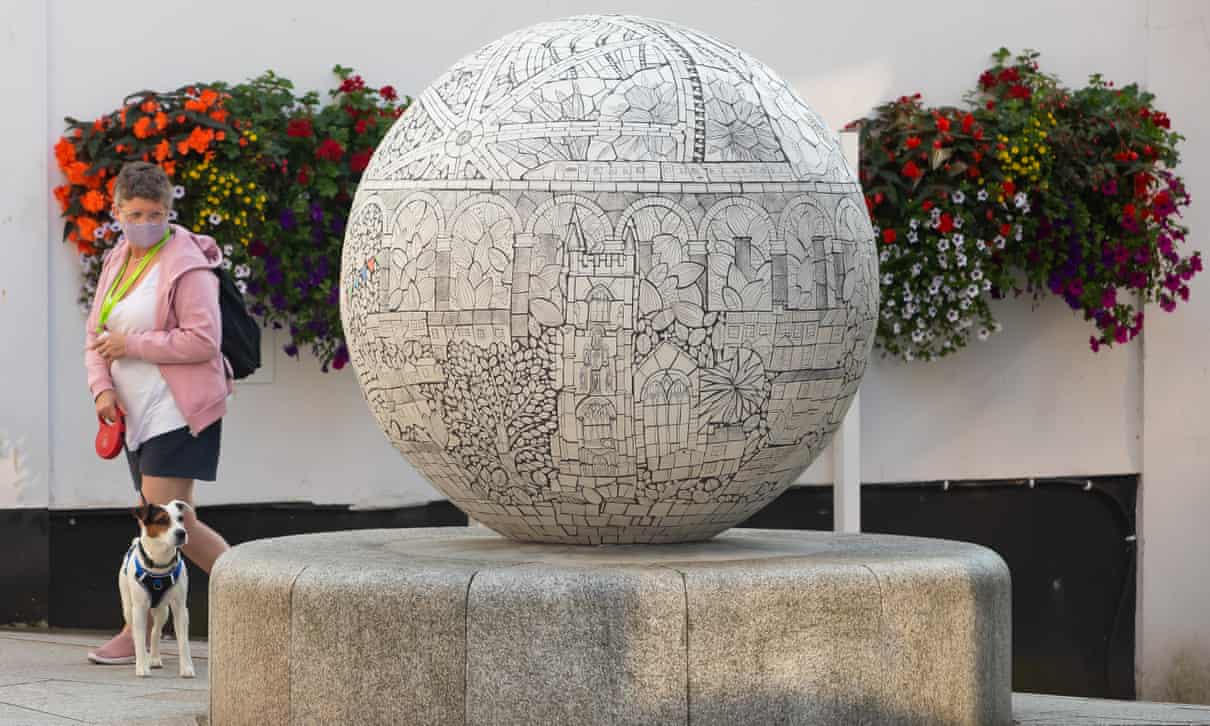
Photo: Jonny Weeks/The Guardian
A new artwork, part of the Whitegold trail in St Austell, Cornwall. (That mask tells me we are still in the Covid era!)

Artists to the rescue again! In today’s story, they have molded clay that was once profitably mined for industrial purposes into a new draw for a UK town.

Steven Morris writes at the Guardian, “Tourists have long tended to bypass the Cornish town of St Austell on their way to the surfing beaches of Cornwall’s north coast or the bays and creeks of the south, while artists have have been drawn by the crystal-clear light of St Ives and Newlyn.

“But thanks partly to a public art project inspired by its once-great china clay industry, and the impending arrival of a Cornish answer to The Angel of the North [a gigantic statue designed by artist Antony Gormley]. St Austell is enjoying something of a renaissance.

“Visitors have arrived this summer to follow a trail around the town, taking in art installations including an imposing mural of a Cornish honey bee constructed out of 11,000 tiles handmade from china clay.

“Young artists who cannot afford to live in places like St Ives are opting to move to St Austell and other towns in the former industrial backbone of Cornwall, opening ceramics studios and brightening the towns with street art. …

“ ‘It’s a really exciting time for the town,’ said St Austell’s mayor, Richard Pears. ‘The town is being transformed by art. You walk around now and see scaffolding all over the place. The place is on the move: more interesting, more vibrant, cooler.’

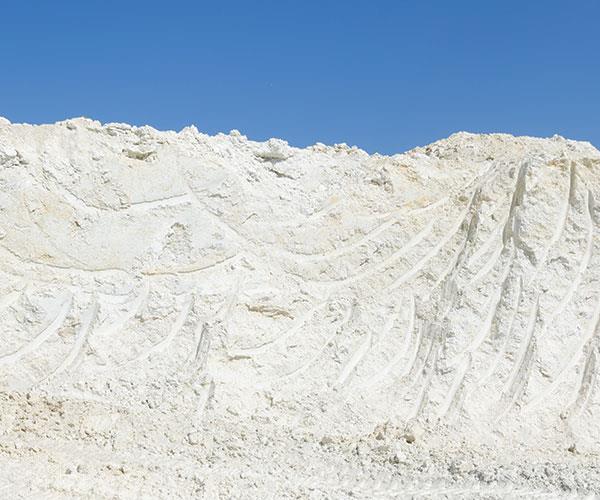
“Pears said the discovery of china clay, used in the manufacture of a products including paper, rubber and paint, made St Austell the Silicon Valley of the 18th and 19th centuries. It employed thousands of people and created a striking addition to the landscape – the bright white sharp-tipped spoil tips nicknamed the Cornish Alps.

“Over the decades the number of people working in the industry fell off and the fortunes of the town declined. The arrival of the Eden Project in a reclaimed china clay pit has helped the wider area, but relatively few of the attraction’s million annual visitors bothered to go to the town centre. …

“Partners including Eden, St Austell Brewery and the mining company Imerys have backed the ‘Whitegold art trail’ as part of a regeneration scheme, the Austell Project.

The art curator Alex Murdin said: ‘It’s about reinventing St Austell. Art always makes people look again.’

“The bee mural has been an important centrepoint of the project. Local people were asked to draw things they liked about the area and the images – from Cornish pasties to mackerels – were printed on individual china clay tiles.

“Favourite sites such as an aqueduct and Eden’s biomes also feature on an installation in the town called Clay Planet. A piece called Seed Bank is made out of recycled fragments of china clay while the Age of Aquarius takes inspiration from the revered St Ives potter Bernard Leach.

“The project is also about details. A cafe features a gleaming new sign made from china clay tiles. The planters outside the market house have been made by a local potter using a rough glaze popular in the 19th century. The place has a buzz about it, with new shops opening including an artisan baker and chocolatier. …

“The final commission – Earth Goddess – should be in place by the end of the year, created from five large circles of clay, each built in three sections, placed on top of each other – looking like giant ceramic beads on a metal pole.

“The artist, Sandy Brown, who has a studio in north Devon, has had a challenging time working out how to make such a large structure stable but is confident it will stand the test of time.”

More at the Guardian, here. There’s more about china clay at the Independent, here. And I just learned that the upset-tummy standard of my childhood, Kaopectate, is made from china clay (kaolin) and pectin!

Photo: CDE.
China clay.

Read Full Post »

Photo: PA/Owen Humphries
Murmuration of starlings over Gretna, Scotland

Starlings swarm in flash mobs over Scotland every November and February, and they don’t even need social media to remind them it’s time.

According to an article at the BBC, “Tens of thousands of the birds are regularly seen around this time of year near the Dumfries and Galloway town. It is one of the most famous locations for the natural spectacle, the reason for which is not definitively known.

“A survey of the birds across the UK is currently under way with members of the public urged to record sightings. The poll, conducted by the University of Gloucestershire and the Society of Biology, is the first of its kind and has already received more than 600 reports from Cornwall to John O’Groats.

“Dr Anne Goodenough, reader in applied ecology at Gloucestershire University, said: ‘One of the theories behind the murmurations is that it means they are safer from predators such as hawks and falcons.

” ‘Another theory could be they are signalling a large roost and it could be a way of attracting other birds to that area to build up a big flock as it would be warmer. It’s much warmer to roost as a big group rather than a smaller one and the murmurations can be as big as 100,000 birds.’ ”

More here. Don’t miss the other amazing photos at the BBC site.

YouTube video: DylanWinter@virgin.net

Read Full Post »

“Nearly two decades ago,” writes National Public Radio, “a massive wave struck the Tokio Express, a container ship that had nearly 5 million Legos onboard. The colorful toy building blocks poured into the ocean. Today, they are still washing up on shores in England.

“Tracey Williams and her children first happened upon the Tokio Express Legos in the late 1990s. Since then, she’s created a Facebook page called — Lego Lost At Sea — where other collectors show off their findings.

“Williams, who lives in Cornwall, tells NPR’s Scott Simon that among the many small, colorful and ironically nautical-themed Lego bits are flowers, swords, life vests, scuba tanks and even Lego octopi. …

” ‘I thought it would be quite interesting, from a scientific point of view, to monitor where it was all turning up, what was turning up and in what quantities and who found it,’ Williams says.” Read more here.

I note a variation on a theme in Pen Pal (which tells what happens when a child on the Gulf Coast throws a message in a bottle into the sea and ends up with a political-prisoner pen pal across the world). Francesca Forrest, author of Pen Pal, records true stories about messages in bottles at her website about the novel, here. Like the stories of Legos washed up near England, some of the message-in-a-bottle stories are pretty intriguing.

Photo: Tracey Williams/Lego Lost at Sea

Read Full Post »