Feeds:
Posts
Comments

Posts Tagged ‘coronavirus’

gallery-shot-copy-scaled-e1588694198703

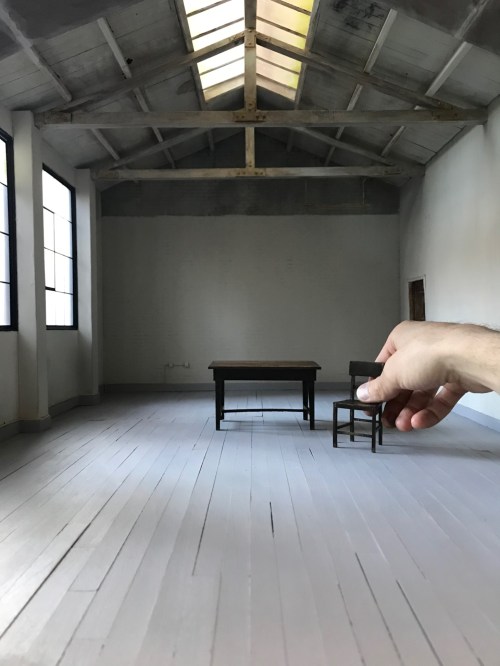
Photos: Shelter in Place Gallery
Shelter In Place is a miniature, coronavirus-inspired gallery. It was launched by artist Eben Haines, who built the maquette and invited artists to submit works to scale.

If I didn’t believe that for most of us the lockdown would last a lot longer than the current “opening up” stuff, I’d write a post about happy I am to read books to grandchildren again and how sorry I am to see artists abandon their wildly inventive pandemic pursuits.

But I’m pretty sure most of us will still be self-distancing for many moons and enjoying the output from creative people that might never have happened but for coronavirus. I love following @covidartmuseum on Instagram, for example. Some of the submissions are a little too weird for me, but most of them make me laugh out loud. Another great source is the arts website Hyperallergic, where I recently learned about a miniature gallery called Shelter in Place.

Valentina Di Liscia wrote, “In the past month, a Boston gallery has managed to mount 15 exhibitions of brand-new works, with a rigorous program still to come. With the onset of the coronavirus pandemic, arts institutions around the globe shuttered one after the other; meanwhile, Shelter in Place Gallery [@shelterinplacegallery on Instagram] was not only founded during the crisis but continues to thrive.

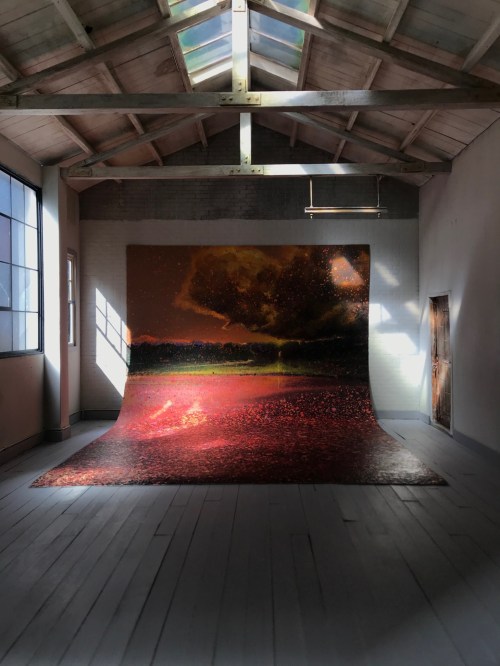
“Of course, there’s a catch. Shelter In Place is a miniature gallery, measuring 20 by 30 inches and exhibiting scaled-down works in a model structure created using foam core, mat board, balsa wood, and plexiglass. Artists can submit works at a 1:12 or one inch to the foot scale, allowing them to create and show even ambitious, seemingly large-scale pieces — a romantic, suspended latex installation by Mary Pedicini; wall-to-wall canvases by B. Chehayeb — while traditional exhibition spaces remain closed. With high ceilings and skylights that flood the space with sunshine, the condensed gallery is impressively lifelike, giving artists room to get particularly creative. …

“The brilliant concept was devised by Eben Haines, a painter and graphic designer for exhibitions at the Museum of Fine Arts (MFA), Boston.

‘With the ongoing shutdowns and lockdowns across the globe, artists are having to stay home … So I’ve built SIP gallery as a new platform for Boston Artists (and eventually from all over) to allow for large scale artworks to be made at a desk or dining room table.’ …

“The idea first came to him back in 2018, long before the pandemic, when Haines was asked to participate in a group show at the Porch Gallery in Minneapolis titled Art Fair. The concept was simple: each artist received a 10-by-10-inch, white-painted MDF box that would serve as an ersatz fair booth where they could show scaled work. …

“Months later, as a rainy day project, he decided to create his own 1:12 scale model to house maquettes for large-scale works that he could not produce in his studio due to space or financial constraints. ‘But then the weather got better, and the more or less abandoned model stayed tucked away in my studio,’ he said.

“Enter the current crisis. Haines was one of more than 300 workers furloughed from the MFA Boston, which closed its doors in March … Haines dusted off the gallery model from years back and began making miniature paintings, initially as a strategy to continue working in his reduced studio space, which had shrunk from 400 square feet to a mere 10. But it dawned on him that other artists might be in a similar predicament, confined to less-than-ideal work conditions and aching to share their creations in a meaningful way. …

“All of the works on view are original, and it prioritizes new pieces as opposed to small copies of existing ones. Digital copies are all but prohibited. … So far, all works have arrived ready to be hung, which has made installations easier. …

“Haines emphasizes the project is not commercial; instead, any sales inquiries received are rerouted to the artists themselves, or to their galleries. Nicole Duennebier’s exhibition, for instance, nearly sold out before they could deliver the mini-paintings back to her gallery, 13FOREST. …

“Said Haines. ‘One of my ambitions for this project, besides urging people to step outside of their crisis mode for a little bit, is for artists to be able to use their submission proposals and photographs of their installed work to send to galleries, residencies, or grant programs, and have some momentum when the country opens back up. …

” ‘We’re honestly so busy with the local response we’ve had that it seems daunting to open it up, but once going to the post office gets a little safer and easier, I’d love to be able to show work from outside Boston,’ said Haines.”

Read the whole article at Hyperallergic, here. The pictures are amazing.

Wilhelm Neusser, “Untitled Bog Painting” (2020), oil on linen, a miniature.
wilhelm-neusser-copy-scaled-e1588694217782

Read Full Post »

image_1

Photo: Simone Saunders
Thanks to the pandemic and the Long Distance Art series, Canadian artist Simone Saunders is making connections with artists around the world.

The other day, I was talking to a friend about activities that were started only because of coronavirus self-distancing but were perhaps enough fun to keep doing in the future.

I like the FaceTime meetings that my husband and I have managed to do a couple times with our grown children when the grandchildren were otherwise occupied. The conversations were funny.

My friend mentioned an art lecture that would previously have had a dozen local students but is now online and attracting hundreds of international participants. She also spoke of a Zoom call with nieces and nephews around the country, marveling, “We’ve never all been together at the same time before!”

On the theme of helpful pandemic discoveries, here’s a report by Bianca Hillier at Public Radio International’s the World about an art collaboration that also might last beyond the pandemic.

“Speaking a dream or a goal into existence has little evidence proving its effectiveness. But for Nick Green, creator of the Social Distancing Festival, the practice has worked.

“ ‘My dream is to hear the story of two artists that have met through my site and collaborate on some really profound piece of art,’ Green told the World in March. His site aggregates content from artists whose performances have been canceled due to the coronavirus pandemic. ‘And they live across the world and never would have met, otherwise.’

“Weeks later, Green’s dream came to fruition.

“ ‘It’s quite poetic that we’re speaking again, given the last words in our last interview of what my big dream was — to have this become more of a collaborative project,’ Green told the World more recently. ‘And now, there have been some new projects happening that are really, really exciting.’ …

Long Distance Art, which launched this week, is an international, multidisciplinary collaborative art series that emerged from the Social Distancing Festival. Artists can contact Green and inquire about collaborating with another artist they’ve seen on the site, or have Green pair them with another artist of his choosing. …

“ ‘For online art, I’ve become a matchmaker,’ he joked. … Green’s matchmaking magic has recently connected a team of Canadian musicians with a dancer in Dar es Salaam, Tanzania. Barbara Johnston, a member of the Toronto-based composing team alongside Anika Johnson and Suzy Wilde, was contacted by Green and immediately thought the idea was ‘the most exciting thing possible in the world.’ Once paired with Tanzanian dancer Tadhi Alawi, Johnston’s team got to work. …

“Johnston said. ‘We just wrote an email about what we felt the song was about, how we thought the themes could be expanded upon, how certain aspects of what’s going on in the world can relate to what this song is about. And he wrote us back this beautiful email the next day. And we just began sharing emails back and forth, talking about our process, talking about the song and the movement to the song.’

“The final product of the collaboration is a video showing Alawi dancing to ‘Wild Heart,’ a song composed by Johnston and her team. It’s a partnership unlike any Johnston’s been a part of, she said, but one she wants to explore more. …

“ ‘It’s just amazing how quickly we connected as collaborators without ever having met, and with being, you know, literally a world apart. … All I want to do now is try to find ways to connect with people. And I feel that this is an opportunity to see beyond the barriers that exist and have existed, because we’re in unknown land now. We’re just trusting in the process.’ …

“Other collaborations in the Long Distance Art series’ unveiling include work between Calgary, Canada-based visual artist Simone Elizabeth Saunders and Tekikki Walker, a Cleveland, Ohio based multimedia designer. Painter Liza Merkalova, based in Adelaide, Australia, also teamed up with New York musician Charlie Rauh. …

“As venue doors remain closed, laptop computers remain open. Green said his aspirations for the Social Distancing Festival and the Long Distance Art series aren’t canceled — but they need funds to sustain themselves.

“ ‘A dream of mine is that there might be someone or an organization out there who sees that this is the artistic embodiment of connecting people across the world and global conversations about humanity and lived experiences,’ Green said. ‘And they might say, “Hey, you know, that aligns really well with what we, as an organization, are doing. Why don’t we put some money into this?” …

” ‘Why stop now?’ ”

More at PRI, here.

Read Full Post »

…–Ø‚³‚ñ‚ª•`‚¢‚½ƒAƒ}ƒrƒG

Photo: Mizuki Production/via Kyodo
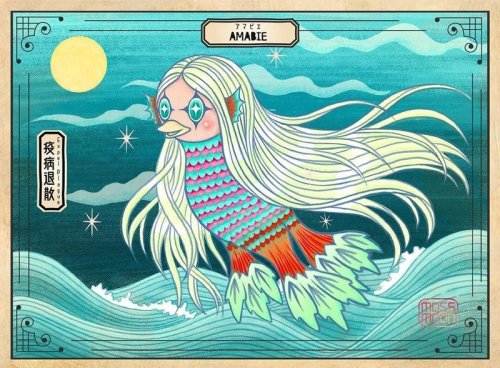
An amabie drawn by the late manga artist Shigeru Mizuki. The amabie, says National Public Radio, is a “sea monster from 19th century Japanese folklore that has become an Internet meme and pop culture mascot in the fight against COVID-19.”

Isn’t it interesting how we turn to ancient wisdom and mythology to find meaning in crisis? It’s not so much that we believe in fantasies, but we begin to realize that metaphor may have something to tell us that can’t be captured in headlines or scientific reports.

Consider the little amabie, a friendly, protective monster that has risen up from Japanese folklore to address coronavirus.

From the Japan Times: “Social media users have been getting creative recently with images of a legendary Japanese [monster] said to have emerged from the sea and prophesied an epidemic. …

“The story of the half-human, half-fish amabie monster was first featured in a 19th century woodblock-printed news sheet from the Edo Period (1603-1868). The creature was depicted with long hair and a beak, and a body covered in scales.

“An amabie is said to have [told a Kumamoto] official, ‘There will be a bountiful harvest for six years, but disease will also spread. Quickly draw a picture of me and show it to the people.’ …

“On March 6, Kyoto University Library posted on its Twitter account a picture of the original news sheet, dated April 1846, with an illustration of an amabie and a description beside it. …  Since then, social media users have posted amabie images in myriad forms — including clay figurines, embroidery, paper cutouts and manga — alongside phrases wishing for an early end to the current pandemic. …

“A drawing of the monster by late manga artist Shigeru Mizuki (1922-2015) [was] published on the Mizuki Production Twitter account on March 17. …

” ‘Japan has traditionally had a custom of trying to drive off epidemics by such means as drawing oni ogres on pieces of paper and displaying them,’ said Yuji Yamada, a professor at Mie University who is well versed in the history of faith practices in Japan.

“ When many people are suffering and dying, our wish for an end (of the pandemic) is the same in all ages,’ he said.” More at the Japan Times, here.

National Public Radio (NPR) points out that even the Japanese health ministry has pressed the amabie into service:

” ‘Stop the infection from spreading!’ The words appear to come straight from the beak of a creature with a bird’s head, human hair and a fish’s scaly body, in a recent public service announcement from Japan’s health ministry.’ ” More at NPR, here.

P.S. Since most of us continue to be fascinated by humanoids sporting fish tails, I have to point you to Asakiyume’s post about a real-life maker of mermaid and merman tails, here.

Art: Kaori Hamura Long
At NPR, another illustration of an Amabie.

90507095_1344951189040379_9196939669948858368_o_custom-debf119d9d9aad4d61291d81c56dd00c49acd924-s800-c85

Read Full Post »

andyandersen_st.fauci_-1080x1080-1

Art: Andy Andersen via Hyperallergic
Andy Andersen’s depiction of Dr. Anthony Fauci, of the National Institute of Allergy and Infectious Diseases, as Saint Pantaleon the Healer. Andersen, a Los Angeles area illustrator, is one of many artists reimagining the doctor as pandemic cultural icon.

Don’t you love how creative people always find ways to have fun with current events, no matter how dire? Consider this charming story by Hakim Bishara at Hyperallergic, where we learn about the art community’s take on the doctor at the center of federal Covid-19 communications, the doctor that people trust.

“Dr. Anthony Fauci, head of the National Institute of Allergy and Infectious Diseases and a member of the White House coronavirus task force, is by all accounts the man of the hour [and] being showered with praise and admiration, sometimes uncomfortably, as he became the most recognized voice in the United States on the coronavirus pandemic.

“On social media, Fauci is being celebrated with thousands of artistic tributes, from admiring portraits and cartoons to tattoos, sock puppets, and saint icons bearing his image.

“One of the most intricate tributes to Fauci belongs to Andy Andersen, an illustrator based outside of Los Angeles. His illustration depicts the famed doctor as the late-medieval Saint Pantaleon the healer. ‘Saint Fauci’ holds a box of medicine, flanked by angels of death and spikey coronaviruses.

“ ‘I based it on some of the classic saint iconography that exists,’ Andersen explained to Hyperallergic in an email. ‘The pose, the composition, the elements all reference those iconic images, but updated with references to the virus.’

“ ‘To me, Fauci is the calming, reassuring voice during this confusing and unpredictable time,’ Andersen wrote. ‘He reminds me of a grandfather who assures you that everything will be ok. It will be hard, it will most likely suck, and sh#!t will happen, but in the end, everything will be ok. The silver lining is that humanity has such a competent, intellectual powerhouse on its side.’

“Several other fans also elevated Fauci to saintdom. One of them created a ‘Saint Fauci’ votive candle with the caption: ‘Not all heroes wear capes! 🙏🙏🙏🙏’ [See @taintedsaint_ on Instagram.]

“One of the most famous public images of Fauci captures him facepalming … during a coronavirus briefing at the White House. For many Americans, the image highlighted Fauci as a voice of reason …

“Brad Albright, an artist and an illustrator based in Texas, decided to perpetuate Fauci’s facepalm with a sticker. ‘Somebody get this man some (more) medals, honors and awards!!! Seriously. He’s a saint,’ he wrote in the caption.

“In addition, there are myriad admiring portraits of Fauci online, from pencil sketches to paintings and GIFs. One such artwork, titled ‘The Explainer in Chief,’ captures Fauci explaining the disease to the press cameras. The artist, Phil Bateman, writes in the caption: ‘Who else but Anthony Fauci could tell you terrifying things and yet whose terrifying explanations made you feel better because you believed only him.’ …

“How does this intense level of attention affect Fauci himself? When asked in an interview with CBS’s Gayle King if he feels personal pressure he calmly answered, ‘It’s my job. This is the life I’ve chosen and I’m doing it.’ ”

Read Hyperallergic here. And for more on the curious manifestations of Fauci fandom, check out the Verge.

By the way, did you ever see the documentary How to Survive a Plague, about the AIDS crisis?  Dr. Fauci was in government back then, too, and in the the early 1980s, before his hair turned gray, he was definitely not considered a hero by terrified AIDS victims. Clearly, he has learned a lot. Which proves that there really are second chances in life.

Photo: Donut Crazy via the Hartford Courant
Donut Crazy has honored infectious disease expert Dr. Anthony Fauci with special doughnuts bearing his image.

oiwoz6yjrnbpjpvre2mrkujbhu

Read Full Post »

ysm20stock20201920220019

I see a lot of discussion on social media about whether this company or that school is doing the moral thing in the pandemic, and I think it’s reasonable to criticize wealthy institutions when they lay off employees with little severance or health-care coverage or when they fail to help college students with housing if they can’t go home. But some organizations use their ample resources more ethically. Consider Yale University’s School of Music.

Zach Finkelstein writes at Middle Class Artist about a massive stimulus package for music students that earlier this month, the Yale University School of Music “offered its students, over 200 young musicians — a relief package on a sweeping, unprecedented scale.

“In a March 31st letter to alumni, Dean Robert Blocker outlined an ambitious plan to provide aid, including ‘a one-time stipend of $500’ to all students to assist with travel and expenses; full pay, despite social distancing, for all student employees through May 1st, 2020; and relocation of all international students who could not return home to University housing.

“For the remainder of the semester, Blocker announced that all classes and degree recitals have moved online. …

adams20center2001

Photo: Matt Fried

“The Yale School of Music is in a rarefied position among its peers to provide aid. Under the leadership of Dean Blocker, the school has grown its endowment from $29 million to over $400 million, in part due to a ‘transformative $100 million gift.’ Since 2005, thanks to this generous donation all students admitted receive a full tuition award and fellowship.’ …

“Alumni interviewed were deeply moved by the School’s actions on behalf of students: ‘I am proud to know that my alma mater, the Yale School of Music, is taking proactive, compassionate steps to aid its students during the unprecedented COVID-19 crisis. … By putting its considerable resources to good use – such as housing students, disbursing emergency funds, or paying student employees for cancelled work — the YSM is taking a lead role among its peers in finding a helpful, humane response. This is a wildly scary time for many musicians around the world, and it is heartwarming to see a world-class educational institution stand up and support its artists.’

“Another alumni also stated their pride in Yale, and that the email ‘showed the generosity possible from heavily-endowed institutions as well as a level of interpersonal caring that has not been exemplified across the board, in the university or professional settings. Our student colleagues are some of the most vulnerable and impressionable amongst us, and Yale’s willingness to help with issues of housing and travel, as well as extending a generous financial donation to each student, sets a great example to the community at large.’ ”

You might say, Well, look what a wealthy institution it is! But there is no end of examples of wealthy institutions that are not doing much of anything. The Kennedy Center in Washington, DC, for example, received $25 million from Congress as part of a coronavirus relief package and promptly furloughed workers, saying it was running out of money. And while Amazon’s Jeff Bezos gives millions to Covid-19 relief, he is making extra billions for himself and not protecting his workers.

So I have to applaud whoever does the right thing for people who are in their care.

More at Middle Class Artist, here.

Read Full Post »

04062020_muralartists_105054-1020x574-1

Photo: Ramon Dompor
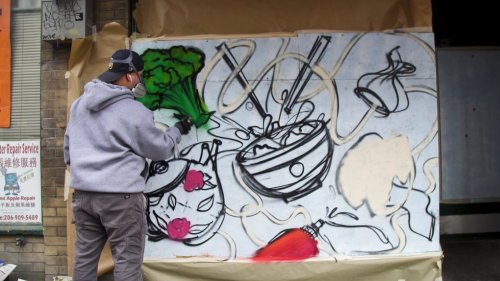
Artist Carlos Ruiz works on his mural to cover the boards on the Jade Garden Restaurant. Ruiz and other local artists donated their time and paint to help several restaurants in Seattle.

As we all know, Washington State had the first cluster of coronavirus cases in the US, and it is still struggling. That’s why the Seattle Times decided to solicit stories for a Stepping Up series meant to bring residents some encouragement.

In one example, Chris Talbott reported on artists beautifying boarded-up storefronts.

“Plywood is going up all over town. It’s not pretty. Give Seattle’s art community a little time, though, and it will catch up. Already artists are out and about, painting  murals to combat the growing blight as the novel coronavirus pandemic forces continued closures of local businesses and restaurants.

” ‘I have been homebound mostly like everybody else and trying to think of ways that I can help my community,’ artist Amanda Bishop said.

‘I’ve been feeling a little bit helpless because I’m not on the front lines. I’m not a nurse, I’m not a doctor. I don’t have a ton of money and my husband and I both lost work because of the virus. So when this opportunity came up, I was like, “This is a way that I can use my skills because this is my full-time thing.” ‘

“Working with permission from owners through the group Overall Creative, Bishop has started painting murals. She spent Sunday at the corner of Pike Street and 10th Avenue working in front of the Comet Tavern and Lost Lake Café along with other artists, each presenting their own vision. …

“Bishop said, ‘I actually did have a lot of people come up and say thank you. And I’ve done a ton of murals over the last eight years of doing this professionally and I haven’t had that as much as I had the last two days.’

“Plywood started going up [in March] after vandals began smashing windows of closed businesses. That led to more plywood from store owners who feared they might be next. Things were starting to look bleak all over town.

“The folks at Venue in Ballard realized this immediately. The shop sells the work of local artists and features a row of large picture windows. There was no question the windows needed to be covered up, but plywood seemed so … blah. So owners decided to hire a painter to beautify the plywood with a forest scene. …

“Venue owner Diane Macrae said, ‘Knowing artists are struggling as well with canceled shows and lack of sales, we figured it was a chance to provide some additional work for them. Our store is all about supporting local artists, so it made sense to continue to do this during this time in any way we can.’

“A similar effort has been under way in the International District and Little Saigon areas after vandals took out the windows of several restaurants nearly two weeks ago. …

“Ivy Chan and her family, which has run Jade Garden for 17 years, aren’t sure if the vandals were trying to break in or were just out to cause damage. But she feels the opportunity arose because the streets are virtually empty thanks to the stay-at-home order.

“ ‘Those people, they like to take advantage of the fact that there’s less people now because they’re all trying to do their diligent part to stay home,’ Chan said. “And then other people are like, ’Oh, it’s easier for me to go out there and do stuff. There’s less police patrolling, there’s less eyes to watch.’ …

“Keoke Silvano, a local photographer, … organized a group of artists who proceeded to paint the colorful mural at Jade Garden. He hopes it’s just the start, and that painters who might be out of work or looking for a way to contribute will continue the effort for businesses forced into fortress mode. …

“ ‘It seems to me that some of these businesses might’ve been targeted because they are Asian businesses,’ Silvano said. … He decided to fight back and put out word to the art community. He ended up with a half dozen or so painters who decorated the front of Jade Garden in a variety of colorful styles. They used mostly spray paint to craft scenes that included a meal of noodles, vegetables and tea with a fortune cookie, and a Seattle skyline framed by jacaranda blossoms.”

More here.

Isn’t that the way things go? First something bad like vandalism happens, then individuals in the community basically say, “I’m not on that team” — and join forces.

Read Full Post »

200331092911-02-wild-goats-wales-coronavirus-exlarge-169

Photo: Carl Triggs
Wild Kashmiri goats pay a visit to a newly empty Welsh town. “The goats live on the hill overlooking the town. They stay up there, very rarely venturing into the street,” a resident told CNN.

They say that Nature abhors a vacuum, but I doubt anyone was thinking of this. In a Welsh town under quarantine, wild Kashmiri goats decided it was safe to check things out.

Aleesha Khaliq writes at CNN, “A coastal town in north Wales has found a whole new meaning to the phrase herd immunity, after goats were spotted roaming its quiet streets.

“It comes just days after British Prime Minister Boris Johnson introduced tighter restrictions around social movement last week in a bid to limit the spread of coronavirus.

“Residents spotted herds of goats strolling around Llandudno on Friday and over [last] weekend, after more than a dozen of the animals ventured down from the Great Orme headland and roamed the streets of the coastal town. …

“They are referred to as Great Orme Kashmiri goats, whose ancestors originated from northern India, according to the town’s official website.

“Town resident, Carl Triggs, was returning home after delivering personal protective equipment masks when he saw the goats. ‘The goats live on the hill overlooking the town. They stay up there, very rarely venturing into the street,’ he told CNN. …

“Mark Richards, from hotel Lansdowne House, told CNN: ‘They sometimes come to the foot of the Great Orme in March but this year they are all wandering the streets in town as there are no cars or people.’ …

“Local councilor Penny Andow told CNN she has lived in the area for 33 years and has never seen the goats venture from the Great Orme down into the town. …

“However, the [police] force said it was ‘not that unusual in Llandudno. … They usually make their own way back.’ ” More here.

The town’s website has lots more: “The first intimation of Llandudno Goat – Latin name, Capra Markhor, is the rank odour. It is strong, musty and compelling (a bit stinky). … The creatures eat with discrimination. Delicately nibbling the juiciest berries, whilst carefully avoiding the thorns. …

“All goats have their own peculiarities, and it is possible to identify individuals. One billy, in particular, is easily recognisable. He is smaller than the others, and has a longer, shaggier coat. This goat is an outsider. He is one of three goats introduced into the herd from Whipsnade Zoo.

“It was not a very successful experiment. The first goat died within weeks of arrival. The second decided that he was probably not a goat, but a sheep. He mixed quite happily with the flock, until, unfortunately, he fell off a cliff and was killed. This is very unusual, as goats are extremely sure footed. The third goat survived, and eventually became accepted by the herd.”

You know what I would like to see walking through town: a moose. I have always wanted to see a moose that wasn’t just in a zoo. What would you like to see? Mythological beasts permissible.

Read Full Post »

merlin_171027342_b2073294-9cfa-462a-ab1d-2b4acc7952b7-jumbo

Photo: C.J. Chivers
Andrade’s Catch has been buying clams from a rotating group of fisherman to keep revenue flowing to quahoggers.

My friends in Minnesota and Wisconsin have perhaps not been asking themselves, “How are the quahoggers doing these days?” but on the coast, a few journalists are checking in on the folks who provide our seafood.

C. J. Chivers (a New York Times writer who sells clams but has no connection to the shop in this story) reports about a lifeline for clam diggers.

“Lou Frattarelli eased his flatbed truck into the loading zone at Andrade’s Catch, a small seafood shop in [Bristol] on Narragansett Bay. … He had four sacks of quahogs to sell, raked on the still-running tide from the bottom of the bay.

“Davy Andrade, one of the shop owners, met him at the door. Mr. Andrade was buying, one of the few shellfish dealers in the state still employing clammers and bringing a local seafood staple to residents.

“ ‘What do you want me doing tomorrow?’ Mr. Frattarelli asked, hoping for one more day’s pay.

“ ‘Another 500, if you can,’ Mr. Andrade answered.

“Five hundred littlenecks is far fewer clams than an experienced quahogger can rake in a day from the rich waters around Prudence Island, where Mr. Frattarelli had been working. But in the age of the coronavirus, it amounted to a boon.

“Many fishing ports across the United States, long imperiled and struggling under strict regulations and the declines of valuable fish and shellfish stocks, have fallen even quieter in the pandemic. …

“Until two weeks ago, much of the East Coast’s daily harvest of wild clams was channeled through wholesale buyers to restaurants and raw bars, many of them in New York City. When bars and restaurants were closed, wholesalers stopped buying.

“In Rhode Island, where state regulations forbid quahoggers from selling clams directly to consumers, the result is that the fleet has all but stopped working — even though catches were high and people, wary of going into crowded and picked-over grocery stores, are eager for healthy meals. …

“Andrade’s Catch has managed to support quahog sales, at least at a small scale. While the shop does a robust wholesale business, it also runs a retail shop out front. By shifting operations almost entirely to retail, it has kept a few boats on the water.

“ ‘I’ve got about six guys I am buying from,’ Mr. Andrade said, and he rotates their days. ‘We want to keep the guys going.’ …

“Said David Andrade, Davy’s father and a co-founder of the shop with his wife, ‘I’ve been telling the diggers, take it easy, wait for the restaurants to come back, [but in] all reality, you’ve got to make $200 a day to pay for the boat.’ …

“A town resident donated $600 to provide free clams to Andrade’s Catch customers. The donation became the impetus for a retail special: Anyone spending $24 or more on seafood this week received 24 free clams. …

“Mr. Andrade’s fiancée, Victoria Young, [encourages] shoppers to place orders by phone and to collect purchases curbside — reducing traffic in the store and potential dangers to the customers and staff.

“Between customers, Ms. Young sprays and wipes anything they might touch — the counters, the A.T.M. and the frame, glass and handles of the front door. …

“ ‘We were supposed to get married next week,’ she said, looking at Davy. ‘We’ve postponed it.’ ”

Read what some Rhode Island quahoggers are saying about the future, here.


Read Full Post »

dmypsrrs3vbi3pxqmjh4gzszda

Photo: Suzanne Kreiter/Globe staff
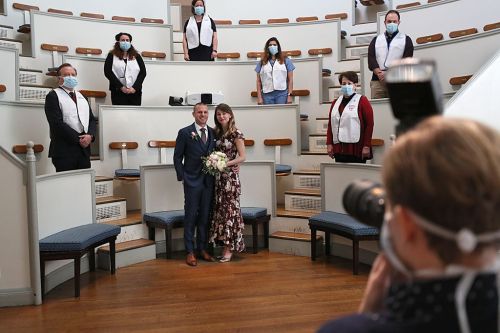
Jen Andonian and Matt Shearer, both epidemiologists, recently got married at Massachusetts General Hospital.

Where there’s a will, there’s a way. Many group events are being put off because of the war against coronavirus, but recently I’ve been learning how weddings, Passover feasts, funerals, conferences, and the like are probably managed in other kinds of war.

Here are two wedding stories from the Boston Globe.

Liz Kowalczyk reports on Jen Andonian and Matt Shearer, who “had it all planned: her burgundy floral dress, his matching checked tie. They live in Cambridge, but chose Ann Arbor, Mich., where they met as graduate students, for their simple courthouse wedding ceremony in March with immediate family. A reception for 75 guests would follow the next day at her parents’ lakeside restaurant.

“Then the fast-moving coronavirus began spreading through the world — and the United States. Andonian and Shearer, both epidemiologists on the frontlines of COVID-19 — she at Massachusetts General Hospital, he at Johns Hopkins Center for Health Security — knew they could not ignore the risk of a large celebration. …

“When she told her coworkers at the MGH Center for Disaster Medicine the next day, a colleague joked: What about just getting married at the hospital? Her co-workers turned the offhand remark into an actual plan, executed in the midst of exhausting 12-hour workdays.

During quick breaks from setting up coronavirus testing sites and expanding intensive-care units, team members ordered flowers and vanilla cupcakes and devised a music playlist. Nurse Eileen Searle applied for a one-day state certificate to perform a marriage ceremony. …

“On Friday, Andonian, 30, and Shearer, 36, were married before a small group of disaster medicine colleagues, all wearing surgical masks and sitting six feet apart to prevent the spread of germs, as the sun streamed in from the windows high in the light-blue dome. It was a welcome but brief break amid the relentless arrival of patients ill with a relentless virus; the number of patients sick enough with COVID-19 to be admitted to Mass. General had more than doubled over the course of the week, to 61 on [March 27] alone.

” ‘This may not have been the wedding you wanted, but it is clearly the wedding MGH needed,’ began Searle, whose job includes training nurses to properly put on protective gear. ‘Thank you.’ …

“When they told their families about the plan to marry at the hospital, Andonian said they had mixed feelings. ‘Everyone was sad, but after seven years, they were ready for us to get married,” she said. …

“The couple arrived about 15 minutes before the ceremony was scheduled to begin at 11 a.m., walking past a long table outside the Ether Dome set with cupcakes to share, a cake for them to take home, tiny colorful containers of bubbles, and a gift bag hiding a bottle of champagne. ..

“As Andonian waited in the hallway, Shearer stood between a white plaster statue of Apollo and a glass case containing an Egyptian mummy, part of a small collection of artifacts [in the MGH museum].

” ‘You ready?’ Searle asked.

” ‘Let’s do it,’ he said.” More.

Another Globe story detailed how a photographer that a couple had never met was determined to put together all the traditional pieces so that a soldier could “elope.”

Megan Johnson writes of bride Victoria Pass, “ ‘If you still want to get married, I definitely want to get married,’ said Victoria. ‘We gotta figure this out.’

“The couple decided they’d wed at Chicopee City Hall. But with none of their family and friends in the area, Victoria wanted to have a photographer capture the moment. They started making phone calls, and stumbled upon Dani Klein-Williams, a Northampton-based photographer.

‘They said they were just planning a very quick, no-frills elopement at Chicopee City Hall,’ said Klein-Williams. ‘I was like, “Okay, can you give me two hours? I’m gonna put something even more spectacular together for you.” ‘

“Klein-Williams called Blantyre, the Tudor-style Relais & Châteaux property in Lenox, Mass. … Within two hours, she got approval from Blantyre, which was already shut down for their annual winter closure. …

“Next, Klein-Williams called her favorite wedding planner, Tara Consolati, who also happens to be ordained. Though she had never performed a ceremony before, she was on board to officiate. Carolyn Valenti, a Berkshires-based florist, offered up a blend of snapdragons, hyacinth, and other blooms. ‘She said, “I have all these gorgeous flowers and they’re just going to rot and die,” ‘ said Klein-Williams.

By the end of the conversation, she discovered that Valenti had a house guest who could bake. Without her baking equipment on hand, however, they dumped the contents of an oversize can of tomatoes, sterilized the can, and used that as a frame for a small wedding cake, topped with berries and flowers.

“[Klein-Williams next] … reached out to Mike Murray of Summer Wind Wedding Films, who volunteered to live stream the event, so Victoria and Jerrod’s family and friends could follow along.” More.

Oh, the kindness of strangers!

Photo: Dani Klein-Williams
Victoria and Jarrod Pass eloped in the Berkshires after having to cancel their 60-guest wedding in Las Vegas. A photographer they hadn’t met, Dani Klein-Williams, was determined the couple should have all the traditional features of a wedding.

bfvwmxbidfgbhiapa6gtzpsksi

Read Full Post »

1584999155004-gettyimages-161025682

Photo: Karl Gehring/Denver Post via Getty Images
According to
Vice, the FCC needs to clarify whether libraries lose their subsidized rates during Covid-19 social distancing if they offer wifi away from their buildings.

Libraries, as usual in a crisis, are stepping up. Remember the critical role of the Ferguson Library during the 2014 riots in Ferguson, Missouri? I’ve been following that library on social media since then, and I’m impressed with what it does for the community and how fast it responds to needs.

Now, during social distancing, libraries are offering wifi hotspots via bookmobiles. Karl Bode reports at Vice, “As millions of Americans hunker down to slow the spread of coronavirus, the lack of affordable broadband access has become a far more pressing problem.

“The FCC’s 2019 Broadband Deployment Report states that 21.3 million Americans lack access to any broadband whatsoever, be it cable, DSL, fiber, or wireless. Recent studies suggest that number is actually twice that thanks to inaccurate FCC broadband availability maps.

“It’s a problem that is notably worse in many low-income and minority communities, long-neglected by the nation’s incumbent broadband monopolies.

“For many Americans, the local library is their best and sometimes only opportunity to get online. But with many schools and libraries closing to protect public health, these users are losing access to a valuable resource in a time of crisis.

“In a letter to the FCC [March 19] the American Library Association (ALA) floated a solution: why not turn the nation’s 16,557 public libraries into free, communal broadband Wi-Fi hotspots, then extend that access into the broader communities that surround them?

“American libraries are subsidized by the FCC E-Rate program, which helps them obtain and deliver broadband access to bridge the digital divide. But the ALA said libraries were worried that the [current administration] —which has taken aim at the program in recent years — would penalize them for extending broadband access to users that are technically not on library property. …

“The ALA urged the FCC to waive E-rate restrictions so libraries could not only offer Wi-Fi access via local libraries, but could also provide broadband service to disconnected communities via bookmobiles and mobile hotspots without running afoul of FCC rules. …

“Former FCC lawyer Gigi Sohn told Motherboard that the FCC has more than $1 billion in available funding from the last round of E-rate subsidies, and could easily waive E-rate restrictions during a crisis. …

“On Monday the FCC issued a statement making it clear that libraries would not be penalized under E-Rate rules for extending Wi-Fi access beyond their property boundaries. …

“While the FCC said it was ok for libraries to leave their hotspots running during the pandemic, the agency simply ignored libraries’ questions as to whether they’d be penalized for extending access into the broader community. …

” ‘We are pleased that the FCC, in response to our request, has clarified that schools and libraries may leave their Wi-Fi networks on for community use without jeopardizing their E-rate funding,’ the The SHLB Coalition said in a statement. ‘The SHLB Coalition now encourages the FCC to take the next step and grant the Petition of the Boulder Valley School District to permit schools and libraries to extend their broadband services to surrounding residential consumers.’ ”

More at Vice, here.

Read Full Post »

3500

Photo: Elias Marcou/Reuters
Migrants from the Moria camp in Lesbos, Greece, use their skills to sew protective masks.

A friend posted on Facebook a Patch.com request for people with sewing machines who might be willing to make surgical masks. This particular call to arms is local to Massachusetts (read), but you might find a similar opportunity near you. All Hands on Deck!

In Greek refugee camps, residents who have already known a ton of hardship are on the case: they know that they’re not likely to get much protection from outside.

Katy Fallon has the story at the Guardian: “In some of the most dangerously overcrowded Greek refugee camps, it has become a race against time to raise awareness about Covid-19 and ensure an outbreak does not spread among an already vulnerable population.

“In the infamous Moria camp on the island of Lesbos close to 20,000 people live in a space designed for just under 3,000. There is is already limited access to running water in the camp, and toilets and showers regularly block due to overuse. The first case of Covid-19 was confirmed on the island last week when a Greek woman from the town of Plomari tested positive. So far [March 18] this the only confirmed case on the island.

“There is an increasing sense of urgency in Moria about hygiene and handwashing. In the absence of support from the Greek authorities, residents are taking matters into their own hands.

 ‘The conditions were out of control and so we knew that we needed to do something by ourselves,’ said Deen Mohammad Alizadah, 30, originally from Afghanistan.

“The members of the team are a snapshot of the diverse population of Moria, heralding from countries such as Syria, Afghanistan, Eritrea and the Congo region, each dispensing advice to their own communities. …

“Due to high demand, face masks are currently in short supply in pharmacies in the local town of Mytilene, and since there is no current mass distribution of masks to the camp, industrious Moria residents have come up with their own solution.

“In a small building around a kilometre from Moria, a group of four Afghan women have volunteered their time to sew face masks for the camp’s population. Stand By Me Lesvos, a Greek NGO, realised that they could make use of the sewing machines from a previous project.

‘It was set up within six hours on Friday,’ said Mixalis Avialotis from Stand By Me Lesvos. ‘One of the Afghan women used to be a tailor in Kabul and said she’d have no problem managing the operation.’

“The women are working at a rapid rate and in their first day made approximately 500 masks, which are fashioned from cotton fabric bought from local shops. The masks are then packaged into plastic wrappers purchased from the local Lidl supermarket and boxed to be brought to the camp. The masks, which will be given out for free, will initially only be distributed to camp residents who start to feel unwell or exhibit symptoms of the virus, such as a cough. …

“On the island of Samos where the refugee camp hosts nearly 7,500 people in a space designed for 648, conditions are similarly cramped. … Guilia Cicoli, co-founder of Still I Rise NGO, which runs a youth centre for children living in [camp], told the Guardian that they had spent a lot of time speaking to the children about Covid-19. The children have also produced posters about hand washing and hygiene in class.

“ ‘Most of us are Italians so we took it very seriously and started awareness raising before Greece even had any confirmed cases,’ she said. ‘Before we had to close last week we had already replaced handshakes with elbow or feet bumps.’ More at the Guardian, here.

Meanwhile in the US, some hospitals feel like they are on their own, too: “Medical staff in one of the nation’s epicenters of the novel coronavirus outbreak have resorted to creating makeshift masks to care for patients, Bloomberg News reported.

“Washington state hospital workers, part of Providence St. Joseph Health system, are improvising protective wear by crafting masks out of marine-grade vinyl, industrial tape, foam and elastic bought from craft stores and Home Depot, the outlet reported.

“Washington state has the highest death total from covid-19 and the second highest total of confirmed cases.” Read this.

Read Full Post »

squolquol

Image: Lummi Nation
So far, the Lummi tribe has reported three Covid-19 cases, but they expect numbers to rise as the pandemic progresses. Unlike many constituencies, the Lummi are prepared.

Here are a couple things we can learn from the kind of people who think about the effects of their actions on seven generations: Be generous; act like a grownup.

Consider the Lummi tribal leaders in this article from the Guardian. They began to prepare as soon they heard about the coronavirus in Wuhan, China, and now they are even offering help to people outside their community.

Nina Lakhani reports, “The Lummi nation, a sovereign Native American tribe in the Pacific northwest, will soon open a pioneering field hospital to treat coronavirus patients, as part of a wave of strong public health measures which have gone further than many governments.

“Tribal leaders have been preparing for Covid-19 since the virus first appeared in Wuhan, China, in late 2019, with medical staff beefing up emergency plans, reorganizing services and gathering medical supplies, including test kits and personal protective equipment.

“The Lummi reservation is located in Whatcom county – 115 miles north of Seattle, Washington, where the first US Covid-19 case was confirmed in January, followed by the first death in February. …

‘We quickly recognised the need to make sacrifices for the greater good, in order to protect our people and the wider community,’ said Dr Dakotah Lane, medical director of the tribal health service, who is in strict self-quarantine after coming into contact with a Covid-19 patient. …

“The tribe swiftly introduced mitigation and prevention measures such as social distancing, drive-through testing, telemedicine clinics, and a home delivery service for the elderly.

“The tribal council declared a state of emergency on 3 March – 10 days before … the US – and approved $1m to prepare and respond for the evolving pandemic, which includes setting up the hospital.

“A community fitness centre, located next to the tribe’s health clinic, has been repurposed into a makeshift hospital, with beds, protective gear and other essential equipment in place. It will open once the pharmacy is fully stocked. The 20-bed hospital will treat less critical inpatients, in order to free up intensive care units in nearby facilities, and prioritize Native Americans from any tribe. …

“The tribe’s proactive response to the evolving global pandemic has been possible thanks to vast improvements to the quality and capacity of its community healthcare system over the past decade.

“Like an increasing number of tribes, the Lummi nation has opted for ‘self-determination,’ which enables greater financial flexibility and clinical autonomy – as opposed to depending on the federally controlled Indian Health Service (IHS) which has suffered decades of severe underfunding.

“As a result, the Lummi health services raises substantial revenue by treating patients on Medicaid and Medicare. … This extra cash has allowed them to invest in infrastructure and build capacity: the tribe now has eight doctors compared with just three in 2013, including three physicians with public health expertise. …

The Lummi want to help. Dr Lane said: ‘The Lummi believe in controlling our own destiny. We don’t count on help reaching us, but the hospital is something we can do to help the community.’

More at the Guardian, here. By the way, do you read the Guardian? It’s free online. It just requests donations. The US coverage is amazing.

Read Full Post »

rtx79fmi-e1584114422319

Photo: Reuters/Guglielmo Mangiapane
Italy formally recognizes that newspapers are essential services.

The demise of newsprint has been exaggerated. Newspapers are still needed. Not only did one in Australia — partly as a joke — print some blank pages with dotted lines for making your own toilet paper, but in Italy newspapers have now been characterized as “essential” services.

Luiz Romero reports at Quartz: “As it became increasingly clear earlier this week that the Italian government would announce even more stringent measures to combat coronavirus, in a country that already faces extraordinary restrictions, a debate began to brew over what should be left open and what should be forced to closed. Places that sell food and medicine would have to keep functioning, but what about the edicole—the small shops that sell newspapers and magazines, and that still exist in the thousands in Italy?

“On Wednesday (March 11), Carlo Verdelli, the director of Repubblica, one of the two largest newspapers in the country, alongside Corriere, published a note arguing that newsstands should be added to the list of essential services that was being prepared by the government. …

“Here, like everywhere else, newsstands are disappearing. They went from 18,400 to 14,300 during the 2010s—a number that  includes those that also sell souvenirs for tourists. Excluding them, the real number of newsstands in Italy is estimated to be around 5,000. Still, Italians like to read newspapers. Almost a third of the population gets its daily news in print. …

“After some debate, and as the number of cases continued to spike, the government finally took a decision. Everything had to close except what it deemed essential services—food stores, pharmacies, hardware stores, and factories. … Newsstands were also allowed to keep going. …

“In Milan, newspaper vendors are proud of what they do. Rosi Varezza, who operates a small but busy newsstand, explained that papers are essential for elderly readers, who are most at risk from the outbreak. Clients buy newspapers for habit, but also to get information they deem more trustworthy; to go deep into subjects they consider important; and to hear the news delivered from specific voices—columnists that have informed them for decades. …

“Newsstands are even registering a small bump in sales. That was clear in Milan. In a busier newsstand, near a major shopping street here, I had to wait to pay for the newspaper. And when my turn came, I had to ask my questions quickly. The newsagent was impatient, answering with short sentences, and insistently looking over my shoulder. A line was forming.” More at Quartz, here.

In my own case, I have always read articles more deeply if they are in print. And in my semi-isolation, I look forward to the paper delivery every day and read more sections than usual. You?

Read Full Post »

merlin_170474973_91ef72aa-3ae2-42f9-bafc-b67945f958b8-jumbo

Photo: Alessandro Grassani for the New York Times
This woman in Milan is part of Italy’s spontaneous self-isolation music scene. I love the look on her face. For all I know she may be thinking about making dinner or washing the bathtub, but it sure looks like she’s conscious of performing a sacrament.

If you’re on social media or following the news in some other way — and who isn’t? — you probably already know about this lovely aspect of the Italian spirit, but I thought the piece by Jason Horowitz at the New York Times was especially good.

“It started with the national anthem. Then came the piano chords, trumpet blasts, violin serenades and even the clanging of pots and pans — all of it spilling from people’s homes, out of windows and from balconies, and rippling across rooftops.

“Finally, on Saturday afternoon, a nationwide round of applause broke out for the doctors on the medical front lines fighting the spread of Europe’s worst coronavirus outbreak. …

“Italians remain essentially under house arrest as the nation, the European front in the global fight against the coronavirus, has ordered extraordinary restrictions on their movement to prevent contagions. … But the cacophony erupting over the streets, from people stuck in their homes, reflects the spirit, resilience and humor of a nation facing its worst national emergency since the Second World War.

“Like any national crisis, the virus has exposed the flaws of those countries it has struck the hardest, whether it be the reflex for secrecy in China, the downplaying of the crisis in Iran or the initial confusion and fragmentation in the Italian response.

“But to the extent that this is a virus that tries people’s souls, it has also demonstrated the strengths of those national characters.

In China, patriotic truck drivers risked infection to bring desperately needed food to the people of Wuhan, the epicenter of the outbreak. In Iran, videos show doctors in full scrubs and masks dancing to keep spirits up.

“And in Italy, the gestures of gratitude and music ring out above the country’s vacated streets, while social media feeds fill with encouraging, sentimental and humorous web videos.

“On Friday evening, at the exact hour that health officials normally update the daily numbers of the country’s increasing infected and dead, Italians from the southern islands to the Alps sang the national anthem and played instruments. … On Saturday, one image circulating widely showed a nurse cradling the Italian peninsula in her arms. …

“The duress also seemed to stir patriotism in a country that has a deep suspicion of nationalism. The Italian media reported a spike in sales of the Italian flag. The national anthem, usually limited to the start of soccer matches, reverberated off palazzo walls at 6 p.m. on Friday. …

“At noon in Verona on Saturday, the peal of church bells gave way to the clapping of hands as Cristina Del Fabbro, 53, stood on her balcony applauding with her daughter Elisa, 21.

“ ‘We want to thank doctors and nurses,’ she said. ‘They can’t stay safe at home as we do, they are tired and worried but they stay there, for those who get sick and need them.’ …

“A reporter working at home in the Chinatown section of Milan for the online newspaper Il Post, stuck his head out the window on Friday and added to the concert with refrains from ‘Nessun Dorma.’ He considered the sudden symphony ‘a small brick in nation building.’

‘We showed that in this hard time we can stick together,’ he said. ‘We were a community, not just a bunch of individuals.’

Lots of other lovely examples at the New York Times, here.

PS. Don’t you find that your perceptions of how you should behave change on a daily, almost hourly, basis? When I woke up Thursday, I thought I’d be going for my annual physical Friday — on the subway. Nope. Rescheduled. Now I don’t even meet my grandchildren unless it’s outdoors. And I’m ordering home delivery of milk in bottles from a dairy. It won’t be delivered by horse, but it’s still kind of cool.

Read Full Post »

coronavirus-comic-1460-7-1080x802-1

Art: Wei Man Kow

While many of us feel crushed under the weight of stories about Covid-19, cartoonists have been addressing the coronavirus in their own way, mostly trying to be helpful.

Jason Li writes at Hyperallergic, “No corner of the globe experiences the epidemic in quite the same way. … Cartoonists and illustrators have taken to the public squares of social media to express statements of solidarity, share experiences (and grievances), and laugh a little. [We’ve] collected our favorite works from around the world — taking care to include as many perspectives and geographies as we could, while still centering those in China, who remain most impacted by the virus. …

“[One] viral illustration by momo shows that Wuhan, ground zero of the epidemic, carries the support of everyone else in China. Wuhan is represented by a caricature of its famous food, hot dry noodle, while those cheering them on are drawn as foods from other regions of China.

“On a gentler note, the 3×3 comic [by] Wang XX is a fantastic encapsulation of the tenderness and care that people in China are feeling for one another during this calamitous period. In it, a seal, octopus, walrus and mouse help each other don their face masks and then hug it out. …

“[Another] comic about the shortages in Hong Kong by Ah To shows a person keeping toilet paper them in their safe along with their gold bars and surgical masks. …

“Many in and outside of China criticize its authorities for handling the crisis poorly and for muffling early warnings from medical experts. [A] mini-comic by A ee mi in Taiwan weaves a fantastical yet blunt critique of China’s healthcare system. In it, a coronavirus carrier is sent home without proper treatment, spreading the virus to their friends and community.

“While many airlines have suspended flights to China, the authorities in Hong Kong, which shares both land and sea borders with Mainland China, have staunchly refused to close off its borders. This has left its citizens incredibly anxious and angry. [Toballkidrawing] aptly depicts how the issue is viewed in Hong Kong — that the government is handing out a free pass for the virus to move in. …

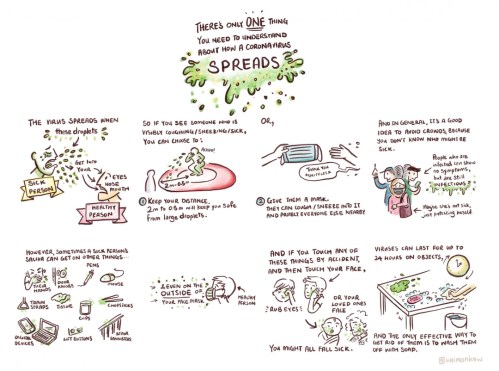
“One genre of responses that’s been common across the globe is illustrated health advice. Some are comedic, some pithy, but the most popular are detailed and instructional. The above example by Wei Man Kow in Singapore was an unexpected hit and was subsequently translated into seven different languages by various strangers on the internet. (The artist has also made the instructional available for free download, including coloring book versions in Chinese and English.) Meanwhile, veteran cartoonist Sonny Liew (also in Singapore) teamed up with local doctors to put out [a] calming, animal-themed strip combating paranoia and disinformation.

“The breadth of these illustrated responses mirrors the myriad lived realities of the coronavirus. While none will argue that the virus is not a global epidemic or phenomenon, few agree on how serious the problem is, and people around the world are experiencing and interpreting its impact in vastly different ways. ”

Check out all these comics and more at Hyperallergic, here. If you have seen other good cartoons on this topic, please link to them in comments.

Read Full Post »

« Newer Posts