Feeds:
Posts
Comments

Posts Tagged ‘costa rica’

Photo: The Verge.
Daniel Janzen and Winnie Hallwachs, together with other conservationists, has brought forests back to the Area de Conservación Guanacaste (ACG) in Costa Rica — an area larger than the Hawaiian island of Oahu.   

Costa Rica, a beautiful country, has the right priorities. It has restored its forests and moved to renewable energy. Justine Calma at the Verge writes about the people behind the reforestation efforts and how climate change is starting to make their work more difficult.

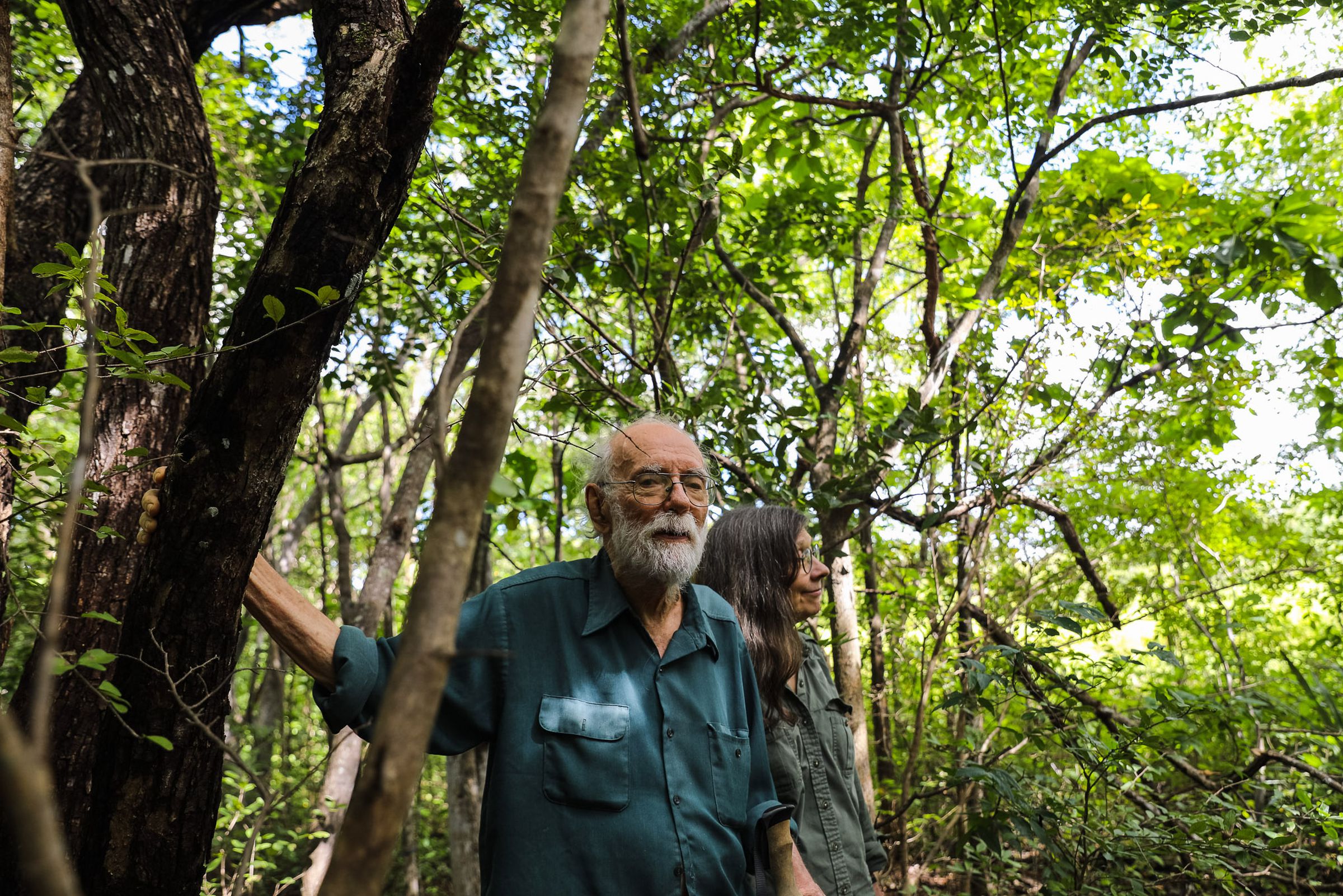
“Ecologist Daniel Janzen wades into the field, clutching a walking stick in one hand and a fist full of towering green blades of grass in the other to steady himself. Winnie Hallwachs, also an ecologist and Janzen’s wife, watches him closely, carrying a hat that she hands to him once he stops to explain our whereabouts. 

“Together with other conservationists who have dedicated decades of their lives to this place, the couple has brought forests back to the Area de Conservación Guanacaste (ACG). It’s ​​an astonishing 163,000 hectares [~403,000 acres] of protected landscapes — an area larger than the Hawaiian island of Oahu — where forests have reclaimed farmland in Costa Rica. …

“ACG is a success story, a powerful example of what can happen when humans help forests heal. It’s part of what’s made Costa Rica a destination for ecotourism and the first tropical country in the world to reverse deforestation. But now, the couple’s beloved forest faces a more insidious threat.

“Across the road, the leaves are too perfect. It’s like they’re growing in a greenhouse, Janzen says. There’s an eerie absence among the foliage — although you’d probably also have to be a regular in the forest to notice. …

“There should have been bees, wasps, and moths along our walk, she explains. And plenty of caterpillar ‘houses’ — curled up leaves the critters sew together that eventually become shelter for other insects. …

“The bugs play crucial roles in the forest — from pollinating plants to forming the base of the food chain. Their disappearance is a warning. Climate change has come to the ACG, marking a new, troubling chapter in the park’s comeback story. … What’s happening here in the ACG says a lot about what it takes to revive a forest — especially in a warming world. …

“The dry season is about two months longer than it was when Janzen arrived in the 1960s. Climate change is making seasons more unpredictable and weather more erratic across the planet. …

“María Marta Chavarría, ACG’s field investigation program coordinator … explains it like this, ‘A big rain is the trigger. It’s time! The rainy season is going to start!’ Trees unfurl new leaves. Moths and other insects that eat those leaves emerge. But now, the rains don’t always last. The leaves die and fall. That has ripple effects across the food chain, from the insects that eat the leaves to birds that eat the insects. They perish or move on. And next season, there are fewer pollinators for the plants. ‘The big trigger in the beginning was false,’ Chavarría explains. …

“In 1978, Janzen … recalls in a 2021 paper he and Hallwachs published in the journal PNAS [his front wall was plastered with moths at night]. The title was ‘To us insectometers, it is clear that insect decline in our Costa Rican tropics is real, so let’s be kind to the survivors.’

“That observation in 1978 led the couple to focus their research on caterpillars and their parasites. In 1980, they used light traps to inventory moth species across the country, documenting at least 10,000 species. Since then, however, they’ve seen a steady decline in caterpillars. … 

“Hanging a white sheet and lights at the edge of a cliff overlooking a vast stretch of both old and new-growth forests, they photographed moths that came to rest on the sheet in 1984, 1995, 2007, and 2019. The first photograph is an impressive tapestry of many different winged critters. By 2019, that’s been reduced to a mostly white sheet speckled here and there with far fewer moths. Instead of an intricate tapestry of wings and antennae, the sheet looks more like a blank canvas an artist has only started to splatter with a brush. 

“Hallwachs and Janzen can see the same phenomenon now standing in broad daylight in the forest across from the field. Just because forests have come roaring back across the ACG doesn’t mean the struggle to survive is over. …

” ‘A lot of the reforestation projects are kind of assuming that trees are mechanical objects,’ Hallwachs says. But they don’t stand alone, not in a healthy forest. 

“Merely plant rows of trees, and the result is a tree plantation — not a forest. Bringing back a forest is a much different endeavor. It’s more about restoring relationships — reconnecting remaining forests with land that’s been cleared and nurturing new kinds of connections between people and the land.  

“In ACG’s dry forest, they didn’t have to plant trees by hand. By getting rid of the grass and stopping the fires, they cleared the way for the forest’s return. The first seeds blew in with the wind.

“Hallwachs and Janzen recognize them like old friends — stopping next to a Dalbergia tree that was one of the first to grow where they stomped out the fires. Its seeds are light and flat, allowing them to float on a breeze. When those trees start to grow, they attract animals in search of food or shelter. 

“Janzen measures each animal up by how many seeds they can hold and then spit or defecate onto the forest floor. ‘When you see a bird fly by, what you’re seeing is a tablespoon full of seeds,’ he says. ‘Every deer you see is a liter of seeds.’ ”

More at the Verge, here.
Read Full Post »

Photo: Earthshot.
Costa Rica won a Earthshot prize for its success reversing damage to tropical forests by incentivizing landowners to leave unused land alone.

I really liked this story about an effort in Costa Rica that is helping restore tropical forests. A study says that although “it’s not a license to kill” forests, they can come back eventually if humans just leave them alone to heal.

Tik Root writes at the Washington Post, “Deforestation is a global and accelerating threat. But new research shows that tropical forests can recover naturally and remarkably quickly on abandoned lands.

“The study, published [in] the journal Science, found that under low-intensity use, soil on previously deforested land can recover its fertility in less than a decade. Characteristics such as the layering of plants and trees in a forest, as well as species diversity, came back in about 25 to 60 years.

“ ‘I was totally surprised how quickly it went,’ said Lourens Poorter, an ecologist at Wageningen University in the Netherlands and lead author on the paper.

‘These forests can recover very fast and they can do it by themselves.’

“Burgeoning secondary forests are good for the climate as well. They are able to sequester more carbon dioxide from the atmosphere than established forests; like the voracious food intake of a sprouting teen compared to that of an older adult.

“ ‘It does provide a glimmer of hope for this process of tropical reforestation,’ said Meg Lowman, a conservation biologist and author of The Arbornaut: A Life Discovering the Eighth Continent in the Trees Above. ‘My only caution is that I don’t think it’s ever a substitute for the importance of saving big trees and old growth forests.’

“Older forests ultimately store more carbon dioxide than young forests, and deforestation releases those stockpiles, which helps drive climate change. The study found that it took more than a century for the overall biomass of tropical forests — and thus their carbon storage ability — to return fully. The recovery of a forest’s species makeup lasted a similar period.

“The longer time frame for the revival of these key benefits is among the reasons that Poorter says maintaining current forest cover is crucial. ‘First, stop deforestation and conserve old growth forests,’ he emphasized. The fact that deforested land can recover ‘is not a license to kill.’

“A 2019 study estimated that some 5.5 million hectares of tropical forest — an area more than twice the size of Belize — is lost each year to expanding commercial cropland, pastures and tree plantations. But cleared land is often abandoned as cultivation shifts, said Poorter, and researchers wanted to know, ‘Can it recover?’

“The answer is yes. … The subsurface soil, for example, often remains relatively vibrant after deforestation, which enables a faster recovery. The warmth and humidity of the tropics also allow trees to grow extremely fast, with some species climbing more than a dozen feet per year.

“And this all happens largely without human intervention, Poorter said. Seeds, roots and stumps embedded in the soil, or the spread of plants from adjacent forests, kick-start the recovery process. … ‘The conditions are that there has to be nearby forests, and the soil can’t be too degraded.’ “

The Post article continues with Daniel Nepstad, a tropical ecologist and president of the San Francisco-based Earth Innovation Institute, who says, ” ‘The research bolsters the policy argument for a nature-based approach to forest restoration. The cheapest way to get forest back on the land is to let nature do the work.’

“He would encourage governments to incentivize farmers and landowners to protect secondary forests and promote regrowth.

“Organizations such as the Natural Capital Project advocate for similar approaches to ecosystem services restoration. Costa Rica recently won Prince William’s Earthshot Prize for a program that helps reverse deforestation by paying farmers to protect and reforest their land. …

“This paper drew on 77 sites in three continents, comprising 2,275 plots and 226,343 stems.”

More at the Post, here.

Read Full Post »

2437

Photo: Curridabat Municipality
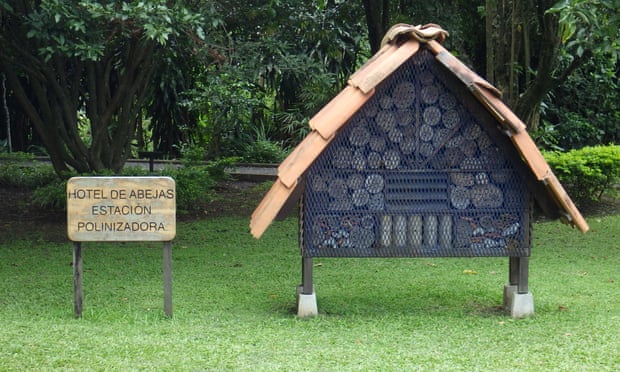
A bee hotel, part of Curridabat’s drive to welcome and protect pollinators. Costa Rica takes environmental issues seriously, which has made it a popular destination.

Some folks believe that many of the troubling aspects of our world will get fixed after coronavirus. Some say that’s unlikely. Others expect everything to get worse — problems such as inequality, nationalism, and environmental degradation.

The only prediction I’m confident about is that it will be a long time before we know. Meanwhile, stories from around the world are showing us options — often completely different ways of being.

Consider this story. Patrick Greenfield reports at the Guardian that a suburb of San Jose, Costa Rica, is taking environmental quality very seriously. In fact, the attitude toward nature nationwide has made this part of Central America a desirable destination in normal times. We ourselves went there when the kids were young.

” ‘Pollinators were the key,’ says Edgar Mora, reflecting on the decision to recognise every bee, bat, hummingbird and butterfly as a citizen of Curridabat during his 12-year spell as mayor.

‘Pollinators are the consultants of the natural world, supreme reproducers and they don’t charge for it. The plan to convert every street into a biocorridor and every neighbourhood into an ecosystem required a relationship with them.’

“The move to extend citizenship to pollinators, trees and native plants in Curridabat has been crucial to the municipality’s transformation from an unremarkable suburb of the Costa Rican capital, San José, into a pioneering haven for urban wildlife.

“Now known as ‘Ciudad Dulce’ – Sweet City – Curridabat’s urban planning has been reimagined around its non-human inhabitants. Green spaces are treated as infrastructure with accompanying ecosystem services that can be harnessed by local government and offered to residents. Geolocation mapping is used to target reforestation projects at elderly residents and children to ensure they benefit from air pollution removal and the cooling effects that the trees provide. The widespread planting of native species underscores a network of green spaces and biocorridors across the municipality, which are designed to ensure pollinators thrive. …

“The metropolitan area surrounding San José is home to more than 2 million people – about half of the population of Costa Rica – despite covering less than 5% of the country’s area.

“Were it not for the lush volcanic peaks that surround Costa Rica’s central valley, it would not be immediately obvious that you were in the heart of one of the most biodiverse countries on the planet. Humans dominate and the country’s cloud forests, pristine coastline and emblematic sloths can feel a long way from the concrete and traffic.

“ ‘We attract a lot of tourists because of nature and conservation but there is still friction in the city,’ says Irene Garcia, head of innovation at the mayor’s office in Curridabat, who oversees the Sweet City project. …

“By the middle of the century, the UN projects that 68% of humanity will live in towns and cities, placing further pressure on ecosystems and rapidly vanishing habitats.

“But many urban planners are trying to change this relationship and the importance of green spaces in towns and cities has been recognised in a draft UN agreement to halt and reverse biodiversity loss, often referred to as the Paris agreement for nature.

“Sweet City is just one of a number of biocorridors around the country that allow the genetic spread of species to maintain their strength. In Central America, this concept has developed since the early 2000s following an agreement to form a biocorridor network to connect jaguars.

“ ‘Grey infrastructure makes the city warm up too much. So the idea to connect green areas is to cool down parts of the city, return the ecosystem services that were there previously but have deteriorated,’ says Magalli Castro Álvarez, who oversees Costa Rica’s network of biocorridors with the National System of Conservation Areas (Sinac).

“ ‘Inter-urban biocorridors have a double objective: they create ecological connectivity for biodiversity but also improve green infrastructure through roads and river banks lined with trees that are linked with the small forested areas that still exist in metropolitan areas. They improve air quality, water quality and give people spaces to relax, have fun and improve their health.’

“Many Costa Ricans are happy to speak about the policy benefits of schemes such as Sweet City, as their response to the challenges of bringing nature into the city is part of a deeper national sentiment. It is not in this tiny Central American country’s DNA to behave as if humans were somehow set apart from nature. …

“Says the country’s president, Carlos Alvarado Quesada, who credits Costa Rica’s tradition of pacifism and respect for nature with its desire to tackle big environmental issues, ‘Even though we have a small territory, its characteristics allow us to have 6% of the biodiversity of the world in our land.’ ”

More here.

Read Full Post »

Photo: Phil Torres, Dr. Geoff Wheat
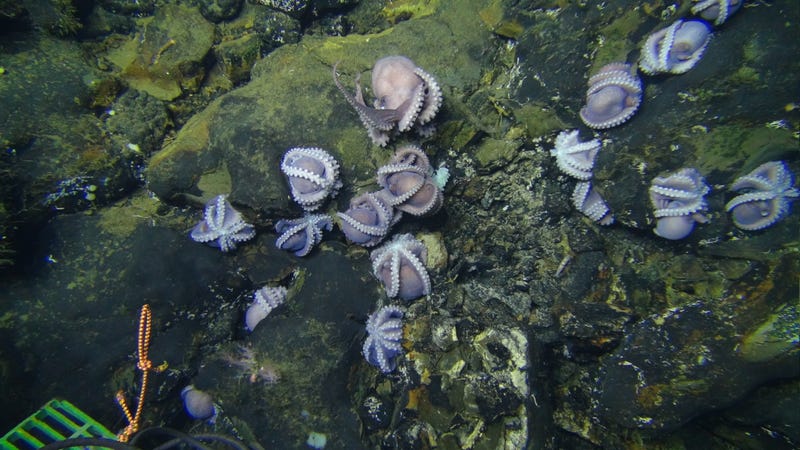
Seventeen octopods huddled on the Dorado Outcrop, two miles underwater near Costa Rica. Most are in a brooding (in the sense of baby-launching) posture.

Not sure where I picked up this octopus story, maybe from twitter. But who knows? Sometimes I learn facts about sea creatures from the Octonauts-loving grandchildren. (I’m grateful that cartoons these days have educational content. The cartoons I watched as a child were often no more than a bunch of mice running around and squeaking.)

Maddie Stone reports at Earther, “Scientists have made a truly bizarre discovery on an expanse of cooled lava 150 miles west of Costa Rica and nearly two miles underwater. There, they laid eyes on more than a hundred female octopuses, tending to eggs that didn’t seem to be growing in water that seemed too warm for their liking.

“Deep sea octopuses are a rare sight, and it’s even rarer to catch them in the act of brooding. So when Janet Voight, a deep sea biologist at the Field Museum of Natural History, examined footage collected at the Dorado Outcrop during a 2013-14 study of warm hydrothermal fluids seeping out of cracks in the rocks, it was nothing short of shocking to discover an enormous camp of tentacled, seemingly-expectant moms. …

“It’s [puzzling], because deep sea octopuses tend to thrive in near freezing temperatures. Warm water speeds up their metabolism, causing them to use up too much oxygen. And indeed, when lead study author Anne Hartwell examined the octopods’ breathing patterns in hundreds of hours of video footage collected by an ROV and a crewed underwater vehicle, she learned that those in or near hydrothermal fluids were breathing faster, suggesting oxygen stress.

“Moreover, none of the nearly 200 eggs the researchers examined appeared to be developing at all. …

“The researchers go on to speculate that females are drawn to the area because of the lack of sediment, which makes it easier to anchor their eggs, blissfully unaware of their new home’s thermostat problem.

“As the authors explain, hydrothermal fluid discharges can ramp up quickly at any given site, and once a female chooses a place to brood, she’s stuck with it — stressful environment or not. …

“Nicole Morgan, a deep sea biologist at Florida State University who also wasn’t involved, told Earther in a Twitter DM that while the water is warm, it’s ‘not outside known ranges for the octopus genus.’ The oxygen levels are also low but not lethal, she said, suggesting ‘the authors are probably right that this is sub-par brooding habitat.’

“ ‘I think they have captured a snapshot of what evolution looks like in real life — they are brooding in an area that is stressful but available and not immediately lethal,’ Morgan continued. ‘More likely than not this subpopulation will die out because of the high egg fatality, but if some eggs do survive, that could be a start to speciation.’ ”

More here.

Read Full Post »

In September, Victoria Lynden tweeted about Costa Rica’s clean electricity. Although hydroelectric and geothermal approaches sometimes have issues of their own and cars in Costa Rica still use gas, two months without using fossil fuels to generate electricity sounded pretty good to me.

Brad Plumer wrote at Vox, “Costa Rica is pulling off a feat most countries just daydream about: For two straight months, the Central American country hasn’t burned any fossil fuels to generate electricity. That’s right: 100 percent renewable power.

“This isn’t a blip, either. For 300 total days last year and 150 days so far [in 2016], Costa Rica’s electricity has come entirely from renewable sources, mostly hydropower and geothermal. Heavy rains have helped four big hydroelectric dams run above their usual capacity, letting the country turn off its diesel generators.

“Now, there’s a huge, huge caveat here: Costa Rica hasn’t eschewed all fossil fuels entirely. The country still has more than 1 million cars running on old-fashioned gasoline, which is why imported oil still supplies over half its total energy needs. The country also has cement plants that burn coal.

“What Costa Rica’s doing is nevertheless impressive — and a reflection of how serious the tiny Central American country is about going green. At the same time, a closer look at the story shows just how difficult it would be for other countries to pull off something similar.

“When many people think of ‘renewables,’ they tend to think of giant wind turbines or gleaming solar panels. But that’s not what Costa Rica is relying on. For years, roughly 80 percent of the nation’s electricity has come from a technology that’s more than a century old — hydroelectric dams …

“Another 12 percent or so of Costa Rica’s electricity comes from geothermal plants, which tap heat deep in the Earth’s crust and can also run around the clock. …

“So if Costa Rica can get 100 percent of its electricity from renewable sources, why couldn’t other countries do the same? Why can’t the United States, which is far richer?

“One obstacle here is that hydropower and geothermal are very location-specific — and only a few countries are lucky enough to have such rich resources. Iceland gets nearly 100 percent of its electricity from these two sources. Paraguay gets almost all of its electricity from the massive Itaipú Dam. Brazil gets more than 75 percent of its power from hydropower. But those are exceptions. For most countries, hydropower can only satisfy a portion of their power needs.” Read on.

Seems to me that when a country wants to be greener (whether for the environment or to save money or both), it has already taken the first step to finding solutions that work for its own geography.

Chart: Observatory of Renewable Energy in Latin America and the Caribbean


Read Full Post »