Feeds:
Posts
Comments

Posts Tagged ‘bats’

Photo: Dan Bashakov/AP.
A volunteer of the Ukrainian bat rehabilitation center shows the wing of a rescued bat to people before returning bats to the wild in Kyiv, Ukraine, Saturday, April 4, 2026.

I wonder how some celebrations emerge and become yearly events. Do they start with one person or family being excited about something — perhaps the return of a certain bird in spring — and the next thing you know, a whole community is having annual cookouts and parades?

Derek Gatopoulos and Vasila Stepanenko at the Associated Press and have a story about an annual celebration in Ukraine, war or no war.

“As night falls over a nature park on the edge of Kyiv,” they write, “children crowd around volunteers who carefully open cloth bags and release bats into the twilight.

“As each one takes flight, snapping through the air, more than 1,000 spectators cheer and applaud — families, off-duty soldiers, and bat enthusiasts, a few dressed in Goth outfits.

“Hundreds of bats, many rescued from war-torn areas in the east of the country, were released [in April] at one of multiple events around Ukraine planned to coincide with the arrival of spring.

“ ‘This is important for us as an organization because these are on a red list of endangered animals. Preserving them is very important,’ said Anastasiia Vovk, a volunteer at the Ukrainian Bat Rehabilitation Center, which organized the release. All 28 bat species in Ukraine are listed as protected animals due to declining populations.

“For many attendees, the event offered welcome relief and an excuse for a family outing after a harsh winter marked by subzero temperatures, nightly Russian drone and missile attacks and crippling power cuts.

“Late Saturday, children, many wearing bat-themed T-shirts and hats, watched as volunteers fed the animals mealworms with tweezers before letting them go. Some were allowed to wear gloves and handle the bats themselves.

“ ‘Life goes on despite the war,’ said Oleksii Beliaiev, a 54-year-old Kyiv resident who attended with his family. … Beliaiev runs a small printing business and spends time volunteering for army projects.

“The war has displaced animals as well as people. Buildings destroyed by shelling damage bats’ shelters, and explosions terrify the tiny mammals, experts say.

“ ‘In winter, bats hibernate, and if they are disturbed, they can die. They reproduce slowly — one or two offspring per year — so populations recover very slowly,’ said Alona Shulenko, who headed Saturday’s release. ‘As natural hibernation sites disappear, bats move into cities, into cracks in buildings and balconies. But repairs or destruction of these places can kill entire colonies,’ she said.

“All Ukrainian bat species are insect-eating and legally protected. … The charity says it has rescued more than 30,000 in total, including 4,000 bats last winter.

“ ‘We are all living in wartime, and everyone has their own struggles,’ Shulenko said. ‘But we are doing what we know best. … If we stop what we are doing, thousands of bats will die.’ ” More at AP, here.

I know some of you may be thinking, “Ugh. I really don’t like bats!” So I can’t leave this topic without saying a word about why bats are important.

Much of the information below applies to bats globally, not just in the US.

“Few of nature’s animals are as misunderstood as bats. We at the U.S. Fish and Wildlife Service [FWS] want to set the record straight and help others understand the importance of bats. Though often feared and loathed as sinister creatures of the night, bats are vital to the health of our environment and our economy. …

“Bats play an essential role in pest control, pollinating plants and dispersing seeds. Recent studies estimate that bats eat enough pests to save more than $1 billion per year in crop damage and pesticide costs in the United States corn industry alone. Across all agricultural production, consumption of insect pests by bats results in a savings of more than $3 billion per year. While many bats eat insects, others feed on nectar and provide critical pollination for a variety of plants like peaches, cloves, bananas and agaves. In fact, bats are the sole pollinator for the agave plant, a key ingredient in tequila! A third bat food source is fruit, leading to yet another important role in the ecosystem – seed dispersal. Fruit-eating bats can account for as much as 95% of the seed dispersal responsible for early growth in recently cleared rainforests.

“Unfortunately, bats are declining across the globe. Many bats are needlessly killed because people do not understand the important role bats play in a healthy ecosystem. For bats that hibernate in caves, the need for winter shelter during hibernation puts them at another disadvantage. Human activity resulting in loss of habitat and disruptions during hibernation are detrimental. Making matters worse, a fungal disease called white-nose syndrome has claimed the lives of more than 5 million bats since its discovery in 2006 and has spread across North America at alarming rates. …

“Across the continent, we’re working with partners to protect bats, research treatments to halt the spread of white-nose syndrome and raise awareness about just how incredible, and vulnerable, bats are. More than 15 bat species are currently listed as federally endangered, threatened or under review in the candidate or petition process under the Endangered Species Act. … One recent study led to the discovery of a large summer roost for Indiana bats in Missouri — a single tree was providing refuge to more than 150 endangered Indiana bats!”

More at FWS, here.
Read Full Post »

2437

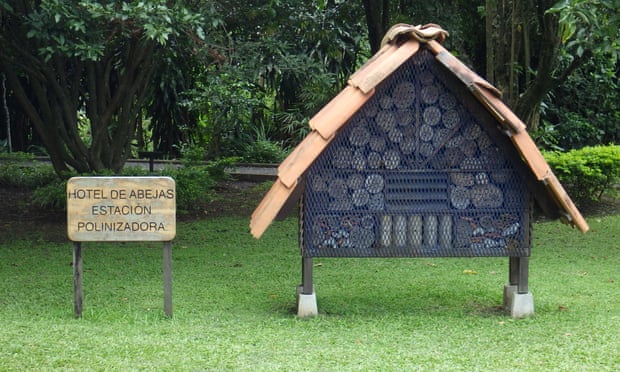
Photo: Curridabat Municipality
A bee hotel, part of Curridabat’s drive to welcome and protect pollinators. Costa Rica takes environmental issues seriously, which has made it a popular destination.

Some folks believe that many of the troubling aspects of our world will get fixed after coronavirus. Some say that’s unlikely. Others expect everything to get worse — problems such as inequality, nationalism, and environmental degradation.

The only prediction I’m confident about is that it will be a long time before we know. Meanwhile, stories from around the world are showing us options — often completely different ways of being.

Consider this story. Patrick Greenfield reports at the Guardian that a suburb of San Jose, Costa Rica, is taking environmental quality very seriously. In fact, the attitude toward nature nationwide has made this part of Central America a desirable destination in normal times. We ourselves went there when the kids were young.

” ‘Pollinators were the key,’ says Edgar Mora, reflecting on the decision to recognise every bee, bat, hummingbird and butterfly as a citizen of Curridabat during his 12-year spell as mayor.

‘Pollinators are the consultants of the natural world, supreme reproducers and they don’t charge for it. The plan to convert every street into a biocorridor and every neighbourhood into an ecosystem required a relationship with them.’

“The move to extend citizenship to pollinators, trees and native plants in Curridabat has been crucial to the municipality’s transformation from an unremarkable suburb of the Costa Rican capital, San José, into a pioneering haven for urban wildlife.

“Now known as ‘Ciudad Dulce’ – Sweet City – Curridabat’s urban planning has been reimagined around its non-human inhabitants. Green spaces are treated as infrastructure with accompanying ecosystem services that can be harnessed by local government and offered to residents. Geolocation mapping is used to target reforestation projects at elderly residents and children to ensure they benefit from air pollution removal and the cooling effects that the trees provide. The widespread planting of native species underscores a network of green spaces and biocorridors across the municipality, which are designed to ensure pollinators thrive. …

“The metropolitan area surrounding San José is home to more than 2 million people – about half of the population of Costa Rica – despite covering less than 5% of the country’s area.

“Were it not for the lush volcanic peaks that surround Costa Rica’s central valley, it would not be immediately obvious that you were in the heart of one of the most biodiverse countries on the planet. Humans dominate and the country’s cloud forests, pristine coastline and emblematic sloths can feel a long way from the concrete and traffic.

“ ‘We attract a lot of tourists because of nature and conservation but there is still friction in the city,’ says Irene Garcia, head of innovation at the mayor’s office in Curridabat, who oversees the Sweet City project. …

“By the middle of the century, the UN projects that 68% of humanity will live in towns and cities, placing further pressure on ecosystems and rapidly vanishing habitats.

“But many urban planners are trying to change this relationship and the importance of green spaces in towns and cities has been recognised in a draft UN agreement to halt and reverse biodiversity loss, often referred to as the Paris agreement for nature.

“Sweet City is just one of a number of biocorridors around the country that allow the genetic spread of species to maintain their strength. In Central America, this concept has developed since the early 2000s following an agreement to form a biocorridor network to connect jaguars.

“ ‘Grey infrastructure makes the city warm up too much. So the idea to connect green areas is to cool down parts of the city, return the ecosystem services that were there previously but have deteriorated,’ says Magalli Castro Álvarez, who oversees Costa Rica’s network of biocorridors with the National System of Conservation Areas (Sinac).

“ ‘Inter-urban biocorridors have a double objective: they create ecological connectivity for biodiversity but also improve green infrastructure through roads and river banks lined with trees that are linked with the small forested areas that still exist in metropolitan areas. They improve air quality, water quality and give people spaces to relax, have fun and improve their health.’

“Many Costa Ricans are happy to speak about the policy benefits of schemes such as Sweet City, as their response to the challenges of bringing nature into the city is part of a deeper national sentiment. It is not in this tiny Central American country’s DNA to behave as if humans were somehow set apart from nature. …

“Says the country’s president, Carlos Alvarado Quesada, who credits Costa Rica’s tradition of pacifism and respect for nature with its desire to tackle big environmental issues, ‘Even though we have a small territory, its characteristics allow us to have 6% of the biodiversity of the world in our land.’ ”

More here.

Read Full Post »

7111

Photo: Sasha Gusov/Alamy
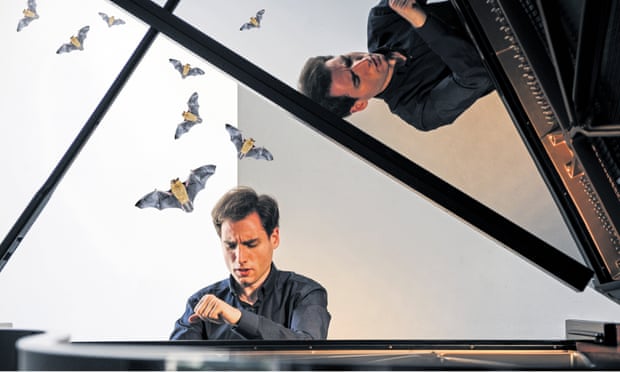
Boris Giltburg … and a composite image showing his fiercest critics.

Becoming a professional musician requires dedication no matter what the situation, and you have to admire the perseverance of all musicians. But sometimes the dedication is so completely over-the-top it deserves an Olympic medal.

Pianist Boris Giltburg survived to tell his own story at the Guardian.

“There I was in a verdant valley, playing an open-air concert to 2,000 people, with snow-capped mountains rising off in the distance behind the stage. …

“As night fell, the brightly lit piano became a shining beacon in the surrounding blackness. It also became, I now realise, an immensely attractive object to various heat- and light-loving creatures. Shortly after the opening of Chopin’s Ballade No 1, a thin black insect landed on the keyboard. Before long, it was joined by another, then a few more, and by the time I got to the whirlwind of passages in the coda, I was fighting a mounting panic – as there were insects everywhere. …

“In the interval, the promoters sprayed me all over with insect repellant. It made me very sticky – and it seemed to matter not a bit to the crawlies occupying the keyboard. If anything, they seemed to actually be attracted to it, with several now landing on my ears and a few others exploring the nape of my neck. …

And then there are all my encounters with bats.

“Bats like to live in theatres, particularly in old Italian-style ones that provide them with comfortable rafters above the stage, and plenty of flying space in the darkness above. I discovered this fact during a rehearsal in one such theatre, when loud, neurotic squeaks erupted above me as I started playing. ‘Ah, the bats!’ the promoters said with smiles, in reply to my slightly concerned questions. ‘They’ve lived here since always. Don’t worry – you can’t hear them from the hall.’ …

“It turned out that having had the theatre as their residence for ages, the bats had become very cultured – and also very opinionated. They liked the Rachmaninov preludes well enough and listened politely. The darkening mood of Prokofiev’s 8th sonata, however, put them into a state of nervous agitation. They clearly didn’t like my take on it and I heard them fluttering above me, conversing in worried squeaks.

“Then came Ravel’s La Valse, darker still. That turned out to be too much. At first there was ominous silence from above but then in the coda, as the demise of the Old World inescapably approached in rising waves, first one and then many black-brown signs of the bats’ displeasure rained down on to the stage.

“[It] fell from above on my hands and the very brightly lit keyboard. The first made me jump – literally — and I pulled my hands off the keys for a split second. I then managed to go on, all the while noticing in growing discomfort and disbelief the continued delivery of the bats’ verdict on my performance. I think that was the bat equivalent of zero stars.

“After the concert, I was livid with indignation and shock. I expected the same sort of reaction from the promoters, but they took a much more pragmatic and good-natured view of the situation. Bats lived in theatres, they said, and that was that. Apparently they saw the discharge from their vantage point in the hall and thought it quite funny.

“They also told me of a previous attempt to curtail the bats’ activity (and population) with the help of an owl – but the owl proved to be just as, well, opinionated as the bats. It had nothing against Ravel, but seemed to show a particular dislike of the cello, which it let be known in no uncertain terms. After two cellos and their adjoining players had to be wiped clean, the owl was dismissed, and the bats had free rein to continue their musical education.

“I go back to that theatre almost every year. The audience is wonderfully enthusiastic, the acoustics clear and carrying, and the promoters’ hospitality among the warmest I’ve ever experienced. But I still haven’t been able to win over the bats. During my last visit, they pooh-poohed the 2nd movement of Beethoven’s Emperor concerto.”

More here.

Read Full Post »

I’m hearing more and more these days about “good bacteria,” including in a song by singer-composer Will McMillan on the friendly bacteria we humans carry around.

Now, it seems, bacteria found in soil may help to save amphibians from dangerous fungal epidemics. Public Radio International’s environmental news program, Living on Earth, has the story.

“Around the world, fungal diseases have been killing millions of frogs and bats and snakes. And a newly emerging disease in salamanders in Europe is scaring biologists here, so the US Fish and Wildlife Service has introduced a ban on their import to try to protect amphibians in the US.

“But now scientists see some hope in soil bacteria that get onto the salamanders and frogs and apparently protect them. Doug Woodhams is an assistant professor of biology at UMass Boston, who’s been working with amphibians in Panama – and he explained what his team has found to Living on Earth’s Helen Palmer.

“WOODHAMS: Some of the amphibians have beneficial bacteria that live on their skin and these have antifungal properties.

“PALMER: This is kind of like having good bacteria in your gut, for instance, that stop you from getting sick. … Is there any evidence that  good bacteria actually work against devastating funguses?

“WOODHAMS: Yeah, there’s quite a bit of evidence. Many of the bacteria that we can culture from some amphibian species are able to inhibit the fungus in culture. We also have some population-level data that shows populations that tend to have these antifungal bacteria can persist with Bd in the environment and survive. …

“Bd is the chytrid fungus that’s been spreading around the world and devastating amphibian populations. So salamanders, frogs, toads. Populations that tend to have more of these beneficial bacteria seem to be surviving, and populations that don’t have as many of the individuals that have these bacteria seem to disappear. …

“The next thing we want to try is adding some of these bacteria, not just to petri dishes, but to soil and see if infected amphibians can be cleared of their infection by being housed on soil that’s been inoculated with these bacteria. …

“There are other fungal pathogens, so it could be something that you could apply in a cave that could reduce White-nosed syndrome [in bats]. Also, rattlesnakes have been recently affected by fungal disease during hibernation, so it could be applied into a rattlesnake den.”

More on the science here.

Photo: Matt Becker
The Appalachian Mountains are home to this Cow Knob Salamander, Plethodon punctatus, from George Washington National Forest, Virginia.


Read Full Post »