Feeds:
Posts
Comments

Posts Tagged ‘craftsman’

Photo: Sasha Arutyunova.
Austin Phillips, one of the last full-time professional makers of ventriloquist dummies in America.

Sometimes the unusual careers that one reads about seem to fall out of the blue onto the people.

Not so in the case of the young man making ventriloquist dummies in today’s story. It sounds like he was born to do this work.

Cornelia Channing writes at the New York Times, “In the backroom of a small, cluttered workshop in Portland, Maine, a figure lies facedown on a table. Its head has been cut open, exposing a delicate anatomy of brass rods, hinges and levers.

“It is motionless, as though sleeping. But soon it will turn its head, blink, crack a wry smile and part its lips to speak. Each movement will be directed by an intricate network of hand-soldered mechanisms concealed inside its small, hollow body.

“The figure is a recent creation of Austin Phillips, one of the last full-time professional makers of ventriloquist dummies in America. A craftsman working in a tradition that stretches back to Victorian music halls and vaudeville theaters, Phillips, 33, creates custom figures for performers and collectors while preserving a disappearing art.

“ ‘To some people, these are just puppets,’ Phillips said in a recent interview at his shop. ‘To me, there’s so much to them. It’s sculpture, casting, painting, sewing, mechanics, history, research, performance design — all at once. ‘They are like kinetic art objects.’ …

“Making a dummy begins with the face. Phillips pours resin into a handmade mold and then reinforces the shell with epoxy. Once the casting cures, a hollow skull is ready for eyes, a mouth and internal mechanisms. Phillips then paints the dummy’s features, creating distinct, expressive characters. …

“Phillips’s fascination with puppets began early. When he was 5, his parents took him to a mall where he spotted in a shop window a toy Charlie McCarthy, the monocled dummy made famous by the ventriloquist Edgar Bergen.

“Phillips was transfixed. ‘There was something about it that really drew me in,’ he said. ‘It looked mechanical and yet somehow alive.’

“By 14, he was carving his own figures from wood and building simple machines, obsessed with anything that could be taken apart and fixed, like pinball machines and motorcycles. While studying technical theater at the University of Maine at Farmington, he built dummies in his dorm and began selling them on eBay, which snowballed into a career. …

“To create the interior mechanisms, Phillips hand-solders brass components that will control every blink and smile. Each element is attached, via wires or strings that run through the neck, to a small lever in the puppet’s torso. …

“The puppets vary in complexity. Some have simple designs with just a moving head and mouth, while others are elaborately mechanized with 10 or more finger-operated levers. These can have eyelids that blink and wink, eyebrows that rise and lower, lips that appear to spit, ears that wiggle and legs that kick — all in one figure. …

“Most of his customers are collectors and hobbyists, but a few are professional ventriloquists. He recently repaired a talking-dog apparatus for a performer. Another customer, the comedian and ventriloquist Sophie Becker, has called him from the road for emergency repairs.

“ ‘We changed a string over FaceTime once,’ he said.”

More at the Times, here.
Read Full Post »

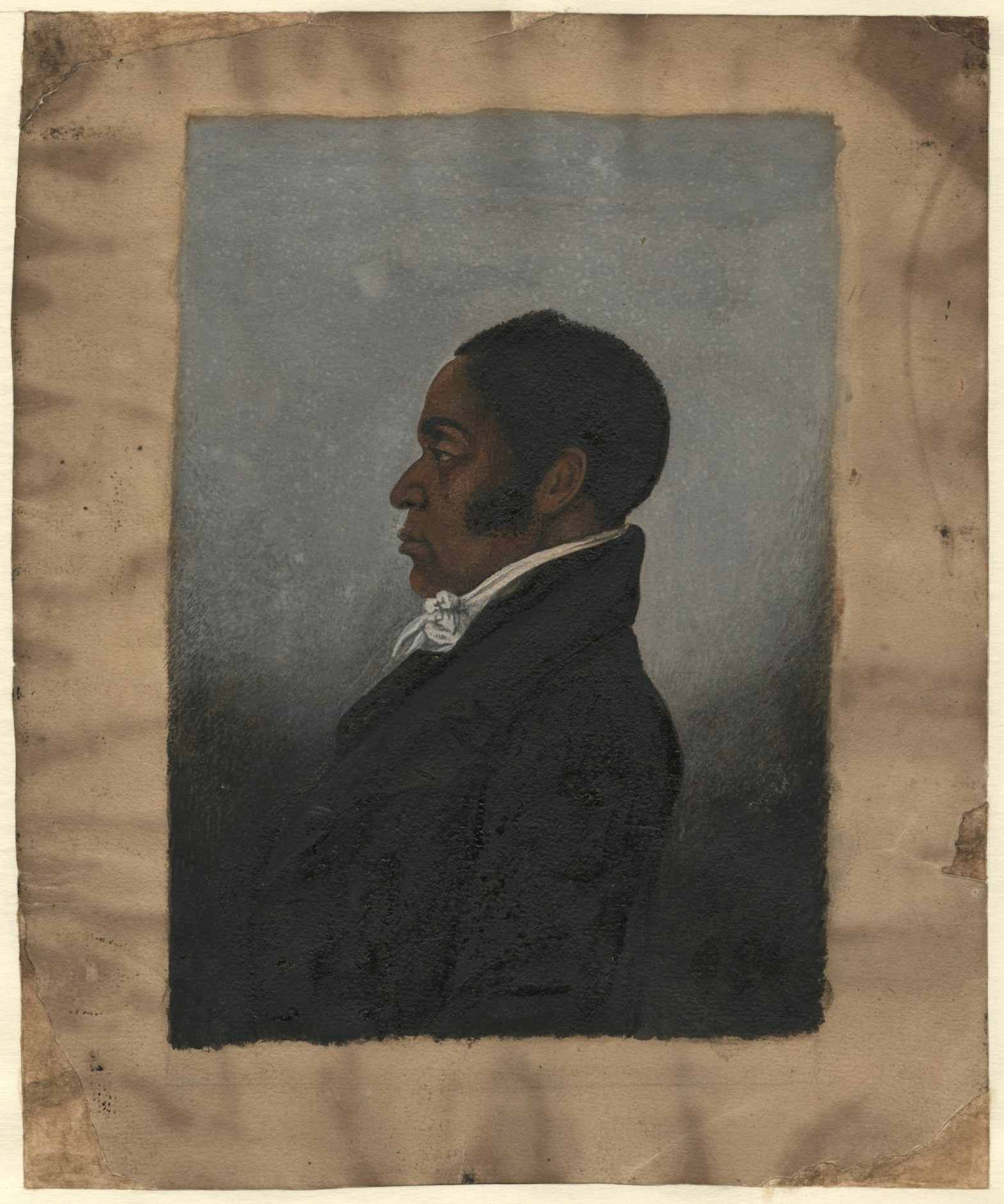
Photo: Artist unknown/Historical Society of Pennsylvania.
Portrait of James Forten (c. 1834), oil on paper, from the Leon Gardiner collection of American Negro Historical Society records.

The US likes to designate a month for neglected groups to be honored, which is OK, I guess, but accomplished women are interesting even when it isn’t Women’s History Month, as are people who identify as Latino/a when it isn’t National Hispanic Heritage Month or African Americans when it isn’t Black History Month in February. I like to post the stories year round. So it’s August, and here’s a bit of Black history.

At Hyperallergic, Xenobia Bailey offers research on 19th century fiber craftsman James Forten.

Bailey begins, “That I, a quiet, radical, African-American fiber artist, raised in a nautical lakeshore Black community in the Pacific Northwest, would find the book A Gentleman of Color: The Life of James Forten by Julie Winch, about a free-born, quiet, radical, elite African-American fiber craftsman, living in North America from 1766 to 1842 — the most prosperous and philanthropic sailmaker, born in Philadelphia during the turbulent period of the Revolutionary War — was truly a cosmic alignment. … I saw this book steps from the Schomburg Center for Research in Black Culture in Harlem, on the table of a street vendor and book dealer, Brother Mustafa. …

“James Forten’s miraculous life, and its role in shaping a prominent African-American history, is one of my greatest inspirations. Unknown to me, I opened my fiber arts studio in Philadelphia blocks away from where Forten’s sailmaking loft was located at Penn’s Landing on the Delaware River. It was my research into Forten’s life that bridged my wild, aquatic childhood, along Seattle’s Lake Washington, with my present fiber arts practice, which focuses on the evolution of African-American domestic textiles before and after emancipation.

“Looking back, it was fulfilling growing up in a lakeside ‘redlined’ Black community in Seattle’s Central District, with a pack of rambunctious children from the neighborhood. We played in the ponds and wooded area around our homes, venturing through Washington Park’s Arboretum to a now gentrified and forgotten area of natural bodies of shifting sand and clay mounds. They would emerge and disappear with the tides that created patches of land we claimed and named as our islands.

“We’d play pirate captains, patterning ourselves on the rowdy Seafair Pirates who opened the citywide Seafair summer festival of parades, hydroplane boat races, and carnivals every year. We built three-walled log cabins with open roofs and gathered floating logs for rafts from the fallen trunks, broken roots, branches, mud, and stones, and as our furniture we used the beautiful, organically sculpted driftwood that was scattered along the edge of the lake.

“Like James Forten’s community, ours was an unfamiliar story of the African-American experience. Our playground was the shoreline, with a backdrop of flying sea hawks, seagulls, rowboats, motorboats, and houseboats. And, like Forten, we were mesmerized by the majestic sails on the sailboats. …

“As with young James Forten in the mid-1700s, we too had the inquisitiveness and freedom of imagination of childhood — characteristics that continue to serve us as adults. We were aware of the community activism, cultural revolutions, and Black Power Movement happenings of the 1960s. In our imaginations, this was our private utopia. We’d make believe whatever we wanted. …

“James Forten and my siblings and I also share the experience of having a father who was an intuitive and knowledgeable maker. The senior Forten was a master sailmaker who repaired worn sails and prepared raw materials for sewing the strong textiles into tents for surveyors and sails for large-sail ships. …

“My father was a self-taught manipulator of electrical wiring. He purchased an abandoned van for about $100 and a broken floor buffer for $25 from a local junkyard and rewired them, which allowed him to start our family’s janitorial business.  This upcycling practice was common in our underserved yet sustainable community in an otherwise booming industrial Seattle. 

“Mrs. Forten, a ‘fierce’ homemaking mother, refused to give birth to children until she was able to buy her freedom at age 42; this was followed by her birthing two free, healthy children whom she groomed into outstanding adults. One of my fierce homemaking mother’s many gifts was enriching our home with vintage crocheted Afghans and quilts that she would purchase from the Goodwill Store and then elegantly drape and tuck the handmade textiles over our secondhand furniture.

“Forten was an abolitionist. His benevolent service to both free and enslaved Black people during the unsettling times of the Fugitive Slave Acts (passed by the US Congress in 1793 and 1850), the American Revolution, and the state of affairs before Emancipation is deeply admirable. 

“Forten learned his discipline starting at the age of seven, from going to work with his father when an apprentice was absent, at the sailmaking loft near their home. This is the same loft young Forten would buy for his future successful sailmaking business, from Robert Bridges, the man who employed his father.

“At his prestigious sailmaking loft, Forten employed Black, White, and Indigenous men who were supported by his engineering a unique suite of sails and a device I am currently researching allowed his commissioned ships to outpace British war ships during battles and sea pirate ships searching for booty.”

Read about Forten’s connection to Paul Cuffe and the Back to Africa movement at Hyperallergic, here. No firewall.

Read Full Post »