Feeds:
Posts
Comments

Posts Tagged ‘sculpt’

Photo: Sasha Arutyunova.
Austin Phillips, one of the last full-time professional makers of ventriloquist dummies in America.

Sometimes the unusual careers that one reads about seem to fall out of the blue onto the people.

Not so in the case of the young man making ventriloquist dummies in today’s story. It sounds like he was born to do this work.

Cornelia Channing writes at the New York Times, “In the backroom of a small, cluttered workshop in Portland, Maine, a figure lies facedown on a table. Its head has been cut open, exposing a delicate anatomy of brass rods, hinges and levers.

“It is motionless, as though sleeping. But soon it will turn its head, blink, crack a wry smile and part its lips to speak. Each movement will be directed by an intricate network of hand-soldered mechanisms concealed inside its small, hollow body.

“The figure is a recent creation of Austin Phillips, one of the last full-time professional makers of ventriloquist dummies in America. A craftsman working in a tradition that stretches back to Victorian music halls and vaudeville theaters, Phillips, 33, creates custom figures for performers and collectors while preserving a disappearing art.

“ ‘To some people, these are just puppets,’ Phillips said in a recent interview at his shop. ‘To me, there’s so much to them. It’s sculpture, casting, painting, sewing, mechanics, history, research, performance design — all at once. ‘They are like kinetic art objects.’ …

“Making a dummy begins with the face. Phillips pours resin into a handmade mold and then reinforces the shell with epoxy. Once the casting cures, a hollow skull is ready for eyes, a mouth and internal mechanisms. Phillips then paints the dummy’s features, creating distinct, expressive characters. …

“Phillips’s fascination with puppets began early. When he was 5, his parents took him to a mall where he spotted in a shop window a toy Charlie McCarthy, the monocled dummy made famous by the ventriloquist Edgar Bergen.

“Phillips was transfixed. ‘There was something about it that really drew me in,’ he said. ‘It looked mechanical and yet somehow alive.’

“By 14, he was carving his own figures from wood and building simple machines, obsessed with anything that could be taken apart and fixed, like pinball machines and motorcycles. While studying technical theater at the University of Maine at Farmington, he built dummies in his dorm and began selling them on eBay, which snowballed into a career. …

“To create the interior mechanisms, Phillips hand-solders brass components that will control every blink and smile. Each element is attached, via wires or strings that run through the neck, to a small lever in the puppet’s torso. …

“The puppets vary in complexity. Some have simple designs with just a moving head and mouth, while others are elaborately mechanized with 10 or more finger-operated levers. These can have eyelids that blink and wink, eyebrows that rise and lower, lips that appear to spit, ears that wiggle and legs that kick — all in one figure. …

“Most of his customers are collectors and hobbyists, but a few are professional ventriloquists. He recently repaired a talking-dog apparatus for a performer. Another customer, the comedian and ventriloquist Sophie Becker, has called him from the road for emergency repairs.

“ ‘We changed a string over FaceTime once,’ he said.”

More at the Times, here.
Read Full Post »

Photo: Business Trip Friend, 2017.
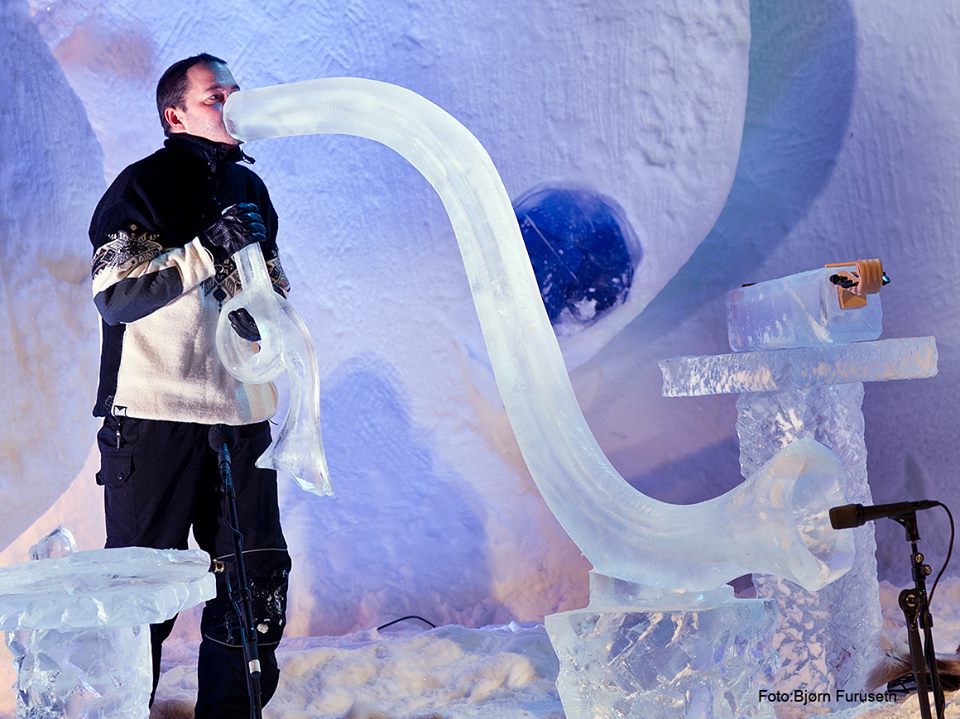
An Ice Music Festival is held in Norway most every year, although it was cancelled for 2021 because of Covid. In 2020, it was held in the village of Finse, near the Hardangerjøkulen glacier.

Finally, the ice is melting where I live. I can’t help but think “good riddance” after an outdoor birthday party Sunday that saw us slipping and sliding with the grandchildren through the woods. But I have to remind myself that they actually love the ice (two kids are hockey players), and in fact, there are a variety of reasons to love ice.

Consider Lola Akinmade Åkerström’s report at National Geographic.

“Brittle bursts that mimic cymbals. Deep hollowed notes reminiscent of metal drums. These are some of the surprising sounds that Siberian percussion group Ethnobeat created from Russia’s frozen Lake Baikal in a 2012 viral video that introduced millions around the globe to ice music.

“But similarly haunting melodies had been filling dark Arctic nights across Norway and Sweden for several years. In 2000 Norwegian composer and percussionist Terje Isungset performed the world’s first ice music concert inside a frozen waterfall in Lillehammer.

“Six years later Isungset founded the annual Ice Music Festival Norway, drawing curious adventurers willing to brave subzero temperatures in order to experience this unique way of bonding with nature through music. (This winter’s festival was canceled due to the pandemic, but he’s planning to livestream a concert on March 14.)

“For Isungset, who was already experimenting with natural elements such as stone and wood when composing music, his foray into ice was an organic next step.

‘When I first started playing on clear ice, I found its pure sound surprisingly warm and gentle compared to the sound of crushed ice beneath your feet.’ …

“So what exactly is ice music? Musicians tap beats out of naturally occurring ice or play instruments crafted from ice. Many of the instruments may seem familiar, but with ice music, nature takes center stage—and brings more than a few notes of unpredictability. Both the making and playing of the instruments are processes that can’t be fully controlled, which only adds to the art’s appeal.

“Carved instruments can be either completely made of ice, such as horns and percussion, or hybrids, like harps, in which the main body is ice with metal strings attached. Isungset collaborates with award-winning ice sculptor Bill Covitz, who is based in the United States but travels to concert destinations around the world to make instruments on location.

“Another American artist, Tim Linhart focused on snow and ice sculptures in the U.S. before moving to Europe and building a reputation for crafting ice instruments. Thirty-six years later he has created hundreds of them. …

“By studying and intricately blending materials — such as homemade clear ice and carbonated water, plus crushed mountain snow — Linhart can make instruments like violins and tune them as close to perfect as nature allows. …

” ‘When you approach that breaking point between the tension of the string and the thickness of the material, right there is where music truly happens,’ says Linhart, who honed his craft through trial, error, and a few exploding instruments. …

“When the show starts, other complications arise. “’Ice is always in motion; expanding, contracting and sublimating away into the atmosphere,’ says Linhart. ‘Warm bodies melt instruments. Audiences increase temperatures because they are breathing. Instruments need to be re-tuned differently. Some drop several notes, others rise.’ To mitigate this, he designs domed concert venues that ventilate heat away from the instruments.

“Another hazard? Horn players’ lips can stick to the mouthpieces of their instruments. And most of the time, the performers can’t practice on their delicate tools, so they often compose music live and improvise in front of the audience. …

“Other instruments such as the ‘iceofon’ — a cross between a xylophone and a marimba that pairs nicely with the harp — need to be tuned differently to avoid playing entire concerts in one tone.”

Lots more about musicians up for a challenge at National Geographic, here.

Read Full Post »