Feeds:
Posts
Comments

Posts Tagged ‘culture’

Photo: Alexandra Corcode.
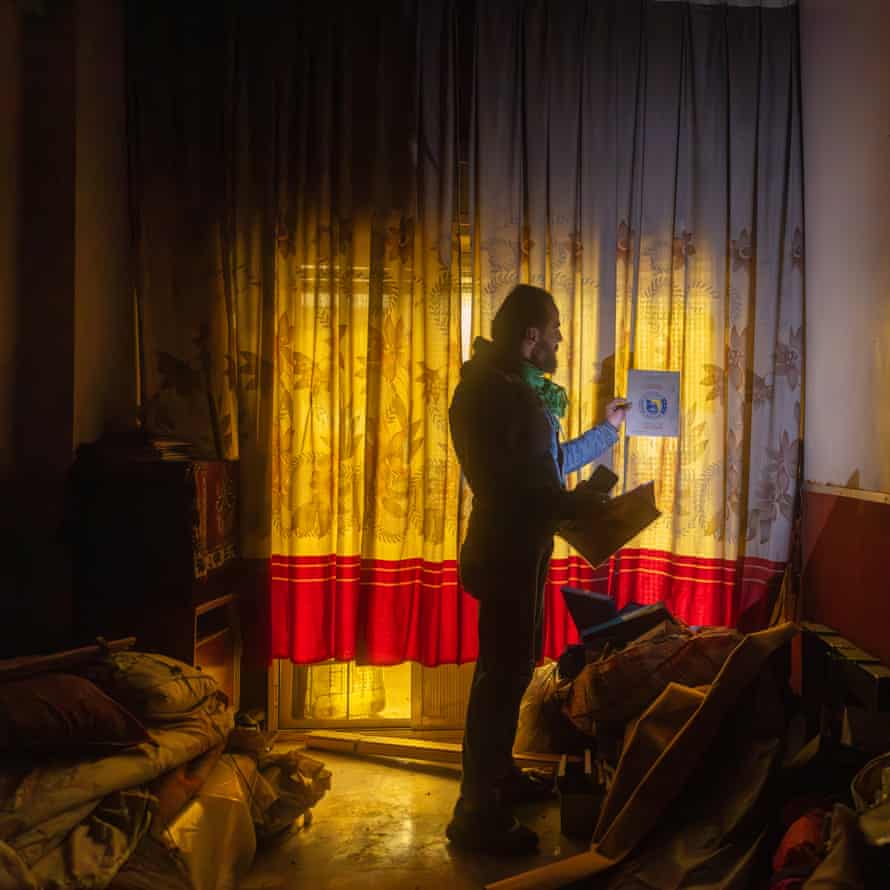
Mohamad searching for memories in a suitcase in Damascus. Their apartment was a stage — until the Assad government arrested them.

In today’s post, we learn more about how people living under repressive regimes keep culture and freedom going.

Andrei Popoviciu writes at the Guardian, “Thick layers of dust shimmer in sunlight as Mohamad and Ahmad Malas sift through old belongings in their Damascus apartment, abandoned for 14 years. …

“On one of the walls portraits of their father and one of their brothers, who have died, hang frozen in time. There’s no electricity so they use their phone torches to light their way as they collect personal artifacts they long forgot about.

“ ‘Looking around brings back so many memories,’ Mohamad says. ‘It’s painful.’

“For the 41-year-old brothers, returning to their flat is bittersweet. Their apartment was more than just a home. It was once a stage, a space where they performed original theatre plays away from the watchful eye of the Bashar al-Assad regime, which tightly controlled and censored artistic expression. In the two years before they left Syria, they performed more than 200 plays in their home.

“But their lives changed in 2011 when they were arrested for participating in the popular movement that started on the heels of the Arab spring and sought to remove Assad from power. Ahmad was wanted by the political police for sharing a revolutionary magazine with a friend, so the day security forces came knocking he fled immediately. Mohamad stayed behind to gather a few belongings before they escaped to Lebanon.

“Life there was uncertain, with Syrians facing the constant threat of deportation. Egypt offered brief stability, despite them feeling they could not continue their work as actors. Europe was where they felt they could freely perform with no censorship or threat. In 2013, they arrived in France as asylum seekers and speaking no French.

“Their first year in France was a struggle, spent moving from city to city, unable to work and battling to learn the language. Eventually, they were granted asylum and settled in Reims, in the country’s north-east. There, they rebuilt their acting careers, landing roles in theatre plays, films, and television.

“As they found their footing, they wrote and performed a play, The Two Refugees, chronicling the experience of refugees in France and inspired by their story. The production was a success and gained international recognition, taking them from Iraq to Japan and Jordan, often with the support of French cultural institutions.

“ ‘France gave us security and a chance to continue our art in a free world,’ said Ahmad. …

“They never imagined they would return to Syria. But as rebel forces were taking city by city, advancing toward Damascus in late 2024, they closely followed events from afar. Mohamad was at a film festival in Jordan; Ahmad was in France.

“On the morning of 8 December, Mohamad sent Ahmad a video. It showed people celebrating in a Damascus square, waving the revolution’s green flag and singing slogans against Assad. Ahmad could hardly believe his eyes. A deep longing stirred within them both. Soon after, Mohamad traveled from Jordan, and Ahmad followed from France.

“ ‘It felt like a dream come true,’ said Mohamad of the moment they entered Syria. ‘We felt like we could fly, it was surreal to walk through the streets and not see Assad’s photos everywhere.’ …

“The brothers knew they had to bring their play home, so they started performing it across the country, from Aleppo in the north to the coastal city of Tartus. They were unsure how an audience that had never left would react to a story of exile.

“ ‘Everyone understood it,’ Mohamad said. ‘I get it now – because even though they never left, they felt trapped in their own country.’ “

More at the Guardian, here. No paywall. Nice pictures.
Read Full Post »

Photo: Howard LaFranchi/The Christian Science Monitor.
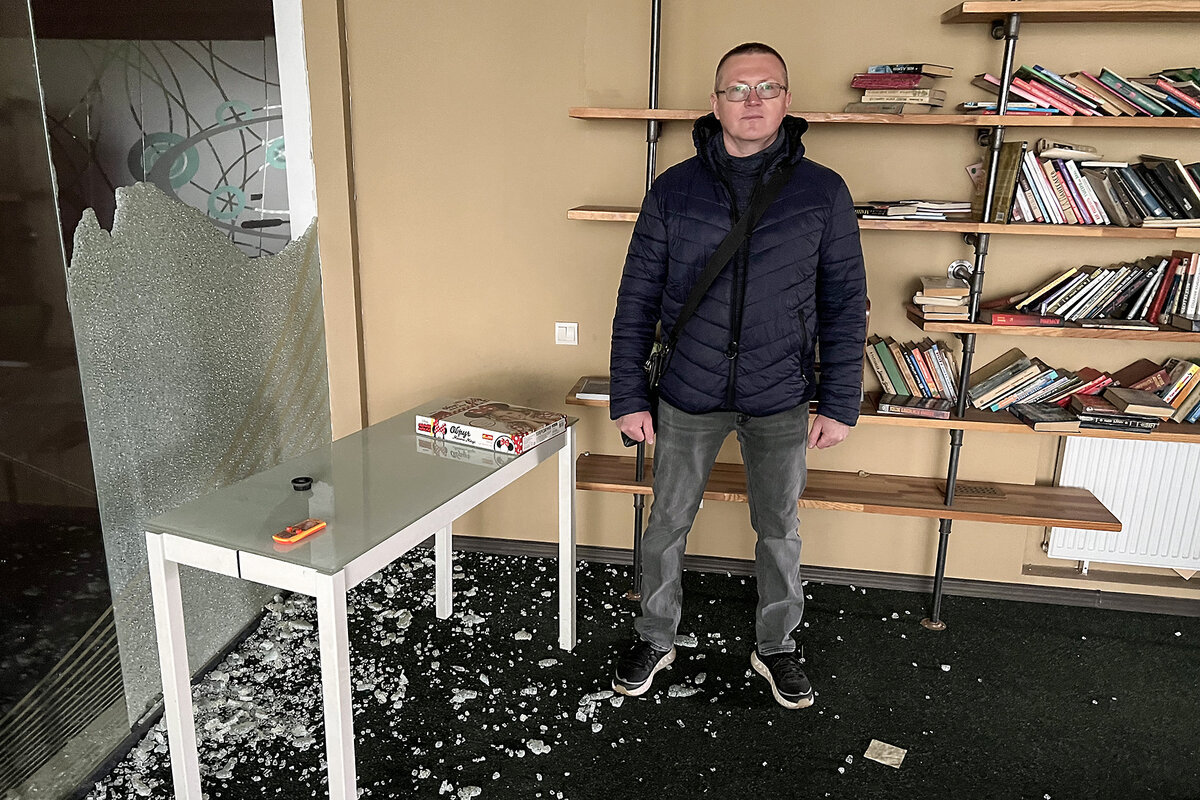
Ihor Pohorielov, commercial director of Ranok Publishing, at the company’s bomb-damaged offices, in Kharkiv, Ukraine, Nov. 4, 2024.

If ants can keep working and rebuilding after we’ve knocked over their anthill, how much more humans in war zones?

Among the many buildings damaged or destroyed by the Russian invasion in Ukraine are publishers of books. But books remain strong and Ukrainians keep reading.

Here’s a story by Howard LaFranchi at the Christian Science Monitor.

“Across Ukraine, but especially in Kharkiv, the country’s publishing capital, Russia’s war has been something of a boon to the nation’s publishing industry. More Ukrainians are seeking solace and distraction in books, and interest in Ukrainian literature and Ukrainian-language books is spiking.

“Many of the country’s publishing houses – from textbook-publishing giants to boutique operations specializing in culture – are keeping busy. And this despite the fact that Russian President Vladimir Putin has made publishing houses a key target of his war on Ukrainian culture.

“Publishers say a combination of their resolve to keep operating and a reawakened enthusiasm for books among a variety of readers is keeping the presses running.

“ ‘The war is reminding Ukrainians that books are an outlet for joy, for culture, for travel, when other outlets are closed to us,’ says Yuliia Orlova, general director of Vivat Publishing.

“ ‘We hear all the time about people rediscovering the joys of books as they spend less time on their computers and phones,’ she says. ‘People want to distract themselves from all the sad and depressing things going on around them, so they turn to fiction and fantasy. It’s their way to escape.’

“One night in November, Ihor Pohorielov was awakened by a Russian bomb blast that nearly shook him out of bed. His thoughts went to the modern offices and cavernous storage facilities where he works as the commercial director for Kharkiv’s Ranok Publishing, and which had already been the target of Russian air strikes. …

” ‘I thought of the orders we need to get out and the clients we need to serve – so I came into work’ the next day. …

“Across Ukraine, but especially in Kharkiv, the country’s publishing capital, Russia’s war has been something of a boon to the book publishing business.

“As more Ukrainians seek solace and distraction in books, and as interest in Ukrainian literature and Ukrainian-language books spikes, many of the country’s publishing houses – from textbook-publishing giants to boutique operations specializing in culture – are keeping busy.

“And this despite the fact that Russian President Vladimir Putin has made publishing and printing houses a key target of his war on Ukrainian culture.

“Kharkiv’s publishing industry was shaken to its core last May when a Russian S-300 missile struck the giant Faktor-Druk, one of Europe’s largest printing houses. The blast destroyed presses, incinerated some 100,000 books, and knocked out the three publishing companies housed there. …

“But the sense of devastation was short-lived. In a show of solidarity, several European publishers offered to print Ukrainian books for distribution to millions of Ukrainian refugees around Europe.

“An American philanthropic organization, the Howard G. Buffett Foundation, quickly agreed to pick up the tab for Faktor-Druk’s reconstruction. …

“ ‘Printing in Kharkiv is hanging on despite the almost daily attacks on the city,’ … says Yuliia Orlova, general director of Vivat Publishing, a division of the Faktor Group. …

“Ms. Orlova does not hide the fact that the war has been devastating for Ukrainian publishing in many ways, especially for the people who work in the sector. ‘The attacks and the destruction in the city have a big impact on the mental health of our workers. People don’t sleep and they are constantly worried for their families,’ she says. …

“Since 2022, the number of registered publishers in Ukraine has plummeted from about 1,600 to 150, Ms. Orlova says. …

“But Ms. Orlova cites another statistic that underscores the bright side of Ukrainian book publishing: Over the same period, the total number of books printed grew by 70%.

“The reasons for that jump are largely related to the war. Russia’s systematic destruction of Ukraine’s infrastructure has meant widespread power outages and spotty access to the internet, Ms. Orlova says. ‘We hear all the time about people rediscovering the joys of books as they spend less time on their computers and phones,’ she says. …

“Mr. Putin’s war on Ukrainian culture – targeting museums, churches, universities, and publishing houses – is feeding a renewed interest in history, language, art, and literature that confirm Ukrainian nationhood, publishers say.

” ‘Interest among Ukrainians in who we are was already starting to grow, but it was the full-scale invasion that really encouraged this desire to know more about our history and culture,’ says Oleksandr Savchuk, whose specialty Kharkiv publishing house carries his name.

“ ‘For many Ukrainians, the picture of who we are was like a puzzle with lost pieces,’ he says. ‘But now people are finding those pieces so we can complete the full picture.’

“To help nurture that process, in 2023 the philosophy professor and publisher opened a facility he calls a ‘Book Strongroom,’ a combination bookstore, event space, and neighborhood bomb shelter adjacent to his publishing operations. …

“Oleksandr Savchuk is a small player who has published about 50 titles over the last decade. … ‘For the 12 years before the invasion I was suffering to try to show people their great history and culture. It was a hard-going process,’ he says. … ‘I see now that I’m being heard.’ “

More at the Monitor, here. No firewall, reasonable subscriptions rates for a paper unusually strong in international news.

Read Full Post »

Photo: Altitude.
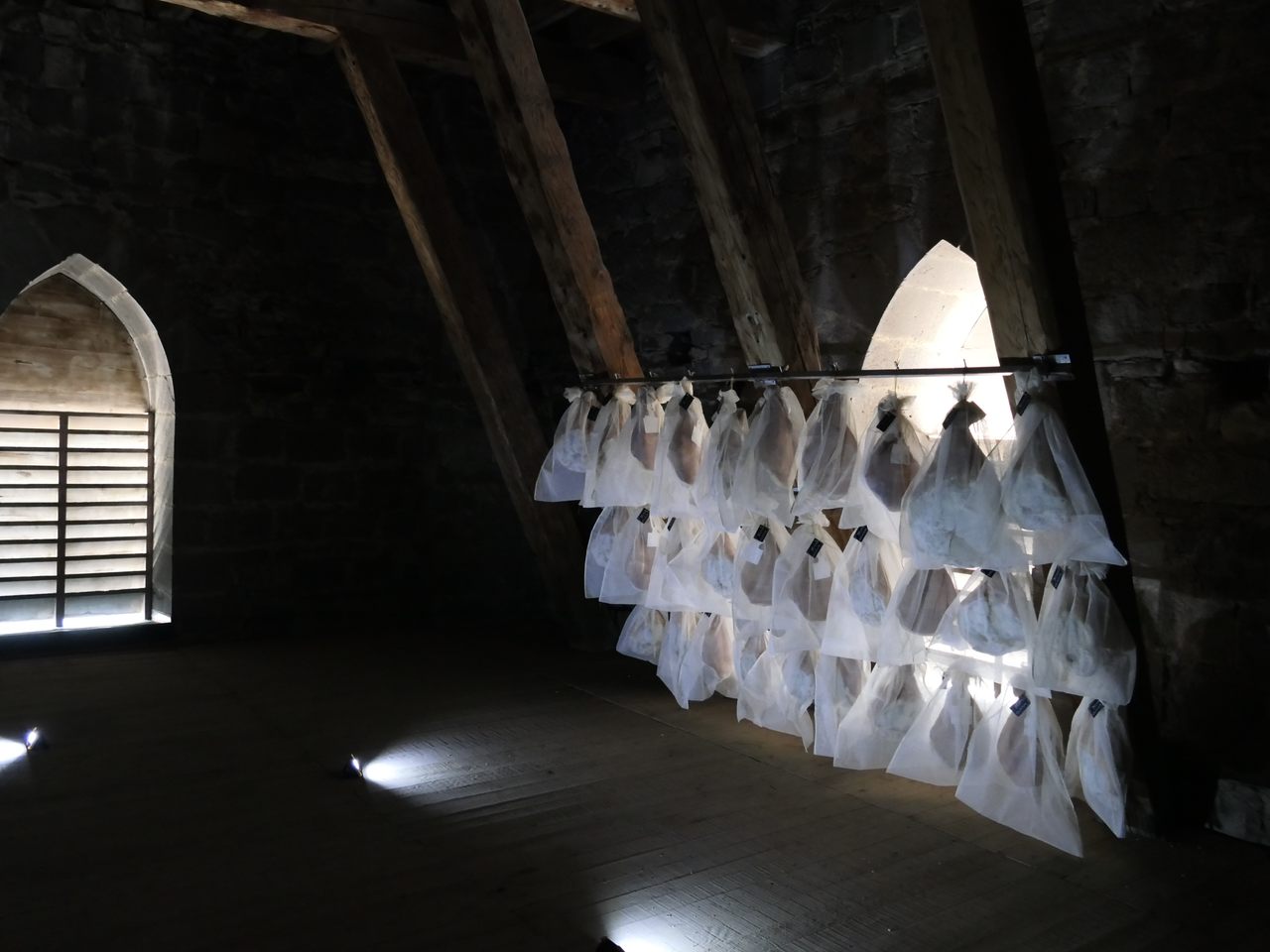
At Saint-Pierre Cathedral in France, winds from the surrounding plateaus create an ideal environment for curing ham in the bell tower. 

I’ve read about decommissioned churches being repurposed for affordable housing or art centers, but today’s story is the first I’ve seen about providing an important service for pig farmers.

Emily Monaco writes at Atlas Obscura, “In Saint-Flour, a town in the Auvergne region of central France, the highest cathedral in Europe perches at 892 meters (nearly 3,000 feet) above sea level. Saint-Pierre sits at the confluence of the dry winds blowing across the surrounding plateaus, making it, surprisingly, the ideal place to age local hams to perfection.

“This church-aged charcuterie was the brainchild of Philippe Boyer, who became rector of Saint-Pierre in 2011. Soon thereafter, he encountered his first challenge: The 600-year-old cathedral was in need of some TLC, specifically for its 19th-century choir organ. Repairs would cost several thousand euros, money no one had. …

“Boyer was undeterred. ‘I said to myself, “Why not make a product in the spirit of the great medieval abbeys, who made their own food, which they sold to survive, to live?” ‘ he says. ‘In this case, it’s not for us to live, but to give new life to heritage.’

“Boyer began by adding beehives to the cathedral roof, and, following the success of the resulting honey, he turned his attention to one of the region’s star products: Jambon d’Auvergne, a ham boasting a protected status similar to Champagne or Roquefort.

Typically aged in drying rooms for eight to 12 months, these hams, Boyer figured, could easily be aged instead in the cathedral’s breezy north tower.

“He mentioned the idea to a reporter from local newspaper La Montagne, and the article caught the attention of farm cooperative Altitude. ‘We thought the idea was pretty original, pretty iconoclastic,’ recalls Altitude communications manager Thierry Bousseau, noting that the group also thought the project would be the ideal way of promoting the work of their farmers and salaisonniers, experts in the art of curing and aging charcuterie like sausages and hams.

“A host of bureaucratic hurdles loomed, including authorizations from French health services and the certifying board granting the hams IGP (Indication Geographique Protégée) status. And of course, the architecte des bâtiments de France, a civil servant devoted to the protection of state-owned buildings, had to be consulted. ‘He gave his OK,’ says Bousseau, and so, in June 2022, Bishop Didier Noblot officially invoked the protection of Saint Antoine, patron of charcutiers, in blessing the first hams.

“Today, hams produced by one of Altitude’s 30 farms are first aged in the cooperative’s aging rooms. Only the best are selected for sale to the Association des Amis de la Cathédrale, whose volunteers meet weekly to replenish the supply, carrying each ten-kilo (around 22 pounds) ham up the 150-odd steps of the spiral staircase to the tower. Here, they’re swaddled in bags and suspended from hooks just beneath the 19th-century bells. About 50 hams hang here at any given time, dry-aged for at least two months under the watchful eye of Patrice Boulard, a member of the Association and an expert salaisonnier with Altitude. The environment, he says, makes for a superlative ham. …

“But after just a few months, the project hit a snag. The new architecte des bâtiments de France noticed grease stains on the floor below the hams, and, Boyer recalls, ‘he started to panic.’ The stains were easily explained by the fact that the bells are greased every six months, but, fueled perhaps by the memory of Notre-Dame’s 2019 conflagration, the architect dubbed the hams a fire hazard. ‘Hams don’t catch fire, just like that,’ protests Boyer. But the group was nevertheless forced through yet another series of bureaucratic hoops. Six months after adopting new protocols, things seemed to have settled, Bousseau recalls. ‘And then in October 2023, we got a letter.’

“By this point, Boyer had been transferred to nearby Aurillac, so it was the new vicar, Jean-Paul Rolland, who received the news: The changes had been deemed insufficient, and effective immediately, the hams had to be removed.

“But Rolland took advantage of the bureaucratic tangle in forming his response. ‘He decided that the diocese, as the renter of the space, was not responsible for what happened in the cathedral,’ says Bousseau. ‘He got the message across that basically, the hams weren’t going anywhere.’

“These days, the status of the project is ‘a bit convoluted,’ admits Bousseau. ‘Officially, aging the hams is illegal, but the reality is that they’re still there.’ And despite their novelty, they’ve become beloved among locals. ‘Saint-Florins have appropriated them,’ he says, ‘as though they had always been.’ …

“According to Bousseau, ‘There’s a contradiction regarding the announcements made by the state. “We can’t finance our heritage.” And then we, at the local level, find solutions, and there’s a civil servant putting a wrench in the works.’ …

“In late October, the Minister of Culture voiced her official support of the hams.”

Wondering what blogger and farmer Deb has to say about all this.

More at AtlasObscura, here.

Read Full Post »

Photo: María Magdalena Arréllaga.
“People dance into the wee hours,” writes the New York Times. “For many young Brazilians, the charme scene has become a symbol of Black identity and culture unique to Rio’s working-class areas.”

I’m always grateful when the mainstream media digs into an aspect of another culture, something I know nothing about. Today we learn of a vibrant scene that has thrilled thousands of people since the 1970s. And what did I know about it before? Nothing.

Ana Ionova writes at the New York Times, “Trucks, buses and cars rumbled overhead, drowning out Marcus Azevedo’s voice. In the distance, sirens blared and exhaust pipes backfired. From under a highway overpass, Mr. Azevedo, a dance teacher, shouted over the noise, ‘Five, six, seven, eight!’

“He hit play on his phone, and the first song started blasting from a pair of crackling speakers. Six rows of dancers began shuffling, twisting and popping their hips in unison. The playlist? All R&B classics. …

“The dance routine wouldn’t have been out of place in New York City or Atlanta or Los Angeles. But we were on the decaying fringes of Rio de Janeiro, a metropolis better known for samba. And this dance is called charme, a style born here in the 1970s as an ode to American soul, funk and, later, R&B.

“This spot, in the working-class suburb of Madureira, has become a temple for lovers of charme over the decades. By day, it’s where many hone their moves. Once mastered, the steps are flaunted at nighttime parties known as ‘baile charme.’

“ ‘This is a magical place,’ said Mr. Azevedo, 46, who began dancing charme — Portuguese for charm — when he was 11 and now leads a dance company focused on the style. ‘There is something spiritual, an energy that can only be found here.’

“But the old-school R&B tracks shouldn’t fool anyone into thinking that this is a nostalgic crowd yearning for a throwback. This hotbed of charme is attracting an increasingly younger crop of dancers, who are keeping the scene alive — and transforming it in surprising ways.

“On a recent muggy Saturday morning, a few dozen people — from restless children and lanky teenagers to men and women in their 50s and 60s — flocked to the shady overpass. They were there for a class led by Mr. Azevedo and three other instructors, all part of a program meant to introduce charme to more people.

“A small group practiced steps before class started. ‘It’s not hard — a little step here, a little step there,’ said Juliana Bittencourt, 30, an administrative assistant, showing a fellow student how it’s done. ‘Charme is medicine, it has the power to cure anything.’

“Geovana Cruz, 20, a bank teller who had come from São Paulo by bus that morning, excitedly stepped into the front row of dancers.

“ ‘It’s addictive,’ said Ms. Cruz, who comes nearly every week and whose charme dance routines on TikTok draw thousands of likes. …

“ ‘Charme is not just music,’ said Larissa Rodrigues Martins, 25, a schoolteacher. ‘It’s a place where we share and learn from each other — not just about steps, but also about life.’ …

“The birth of charme is rooted in the influx of Black music and culture from the United States in the 1970s and 1980s. At a time when Rio’s far-flung, impoverished outskirts offered young people few sources of pride or identity, the rhythm and style of American artists like James Brown and Stevie Wonder emerged as an inspiration.

“One night in 1980, a D.J. named Corello was working at a club and decided to mix in some Marvin Gaye. ‘Now it’s time for a little charme, slow your body down,’ he called out. The term stuck and came to define the homegrown urban dance movement.

“After many Black social clubs went out of business in the 1990s, charme lovers moved the party to the nearby Madureira overpass, where they could dance undisturbed. …

“The movements that define the dance are at once familiar to urban street dancers yet uniquely ‘Carioca,’ as anyone or anything from Rio de Janeiro is known. The swings carry a hint of bossa nova’s sway; the two-steps have a distinct samba flavor; and the bold hip bounces channel Brazilian funk. …

“For many younger people, the charme scene under the overpass has increasingly become a symbol of Black identity and culture that is unique to Rio’s working-class neighborhoods.

“ ‘This is our ancestry,’ Ms. Martins said. ‘The previous generation showed us this space where we can express ourselves.’

“During the nighttime partying, older revelers mostly hung back. They swayed, stepped and turned with more subtle, sensual movements. ‘We learn from the new kids, and they learn from us,’ said Bruno Oliveira, 44, a clothes salesman wearing a bejeweled cap. ‘It’s love, it’s peace.’ ”

More at the Times, here. Great pictures, especially the videos.

Read Full Post »

For our family, this day is partly about opening gifts and eating. If the roads don’t ice up for our get togethers, it just feels happy and sleepy and good.

Sending greetings to all who celebrate Christmas, to all who are celebrating the beginning of Chanukah tonight, and to all who celebrate other traditions.

In fact, I’d love to hear of any childhood memory you may have of a tradition in your family. Not necessarily for this time of year. Families sometimes develop traditions that no one else shares. I’m thinking of little things like singing a certain song every year when you catch the first glimpse of your favorite beach. Or special gestures after two people say the same thing simultaneously.

I’d also be interested in cultural traditions from a place you spent time as a child.

Thank you for your presence on WordPress. It’s fun to have friends in other places.

Read Full Post »

Photo: Julia Kochetova/The Guardian.
Leonid Marushchak with artworks from his private collection. He launched a death-defying rescue plan to help museums save Ukraine’s art from the invaders.  

You may know about the Monuments Men, charged by President Roosevelt with protecting cultural heritage during World War II. In Ukraine, after the Russian invasion, private individuals took on a similar task. One man especially.

At the Guardian, Charlotte Higgins has a fascinating piece about what historian Leonid Marushchak and his cohorts have accomplished.

“In early March 2022, when his country seemed in danger of falling to the Russians, it occurred to Leonid Marushchak, a historian by training, to call the director of a museum in eastern Ukraine to check that a collection of 20th-century studio pottery was safe.

“He had loved the modernist works by artist Natalya Maksymchenko since he had encountered them almost a decade earlier. There were vessels covered with bold abstract glazes in purple, scarlet and yellow; exuberant figurines of musicians and dancers with swirling skirts; dishes painted with birds in flight. The collection was the radiant highlight of the local history museum in Sloviansk, the ceramicist’s home town.

“It was remarkable that they were in this small museum at all. Though she was born in Ukraine in 1914 and studied in Kharkiv, Maksymchenko had lived the rest of her life in Russia. But, after her death in 1978, her family, fulfilling her wishes, oversaw the transfer of about 400 works from her studio in Moscow to the city of her birth. … Maksymchenko’s final gift to her home town and country seemed like a statement of defiance.

“Now, as the Russian army inched nearer and nearer to the museum, Marushchak worried that these works in delicate porcelain could be destroyed by a missile in a moment – or, if Sloviansk were occupied, taken by the invaders back to Moscow. Had the ceramics been prioritized for the first round of evacuations, Marushchak asked the museum director on the phone.

“ ‘Lyonya, what round?’ came the reply. ‘We still haven’t got the order to evacuate!’

“Marushchak phoned his friend Kateryna Chuyeva, who was then Ukraine’s deputy minister for culture. ‘Katya,’ he asked her, ‘why have you still not given the order for the Sloviansk museum?’ She explained that she couldn’t just authorize it herself – the regional authorities needed to request it first. So he called the region’s culture department. They said that to issue an order, they would first need a full list of items to be evacuated.

“Marushchak was furious. The situation was urgent; there was no time for that kind of paperwork. ‘Let’s just say I have sometimes had to take my time and breathe slowly,’ said Chuyeva, in the face of her friend’s sometimes volcanic passion. She found a way to break the bureaucratic impasse. Before the official order had even arrived, Maruschak was on his way to Sloviansk.

“Marushchak cannot drive. … Without his own means of getting to Sloviansk, Marushchak had his brother-in-law drive him from Kyiv 300 miles east to the city of Dnipro. From there, friends took him a further 50 miles, to the city of Pavlohrad. Then he walked to the last checkpoint in town and hitched a lift for the last 120 miles – this time, on a Soviet-era armored personnel carrier.

“In Sloviansk, artillery boomed alarmingly close; the opposing armies were fighting over a town only 18 miles away. When Marushchak reached the museum, staff were finally packing up the exhibits – though, to his annoyance, the official instructions on what should be prioritized dated from 1970, and stated that what he referred to as ‘an old bucket of medals’ from the second world war should be rescued first. Aside from the Maksymchenko ceramics and the medals, there was also a natural history collection to deal with – AKA, stuffed animals, which, just to add another layer of danger to the enterprise, had probably been preserved with highly toxic arsenic. …

“Since those early days of the war, with the help of a motley group of intrepid friends, Marushchak has achieved something quite extraordinary. He has organized the evacuation of dozens of museums across Ukraine’s frontline – packing, recording, logging and counting each item and sending them to secret, secure locations away from the combat zone. Among the many tens of thousands of artifacts he has rescued are individual drawings and letters in artists’ archives, collections of ancient icons and antique furniture, precious textiles, and even 180 haunting, larger-than-life medieval sculptures known as babas, carved by the Turkic nomads of the steppe.

“ ‘At times,’ said Chuyeva, ‘he has been doing almost unbelievable things’ – putting himself into extreme personal danger for the sake of often humble-seeming regional museum collections on Ukraine’s frontline.

“A nation’s understanding of itself is built on intangible things: stories and music, poems and language, habits and traditions. But it is also held in its artworks and artifacts, fragile objects that human hands have made and treasured. Once lost or destroyed, they are gone for ever, along with the stores of knowledge they contain, and potential knowledge that future generations might harvest from them. For Marushchak, his country’s culture, no less than its territory, is at stake in this war: a culture that Vladimir Putin has repeatedly claimed has no distinct existence, except as an adjunct to Russia’s.

“On that day in Sloviansk, something became clear to him: there was no point relying on official evacuation efforts. If he wanted to see the job done, he was going to have to do it himself. ‘He had to do it with his own hands,’ his friend, the artist Zhanna Kadyrova told me. ‘There was no one else.’

This is a long article. Read it at the Guardian, here. No paywall, but contributions are solicited.

Read Full Post »

Photo: Jean Ogden via Wikimedia.
Navajo Churro sheep.

There’s a story at National Public Radio about the special relationship between a kind of sheep and the Navajo people, or Diné. Ayesha Rascoe hosts the NPR program, which you can listen here, if you prefer.

Ayesha Rascoe: For centuries, the lives of Navajo people have been intertwined with livestock — specifically, one particular breed of sheep they’ve relied on for meat and wool. The tribe is well known for weaving the wool of Churro sheep into colorful clothing and tapestries. Those weavings can fetch thousands of dollars from collectors, but they have far more than monetary value. Raising Churro sheep and weaving their wool is an important way Navajo people pass cultural knowledge from generation to generation. KSJD’s Chris Clements visited a Navajo Churro sheep celebration.

Chris Clements: Inside a crowded farmhouse on the edge of the Navajo Nation, weavers are demonstrating how to spin, dye and treat wool from Churro sheep, which they consider sacred.

Roy Kady: Hello. My name is Roy Kady. I am from Goat Springs, Ariz.

Clements: Kady, who’s in his 60s, is standing outside, wearing an ornate turquoise necklace, earrings, bracelets, and a white hat. He’s considered a master weaver, part of centuries of Navajo citizens who’ve carried on traditional beliefs that date back to the 1500s when Churro sheep arrived with early Spanish colonists.

Kady: I’m filling these big shoes that my mother wore as an agropastoralist.

Clements: Tyrrell Tapaha is Kady’s student and his grandson, who’s here at the event. …

“Tyrrell Tapaha: There’s always been weaving in my life, whether it be his work, my grandma’s work, or my great-grandma’s work. ..

“Kady: Tyrrell [says] I want to weave a human form. Do you have any ideas how I could do that? And so I just share with him. …

“Clements: Tapaha has been learning the tricks of the trade since he was very young. When he was only 8, Kady had him teach a class on the art of finger weaving at a nearby chapterhouse. … Tapaha knows that Kady’s teachings will live on with him.

“Tapaha: At least it’ll last my lifetime, you know? And I kind of hear that in how Roy talks about his contribution to the space is like him being an older person now and kind of seeing that handed off.

“Clements: After the morning’s presentations, it’s time for lunch. The weavers roast mutton, a Churro sheep they slaughtered earlier in the day. Participants of the sheep celebration gather around the grill, watching the fire hiss and sputter as the mutton cooks. It’s common for every part of the animal to be used. Nothing, not even its hooves goes to waste.

“In 1863, the U.S. military forced Navajo people to leave their ancestral homelands and relocate to an internment camp. It’s known as the Long Walk. … It almost led to the extinction of the Churro sheep.

“Navajo people were allowed to return home four years later. Some tribal members who’d managed to escape the Long Walk, kept some Churro alive. And today, thousands of Churro sheep live on or near the Navajo Nation.”

Read more about the sheep and the passing along of Diné culture at NPR, here.

Read Full Post »

Photo: Navajo-Hopi News.
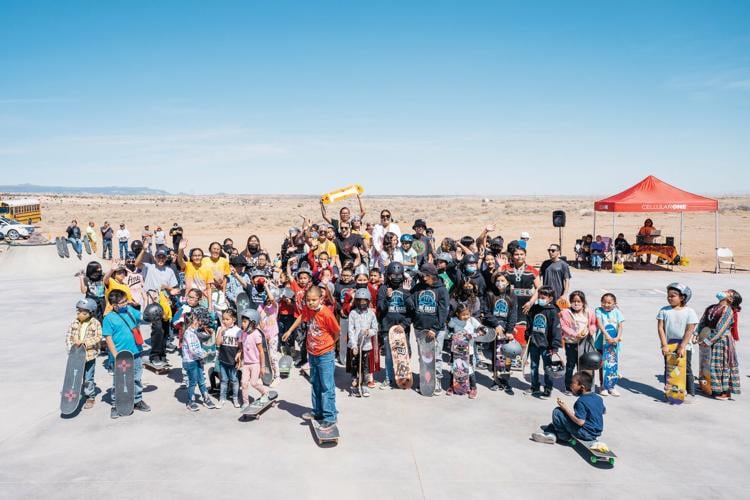
Two Gray Hills Skatepark in Newcomb, New Mexico.

The forced assimilation of indigenous children into colonist culture damaged the children, the relatives of the children, and the grown children’s descendants. In today’s story, we learn how one descendant was surprised to discover she was Navajo and looked for a way to help her long-lost community.

Roman Stubbs writes at the Washington Post, “The wind rolled off the Chuska Mountains and along the desert floor, whipping red dust and tumbleweed across the pavement of Two Grey Hills Skatepark. It was a pale Sunday morning in May, and Amy Denet Deal stood on a ledge, tying a crimson bandanna around her silver braids and smiling as she watched the children swerve down ramps in the middle of the storm.

“ ‘Amy!’ ” a young boy yelled, excited to greet the woman who helped bring the skatepark to this remote northwest corner of the Navajo Nation.

“ ‘Hi, honey. How you doing?’ she replied. ‘You’ve grown a foot since I last saw you!’

“Denet Deal, 59, considered herself younger than the boy in Diné (Navajo) years. She had reconnected with the tribe only five years earlier after a lifetime of displacement, giving up most of her belongings and a ­lofty salary as a corporate sports fashion executive in Los Angeles to move to New Mexico.

“The pandemic opened her eyes to the inequities children on the reservation face, including high rates of diabetes, mental health issues and suicide. Navajo Nation is roughly the size of West Virginia — 16 million acres stretching across Arizona, New Mexico and Utah — yet there are few opportunities for kids to play sports, with many remote areas lacking outdoor recreation and athletic facilities.

“She searched for solutions to give back and finally landed on one: Why not a skatepark?

“It took years of fundraising, with plenty of setbacks, but more than a year after it opened, she could still point to the benefits the park was bringing to her community. The kids from a nearby housing project came for free clinics held every weekend. Parents and grandparents parked their trucks near the concrete to watch, sharing food with one another in their camping chairs as the breeze stung their faces.

‘If I talk to any skateboarder, the first thing they’ll always tell me is, “Skateboarding saved my life,” ‘ Denet Deal said. …

“And so here she was again, making the four-hour drive from Sante Fe to her ancestral homeland, because visits were also helping her with the trauma of her past.

“ ‘The plus side of this is I come from displacement and a strange start in the world,’ Denet Deal said. ‘It’s really helping me heal through that work.’

“Denet Deal didn’t visit the Navajo Nation until she was in her late 30s. Her mother, Joanne, had been forced into a boarding school in Farmington, N.M., in the early 1950s. Joanne’s family had no horse or car to visit her for years. ‘She suffered all kinds of abuse and forced assimilation,’ Denet Deal said.

“Through the government’s Indian Relocation Act, Joanne left the reservation with a one-way bus ticket to Cleveland in her late teens. She got pregnant with Amy. Like thousands of other Native children in the 1960s, Amy was placed into adoption and taken in by a Catholic charity. …

“ ‘I was put up for adoption without anybody contacting my birth family, no connection to the tribe,’ Denet Deal said. ‘I grew up completely displaced from my community. I was the only Brown person in rural Indiana.’ …

“She found something to hold on to when she learned how to use a sewing machine as a child. She started making all of her own clothes and threw herself into fashion. Denet Deal developed into a rising star in the active sportswear space in the early 1990s; at 26, she was creating apparel at Reebok and by 30 she took over as design director at Puma. …

“For years, she searched for her mother. She hired a private investigator and scoured the internet. She numbed the emptiness with alcohol and work.

“In 1998, she had a breakthrough. Denet Deal convinced the Indiana Department of Health to release her record of adoption and was given Joanne’s address and phone number. She wrote Joanne a letter and received a letter back. Denet Deal visited her mother for the first time in Ohio, and together they eventually traveled to the Navajo Nation to meet other family.

“ ‘It wasn’t warm and fuzzy,’ she said. … ‘It brought back a lot of things for my mom that were hard.’ …

“Some locals rejected her because she didn’t grow up in the Navajo Nation. She was still getting to know many of her family members, and her presence could trigger reminders of a painful history for them. …

“The pandemic offered Denet Deal a chance to give back what she learned in another life. She used her past skills as a wealth generator for major corporations to help raise more than $1 million in medical supplies, food and support for a domestic violence shelter. But she wanted to do more, having seen up close the problems for children on the reservation.

“ ‘I just thought a skatepark was a really great thing to have for them.’ “

At the Post, here, you can read about the people who helped make it happen.

Read Full Post »

Photo: Scott Ball / San Antonio Report.
The SWISD mariachi band performs during a school event at Stinson Field, San Antonio, Texas, in February. 

When education programs unite with family culture and community culture, a unique energy is born, and students are more likely to stay in school. That can be seen in this story from south Texas.

Nicholas Frank writes at the San Antonio Report, “In 1969, educator Belle Ortiz introduced mariachi to a ballet folklórico class at Lanier High School, which soon added a dedicated mariachi class. 

“Over the next decades, Ortiz’s pioneering effort would grow into dozens of mariachi education programs in middle schools, high schools, colleges and universities throughout the San Antonio area, now serving more than 2,000 students in 17 schools in the San Antonio Independent School District (SAISD) alone. …

“Musician Juan Ortiz met Belle Ortiz in that Lanier folklórico class, and the pair would emerge as changemakers establishing mariachi as an educational mainstay in the region, building off of deep Mexican American cultural roots throughout South Texas.

“Belle Ortiz spearheaded the first collegiate-level mariachi education program in 1974 at San Antonio College, and Juan Ortiz and musician Pete Moreno are widely credited with creating the first university mariachi program at Texas A&M University at Kingsville, a program that still flourishes today

“Northside ISD Director of Fine Arts James Miculka said he’s regarded as a person who could sell a tree off of an asphalt lot, but more than salesmanship helped him secure his district’s first mariachi education programs in the 1990s.

“Belle Ortiz served as Miculka’s primary research contact for his music education degree studies at UTSA because he ‘was working on a middle school band curriculum that had more cultural pieces and connected to the Hispanic population’ in a way that his knowledge of jazz and classical music did not.

“A professional trumpeter, Miculka had experience performing in salsa bands and developed a special appreciation for the art form of mariachi when he witnessed firsthand the professional mariachi ensemble assembled by Juan Ortiz for Fiesta Texas.

“Seeing and hearing the array of trumpets, violins, guitars and vihuelas, Miculka said his ‘jaw hit the floor. When I heard that I thought, “Holy cow, this is what a mariachi group should really sound like.” ‘ …

“Miculka hired Roland Sandoval as music director of the program established in 1990 at John Jay High School. Miculka then expanded to start a program at Holmes High School and created ‘feeder’ programs at middle schools in the district. …

Both Miculka and Sandoval credit parents in their districts with establishing the importance of formalized mariachi education programs.

“ ‘It’s such a visible part of our culture,’ and when parents realized their children could access the traditional music through formal education, ‘they started advocating for that,’ said Sandoval. …

“Cynthia Muñoz has been working to bring visibility to the art form of mariachi for decades, starting the Mariachi Vargas Extravaganza competition in San Antonio in 1995.

“The annual competition invites high school mariachi groups from around the country to hone their skills toward winning recognition in the prestigious event, with groups from the Rio Grande Valley regularly winning top honors.  

“Muñoz credits Belle Ortiz with inspiring her own work to promote mariachi culture, having witnessed Ortiz’s first mariachi festival in San Antonio in 1979 featuring the world-renowned Mariachi Vargas de Tecalitlán

“ ‘This had a significant impact on me as a young teenager as I realized that our culture, music and history was way deeper and more beautiful than I ever could have imagined,’ Muñoz wrote in a Facebook memorial post commemorating Ortiz’s influence. …

“Education programs need certified teachers. Miculka said that as mariachi learning evolved from being passed along through families to professional apprenticeships and public school programs, musician John Lopez saw the demand and led the effort to establish a mariachi-focused degree-level program at Texas State University in San Marcos. …

“Lopez said the Kingsville program ‘was like lighting a match,’ with students going on to create ensembles at schools in their home communities throughout the Rio Grande Valley and South Texas, many of which have been formalized as programs as those former students rose into the ranks of school administrations. …

“Despite overall growth in mariachi education programs, Poe Middle School mariachi director Augustine Ortiz nearly lost his program in February, with SAISD facing declining enrollment, budgetary tightening and school closures. But Poe principal Elizabeth Castro was able to save the program through a special allocation, in part because hundreds of students prioritized their mariachi studies.

“Studying mariachi not only creates enthusiasm for his students to come to school, Ortiz said, but helps them excel overall. ‘The standard of the students’ education is rising when they’re in programs like these,’ he said. ‘What helps is that it’s culturally relevant to them since we do have a huge Mexican American population in our school.’

“Ortiz said he has been open with his students about the challenges faced by the programs. ‘They need to learn that we need to advocate for ourselves,’ he said. ‘That way we can get the best education [for] our students, not just currently but in the future as well.’ …

“ ‘There’s a supply and demand now for mariachi teachers,’ he said. ‘If you’re gonna go into music education right now, the place to be is mariachi education.’ ”

More at San Antonio Report, here.

Read Full Post »

Photo: Alfredo Sosa/CSM Staff.
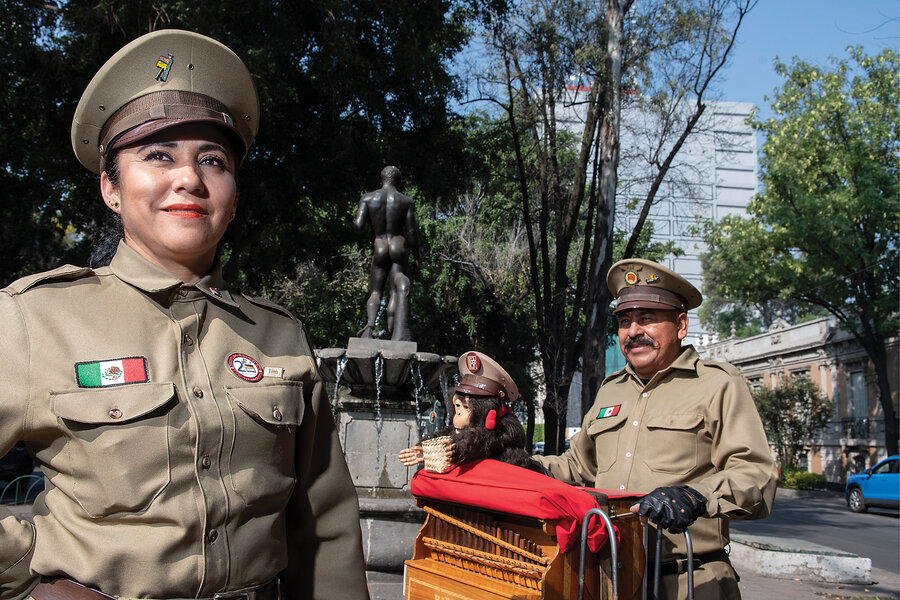
Elsi Sastre (left) and Cresencio Torres work as a team of organ-grinders in the Roma neighborhood of Mexico City.

Between the two of us, my husband and I can tell our grandchildren about having seen an ice-delivery man, a huckster selling vegetables door-to-door, a traveling knife-sharpening guy. Wouldn’t it be great to show such things in person once in a while, not just in historic villages with costumed interpreters?

Today’s article is about something we will need to hurry up to see before it fades into history: the traditional organ grinder in Mexico.

Whitney Eulich writes at the Christian Science Monitor, “Hunched over a weatherworn hand-crank organ in his repair shop, Roman Dichi explains why the work of Mexico’s organilleros has endured for a century and a half. 

“ ‘This music evokes happiness, tradition, and childhood memories of going out to a plaza with Mom and Dad – or of falling in love,’ says Mr. Dichi, president of the organ-grinders union in Mexico City. …

“Organ-grinders, especially ubiquitous in Mexico City’s historic center, date back to the presidential administration of Gen. Porfirio Díaz in the late 1800s. The dictator’s adoration of all things European inspired Mexico’s elite to import organs into their homes. Eventually, the instruments moved out of private parlors and onto the streets as public entertainment. They were used to draw customers to circuses, with the help of monkeys, and to keep soldiers in good spirits. Over time, the European songs inside the machines were replaced with revolutionary ballads and local classics, such as ‘Las Mañanitas,’ the Mexican birthday song.

“Despite these deep roots, today the tradition is at risk. Not everyone is charmed by the tip-seeking musicians. A crank organ’s sound – akin to the pitchy puff of air from a slide whistle – can be loud. In the wrong hands, an organ can be positively off-key, an assault against the ears. …

“The organs are also expensive, with many organilleros renting them from the small stock available locally. And upkeep gets costlier with each passing year. The heavy instruments can get damaged while being wheeled down crowded city streets or warped by weather and time. 

“Edgar Alberto Méndez Hernández has been slowly turning the crank on his organ in the capital’s historic center for some 15 years. He nets about 250 pesos (a little more than $15) on a good day after paying 250 pesos for his rental. …

“After several hours working along a bustling sidewalk near the Bellas Artes theater, he pushes his black-and-brown antique wooden organ on its dolly and heads several blocks toward the Zócalo square. When he shows up at this even busier – and potentially more lucrative – spot, the two young men already playing organs there take their cue, as if in a dance, and move to a side street. These shifts are imperceptible to the public but tediously negotiated with the union’s help. …

“They ‘live off of tips,’ notes Yuleina Carmona, the Mexico City coordinator for Women in Informal Employment: Globalizing and Organizing, an international nonprofit. Shoeshiners and strolling mariachi bands have fixed rates for their services, but organ-grinders churn out music whether they are paid or not. …

“In March, Mr. Dichi’s union submitted a proposal to Mexico City’s Congress to have organilleros’ work recognized as a cultural heritage. It was the fourth attempt – and this time it was approved.

“The legal recognition is expected to translate to better protection on the street from police harassment and greater support for organ-grinders in their disputes with residents and businesses. Ms. Carmona notes it will also give organ-grinders ‘a seat at the table’ – a say in how Mexico City uses funds for cultural activities in the center.”

More at the Monitor, here. Great pictures. No paywall.

Now, what is the coolest old-timey thing in your memory?

Read Full Post »

Photo: Anthony Mongiello via the Boston Globe.
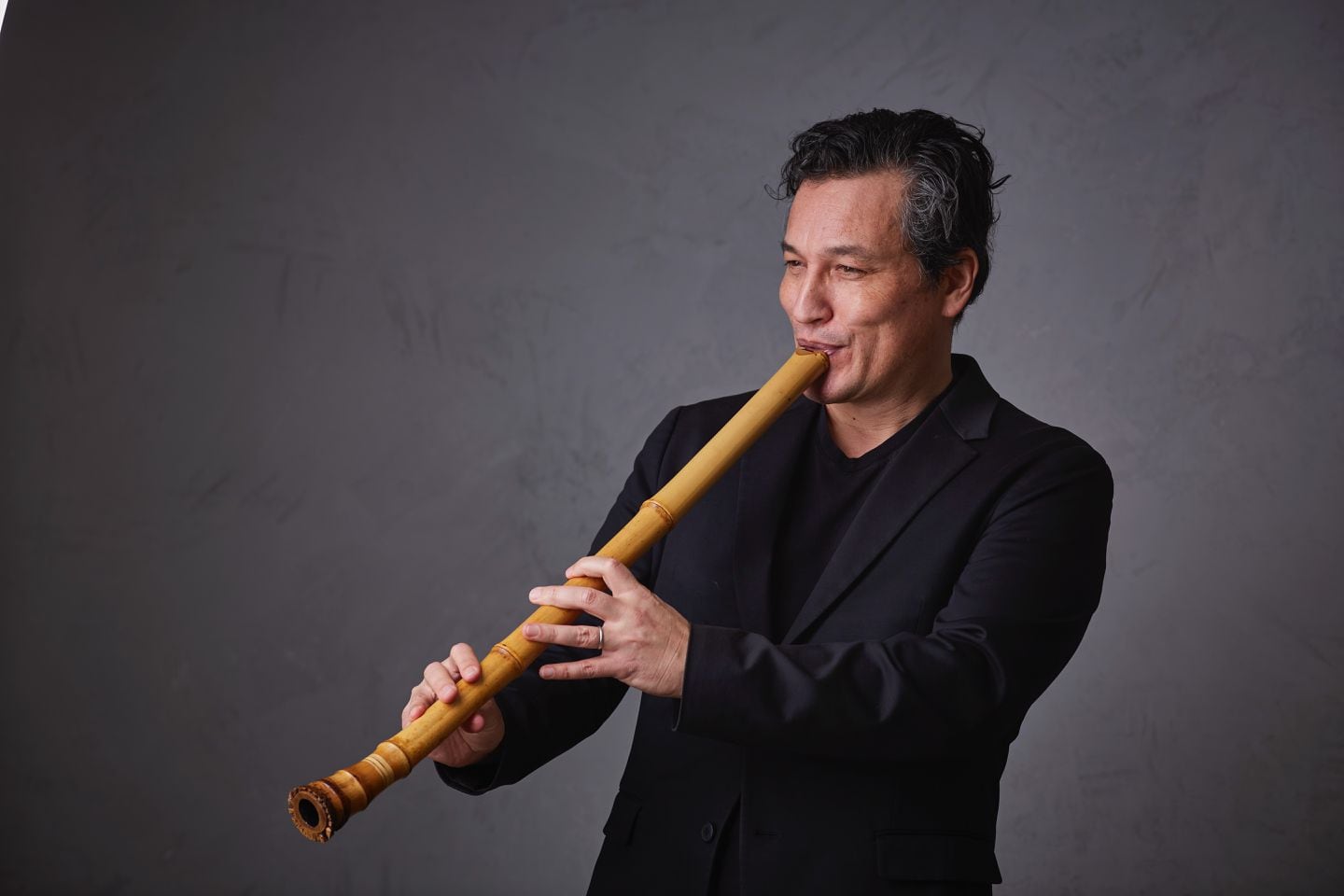
Kojiro Umezaki plays the shakuhachi, a Japanese vertical bamboo flute.

In the same way different languages often express something about a culture that is not seen in other cultures, different musical instruments can do the same. A Japanese musical instrument called the shakuhachi is like that. And it can take hold of musical people in surprising ways.

A.Z. Madonna has the story at the Boston Globe. She writes, You have probably heard this sound before. This is the first thing that shakuhachi player Kojiro Umezaki tells people who aren’t familiar with his instrument.

“Maybe you’ve heard the vertical bamboo flute in movies when you see a scene of Japan, or you’ve heard one playing in the background at an Asian restaurant. Or you might have heard it in video games; if you’ve played ‘Ghost of Tsushima,’ the acclaimed action-adventure game from 2020, you didn’t just hear a shakuhachi, you heard Umezaki playing it.

“But there’s more to the instrument than its status as a symbol of Japanese music and Japan itself. …

“ ‘It is the sound of the earth,’ said shakuhachi player and maker Perry Yung in a phone interview. ‘The sound of the wind passing through a bamboo forest. It’s a sound that is constantly shifting tone colors, like light passing in the sky through clouds.’

“The shakuhachi was historically used as a solo instrument in Zen Buddhist meditation, specifically by wandering mendicant monks. It also sometimes appears in Japanese classical music, often with a koto (zither) and the three-stringed shamisen. Most modern shakuhachis have five tuning holes, with four in the front and one on the rear, and they’re tuned to the minor pentatonic scale. However, the player can partially cover holes and bend pitches to produce any pitch they want. …

“It somewhat resembles a recorder, but has no mouthpiece, so producing a sound is trickier. ‘You have to find the spot that sets up the vibration with your lips,’ said Umezaki … ‘My mother likes to tease me and say that when I first started playing it, it took me a year to make sound.’

“The child of a Japanese father and Danish mother, Umezaki grew up in Tokyo and attended an international high school. There his choir teacher was a student of famed shakuhachi player Goro Yamaguchi, and he suggested Umezaki try the instrument as well. …

‘As someone with a mixed Japanese background, you do start to wonder about the Japanese side of who you are,’ he said. For him, playing shakuhachi was ‘the simplest way to get in touch with something that is very much identified with Japanese culture.’

“The instrument found Yung in 1994, while he was acting in a play directed by Ellen Stewart at the New York experimental theater venue La MaMa. Shakuhachi player Yukio Tsuji was in the production’s band, playing the instrument in a ‘very experimental manner,’ he said. … ‘But at one point, the show was silent, and then there was the shakuhachi, and it changed my world.’ After the show, Yung rushed backstage to ask where he might get one. ‘[Tsuji] just looked at me wide-eyed, and said, “I see you’re bitten now.” ‘ …

“Yung took a DIY approach — he bought bamboo at a flower market, and copied flutes at Tsuji’s own workshop, he said. ‘I basically learned how to play and make at the same time.’

“Some time later, he studied in Japan with Kinya Sogawa, an established professional musician and craftsman. ‘He didn’t speak any English, and I didn’t speak any Japanese at the time,’ Yung said. ‘But in the traditional manner of study, you imitate the master and don’t ask questions.’ …

“Umezaki has played with Silkroad, the broad global music initiative founded by Yo-Yo Ma, for over 20 years. He considers what he’s learned there the closest thing he’s had to conservatory training. …

“Yung, whose workshop floats between New York and Rhode Island, has more recently started incorporating the instrument into activism, particularly at rallies against anti-Asian hate. ‘I start my talk with a shakuhachi offering, to others who have been affected by the violence that has been perpetrated upon the Asian-American community in recent years.’ “

More at the Globe, here.

Read Full Post »

Photo: Melanie Stetson Freeman/CSM Staff.
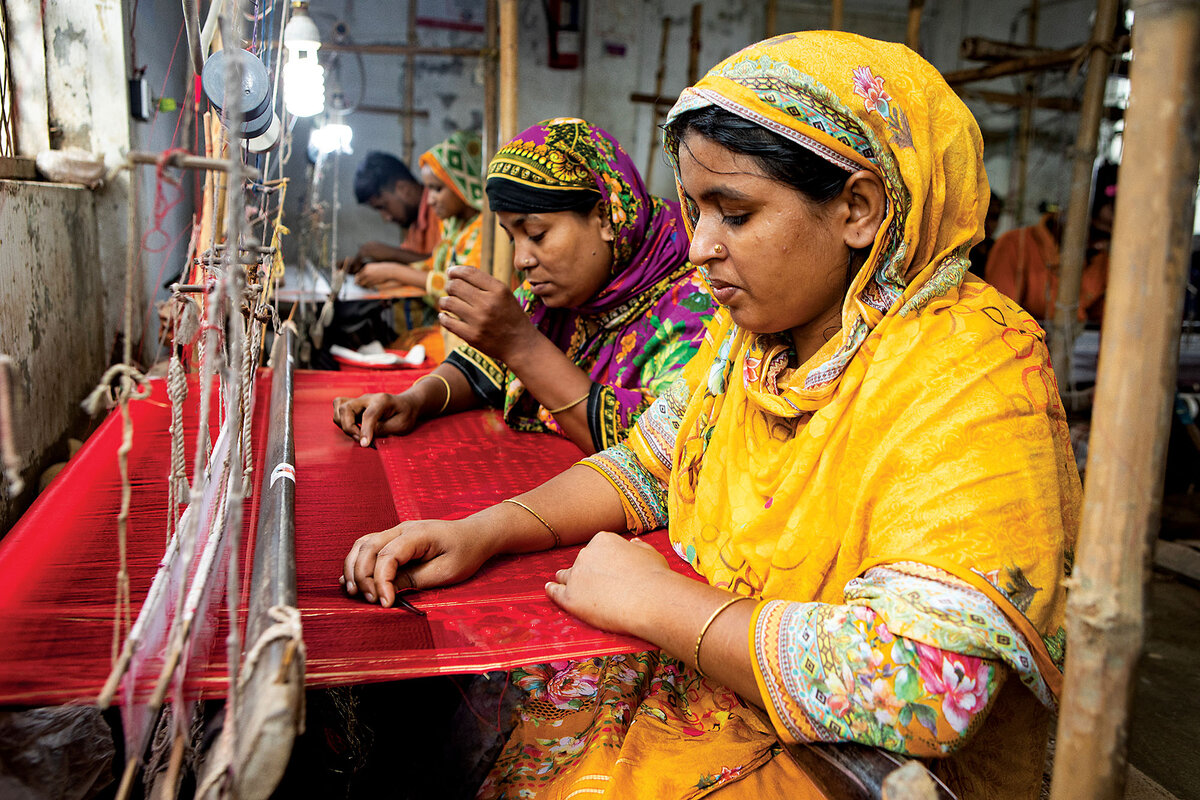
Artisans do “respectful” work on jamdanis at Abul Kalam Jamdani Weaving Factory in Bangladesh.

Recently I wrote about the the Fuller Craft Museum’s exhibit of the Red Dress, an embroidered garment “worked on by 380 individuals from 51 countries, mostly female, many of whom were vulnerable and living in poverty” — women who felt uplifted by an art project that honored their skills.

Today’s post is also about women’s handcrafts.

Sara Miller Llana reports at the Christian Science Monitor, “Two dozen artisans crouch over hand looms threaded with bright-orange and sky-blue cottons. Their fingers nimbly create a jamdani, an intricately woven sari dating back to the [16th century] Mughal Empire. …

“Made of fine cotton or silk, the jamdani was a pinnacle of fashion centuries ago. But in the 19th century, British colonizers brought in their iteration of fast fashion, and the tradition nearly went extinct. …

“After Bangladesh became an independent nation in 1971, the nongovernmental organization BRAC set out to revitalize the weaving practice. It approached artisan families like that of Anwar Islam, owner of this shop. ‘I didn’t think it was feasible, but I was happy to be part of the solution,’ says Mr. Islam. 

“Today he employs 120 weavers at Abul Kalam Jamdani Weaving Factory. …

“But this is not just a business success story. … The jamdani is seen as a story of cultural success, too. It’s part of the championing and preservation of objects from sealskin parkas in the Arctic to duck decoys and quilts across the United States that otherwise may be forgotten.

” ‘People have been striving to decorate their lives to tell the world who they are for centuries,’ says Chris Gorman, a deputy director of the American Folk Art Museum in New York. … ‘Without people championing the study and preservation of objects like these, and others, there is the possibility that people will simply forget about them, and it is hard to revive them or prove their relevance.’

“About the time the jamdani was being revived, a women’s collective was coming to life at the northernmost tip of Canada, in the town of Taloyoak.  

“Begun in 1972, the group, called Arnaqarvik, garnered a burst of fame in its day with its Inuit parkas, mitts, and boots made from caribou, wolf, and seal and patterned with dyes from tundra lichen and flowers. The collective’s work — including, eventually, duffel-wool ‘packing dolls, or miniature stuffed animals carrying their babies in parkas as the Inuit do — was showcased in New York City and the 1974 Arctic Winter Games in Alaska.

“Yet today, just as the jamdani is enjoying global appeal, the work of Arnaqarvik has been largely forgotten. So the Kitikmeot Heritage Society in Cambridge Bay, in Canada’s Nunavut territory, has set out to restore its memory in a digital archive. 

“And to mark the 50th anniversary of the collective, about 250 items in 2021 were sent back to Taloyoak in an exhibition. It was the first time most in the community found out what Arnaqarvik even was. ‘Everybody was really surprised by what their parents did in those days,’ says Arnaoyok Alookee, Arnaqarvik’s co-founder.

“Brendan Griebel, an Arctic anthropologist and manager of collections and archives for the Kitikmeot Heritage Society, says this reconnection is about far more than just the production of goods. ‘Having that physical contact ignites something in the memory and in the senses,’ he says.

“When Arnaqarvik began, the semi-nomadic Inuit of Taloyoak had only gradually moved into this permanent settlement the decade prior. The collective helped the community bridge a gap — between its Indigenous traditions and the new wage economy into which it was settling. 

“Judy McGrath co-founded the collective with Ms. Alookee when her husband was posted for work in the Arctic community. She says she still recalls the sense of purpose that craft-making gave all of them. They collected flowers with their children in 24-hour sunlight; they’d use the 24-hour darkness of winter to boil their dyes on the stove. ‘I can still feel the confidence that the skills they had mattered, and the excitement over making new things from the old, from the land,’ Ms. McGrath says.

“In Bangladesh, the rise of the jamdani was also driven by economics, to help artisans whose enormous skills couldn’t find the market for livelihoods. BRAC, the country’s largest NGO, created the brand Aarong to distribute their products. …

“Making a jamdani, which derives from the Persian words jam (floral) and dani (vase), is what weaver Mohammed Monir calls a ‘respectful’ job. … ‘When I see someone famous wearing something I made, I feel proud,’ he adds.

“Today jamdani weaving is included on UNESCO’s Representative List of the Intangible Cultural Heritage of Humanity.”

More at the Monitor, here. No firewall. Reasonable subscription. You can also sign up for their free weekend updates.

Read Full Post »

Photo: Adeline Heymann/One Ocean Expeditions.
Candice Pedersen, a guide for One Ocean Expeditions in the Arctic, tells passengers that Inuit women feel empowered reclaiming traditional tattoos for themselves.

I love the radio show called The World because of the international focus. It always has a deeper take on mainstream media stories, and you can hear music you’re unlikely to be exposed to anywhere else. Recently, Joshua Coelda, Sejersdal Dreiager, and Shirsha Chakraborty reported about a tradition that is coming back from the brink: Inuit tattoo art.

“Najannguac Dalgård Christensen, 35, pulled back her sleeve on one forearm to reveal a pair of tattoos shaped like train tracks across her wrists. …

“These are traditional Inuit tattoo patterns that speak to her Indigenous Inuit heritage. The markings, she said, represent Sila, a word that carries many meanings, including ‘breath,’ ‘sky,’ ‘spirit’ and ‘universe.’

“To Christensen, who got the tattoo several years ago, it also means ‘the Greenlandic belief that we should be aware of who we are and what we can be, and that is attached to each other.’

“In precolonial times, Inuit women of Greenland, and across much of the Arctic, would have tattoos on both their bodies and faces, holding important pre-Christian spiritual meaning. Today, some Greenlandic Inuit like Christensen are reclaiming their identity through this long-lost art. 

“She said that she didn’t always embrace her Greenlander identity — because it is often associated with negative stereotypes about the Inuit diaspora living in Denmark, who colonized the North American island three centuries ago.  

“ ‘I felt empowered by getting the tattoos because it was like there was some kind of relief that I didn’t have to be embarrassed about being a Greenlander anymore,’ Christensen said. …

“The custom itself is far from new, but tattoos were some of the first traditions to be discouraged when Danish-Norwegian missionaries started colonizing the island at the beginning of the 18th century. The missionaries found tattooing incompatible with Christian faith, [Randi Sørensen Johansen, intangible cultural heritage curator at the Greenland National Museum and Archives] said. …

“As the custom disappeared, so did much of the knowledge about the tattoos’ meaning. ‘We didn’t have that tradition of writing down,’ Johansen said — Inuit passed knowledge through oral storytelling. …

“Inuit would use amulets to protect them from ‘unwelcome spirits,’ but also to help certain attributes or ensure a successful childbirth, among other things. It is likely, Johansen said, that Inuit tattoos were seen as a kind of amulet, giving strength, help or protection to the women or — in rarer cases — men who had gotten them.

“The tattoos were most often made as linear patterns across the brow and vertical lines on the chin made by using both a puncture or dot technique and a sewing technique. The latter technique consisted of pulling sinew dipped in soot under the skin with a needle made of animal bone, curator Johansen said.

“Maya Sialuk Jacobsen is one of about a dozen Inuit tattoo artists across the globe reviving this traditional art. … It was she who created Christensen’s tattoos. For over six years, she’s been helping Inuit like Christensen who live in Denmark connect with their culture through ink. Like Christensen, she is of both Danish and Greenlandic Inuit descent — a group she describes as an emerging ‘third culture’ in the Scandinavian country.

“The community is fairly small in Denmark and not well-defined demographically. According to StatBank Greenland, there are a little under 17,000 people born in Greenland currently living in Denmark. But community leaders, including from the Greenlandic House of Aalborg, aren’t even sure about the exact number of Inuit in Denmark. The number of self-identifying Inuit could be even higher, due to the presence of third-culture community members, who are partially Inuit. …

“Sialuk Jacobsen said, ‘It’s basically identity work all the time.’  Many come to her with a feeling of sadness, in search of a sense of belonging, she said. ‘They need to talk about these things, and to learn about the culture, they just want to learn.’ …

“While Sialuk Jacobsen said she uses inks and needles approved for tattooing on clients in Denmark, her research into the traditional techniques has included experimental tattooing on herself, and using her own right leg as her test area to reconstruct authentic methods of inking up.

“But in Denmark, finger, hand and face tattoos are prohibited (though it’s not illegal in Greenland). So, Sialuk Jacobsen is limited to tattooing the rest of the body. …

“The legacies of colonialism hang heavy over the community living in Denmark. Greenlanders are overrepresented among Denmark’s homeless population — accounting for 7% of people experiencing homelessness, according to VIVE.

“In recent years, Denmark’s colonial past came under public scrutiny.  For her master’s degree, Christensen looked into a form of ‘modern boarding schools.’ She found that Inuit children in Denmark are more likely than Danish children to be taken away from their families and placed in foster homes, which are almost always Danish families. 

“ ‘They learn to speak Danish, and there isn’t any focus on the Greenlandic language, so they lose their Greenlandic language. And when the parents only speak Greenlandic, they can’t talk to each other without an interpreter.’

“Christensen, who has become an activist through her research, believes the government should make it at least mandatory for Inuit children living in foster care to have lessons on Greenlandic.”

More at PRI’s The World, here, and CNN, here.

Read Full Post »

Photo: Isabelle de Pommereau.
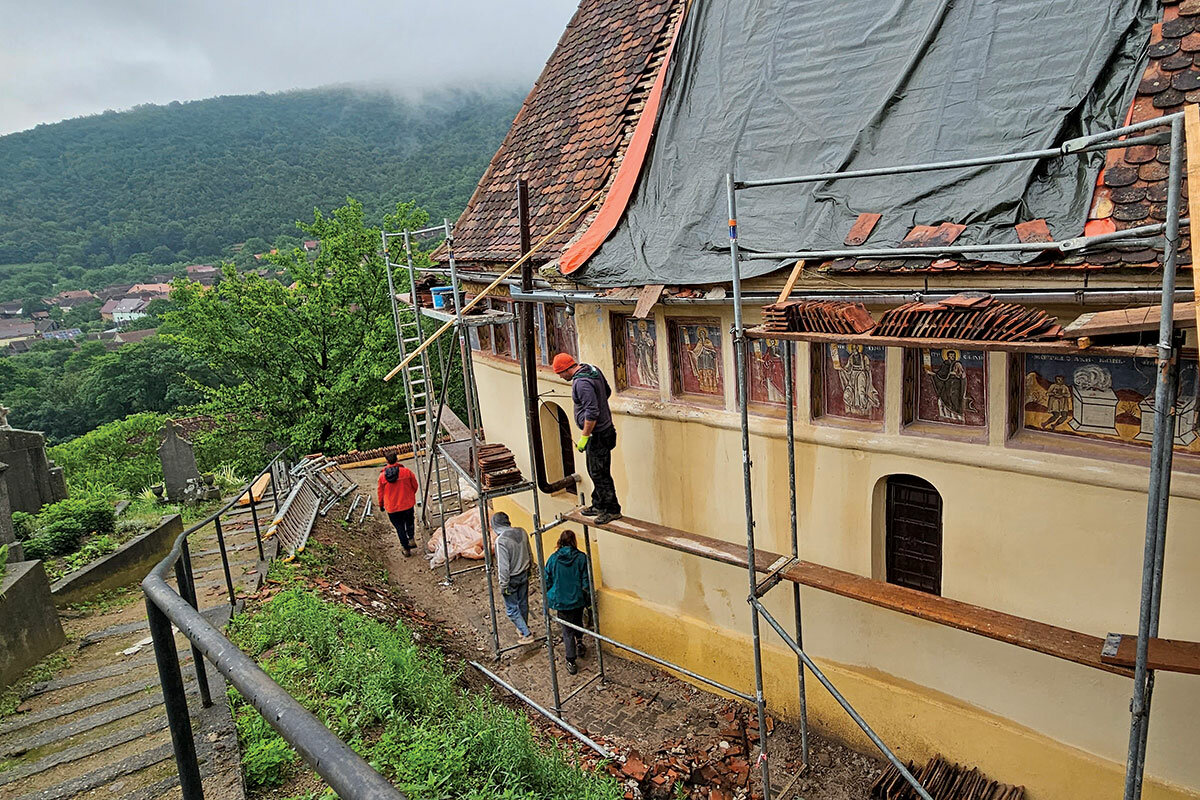
Eugen Vaida and an Ambulance for Monuments team repair the Church of St. Nicholas the Hierarch in Fântânele, Romania.

Today’s story is all about the Power of One. That is, one who organizes many. The setting is a post-Communist country that is struggling to build its economy and has little left over for preserving cultural monuments.

Isabelle de Pommereau writes at the Christian Science Monitor, “It is midday on a damp Friday. Eugen Vaida guides his team into the final phase of re-tiling the roof of a church, at the crest of a forested hill in this mountainous Transylvanian village.

“Village craftspeople and students from the city meticulously lay tiles on the roof timbers of the 18th-century Romanian Orthodox Church of St. Nicholas of the Hierarch. From the scaffolding, students respectfully and attentively watch Nicolae Gabriel Lungu, who is descended from a Romani family who all knew this skill. Soon an older woman summons the crew to share in a platter of clătite, thin cheese-filled crepes.

“Once bustling with families and culture, Mr. Vaida’s home region had become a string of largely empty villages surrounding abandoned stone churches. But now, watching this group interact, he has newfound hope. The repair by his group, Ambulance for Monuments, will help safeguard the church’s stunning outer frescoes. And the impact will ripple far beyond the building itself. 

“ ‘People are starting to understand the value of heritage,’ Mr. Vaida says. For the past seven years, he’s been driving around the country with a van equipped with tools and volunteers in a race against time to rescue endangered historic buildings. He has helped save more than 55 historical structures on the verge of collapse, from medieval churches and fortification walls to old watermills and UNESCO World Heritage Sites. He does so by impressing preservation methods and mindsets onto local communities. 

“ ‘I wanted to reconnect the members of the community to their roots, make them aware that those buildings are part of their cultural identity, and show them how they can continue the work we do,’ he says.

“Mr. Vaida offers a ‘best-practice example of how, with not so much effort, you can save the identity of Romania as a country,’ says Ciprian Stefan, director of the ASTRA Museum, Europe’s largest open-air ethnographic museum, in Sibiu.

“Romania’s rich cultural legacy of painted churches and fortified villages was shaped over centuries. But close to 600 historic monuments are in an acute state of degradation, victims of years of dictatorship, poor legislation, and plain neglect, experts say.

“Mr. Vaida experienced the destruction in a very personal way. He grew up playing with Romani and Hungarian friends, as well as the German Saxons who had literally built the region. When the 1989 collapse of communist dictatorship flung Romania’s doors wide open, half a million people left. The mass exodus tore the Romanian soul apart – and fractured Mr. Vaida’s own identity. Ambulance for Monuments is an attempt to reclaim both his identity and that of his country. …

“He, too, left for the city, to get an education, and he became a successful architect in Bucharest. But six years into the job, he quit to return home. The big city was not his future; his home village was.

“He soon discovered that many village craftspeople who had passed on their know-how from generation to generation had left for Western Europe. … Mr. Vaida wanted to use his architectural skills to save his region’s extraordinary architectural and cultural heritage. He started by teaching children about local history. …

“In 2016, he launched Ambulance for Monuments in hopes of connecting architectural students, craftspeople, and communities around a new effort to restore decaying historic buildings. …

“Volunteer students get hands-on practice in historical restoration; local craftspeople get jobs; and communities help house and feed the teams, and donate the material. … ‘It’s going from grassroots up, from down to up,’ says Mr. Vaida. …

” ‘He doesn’t go to villagers to ask for anything, but he goes there to give something,’ says Mr. Stefan. ‘The community stays in the shadows at first. When they see Eugen comes with material and manpower to restore their church, they say, “Let’s help him,” and, little by little, they come and help with housing, with food.’ …

“The task of rescuing Romania’s cultural legacy is huge, but Mr. Vaida sees signs of progress. … ‘People are moving back to the villages of their grandparents, because they feel they belong there,’ he says. ‘They are rediscovering old houses, their heritage, their villages, and are getting involved in the preservation of this type of living.’ ”

More at the Monitor, here. No paywall. Subscriptions solicited.

Read Full Post »

Photo: Nicole Tung for NPR.
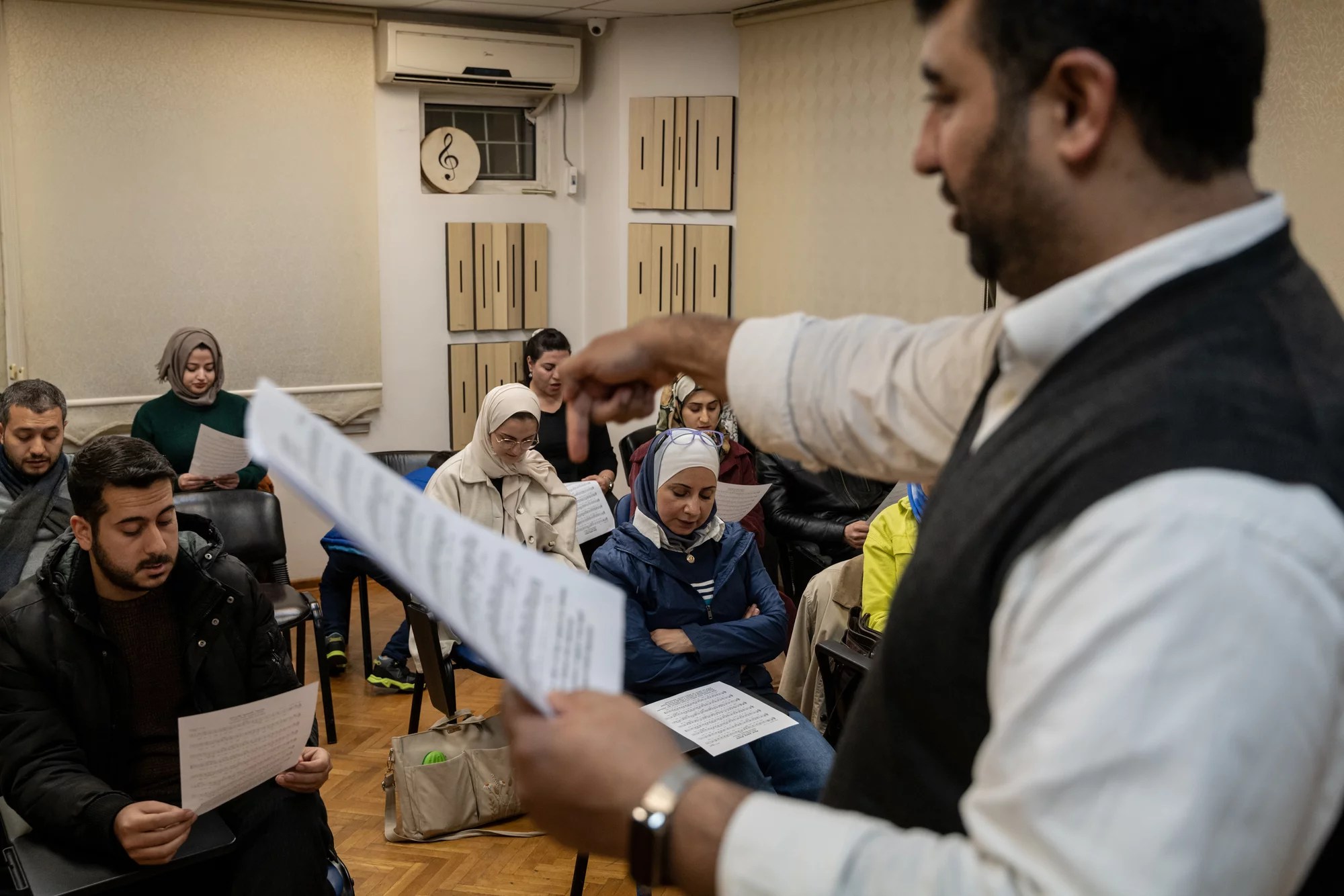
Ibrahim Muslimani, 30, speaks to a class about a piece of music blending different eras and languages at the Nefes Foundation for Arts and Culture, which he cofounded in 2016, in Gaziantep, Turkey.

Today’s story is about how the arts can help victims of disasters get their bearings again.

As Fatma Tanis reported recently at National Public Radio (NPR), “When the powerful earthquake rocked her home in early February, 18-year-old Sidra Mohammed Ali woke up and thought of one thing: her music school — was it OK?

“The next day, as survivors all over southern Turkey were taking stock of the destruction and checking on loved ones, Mohammed Ali rushed to the school, the Nefes Foundation for Arts and Culture, and took a deep breath of relief when she saw it was still standing, only having sustained some minor damage.

‘This school is my sanctuary from the stress of life as a Syrian refugee in Turkey,’ she said. ‘I couldn’t bear the thought of something happening to it.’

“The Nefes Foundation was created by Syrian and Turkish musicians in the city of Gaziantep in 2016. They have group classes where they try to revive forgotten Syrian classics and integrate Turkish and Syrian cultures with music that the two have shared for centuries.

“The school also offers private music lessons on the piano and Middle Eastern instruments like the oud (a pear-shaped string instrument), the kanun (a plucked zither) and the ney (an end-blown flute).

“But more than six weeks after the Feb. 6 disaster, life in the earthquake zone is far from back to normal. The magnitude 7.8 earthquake killed more than 55,000 people in Turkey and neighboring Syria. It damaged or destroyed hundreds of thousands of buildings and left 1.5 million people without a home in Turkey alone, according to the United Nations.

“The school had not been able to resume classes until [March 2023], when only three students, out of many dozens, showed up to sing and play.

“Before the earthquake, the school would be packed on weekday evenings, with students ranging from ages 6 to 50, mostly Syrian, but some Turks attended as well.

“The classes are bilingual — in Turkish and Arabic. And that was especially important, according to Ibrahim Muslimani, a Syrian classical musician from Aleppo, who is the brains behind the organization.

” ‘Because some of the young Syrian kids have spent most of their lives here in Turkey and are more fluent in Turkish,’ he told NPR in November 2022. ‘We’re trying to preserve our Syrian cultural identity but also getting to know the Turkish identity through art.’

“Turkey hosts 4 million refugees, the largest number of any country, according to the U.N. refugee agency. The vast majority are Syrians who fled the civil war.

“In the early years of the Syrian civil war, which started in 2011, Turkey had a generous open-door policy toward Syrian refugees. But without broad integration initiatives by the Turkish government, life for many of the refugees has been difficult.

“More recently, politicians in Turkey who oppose President Recep Tayyip Erdogan have scapegoated refugees for the country’s economic problems, leading to a rise in discrimination and hateful attacks. …

“Mohammed Ali, who studies medicine at university and the kanun at the music school, said last weekend the school has been a lifeline for her. She has a bleak outlook on her future, and doesn’t believe that the people in Turkey will ever accept her existence in the country.

” ‘But anytime I have an upsetting encounter, my Turkish teachers and friends here comfort me,’ she said. …

“Rafeef Saffaf Oflazoglu fled Aleppo in 2013 after a near-death encounter. She comes from a family that’s passionate about classical Arabic music. To be able to continue exploring her love of music in Gaziantep was priceless, she said.

“The school also introduced her to centuries-old Turkish songs from the Ottoman archives, and old tunes that traveled from Istanbul to Aleppo. Studying those shared melodies made her feel closer to the culture in her new home.

“Having to go without classes after the earthquake was harder than she expected. ‘After maybe 10 days, I just figured out, like the thing I miss most is art,’ she said, even though she was living in her car at the time. ‘People under trauma react in different ways. It’s not just about singing, you know? It’s spiritual.’

“For Muslimani, the earthquake was a triggering reminder of how he had lost everything a decade ago in Aleppo. … The civil war in Syria destroyed much of the country’s cultural output, along with the lives of millions of Syrians. Muslimani has a mission to keep Aleppo’s traditional form of music, al-Qudud al-Halabiya, alive from Gaziantep.

“He and other Syrian artists also record music at Nefes. ‘I promised my teacher that I would immortalize those precious pieces in the best form possible,’ he said. ‘With the proper orchestra and the glory that they deserve.’ …

“The Nefes Foundation, which survived on donations and fees for private lessons, is now at serious risk of closing down, said Muslimani. They don’t have the funds to pay for next month’s rent. …

” ‘The mere thought of losing this place… it’s unbearable.’ “

More at NPR, here.

Read Full Post »

« Newer Posts - Older Posts »