Feeds:
Posts
Comments

Posts Tagged ‘defiance’

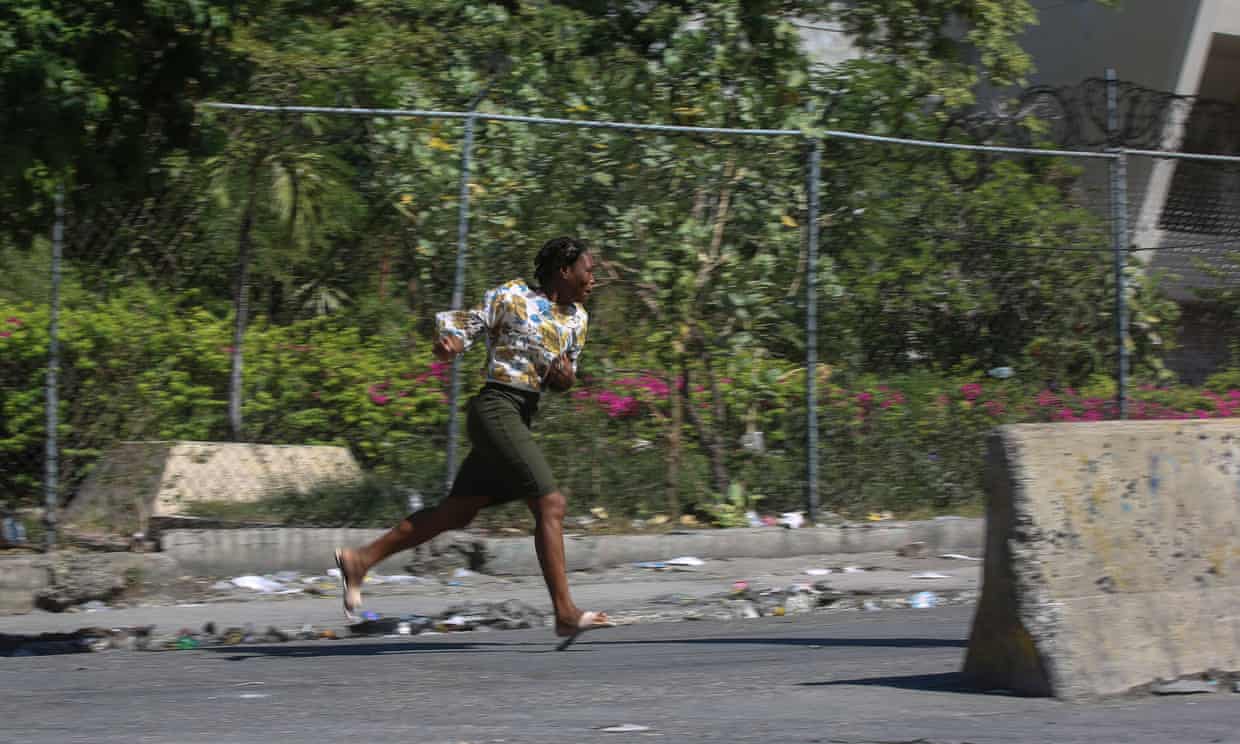
Photo: Odelyn Joseph/AP.
A woman runs to take cover from gunfire during clashes between police and gangs in Port-au-Prince, a city where a theater company perseveres.

There’s something about theater people and defiance. Something that keeps them from giving in to the ways things are when things are bad. I’ve blogged here about the anti-government theater of Belarus and here about Ukrainians offering theater in the subway, away from Russian bombs.

In today’s post, Tom Phillips and Etienne Côté-Paluck report at the Guardian about Haiti.

“In a dimly lit rehearsal room in a city under attack, Jenny Cadet raised an imaginary pistol and fired a single make-believe bullet at her director.

“ ‘Life is a theatre. I am a theatre. We are a theatre. The world is a theatre,’ proclaimed the 31-year-old Haitian actor, turning to the audience as she uttered the tragicomedy’s final lines.

“Moments later, real-life shots rang out outside the stage school in Port-au-Prince – the latest act of violence in an increasingly terrifying drama that has forced tens of thousands of people to flee their homes here in the past fortnight alone.

“ ‘Every day [there’s shooting],’ sighed the play’s director, Eliezer Guérismé, as his company took a break from their read-through to the all-too familiar sound of gunfire. ‘But even with the shooting, we keep on working because that’s our mission. We don’t want to stop.’

As gangs tighten their grip over a city now almost entirely outside of government control, Guérismé, 39, said he saw drama as a key way of interrogating and denouncing the social and political crisis. …

“Theatre was also ‘an act of rebellion and resistance’ and a way of fostering renewal, given the politically charged violence into which Port-au-Prince has been plunged since the 2021 assassination of Haiti’s president Jovenel Moïse.

“ ‘People need to see the reality that they are living up on stage … theatre is the mirror of society … Everything we hear in this city – the sound of the bullets that are very, very present – we try to put on stage,’ the director said. …

“Nearly 4,000 people have been killed since the start of the year, according to the UN, as rifle-carrying gang fighters have advanced across the capital, opening fire on government buildings and burning homes.

“A US-backed policing mission has so far failed to restore order and in recent days the violence has intensified further with gangsters even attacking Pétion-Ville, one of the last supposedly safe enclaves in the hills over Port-au-Prince. … Foreign diplomats and aid workers are fleeing by helicopter amid calls for a UN peacekeeping mission to be deployed.

“ ‘It feels like the end of Port-au-Prince,’ Guérismé admitted this week. “Every day people are leaving their neighborhoods.’

“The Haitian director recognized that continuing to rehearse his latest production was a perilous business in a city where residents’ movements grow more restricted by the day.

“One of his troupe’s actors commutes to the drama school each day from Carrefour, a gang-run area to the city’s south which is effectively off-limits to outsiders. ‘I know he’s taking a risk to come. He’s taking a huge risk… Living in Port-au-Prince today requires a superhuman effort,’ Guérismé said. …

“But Guérismé was determined to fight on. … ‘It’s my country. It’s my homeland. It’s my city’ … and I have responsibilities,’ the director said as his group prepared for Port-au-Prince’s annual ‘En Lisant’ theatre and performing arts event. ….

“Philippe Violanti, the French dramatist who wrote Guérismé’s latest tragicomic play, had planned to fly to Port-au-Prince to see his work staged for the first time. But Violanti was forced to cancel after flights into the capital were suspended because three US aircraft were hit by gunfire while taking off or landing.

“Six of the seven foreign artists invited to the festival – from Guadalupe, French Guiana, France, Belgium and the US – have pulled out. Performances for primary and secondary school children have been dropped from the program. Some rehearsals are being held online.

“Guérismé said the mood was grim, but he believed it was essential Haiti’s acting community did not throw in the towel.

“ ‘The festival will not be postponed. We will go ahead,’ he vowed. ‘This is the time to make a gesture of hope – to affirm that life is here.’ ”

More at the Guardian, here.
Read Full Post »

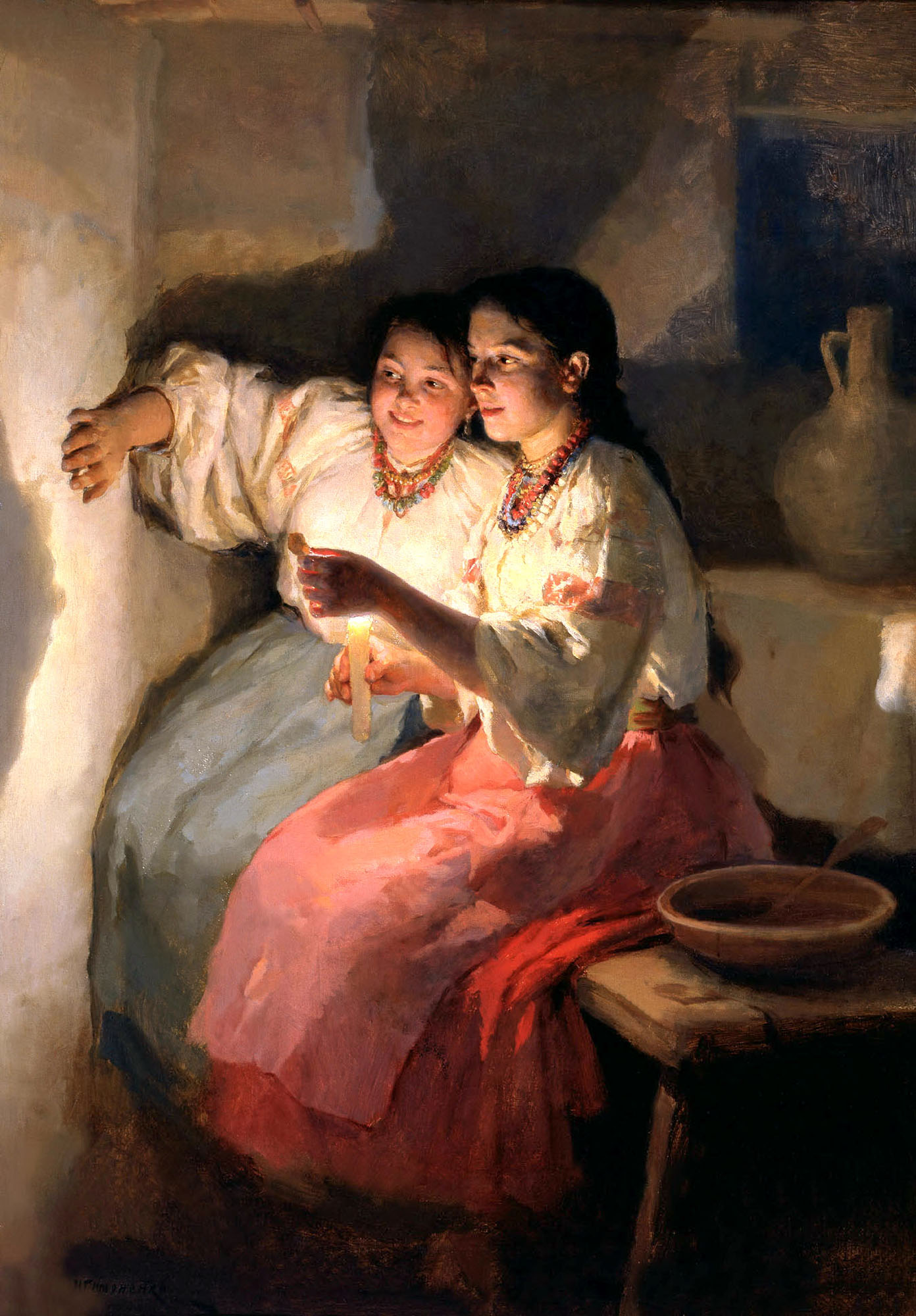
Photo: Ivan Honchar Museum.
Witchy arts are part of Ukrainian folklore. The girls in the painting above (Divination by Mykola Pymonenko, 1888) are trying to predict the future.

Somehow, even in wartime, artists’ imaginations keep creating. Today’s story is about a new Ukrainian play that has captured the country’s attention.

Ashley Westerman at National Public Radio [NPR] tells us that “even though the plot takes place centuries ago, the play’s takeaways and parallels to today resonate with Ukrainians.”

Here are excerpts from the NPR transcript.

Westerman: In the early days of Russia’s full-scale invasion of Ukraine, a video surfaced online – a woman shouting at a Russian soldier sitting atop a tank. …

‘Do you even know where you are? You’re in Konotop,’ shouted the woman off-screen. ‘Every second woman here is a witch.’ …

“The video went viral in Ukraine, not just because of the woman’s defiance, but also because Konotop, a city in the country’s far northeast, is a place associated with witches. ‘Witches are a part of Ukrainian culture and Ukrainian tradition,’ says Khrystyna Fedorak, so you can rely on something having to do with witches going viral. This is one of the reasons the play Fedorak is currently starring in at the Ivan Franko Theater in the capital, Kyiv, has become a summer blockbuster. Fedorak plays the witch in the dark musical comedy The Witch Of Konotop.

“Based on the 1833 satirical fiction by Ukrainian writer Hryhorii Kvitka-Osnovianenko, this story leans hard on the stereotype that Ukrainian literature is full of sadness and tragedy. Taking place in the 1600s, the audience follows the main character, Zabryokha, a Cossack military leader in Konotop, pursuing the lovely Olena, but she rejects his proposal. She loves someone else. In this scene, Pistryak, Zabryokha’s cunning assistant, tries to confuse Olena’s love interest by accusing him of crimes he didn’t commit. …

“Then, in a twist of events that sounds a lot like today, Zabryokha receives an order to join a military campaign to help the Cossacks fend off an overreaching Tsarist Russia.

” ‘They order us,’ Pistryak says, ‘to take our Cossacks in Konotop to join the main army. There may be drills, or there may be war.’

“But Zabryokha refuses to go, saying he needs to stay in Konotop to root out the witch problem — the root, he says, of everyone’s problems. What ensues is a string of ridiculous, funny and very human moments. Spells are cast, couples are wed and, of course, there’s a witch hunt, meaning a swim test. If you’re not a witch, you drown. If you are a witch, you don’t.

“All with a larger threat looming over everything — Russia. But while that might be the most obvious takeaway from The Witch Of Konotop, the cast has some of their own ideas.

Kateryna Artemenko: Don’t kill women (laughter). Don’t mess with women. …

Westerman: Artemenko plays one of the townswomen mistaken for a witch. …

Artemenko: The main message is about people who — they’re trying to fool their destiny, but destiny will find them.

Westerman: Nazar Zadniprovskiy, who plays the ill-fated Cossack commander, views this play as a lesson in avoiding responsibility. … Zadniprovskyi says many people see a parallel with Ukrainian men dodging conscription today. …

“As the play ends and the theater’s mustard-yellow felt curtain drops to a thunderous applause, producer Polina Lytvynova and I ask a few audience members what parallels they drew. Olha Vasylevska is from Kharkiv, the northeastern Ukrainian city currently fending off an intense Russian offensive. She thinks the play is about love.

Olha Vasylevska: (Through interpreter.) If the love is true, it doesn’t need any outside assistance … but if the love is not true, nobody and nothing can help it, even the witch.

“Westerman: Markian Halabala, from Kyiv, says the message he took away is that you shouldn’t interfere in God’s will.

“Markian Halabala: (Through interpreter.) This is like Putin. He interfered in natural Ukraine’s way of independence. And Russians, they try to stop and prevent, like, [the] natural way of Ukrainian history with this war.

“Westerman: Critics say the many takeaways The Witch Of Konotop offers its audiences is one reason it’s been so popular. … But another reason is the overall push to celebrate Ukrainian culture and literature. Putin has repeatedly said victory, to him, means nothing short of Ukraine losing not just their sovereignty, but also their identity.”

Finally, Westerman spoke to Mykhailo Kukuyuk, who plays Pistryak. He speaks of the value of his country’s arts: “What are we fighting for? it’s the details, the sparks, that make us alive.” He adds that, while it’s sometimes difficult to block out the events happening outside of this theater, it’s an honor to perform for his country.

More at NPR, here.

Read Full Post »

Photo: Victoria Onélien/Special to the Christian Science Monitor.
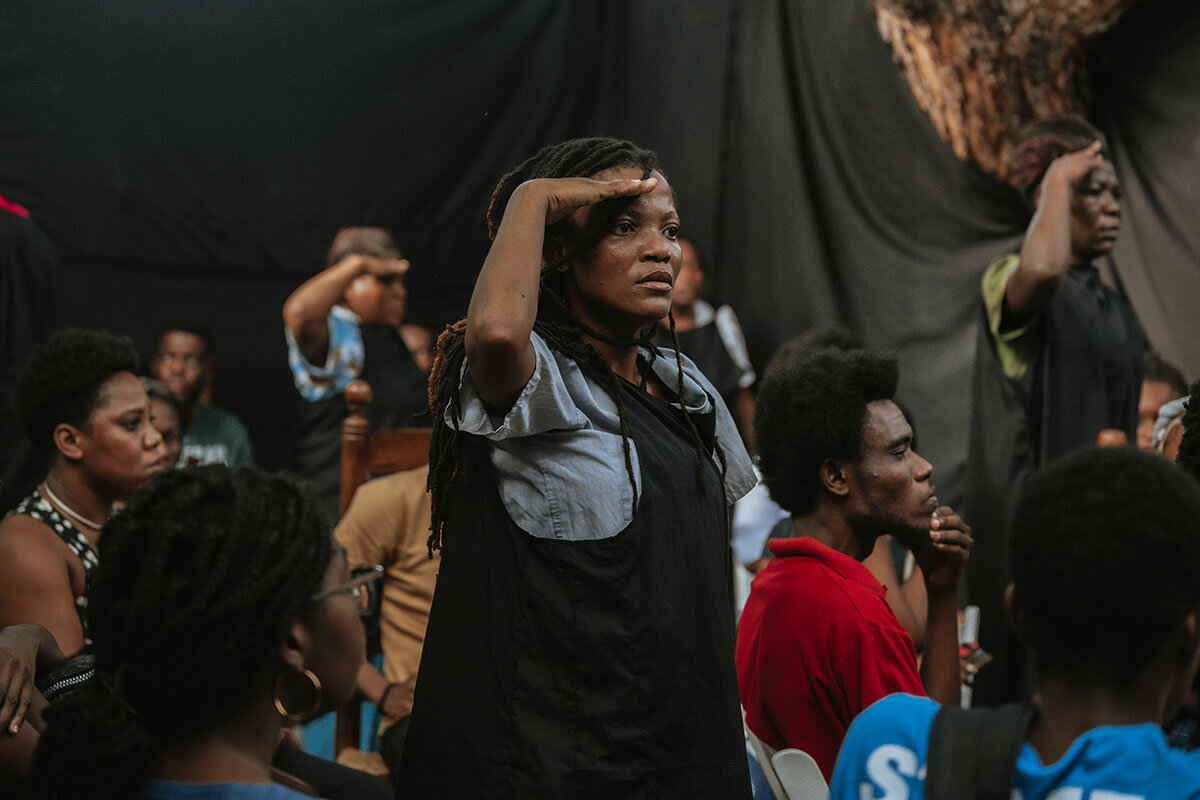
An immersive experience, “Dechouke Lanfè sou Latè” is performed within the audience and features formerly incarcerated women as well as actors to bring home the brutal reality of Haitian prisons. The Quatre Chemins theater festival took place in Port-au-Prince, Haiti, from Nov. 21 to Dec. 3, 2022.

Man, the resilience of the human spirit! Or maybe it’s stubbornness, not resilience. Doesn’t matter. Let us now praise whatever keeps people going in impossible circumstances. In Haiti. for example.

Websder Corneille reports at the Christian Science Monitor, “On a sunny afternoon, some 60 people gather in the small courtyard of Yanvalou Café, the unofficial home of Haiti’s theater scene. It’s the opening of the 19th annual Quatre Chemins (Four Paths) theater festival, but the fact that there’s a full house was never a given.

“For the past three years, Port-au-Prince, Haiti’s capital, has been overrun by criminal gangs. They’ve increasingly terrorized citizens, … blocking freedom of movement since the assassination of President Jovenel Moïse in July 2021. Many citizens have fled their homes in recent months, seeking safety elsewhere – in some cases camping out in public parks because their neighborhoods have become so dangerous.

“ ‘This city is scary these days,’ says Évens Dossous, an educator who came to see the reading of ‘Port-au-Prince et sa Douce Nuit (Port-au-Prince and Its Sweet Night),’ a new play by award-winning Haitian playwright Gaëlle Bien-Aimé. Before leaving home this afternoon, ‘I asked myself, “Is it really worth traveling? Will I be kidnapped?” ‘

“Art, and specifically theater, have a rich history of political resistance in Haiti. Although the unprecedented climate of insecurity has more to do with a vacuum of leadership – there have been no elections since 2016 – than with the overt oppression and censorship that citizens faced under dictatorships in the past, the crowd at Yanvalou today is a reminder that theater remains an act of defiance.

“ ‘You know, life can’t just be about insecurity,’ says Mr. Dossous.

“Colorful murals of well-known artists and thinkers cover the cement walls at Yanvalou, including singer Nina Simone, Haitian dancer Viviane Gauthier, and national anthropologist Jean Price-Mars. The audience at the opening in November makes its way from the courtyard into the restaurant, where chairs are set up facing two lecterns.

“The reading focuses on the lives of two young people, madly in love, in a home in Pacot, a wooded, formerly upscale neighborhood in the heart of Port-au-Prince. It underscores many real-life challenges, like the fragile state of the capital and the difficulty of leaving the house to get food, travel, or go to school or work. But it also dives into bigger questions, such as how to love – oneself and others – when a city is collapsing around you.

“ ‘Theater helps me ask questions about my life,’ says Ms. Bien-Aimé, the playwright, who was the second Haitian in a row to win the prestigious RFI Theatre prize, awarded to emerging Francophone artists. Theater ‘is a living art,’ she says.

“Since the assassination of President Moïse, armed gangs have taken control of some 70% of the capital. … Some 20,000 Haitians are facing starvation, according to the United Nations, the vast majority of whom are located in the capital.

“The insecurity, which includes using sexual violence as a weapon, has led to widespread displacement. Kidnappings increased by nearly 45% in Port-au-Prince in the second quarter of 2022, according to the National Network for the Defense of Human Rights, a Haitian nongovernmental organization. Many believe the gangs are protected by police, politicians, and business elite.

“ ‘The state has agreed to retreat so that armed groups can control the society,’ says Sabine Lamour, a Haitian sociologist at the State University of Haiti, citing research by Haiti’s leading human rights organization, the National Human Rights Defense Network. …

“Micaëlle Charles, the actor reading the lead role of Zily in today’s play, says a lot has changed in Haitian theater over the past three years. She and the entire team putting on today’s show take security precautions she never considered before, such as sleeping over at the rehearsal space. ‘This helps me to hold on, despite the problems in the country or any other problems life might throw my way,’ she says of her passion for the craft. …

“Using theater for social or political commentary isn’t unique to Haiti, but it has a long tradition here. Theater is ‘a weapon of mass awareness that gives the spectator the means to free themselves,’ wrote Félix Morisseau-Leroy in 1955. He was one of the nation’s first writers to create plays in Haitian Creole. Under the Duvalier regime, a father-son dictatorship that ruled Haiti for three decades starting in 1957, Mr. Morisseau-Leroy and others were targeted and exiled for their social commentary and what was perceived as anti-government messages in plays and literature.

“The Duvalier reign was characterized by violence and the suppression of free expression. One of Mr. Morisseau-Leroy’s most prominent works was his Haitian Creole translation of the Greek tragedy ‘Antigone.’ … It was an act of resistance for its message – and its use of the language of the masses. …

“Joubert Satyre, an expert on Haitian theater, told the Christian Science Monitor [that] theater in Haiti plays an important role in social and political struggles. He said, ‘It is this liberating and critical side of the theater that has made it, and that still makes it, suspect in the eyes of autocrats.’ 

“Not that the government is paying much attention to the arts in recent years, says Ms. Bien-Aimé. She’s firmly engaged in a ‘theater of protest,’ she says, but isn’t sure her artwork frightens the government as much as her outright activism. … ‘Today, the state doesn’t even go to the theater,’ she says.”

More at the Monitor, here. No firewall.

Meanwhile, in war-torn Ukraine, theater has gone into living rooms. See a New Yorker story about that.

Read Full Post »