Feeds:
Posts
Comments

Posts Tagged ‘diaspora’

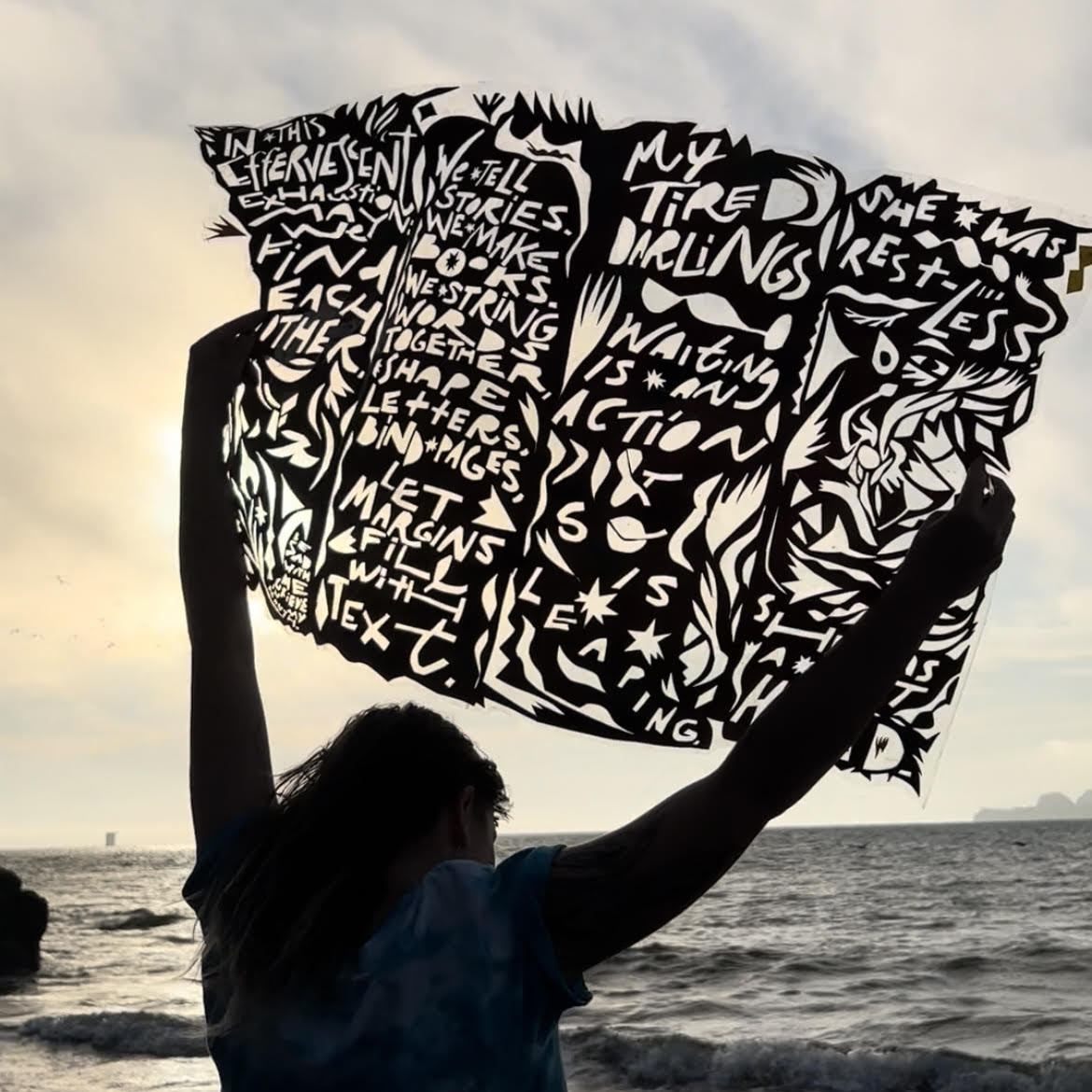
Photo: Kate Laster.
Kate Laster’s paper cutout “Waiting Game” (2022).

I’ve been reading almost more than I can bear lately about the Holocaust, so when I saw this unusual use of a Jewish paper-cutting tradition at Hyperallergic, it really spoke to me.

Isabella Segalovich wrote, “April 5 marked the first night of Passover. Upholding Jewish tradition, we reclined in our chairs, sang boisterously, and drank ample wine. We reveled in the joy and safety many of us are thankful to have in the present while holding close the memory of those that came before us. Alaskan-born Jewish artist Kate Laster carves those memories into delicate paper cuts. Then, she dunks that paper in the ocean.

“ ‘My art is about the people we carry with us,’ she told Hyperallergic in an interview.

“Laster’s first memories are of snow floating on water. She grew up moving from place to place in rural Alaska, from temperate rainforest of Juneau to the icy treeless wilderness in Utqiaġvik. In a world ‘dense with imagination,’ as she described it, she learned to whittle scraps of wood into small figures while hearing stories and poetry by a warm fireside. She said she first saw language being used as a ‘visual medium in the sense of people putting time aside and really either being in nature or being in warm space talking.’

“Today, she uses the visual force behind letters themselves, cutting paper into vibrant collages with fragments of poems — some collected, some written by her. The paper is thoroughly weathered as stencils, multiplying its message as it’s doused in spray paint again and again. Then, she painstakingly laminates the paper by hand, using ‘really scruffy bits of tape.’ The ritual is completed at sundown when Laster dips her works into the Pacific Ocean. As the paper undulates and floats, she understands the waves, part of a living, ‘primordial soup,’ to be reading the text on the pages.

“Laster’s youth in Alaska is proof that the Jewish diaspora spreads far beyond the urban landscape. But for all of us, Jewish practices are deeply tied to the natural world. Festivals begin with the setting sun. … As the great star sets, Laster lifts the text up from the water. And as drips fall off its edges, she uses the hollow paper cut as a viewfinder, so words are filled with the sky. 

“The water that laps at Laster’s paper cuts is of the same body that carried our ancestors as they wandered the world, searching for home and safety. “…

“Laster is one of growing number of anti-Zionist American Jews. For those who do not wish to move to Israel, it’s common to lift up and celebrate the beauty of the diaspora. Following the love of movement, this celebration is also a deep love of the places we find ourselves now. For the Laster, that place is the Bay Area, where the Mexican and Chicano paper-cutting tradition of papel picado is tied to trees lining the Mission, a historically Latinx neighborhood. Chinese paper cuts — 窗花 chuāng huā, or ‘window flowers’ — bloom in glass panes. …

“But this artist’s work is also a part of her own ancestry. Jewish paper cutting is a centuries-old tradition that used to be much more commonplace. It was practiced by both professionals and amateurs at home, not only for marriage contracts or ketubot, but also for holidays like Shavuot and Sukkot. Laster now sees herself as a part of the newest generation carrying it forth. With no other materials needed than paper and a sharp edge, she sees the beauty in paper cutting’s accessibility.

“The belief that everyone has a fundamental right to engage with and create art is central to Laster’s work, both in and outside of her visual practice. She runs suggested donation-based art history classes, and has held a position as a studio assistant at Hospitality House’s Community Arts Program, a free-of-charge art studio for unhoused and low-income residents of the Tenderloin. Today, she works as a studio facilitator at the NIAD Art Center, a creative space for artists with disabilities. …

“ ‘Printmaking and paper cut in general are about accessibility, making a message, a transmission, go as far as possible,’ she said. Laster is also in the tradition of modern Jewish graphic arts: Words that dance and shout diagonally across the page recall the utopian dreams of the 1920s Eastern European Kultur-Lige (Culture League) artists like El Lissitzky and Nathan Altman. …

“Messages can be interpreted differently depending on who hears them. ‘This is the struggle of sharing, of trying to convey anything you feel to someone else. And knowing once it’s public, it can be altered and transformed and interpreted,’ Laster noted. ‘I revel in that.’

“Laster’s work is also deeply personal, as she grieves the loss of her father during the COVID-19 pandemic. In ‘Kaddish Reunion’ (2021) a self-portrait shows the artist sitting by her father’s bedside. Spray-painted shapes bleed into each other. The text typical of her pieces is replaced by swirls, stars, and leaves. Shadows of these words return in another laminated book. Lovingly saved scraps from past paper cuts are laminated alongside a plastic bag that says ‘THANK YOU.’ The only full words are on the cover: ‘I don’t know how to say goodbye.

“Laster’s father was a pilot of a small bush plane. As a child, she studied the dense text and cartoons of flight emergency manuals, replicated today in her shining messages of grief, love, and hope. Perhaps the Haggadah is another kind of emergency manual: a guide on how to keep on going?

“On Passover, we remember those that came before us and those that we lost. … We taste the bitter herbs of longing and grief, but also wash down dry matzoh with sweet wine. And most importantly, we argue, laugh, and tell stories of our survival.”

More at Hyperallergic, here. No firewall. Check out the short video of a paper cutout floating on water.
Read Full Post »

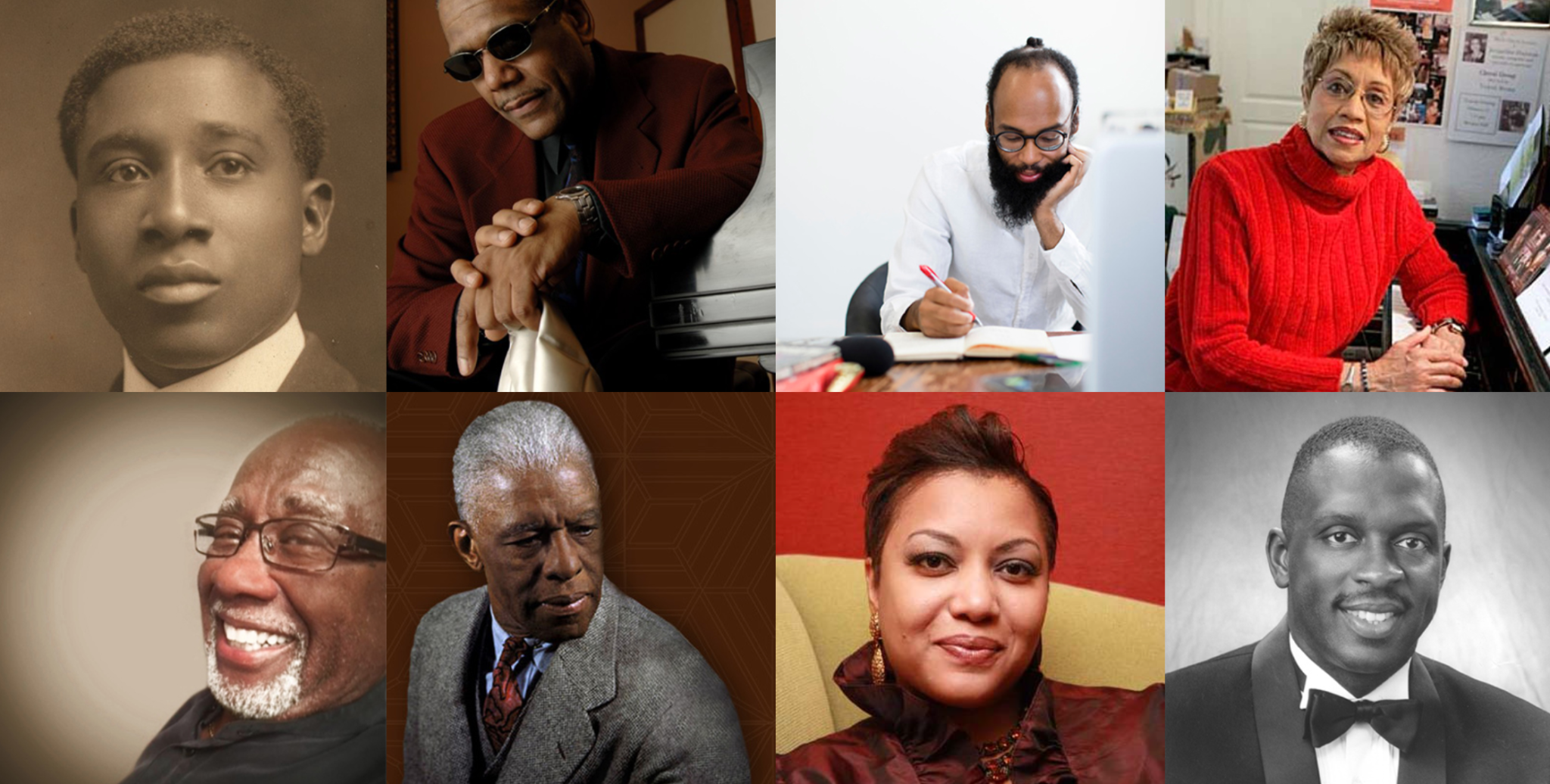
Photo: Classical Voice America.
The composers represented in the African Diaspora Music Project include (top row, left to right) Nathaniel Dett, Donal Fox, Anthony Green, and Jacqueline B. Hairston, and (bottom row, left to right) Robert A. Harris, Roland Hayes, Lori Hicks, and Moses Hogan.

During lockdown, I read an excellent biography of Black classical singer Marian Anderson and learned a lot I didn’t know about Black musicians and composers of the early 20th century. To America’s shame, most of these musicians had to seek training and experience in Europe, which was more open to giving their talents space to grow.

There are still challenges for Black musicians, especially in the classical arena, which is why Louise Toppin has created the African Diaspora Music Project.

Xenia Hanusiak at Classical Voice America has the story.

“ ‘How do you move something from being token to intentional?’ asks musical polymath Louise Toppin. This provocation is just one of the many questions that occupy the mind of the international scholar, opera singer, and activist. As a musical avatar who has performed at Carnegie Hall and Elbphilharmonie, Toppin is on a mission to recalibrate who, what, and how we program our concert seasons to enable a more equitable representation of music from composers of African descent. She is seeking a sustained and systemic cultural shift.

“Toppin’s solution? Her recently launched African Diaspora Music Project, a database that houses nearly 4,000 songs and 1,200 symphonies by composers of African descent. …

‘We need to stop presenting one movement of Florence Price for Black History Month and giving no time to rehearse it,’ she says, ‘and then spend two weeks on the Beethoven Ninth Symphony that everyone has played for the last 30 years.’ … 

“The spotlight programming on African American composers during this year’s post-COVID season openers points to recent mea culpa moments. The staging of Terence Blanchard’s Fire Shut Up in My Bones at the Metropolitan Opera on opening night represented the first production of an opera by a Black composer in the company’s 138-year-old history. Riccardo Muti conducted a work by Florence Price for his opener with the Chicago Symphony. The question arises about what happens next.

“ ‘Before the pandemic, I was talking to programmers about their programming in Black History Month,’ says Toppin. ‘You are bringing in singers of color to sing Mozart? What does this have to do with Black History Month?’

“You might think Toppin is angry or frustrated with the historical lack of representation of African American composers in programming. But in our recent Zoom conversation from her office at the University of Michigan’s School of Music, Theatre & Dance, where she is professor of music and voice, Toppin presented her case with high-octane optimism and boundless passion.

“Her life’s work is genetically pre-determined to advocacy and pushing boundaries. Toppin’s commitment continues the legacy of her father, Edgar Allan Toppin (1928-2004), an author and professor of history specializing in Civil War, Reconstruction, and African American history. His accomplishments were many. But perhaps his most enduring legacies eventuated as board president of the Association for the Study of Afro-American Life and History. In this role, he was instrumental in turning Black History Week into Black History Month in 1976. …

“Toppin’s database is built on her lifelong commitment to her cause. She has been researching, recording, editing, and performing African American music across the globe. In October, Toppin gave a recital dedicated to the songs of Harry T. Burleigh — one of the most influential figures in the history of American song — at London’s Oxford Lieder Festival. The impetus for her database is further inspired by the vocal competition on African American art song and opera that she co-founded with tenor George Shirley. Toppin realized pretty quickly that the same repertoire kept resurfacing in the competition. So, the idea of a database to expand knowledge of the repertoire for the young singers began to take shape.

“ ‘My father’s passion for history as a public historian — not someone who spent his time just writing works for an academic audience, but hosting television and radio shows, writing for newspapers, finding ways to reach a wide audience — has deeply informed my approach and scope for this project.’ …

“Toppin’s father devoted his life to academia, but in equal parts he shared his work with his children. For the Toppin household, the line between his work and their play entwined with daily life.

“ ‘When I was a little girl, my father would take me to the library, and I would do the microfiche with him,’ says Toppin. ‘He would also take me to the stacks. He would teach me to look things up for him. He would give me a date. I could barely read, but I could manage January 1865.’ …

“Toppin began her African American Music Diaspora project in earnest during the 1990s as a way to catalog the music she had been collecting. She became a doctoral research student of Willis Patterson, bass-baritone and professor emeritus associate dean at the University of Michigan, who edited what the New York Times described as a ‘ground-breaking anthology of black art songs’ in 1977. ‘It made an international splash, and it is still selling,’ says Toppin.

“ ‘While I was organizing his music, I made sure that I made extras copies. It was part of what inspired me to start collecting. I had the foresight to see and record everything you see on the data base today: Dedications, dates, performances, biographical information, and recordings are all part of the catalog.’ ”

More at Classical Voice America, here.

You might also be interested a New York Times article on the importance of Europe for Black composers neglected at home. It begins, “In early September 1945, amid the rubble of a bombed-out Berlin, the Afro-Caribbean conductor Rudolph Dunbar stepped onto a podium and bowed to an enthusiastic audience of German citizens and American military personnel.

“The orchestra had gathered in an old movie theater functioning as a makeshift concert hall in the newly designated American zone of the city. First on the program was ‘The Star-Spangled Banner.’ Then came a fairly standard set of orchestral pieces, with Carl Maria von Weber’s ‘Oberon’ Overture followed by Tchaikovsky’s ‘Pathétique’ Symphony. But one piece stood out from the rest: William Grant Still’s ‘Afro-American Symphony.’ When it premiered in 1931 in Rochester, N.Y., it was the first symphony by a Black American to be performed by a major orchestra.” Europe helped that happen. Continue here.

Read Full Post »

mukhtar_20190213_frost_2

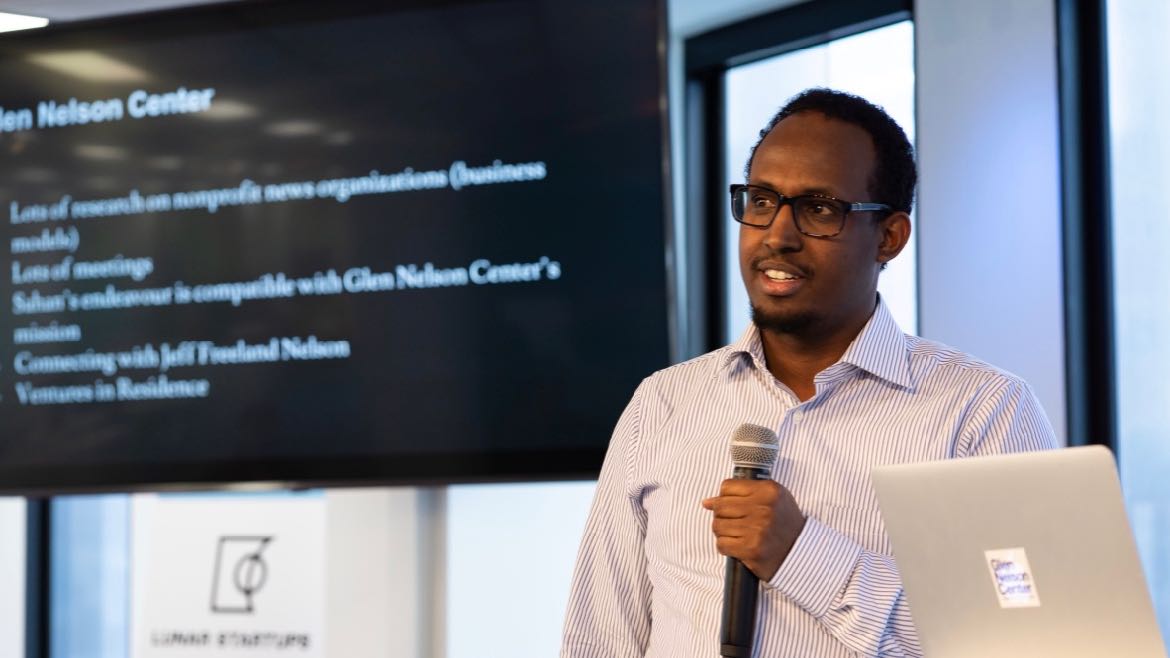
Photo: Evan Frost/MPR
Mukhtar Ibrahim gives a presentation about Sahan Journal at the Glen Nelson Center in Minneapolis.

When we lived in Minneapolis, we got to know a Somali-American who worked at our apartment building’s front desk and later ran for mayor. He was a friendly, curious man, who enlightened me a good bit about Islam and Africa. As a child in Somalia, he played soccer games interrupted by camels, and he loved to get news from around the world on the radio and then study the map to see where the news was happening.

Today the large immigrant community in his new country has a different way to get news.

Andrew Lapin reports at the Current, “Support from Minnesota Public Radio is enabling a website covering the state’s immigrant communities to expand into a full-time venture for its founder.

Sahan Journal is the brainchild of Mukhtar Ibrahim, who began his career as MPR’s first Somali-American reporter before joining the Minneapolis Star-Tribune. He has returned to MPR as a full-time network employee focusing exclusively on Sahan, with the network also providing a content-sharing agreement and other material support.

“Ibrahim said he wants Sahan to be ‘a one-stop shop for all things immigrant in Minnesota.’ …

“Ibrahim began the project in 2013 as a side venture, two years after earning his undergraduate degree from the University of Minnesota’s journalism school. The name ‘Sahan’ comes from the Somali word for ‘pioneer’ and traditionally refers to a group of respected men from a community who are chosen by village elders to embark on exploratory expeditions.

“Recruiting other writers of the Somali diaspora, Ibrahim published news and information related to East African politics and culture on the Sahan website. He tapped an influential network of contributors. One of Sahan’s former writers, Mustafa Muhummed Omer, was recently appointed acting interim president of the Somali Regional State in Ethiopia, one of the country’s nine governing regions divided by ethnicity.

“ ‘People were really hungry for that kind of content,’ Ibrahim said, adding that English-language news sources for young professional Somalis were hard to come by.

“As Ibrahim started a family and devoted more time to his day job, Sahan Journal fell by the wayside. … Ibrahim knew he wanted to return to Sahan Journal and broaden its focus to capture more of the state’s immigrant population, including Hmong and Liberian residents. After earning a master’s in journalism at Columbia University with the aid of a leadership fellowship from the Minnesota-based Bush Foundation, he redirected his attention to his passion project.

“Ibrahim found a willing partner for Sahan Journal in his former employers at MPR. Reaching the state’s immigrant communities is ‘the number-one priority for me,’ said MPR News Executive Editor Nancy Cassutt. …

“Cassutt said MPR aims to republish five stories a month from Sahan Journal, edited by an MPR News editor. She also said MPR would like to see Sahan Journal cover immigrant communities across the entire state of Minnesota, not just the Twin Cities. …

“Ibrahim also hopes to make mentorship and journalism education a part of his site’s mission. … By encouraging more immigrants to become reporters, Ibrahim said, the community will benefit. ‘We say there’s a lack of diversity in the newsrooms, but in the beginning we don’t even give people a chance,’ he said. ‘So this newsroom will be a place where people can run, can fail, can experiment with journalism.’ ”

More here.

Read Full Post »

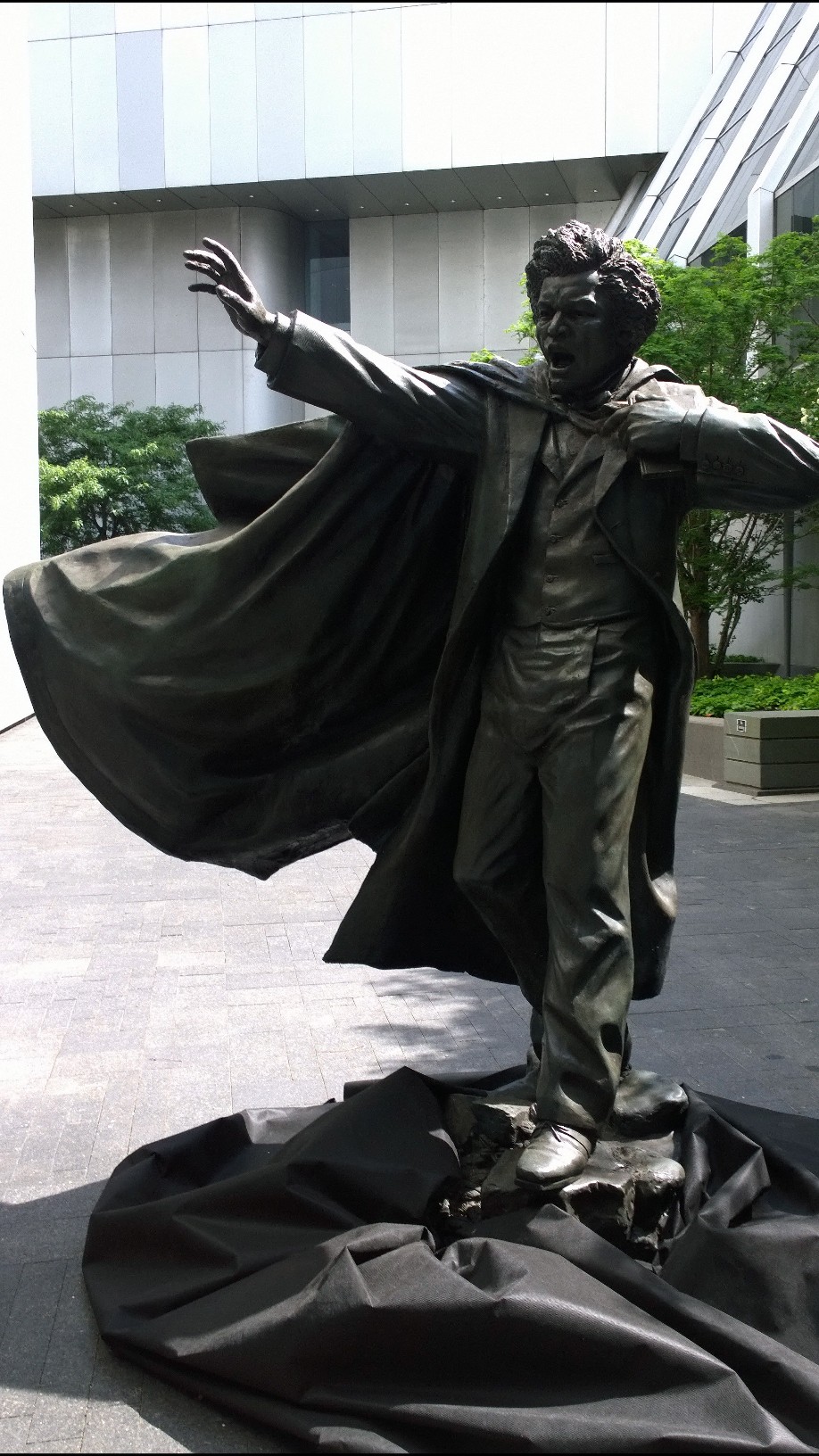
Irish-statue-Frederick-Douglass

I probably wouldn’t have known that Frederick Douglass spent time in Ireland if I hadn’t read the Colum McCann novel TransAtlantic. McCann likes to take historical events of different time periods and imagine the parts we can’t really know. In TransAtlantic, he wove together a historic 1919 flight from Canada to Ireland, the Douglass lecture tour of Ireland and his horrified witness to the famine there, a servant girl’s emigration to the United States and her role in the Civil War, and the rather thrilling negotiations to bring resolution to the Troubles between Protestants in Northern Ireland and Catholics.

According to an initiative called the Douglass/O’Connell Project, “Douglass was greeted in Dublin, Belfast, and Cork by enthusiastic crowds and formed many friendships on his trip, most significantly with Daniel O’Connell, a figure still revered in Ireland today for his role in Catholic emancipation and his fierce opposition to slavery. O’Connell and Douglass shared the stage just once, in September 1845 at a rally in Dublin, but retained a mutual respect and affection until O’Connell’s death less than two years later — and Douglass acknowledged O’Connell’s influence on his philosophy and worldview for the rest of his life.

“The Frederick Douglass/Daniel O’Connell Project is a living legacy to the leadership of these two men and the causes they championed by strengthening the bonds of friendship between Ireland and the United States, encouraging greater understanding between the diasporas of Africa and Ireland in America, and fighting injustice and human rights abuses throughout the world.”

Which brings me to how I happened to be able to take a photo of the Irish statue of Douglass today. The Center for Race Amity in Boston is partnering with the Douglass/O’Connell Project on a celebration this weekend, before the statue goes on tour. Isn’t it magnificent? Andrew Edwards is the sculptor.

There will be a preview of the public television film Douglass and O’Connell Saturday at the Museum of African American History at 7 pm, followed by a lecture by Don Mullen, the author of Bloody Sunday. On Sunday there will be festivities in the Greenway from 1 pm to 5 pm.

Read Full Post »