Feeds:
Posts
Comments

Posts Tagged ‘digital’

Photo: Library of Congress.

I have often thought about what we’ve lost in the digital age, when we can no longer scrutinize the thought process of a novelist from seeing her many revisions. Nor can we learn much about the significant people in her life, given that so many of her emails and texts will have been erased.

What will biographers do? How will today’s archivists deal with the challenge?

Michael Waters writes at the Atlantic (via MSN), “It was long the case that archives were full of physical ephemera. Think of Oscar Wilde’s love letters to Lord Alfred Douglas; … Sylvia Plath’s shopping list; Malcolm X’s lost poem; and other scraps of paper buried in boxes. Today, text messages and disappearing voice notes have replaced letters between close friends, Instagram Stories vanish by default, and encrypted platforms such as Signal, where social movements flourish, let users automatically erase messages. Many people write to-do lists in notes apps and then delete them, line by line, when each task is complete.

“The problem for [historians]: On the one hand, celebrities, artists, executives, and social-movement leaders are generating more personal records than ever, meaning a lucky researcher might have access to a public figure’s entire hard drive but struggle to interpret its contents. On the other hand, historians might lose access to the kind of intimate material that reveals the most. …

“The work of history starts with a negotiation. A public figure or their descendant — or, say, an activist group or a college club — works with an institution, such as a university library, to decide which of the figure’s papers, correspondence, photos, and other materials to donate. Archivists then organize these records for researchers, who, over subsequent years, physically flip through them. These tidbits are deeply valuable. They reveal crucial details about our most famous figures and important historical events. …

“Over the past two decades, the volume of these donations has increased dramatically. When Donald Mennerich, a digital archivist at NYU, first started working in the field, 15 years ago, writers or activists or public figures would hand over boxes of letters, notes, photos, meeting minutes, and maybe a floppy disk or a ‘small computer that had a gigabyte hard drive,’ he told me. Now, Mennerich said, ‘everyone has a terabyte of data on their laptop and a 4-terabyte hard drive’ … plus an email inbox with 10,000 messages or more. …

“Now many libraries possess emails that they don’t have the bandwidth to make accessible to researchers. … Even when an email archive is made public … it’s easy to get lost in the chaos. Jacquelyn Ardam, a writer and a literary scholar, was one of the first people to visit Susan Sontag’s archive, which she told me was filled with digital clutter: Sephora marketing emails, files with unlabeled collections of words (rubberyineluctable), and lots and lots of lists — of movies she’d liked, drinks she’d enjoyed. …

“Among that mess of information, however, Ardam found emails confirming Sontag’s relationship with the photographer Annie Leibovitz, which Sontag had denied. All Ardam had to do to locate them was ‘search her computer for the word Annie,’ she said. …

“In the past, even a writer of Sontag’s stature would typically have a small-enough correspondence collection that they could plausibly review the letters they were planning to donate to an archive—and perhaps wouldn’t have included missives from a secret lover. But the scope of our digital lives can make it much harder to account for everything (imagine giving up your whole social-media history to a researcher) and much easier for a historian to locate the tantalizing parts with a single search.

“Of course, that’s if historians are lucky enough to access records at all. Many people delete their old texts to save storage space. … Mennerich said he’s been locked out of the email accounts of several deceased public figures because they never shared their passwords. …

“Archivists might be able to sidestep some of these problems by rethinking how they present collections of digital records. Today, after archivists do their initial review of a collection, visitors can typically get a complete box of someone’s letters with no questions asked. With emails, conducting that whole initial review up front would be so much more time intensive that blanket access might no longer be realistic. …

“The archivists I spoke with told me they’re all bracing themselves for the moment when, inevitably, a public figure donates their smartphone. It is in some ways the most personal kind of donation someone can make, offering access to text and WhatsApp histories, photos, Tinder messages, saved recipes, TikTok likes. Such a donation seems both likely to reveal more than a person’s emails ever could and even harder to sort through and interpret.”

More at the Atlantic, here.
Read Full Post »

Photo: Nathaniel Bivan.
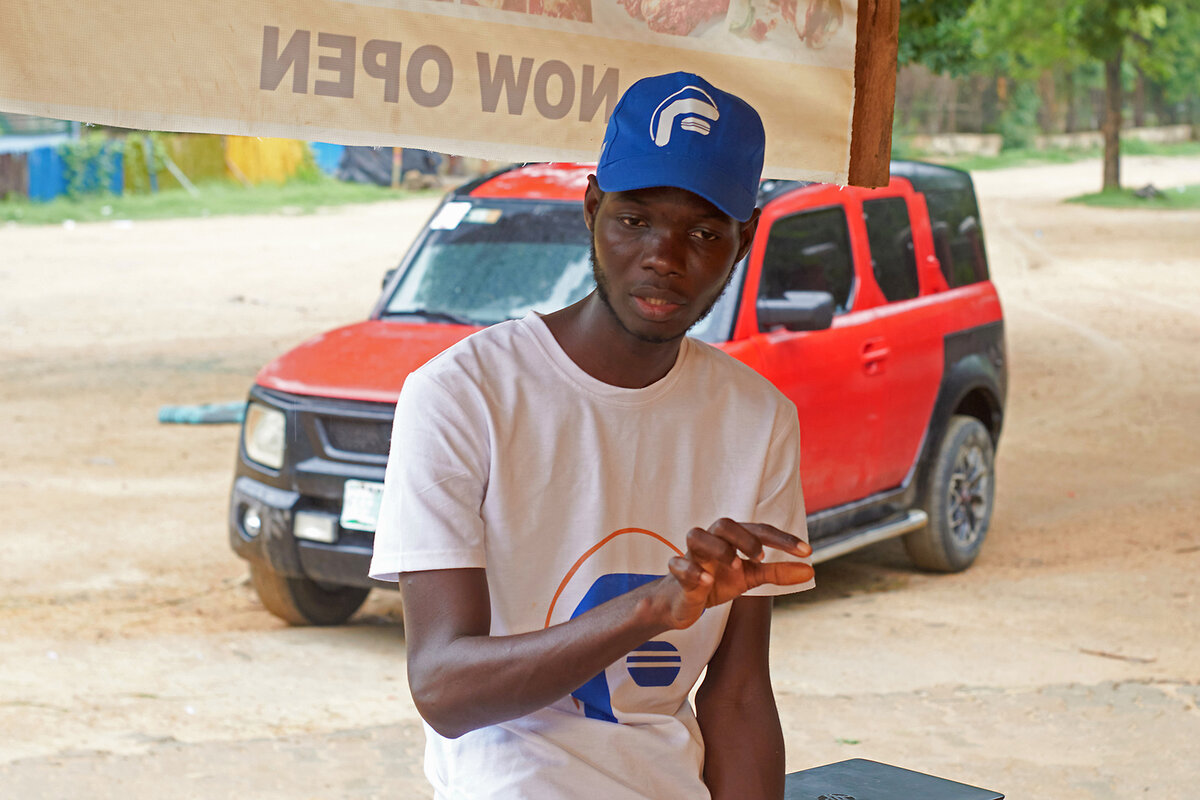
Muhammad Auwal Ahmad wears a cap and shirt with the Flowdiary logo during a meetup in KanoNigeria with some of his educational app’s tutors and students.

Whenever I used to read about Boko Haram terrorists in Nigeria, all I could think was how horrifying and hopeless the situation seemed. But it’s amazing how the human spirit can work around almost any hopeless situation.

Today’s story is about the young man who invented an app to help displaced Nigerian youth learn skills — despite terrorists and a disrupted education.

Nathaniel Bivan reports at the Christian Science Monitor, “Seventeen-year-old Ahmad Aminu finished secondary school and would like to go to college near his village in Zamfara state. But this region of northwestern Nigeria bears the brunt of attacks by bandits who kidnap students for ransom. …

“The 17-year-old Mr. Aminu [has] been able to take – for free, or at very little cost – courses in various digital skills in Hausa. He is becoming a well-known graphic designer within the community surrounding Dalba.

“ ‘The payment depends,’ says Mr. Aminu, the excitement clear in his voice. Designing an invitation card, for example, earns him about 2,000 Nigerian nairas, about $1.25; doing video editing, up to 3,000 nairas.

“ ‘In a month, I make as much as 30,000 naira,’ he says. ‘I really thank God.’ …

“Mr. Aminu is the sort of student whom Muhammad Auwal Ahmad had in mind when he created Flowdiary two years ago as a 23-year-old attending Federal University Gashua in northeastern Yobe state. He says Flowdiary now has more than 8,000 students enrolled from far-flung, impoverished areas across northern Nigeria; on average, almost one-fifth of those are active weekly users. The platform’s name refers to opportunities flowing to young people who might not normally have them.

“ ‘We have students from regions affected by terrorism and banditry … that we train and mentor,’ Mr. Ahmad says, noting that students who speak only Hausa struggle to find online courses in digital skills in their language.

“Mr. Ahmad’s dream began in Bayamari, a village in Yobe state that has only two small schools, a health center, and a police outpost. As a curious tween growing up there, Mr. Ahmad started researching digital technology when his father brought home a mobile phone and, later, a computer. Gradually, Mr. Ahmad started troubleshooting and soon had ambitious digital goals. …

“After unsuccessful attempts at building a couple of online businesses as an undergraduate computer science student, Mr. Ahmad set up Flowdiary in March 2022. It started as a team of tutors, who included some of his friends, teaching digital skills on Telegram to other young people across northern Nigeria at low cost.

“By that November, students could access the Flowdiary website. In February 2023, the app’s release became official. Paying as little as 1,200 nairas per course, students could register to learn web development, graphic design, and other digital skills. Tutors net half of the proceeds from course fees, and the rest goes toward operational costs such as maintaining the app and helping link Flowdiary students with career opportunities, Mr. Ahmad explains.

“Registered as a business, not as a nonprofit, Flowdiary has struggled to find other funding. … But Mr. Ahmad says he is set to obtain some much-needed funding after winning the 2024 Yobe State Research and Innovation Challenge, a prestigious regional competition organized by the Biomedical Science Research and Training Center of Yobe State University, in partnership with Yobe’s state government. …

“In 2011, Al’amin Dalha Suleiman and his seven family members abandoned their home in Maiduguri, the capital of northeastern Borno state, because of the Boko Haram insurgency there. They fled to Kano, more than 500 kilometers (about 310 miles) away, mourning the deaths of neighbors and friends as well as the loss of the family’s hat shop. But discrimination in Kano against outsiders forced them to return three years later to Maiduguri, where Mr. Suleiman struggled to revive the family business. …

“Through a friend on Facebook, Mr. Suleiman heard last year about Flowdiary. He enrolled in several courses, including video editing, web development, and graphic design. There was a major challenge, though – the need for wireless data and a laptop. For months, Mr. Suleiman struggled to finish the courses over his phone, but the payoff – the skills he has acquired – has been worth it. …

“Mr. Ahmad currently teaches computer science in northwestern Kebbi state as part of his National Youth Service Corps requirement. His vision after the one-year program is to expand the Flowdiary platform to reach more young people and – crucially – to help them grow their skills into careers.

“The end of online training for each student does not necessarily mean goodbye at Flowdiary. The Flowdiary team recently set up a mentoring and internship program; any student who takes a course can apply to work with companies that Flowdiary has forged a relationship with. As of late September, 20 students had secured internships – including two with Abdul Gusau, the owner of Abdoul Shoe Ventures in Zamfara.

“ ‘It is impressive to see how effective Flowdiary is through the work the interns are putting in my store,’ Mr. Gusau says. “ ‘The graphic designer has not yet entered the intermediate class, and yet his work is excellent. The same goes for the social media manager, who runs effective ads.’ “

More at the Monitor, here. No paywall. Subscriptions solicited.

Read Full Post »

Photo: NiemanLab.
Now nonprofit, the Salt Lake Tribune has achieved something rare for a local newspaper: financial sustainability.

Yesterday we talked about getting news from a whistler in the mountains. Today we look at a more traditional approach, but one that is also seeing changes. Here’s one of NiemanLab’s deep dives into what’s going on in US news delivery.

Sarah Scire writes, “It started when Andy Larsen, sports reporter and data columnist for the Salt Lake Tribune, got annoyed with an ‘obnoxious’ ad on the Tribune’s own site. He brought his frustration about the digital clutter to someone else who happened to be working late in the newsroom — chief development officer Ciel Hunter.

“ ‘I asked her: “Hey, how much money do we make on this? Is it really worth it?” ‘ Larsen said. ‘That led into a conversation about how much we make from digital ad revenue overall, when compared to sponsorships and donations, which then led to talks on everything else. I was pretty floored and impressed with her transparency on everything over the course of the next couple of hours, which then led me to ask about making those same numbers public, and if I could help with the project.’

“That’s how Larsen ended up writing an annual report that gives the public — including nosy newshounds like you and me — a look at the inner workings of the first legacy newspaper in the U.S. to become a nonprofit.

“Larsen said he was given access to ‘internal financials and metrics of every kind.’ … He also interviewed [chief executive officer Lauren Gustus], Hunter, and director of finance Doug Ryle about the company’s finances and future plans. …

“This public-facing report is a first for the 153-year-old Salt Lake Tribune, which took inspiration from Defector and the Texas Tribune. It imagines an audience that includes subscribers, local residents, potential donors, news industry followers, and — as its origin story suggests — at least some of the Tribune’s own employees.

“News organizations have historically sought to maintain a strict separation between business and editorial operations to protect newsroom independence, and it’s been said — maybe not unfairly — that journalists don’t know much about the business of news. There are signs that is changing. … We’ve seen news organizations open communication that gives journalists a better idea of what, exactly, needs to happen for their publication to survive and thrive — and where they fit in.

“ ‘A firewall between business and editorial is essential for the integrity of the product, IMO,’ Larsen said. ‘On the other hand, that firewall can also be limiting when it comes to belief between the two groups — frankly, I think some of our own writers, including myself, had just assumed that our business was in worse shape than it was, just based on us operating in the newspaper biz in 2024. One way to get the information out to staff without breaking that firewall was just publishing everything to everyone.’

“Larsen said some expenditures stood out to him but that, mostly, he was happily surprised with what he found poking around his employer’s finances. ‘Honestly, that we were seeking donations to specifically address my biggest Tribune if-I-was-czar wants — a better website, free to all — brought me joy.’ …

“Larsen also takes time to address some common misconceptions and criticisms he encounters as a Tribune reporter, including readers who believe Paul Huntsman runs the paper (Huntsman, who rescued the paper from hedge fund ownership eight years ago, stepped down as board chair in February) or assume the Tribune is failing financially. …

“ ‘People in Utah appreciate knowing how we’re doing,’ Gustus said. ‘This is understandable, both because everyone thinks local news is on the rocks and here in Utah it’s the Tribune that can publish stories nobody else does.’ …

“The Tribune expects revenue and expenses to dip in 2024 after chief revenue officer Chris Stegman departed the Tribune in May and brought several Tribune advertising employees with him. Executive editor Gustus praised Stegman for helping turn the Tribune toward financial sustainability but said the change has allowed the newspaper to reorganize its business-side operations to better reflect the nonprofit mission, including moving philanthropy and advertising into the same division, and reduce expenses. …

“The newspaper has not made layoffs — which Larsen describes as ‘damaging to the soul of the Tribune‘ — since 2018 and has grown the newsroom by 10%.

“In July, staff at the Salt Lake Tribune announced their intention to form a union — including, as he disclosed in the annual report, Larsen himself. The newspaper’s management voluntarily recognized the Salt Lake News Guild four days later. …

“The paper edition (now printed twice a week) of the Salt Lake Tribune has 9,165 subscribers — down from 36,000 print subscribers when the Tribune ended its 149-year run as a daily paper back in 2020 and 200,000 subscribers at its peak.

“As of early June 2024, the Salt Lake Tribune also has 30,362 digital subscribers. Digital access costs $8 for the first three months and $8 per month after that. … The newspaper anticipates digital subscription revenue will edge out print revenue for the first time in 2024.”

Larsen also stated in the report, “Our goal is, at some point in the years to come, to remove that paywall. To allow all, regardless of their ability to pay, to read more Tribune journalism.” I would follow it then because Utah is a whole different world to me. “Free” is possible. Thanks to ads and donations, the nonprofit paper in my town is free to all.

More at NiemanLab, here. No paywall.

Read Full Post »

Photo: AP.
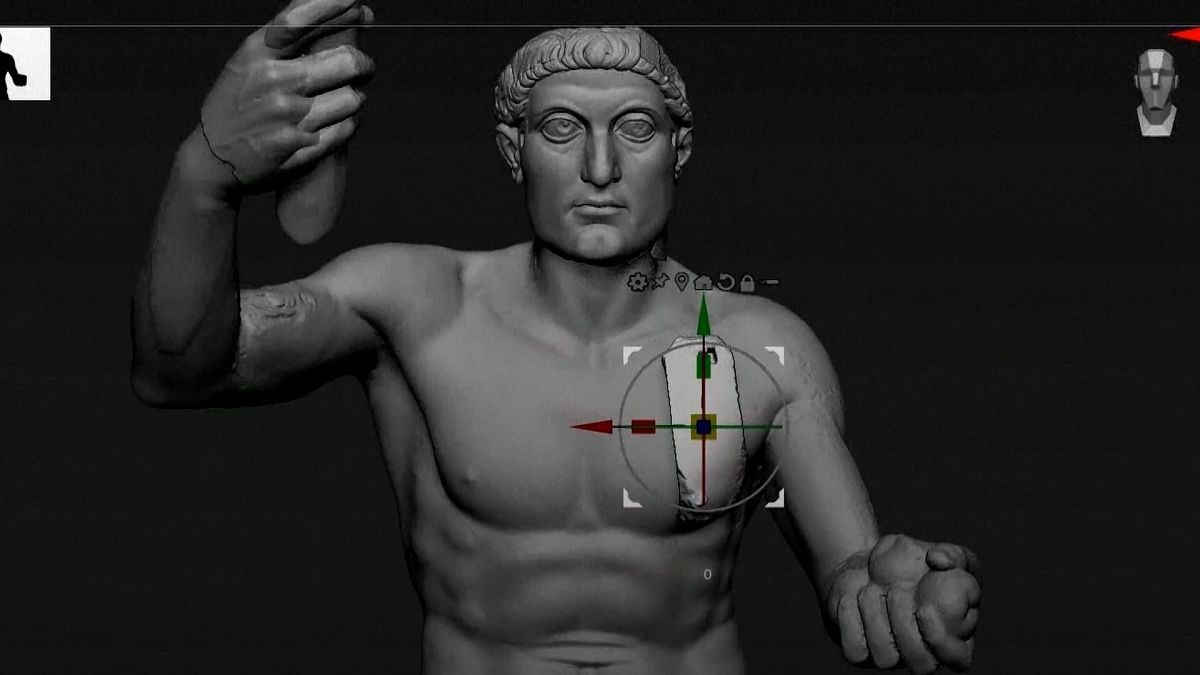
“Factum Foundation, a Madrid-based digital art group, analyzed 10 fragments from a sculpture of Constantine the Great, a fourth-century Roman emperor, to create a 1:1 replica,” says AP. See the digital scan above.

Planning to be in Rome anytime soon? Here’s a sight that’s a bit out of the ordinary — both ancient and completely modern.

Elisabetta Povoledo writes at the New York Times, “It may not be authentic, exactly, or very old at all. But the colossal statue of a fourth-century emperor, Constantine the Great, is a newly erected monument to Rome if nothing else: a homage to the ancient city’s grandeur, and of its endless capacity to remake itself. In this case, the remaking was literal.

“Towering over visitors, the 43-foot seated statue was painstakingly reconstructed by a Madrid-based digital art group, Factum Foundation, from the 10 known fragments of the original sculpture. …

“ ‘Seeing Constantine, on top of the Capitoline Hill, looking out at the whole of Rome, he feels extraordinary,’ said Adam Lowe, the founder of the Factum Foundation, which originally created the statue for a 2022 exhibit at the Prada Foundation in Milan.

“The head and most of the other fragments of the colossal statue were discovered in 1486, in the ruins of a building not far from the Colosseum. They were transferred to what eventually became the Capitoline collection, and nine of those ancient fragments — including a monumental head, feet and hand — are permanently on show at the museums.

“The fragments found fame from the moment they were excavated, said Salvatore Settis, an archaeologist and one of the curators of the Prada exhibit. ‘They have been etched by leading artists from the 15th century on,’ he said. …

“Five hundred years and many more technological advancements later, a team from the Factum Foundation spent three days using photogrammetry, a 3D scan with a camera, to record the fragments in the Capitoline courtyard. Over the course of several months, the high-resolution data became 3D prints, which were used to cast replicas, made of acrylic resin and marble powder.

“Those were then integrated with other body parts — the ones Constantine was missing — that were constructed after historical research and discussions with curators and experts.

A statue of the emperor Claudius as the god Jupiter, now at the ancient Roman altar known as the Ara Pacis, was used as a model for the pose and draping, which was originally in bronze.

“ ‘It’s through the evidence of those fragments, working rather like forensic scientists, with all the experts from different disciplines, we were able to build back something … awe inspiring,’ Mr. Lowe said, adding that new technologies were offering museums new avenues of research and dissemination. …

“Recent scholarship on the statue has suggested the statue of Constantine was itself reworked from an existing colossus, possibly depicting Jupiter. Irrefutable signs of reworking are especially present on the colossal statue’s face, according to Claudio Parisi Presicce, Rome’s top municipal art official, the director of the Capitoline Museums and an expert on the colossus.

“Indeed, some experts hypothesize that the sculpture was originally the cult statue of a temple devoted to Jupiter — the Temple of Jupiter Optimus Maximus — which would mean that the Constantine facsimile has finally returned home.

“ ‘We can’t be certain that it’s the same statue, but there is some possibility that it was,’ Mr. Settis said. Constantine, the first emperor to convert to Christianity, may have specifically selected a statue of Jupiter to transform into an icon of himself. ‘That’s one hypothesis,’ he said. ‘It would mark a passage in Western Europe, from the pagan empire to a Christian one.’

“The statue will be on show in the Capitoline garden until at least the end of 2025, officials said. Where it will go afterward, and whether it will withstand the ravages of time better than its fractured original, remain open questions.

“ ‘It’ll be as fine as anything is outside,’ Mr. Lowe said. ‘We hope. Of course, even during the opening there were pigeons sitting on its head. I’m afraid there’s not much you can do about that.’

More at the Times, here.

Read Full Post »

Not sure if, as a fan of detective mysteries, I should be disppointed or delighted about a new police database in Florida.

I learned about the database from an e-mail listserv I receive at the office. It’s called Innovators Insights. Sign up here to tell the Ash Center at Harvard’s Kennedy School what sorts of public policy topics interested you, and they will e-mail Innovators Insights to you weekly with short descriptions of relevant articles from around the nation — and links to the full story.

Here’s the Florida gumshoe story (to coin a phrase).

“In Cape Coral, Florida, the police department is employing a sophisticated shoe-print database that helps investigators quickly identify what type of shoe a suspect was wearing. While shoeprints are often important in identifying a perpetrator, the traditional process of manually casting a shoeprint and searching the Internet and catalogs for the matching type of shoe can be time-consuming when expedience is of the essence. By contrast, the software houses over 24,000 shoe types and allows information like side-shots of the shoes, their manufacturer, and their color schemes to be immediately forwarded to detectives. If investigators have a suspect’s shoe, they can also compare a digital image of its sole with a shoeprint from other crime scenes and look for a match. Cape Coral police have already used the technology to arrest one offender.”

Read all about it. And no matter how many exotic and unfamiliar shoes you buy in places around the world, you better behave yourself in Coral Gables.

Read Full Post »