Feeds:
Posts
Comments

Posts Tagged ‘dine’

Photo: Roberto Nutlouis.
Danielle Kaye builds a berm spillway on the farm of Roberto Nutlouis. The berm holds back water, flooding the cornfield behind it. Navajos are using ancient ways to restore parched earth.

In their eagerness to invent, humans seem to be programmed to forget why ancient ways worked. Then they have to reinvent the wheel. Fortunately, indigenous people often are repositories of that wisdom and can produce it as needed.

Lela Nari writes at YaleEnvironment360, “Here in Burnt Corn Valley, smack in the middle of the Navajo reservation’s vast Black Mesa region, the hilly land both craves water and is brutalized by it. The sandy Arizona soil cracks under a punishing August sun as red-striped blister beetles search for moisture across its baked surface. Cottonwood trees and sagebrush rise from deep gullies carved by floodwaters that, during the intensifying summer monsoon, sluice off surrounding mesas and wash away fragile topsoil — reminders that with climate change, even quenching rains harbor powers of destruction.

“This portrait of climatic havoc belies a softer reality, though. Farming once thrived in this parched region and could once again — if the right practices are adopted. Exhibit A: The crops on Roberto Nutlouis’s 12-acre Sliding Rock Farm, in his reservation hometown of Piñon, a five-hour drive north of Phoenix.

“ ‘The corn is actually pretty big and thriving,’ Nutlouis says. He believes — and both Western science and the lived experience of his Native elders affirm — that the traditional rock and stick structures he’s built on his property, which help store water and prevent erosion, have a lot to do with it.

“These structures, similar to those used by Native peoples long before Europeans arrived on the continent, are not only delivering water to crops. … They are also restoring Nutlouis’s watershed and those of his neighbors, helping to sequester carbon, and reviving this high-desert ecosystem. It’s all part of a bigger effort among a range of local and regional grassroots organizations to build back the reservation’s fragile, depleted ecosystems and bring greater sovereignty over food, water, and health to its communities.

“Diné (the Navajo name for themselves) are well aware that climate change is making the weather on their semi-arid plateau weirder, wilder, and more destructive. … The ecological health of the reservation has also been weakened by deforestation from timbering operations and from overgrazing over the years.

“Still, this season, Nutlouis, 44, has been able to skip his usual two-hour roundtrip drive to a reliable well to haul water home for his corn. His crop is healthy and hydrated because his land still holds last winter’s snowmelt. Clearly, his heavy labor over the past 20 years — during which he has built woven brush dams, gabions (wirework cages filled with rocks), earthen berms, concrete spillways and trenches, limestone aprons and walls, and stone-lined ‘Zuni bowls,’ which stabilize eroding streambeds — is paying off.

“Diné and others living in arid zones around the world have long used structures made of naturally occurring materials to capture and control water to grow crops and to mitigate the devastation of floods in ephemeral stream systems. …

“Time and again over the last 15 years, Laura Norman, a research scientist with the U.S. Geological Survey, has seen evidence that when these structures — which Norman calls Natural Infrastructure in Dryland Streams, or NIDS — are placed in gullies, they slow water to mitigate erosion, collect nutrient-rich sediment and plant debris that nourish both crops and wild plants, help store carbon, improve groundwater recharge, and increase downstream water availability by as much as 28 percent. ‘It’s a snowball effect that counters degradation, and you get all of these ecosystem services,’ she says.

“The structures on Nutlouis’s farm are integral cogs in a larger system. … Nutlouis’s property lies in an alluvial fan, where mineral-rich sediments and plant waste atop mesas and other uplands wash down onto flatter ground with rainwater, snowmelt, and spring water. Across the valley, similar farms rely on this kind of system, many of which feature stone and stick constructions that Nutlouis helped build. The organic materials trapped behind the structures, says Jonathan Sandor, an emeritus agronomy professor at Iowa State University, ‘are a major input into keeping the fertility of the soils up.’ …

“Whether rock walls or ramps, hand-dug depressions in the soil, earthen walls, or branches plaited into dams, NIDS splash water over a wider area and slow its flow so it can better soak into the soil. Many trap sediments behind them, fertilizing whatever grows nearby. The stone structures create a hyperlocal cooling effect, especially when they’re combined with shade-making vegetation.

“Here, too, smallness is a boon. ‘Even tiny little one-rock dams can make big changes on the landscape,’ Norman says. …

“Lately, climate change has thrown extra challenges at the reservation. … But the ecosystem services provided by Nutlouis’s structures on his farm and elsewhere do seem to be meeting those climatic challenges. He’s noticed small juniper trees popping up on hillsides around his property despite the dryness; A cottonwood tree towering over one cornfield is also lush and full. ‘The idea that Earth will restore itself with natural seed dispersal’ after NIDS begin to do their job ‘has been my observation,’ says Norman.

“Or as Nutlouis puts it, ‘We’re allowing nature to do its own thing and restore itself.’ ”

More at Yale e360, here. Fascinating pictures. No firewall.
Read Full Post »

Photo: Navajo-Hopi News.
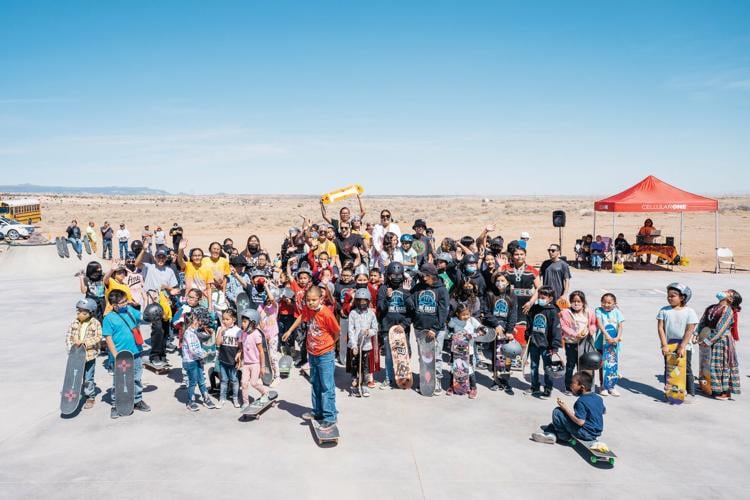
Two Gray Hills Skatepark in Newcomb, New Mexico.

The forced assimilation of indigenous children into colonist culture damaged the children, the relatives of the children, and the grown children’s descendants. In today’s story, we learn how one descendant was surprised to discover she was Navajo and looked for a way to help her long-lost community.

Roman Stubbs writes at the Washington Post, “The wind rolled off the Chuska Mountains and along the desert floor, whipping red dust and tumbleweed across the pavement of Two Grey Hills Skatepark. It was a pale Sunday morning in May, and Amy Denet Deal stood on a ledge, tying a crimson bandanna around her silver braids and smiling as she watched the children swerve down ramps in the middle of the storm.

“ ‘Amy!’ ” a young boy yelled, excited to greet the woman who helped bring the skatepark to this remote northwest corner of the Navajo Nation.

“ ‘Hi, honey. How you doing?’ she replied. ‘You’ve grown a foot since I last saw you!’

“Denet Deal, 59, considered herself younger than the boy in Diné (Navajo) years. She had reconnected with the tribe only five years earlier after a lifetime of displacement, giving up most of her belongings and a ­lofty salary as a corporate sports fashion executive in Los Angeles to move to New Mexico.

“The pandemic opened her eyes to the inequities children on the reservation face, including high rates of diabetes, mental health issues and suicide. Navajo Nation is roughly the size of West Virginia — 16 million acres stretching across Arizona, New Mexico and Utah — yet there are few opportunities for kids to play sports, with many remote areas lacking outdoor recreation and athletic facilities.

“She searched for solutions to give back and finally landed on one: Why not a skatepark?

“It took years of fundraising, with plenty of setbacks, but more than a year after it opened, she could still point to the benefits the park was bringing to her community. The kids from a nearby housing project came for free clinics held every weekend. Parents and grandparents parked their trucks near the concrete to watch, sharing food with one another in their camping chairs as the breeze stung their faces.

‘If I talk to any skateboarder, the first thing they’ll always tell me is, “Skateboarding saved my life,” ‘ Denet Deal said. …

“And so here she was again, making the four-hour drive from Sante Fe to her ancestral homeland, because visits were also helping her with the trauma of her past.

“ ‘The plus side of this is I come from displacement and a strange start in the world,’ Denet Deal said. ‘It’s really helping me heal through that work.’

“Denet Deal didn’t visit the Navajo Nation until she was in her late 30s. Her mother, Joanne, had been forced into a boarding school in Farmington, N.M., in the early 1950s. Joanne’s family had no horse or car to visit her for years. ‘She suffered all kinds of abuse and forced assimilation,’ Denet Deal said.

“Through the government’s Indian Relocation Act, Joanne left the reservation with a one-way bus ticket to Cleveland in her late teens. She got pregnant with Amy. Like thousands of other Native children in the 1960s, Amy was placed into adoption and taken in by a Catholic charity. …

“ ‘I was put up for adoption without anybody contacting my birth family, no connection to the tribe,’ Denet Deal said. ‘I grew up completely displaced from my community. I was the only Brown person in rural Indiana.’ …

“She found something to hold on to when she learned how to use a sewing machine as a child. She started making all of her own clothes and threw herself into fashion. Denet Deal developed into a rising star in the active sportswear space in the early 1990s; at 26, she was creating apparel at Reebok and by 30 she took over as design director at Puma. …

“For years, she searched for her mother. She hired a private investigator and scoured the internet. She numbed the emptiness with alcohol and work.

“In 1998, she had a breakthrough. Denet Deal convinced the Indiana Department of Health to release her record of adoption and was given Joanne’s address and phone number. She wrote Joanne a letter and received a letter back. Denet Deal visited her mother for the first time in Ohio, and together they eventually traveled to the Navajo Nation to meet other family.

“ ‘It wasn’t warm and fuzzy,’ she said. … ‘It brought back a lot of things for my mom that were hard.’ …

“Some locals rejected her because she didn’t grow up in the Navajo Nation. She was still getting to know many of her family members, and her presence could trigger reminders of a painful history for them. …

“The pandemic offered Denet Deal a chance to give back what she learned in another life. She used her past skills as a wealth generator for major corporations to help raise more than $1 million in medical supplies, food and support for a domestic violence shelter. But she wanted to do more, having seen up close the problems for children on the reservation.

“ ‘I just thought a skatepark was a really great thing to have for them.’ “

At the Post, here, you can read about the people who helped make it happen.

Read Full Post »

Weaver and Shepherd

Photo: John Burcham.
Textile weaver and fiber artist Roy Kady.

Today’s story is about a man for whom work and art are inseparable: Navajo weaver Roy Kady.

Elaine Velie at Hyperallergic conducted the interview.

“Diné weaver and fiber artist Roy Kady sat down for a video interview wearing a shirt that read ‘Sheep is life.’ Kady is a shepherd and an artist, roles he sees as definitively intertwined. ‘I am first a shepherd, then art comes with it,’ he said.

“Kady’s decades-long career has been one of constant learning, and in recent years, teaching. He shares weaving techniques and Diné stories that he says are too often missing from younger generations. Kady spoke to Hyperallergic about Diné conceptions of gender, apprenticeship in his small Arizona town, and being accepted as a gay man in his community.

Hyperallergic: What are your earliest memories of weaving, and how did your mother’s practice influence your own?

Roy Kady: My sisters and I grew up in a single-parent household where my mother brought us up, so we were taught everything from building a house to repairing a roof to working under the hood of a vehicle, the sort of things the colonized world would call ‘man’s work.’ We learned inside, too. From washing dishes and getting the house tidied up to cooking and baking, we did what would be considered ‘women’s work.’ But for us, it’s not.

“I was taught about weaving at the young age of nine years old. I have some recollections before that of sitting by my grandmother, grandfather, and mother, who all also partook in fiber arts — weaving and processing the fiber. My mom gifted and shared weaving techniques with me: vegetable dyeing and some of the family designs that came with it. I was fortunate; I was given the tools she and our kin relations had, and that’s what inspired me to become an artist. We learned farming and goat and sheep herding, too. …

“Sheep provide you with sustainability, food, and the opportunity to learn how to maintain the land. We take care of them so that they can take care of us.

“As a shepherd, you know what they like to eat and what keeps them healthy. They also know that themselves, so they’ll take you on journeys to where particular plants exist. On those journeys, you’re able to be inspired by color and the environment, by the mesas. You start to see geometric forms that you can bring back to your weaving repertoire.

“That’s what traditional Navajo weaving is: an interpretation of your environment. A lot of my earlier pieces were designed with that in mind. They’re not necessarily just stripes; they represent rainbows. They’re not just step patterns; they’re mesas or clouds.

“There’s a whole opening of the universe that is represented. In order to understand and have that knowledge, you must have the knowledge of shepherding. But it’s a rarity now because there are not many shepherds. The sheep population has really declined. Navajo fiber artists and textile weavers create beautiful artistry, and while they may no longer have herds, they have memories from their grandparents or parents or maybe from within themselves around growing up with sheep. …

“My mother would sometimes say something like, ‘You’re at the age when you are going to learn about horsemanship.’ She was a horsewoman type. She would teach us, then she would want us to ask a neighbor or other kinfolks to learn other forms. I remember growing up and learning a lot from the neighboring kids. We would go to their houses and learn different types of fiber arts, traditional recipes, or plant foraging. …

“I would go spend a day, a weekend, or even a month in their home and helping them with their livestock. That’s how I would earn the opportunity to learn from them. They’ve always told me that this knowledge doesn’t just belong to one individual, saying, ‘It was gifted to me. It goes all the way back to the creation story.’ That’s how I model my apprenticeships now. …

“I don’t just use wool. I use anything that’s of natural origin, including tree bark and wild cotton, nettle, silk, you name it — whatever I can get my hands on. If I can find somebody who says, ‘I have a herd of bison,’ then I say, ‘What do you do with their wool?’

H: Are there any works that you particularly love?

RK: That would be the one titled ‘Shimá,’ meaning ‘my mother.’ I would wheel her into the sheep corral in her wheelchair, and the sheep knew who she was and come up and greet her. They knew the scent of her hands and how she cared for them. I took a beautiful picture of her making those interactions and decided to weave it. I broke ground for myself by incorporating all different types of techniques that I’ve learned along my weaving journey. At this point, that would be my favorite. …

H: Are there any projects you’re working on now or that you’re excited to start in the future?

RK: There’s an upcoming gallery exhibit near us in Cortez, Colorado, that I’m starting with my grandson, Tyrell Tapaha. He’s come back to learn about shepherding and be my apprentice. We’re doing a collaborative type of show. I will show what took place between the two of us, and it will include his interpretation of what I taught him about sheep, the landscape, or a particular plant.

“We are utilizing what we call barbed wire art. When you’re a sheepherder in this country, you have barbed wires lying around everywhere that are rusty, but we create these wonderful shapes and incorporate that into our textiles or fiber work. We’re excited to venture.”

Read more and see how the artist wove an image of a sheep at Hyperallergic, here. No firewall. Subscriptions encouraged.

Read Full Post »